
In August the cicadas start up early around Lake Kawaguchi, and the air smells of cut grass and warm pine. Hikers in rain jackets and trekking poles walk the lakeside road toward the mountain, while families eat cold noodles on shaded terraces.
It is the month when Mount Fuji is open to climbers and the lowlands of Honshu are sweltering. The lake, at a higher elevation, offers a cooler base for walks, views and long lunches.
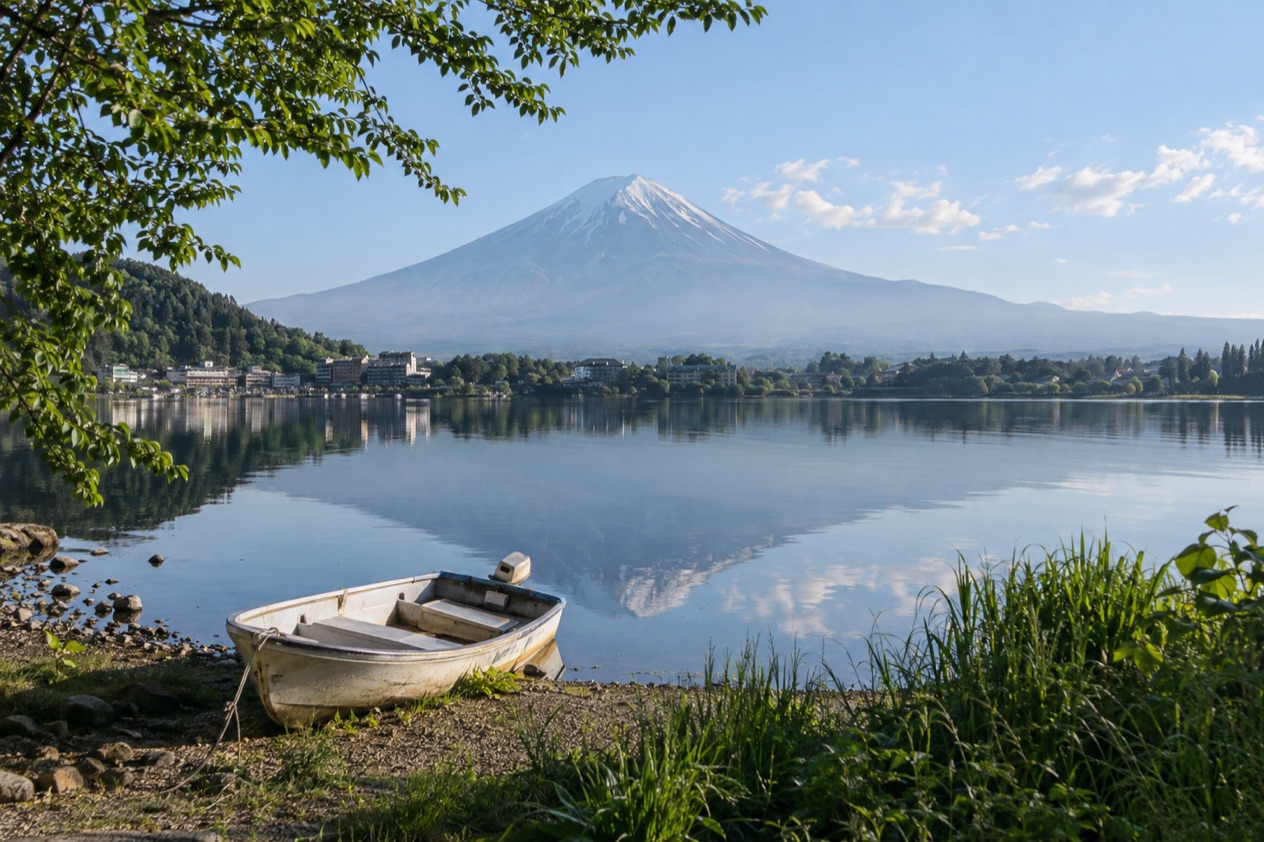
What is the weather like in Mount Fuji and Lake Kawaguchi in August?
August at Lake Kawaguchi is warm, humid and changeable, with sunny stretches broken by showers. At Kawaguchiko, on the lakeshore, this is the warmest and sunniest of the three summer months compared here, and the rain is lighter than in the weeks that follow.
| Month | Average high (°F) | Average low (°F) | Precipitation (in) | Days with 1 mm or more of precipitation | Hours of sunshine | Daylight on the 15th |
|---|---|---|---|---|---|---|
| July | 81.0 | 64.4 | 7.02 | 11.7 | 148 | 14 h 21 min |
| August | 82.6 | 65.3 | 6.96 | 10.1 | 165 | 13 h 32 min |
| September | 74.8 | 58.6 | 10.42 | 11.1 | 122 | 12 h 27 min |
What this means on the ground is a day that feels warm in the sun and pleasantly cool in the shade by the water. Humidity stays high all month, so a walk around the lake leaves you damp, and a light, quick-drying shirt is more useful than anything heavy. Evenings cool down enough that you will want a thin layer on a terrace after dark.
Rain comes as showers rather than a month of gray, and a rain jacket belongs in the daypack every day. Fuji itself sometimes disappears behind cloud in a humid month, so seeing the cone is a chance, not a promise. Up at the summit, the air is a different world, with highs only in the high 40s, which is why climbers carry warm layers and wind protection even in the heat of the lowlands.
Daylight is generous in August, and the evenings stretch long enough for a late stroll along the shore. The light shortens noticeably through the month, a sign that autumn is approaching.
What to do in Mount Fuji and Lake Kawaguchi in August
August is the heart of the climbing season on Mount Fuji, which typically runs from the beginning of July to about the first week of September. That alone shapes the month: the trails are open, the mountain huts are working, and the whole region has a purposeful, outdoorsy feel. Mount Fuji is a UNESCO World Heritage site, listed in 2013 as a sacred place and a source of artistic inspiration, and you sense that mix of pilgrimage and sport in the way people talk about the mountain.
The other tradition of the month is Obon, the Buddhist custom of honoring the spirits of one’s ancestors. It lasts three days, usually around the middle of August, and people return to their family places to visit and clean the graves of their ancestors. In the villages around the lake you may notice flowers and incense at family graves and a quieter, more domestic rhythm to the days.
Around Lake Kawaguchi
The lake is where most visitors spend their days, and August suits its pace. You can walk along the shore, rent a bicycle, paddle a boat or simply sit with an iced coffee and wait for the clouds to open on Fuji. The shoreline cafés and small museums make good stops when a shower rolls through, and the nearby cable car up the hillside is a way to look back at the lake and the mountain from above.
The humid air makes the surrounding forests smell green and damp, and the evenings are the time for slow walks. The lake is one of the Fuji Five Lakes, and neighboring Saiko and Yamanakako each have their own character if you want to extend a day.
Climbing season on the Yoshida Trail
Many climbers start from the Yoshida Trail, a hiking trail on Mount Fuji that has a fifth station as its starting point for the ascent. In August the mountain is in its season, and On-the-Day Nature Guided Tours are available on the Yoshida Trail for those who prefer to go with a guide. Climbing Mount Fuji outside the season is extremely dangerous, since first-aid centers and mountain huts close, cell phone service is lost and the weather turns severe.
The season for the Yoshida, Subashiri and Gotemba Trails closes in early September, so August is among the last full weeks to go. Visitors planning a climb are strongly advised to check the latest information on the Official Website for Mt. Fuji Climbing, which exists to help every climber return safely. If you are not climbing, the fifth station and the first stretch of trail still give a sense of the mountain’s size.
Food of a Yamanashi summer
The local dish is hoto, a hearty stew of wide, flat noodles simmered with pumpkin and vegetables in miso broth. In the humid heat it sounds heavy, but many restaurants around the lake serve it all year, and a bowl after a rainy walk is a pleasure. Yoshida udon, a firm, chewy noodle from nearby Fujiyoshida, is also served in summer, often cold with a dipping sauce.
Yamanashi Prefecture is known for its fruit, and summer stands and desserts often feature peaches and grapes. Shaved ice, cold soba and iced green tea fill the hot hours, and in the evening a small izakaya (a casual pub) with grilled skewers and a cold beer suits the warm night air.
A two-day itinerary for Mount Fuji and Lake Kawaguchi in August
Day 1 is for the lake. Start with a walk along the shore in the morning, while the air is still cool and the water is quiet, and take a bicycle or a boat if you want to go further.
At midday, settle into a restaurant for a bowl of hoto, which gives you a break from the humid sun. In the afternoon, take the cable car up the hillside to look at the lake and, with luck, the cone of Fuji above it.
In the evening, with generous daylight, stay by the water. A stroll along the shore after dinner is the natural close to the day, and a small izakaya serves a cold drink and grilled skewers. If the weather turns, spend the afternoon in a lakeside museum or café and keep the cable car for a clearer hour.
Day 2 belongs to the mountain. Go up to the fifth station on the Yoshida Trail, where the climbing season is in full swing and the air is distinctly cooler than at the lake. Bring layers and rain gear.
Walk the first stretch of the trail, watch the climbers set off and look out over the clouds below. For those who want to climb, On-the-Day Nature Guided Tours are available on the Yoshida Trail.
Come back down for a late lunch of Yoshida udon in Fujiyoshida, then spend the afternoon at a café or an onsen if rain moves in. Finish with a quiet dinner and a last look at the lake, with fruit or shaved ice for dessert.
Is Mount Fuji and Lake Kawaguchi busy in August?
August is the heart of the climbing season, so the region has the energy of a place at its busiest, with climbers, hikers and families around the lake. The season on Mount Fuji typically runs from the beginning of July to about the first week of September, and August sits squarely in the middle of it, so you will see people in hiking gear in the lakeside towns and on the trails.
Obon, which lasts three days and usually falls around the middle of August, brings Japanese families back to their ancestral places, and this adds to the feeling of a national holiday season. In towns around the lake, expect a lively, family-oriented mood, with domestic travelers filling cafés and restaurants.
Shops in urban areas of Japan are generally open from 10:00 a.m. to 8:00 p.m. every day, while in rural areas they often close earlier, sometimes as early as 6:00 p.m. That is worth keeping in mind for small stores outside the main lakeside strip, if you plan to buy supplies for a hike.
What to pack for Mount Fuji and Lake Kawaguchi in August
The lake is warm and humid while the mountain is cold, so the bag holds both kinds of clothing. Pack for showers, sweat and a sudden drop in temperature if you head upward.
- A light rain jacket, because showers pass through often and the humidity stays high.
- Quick-drying shirts, for damp walks along the shore.
- A warm fleece or insulated layer, for the fifth station and the mountain, where the air is far colder than at the lake.
- Sturdy walking shoes with grip, for wet trails and forest paths.
- A hat and sunscreen, for the sunny stretches by the water.
- A small towel, for wiping off sweat and rain.
Good to know before you go
Humid, hot and sultry summers are typical of the islands of Honshu and Kyushu, and August at Lake Kawaguchi follows that pattern with regular showers. The climbing season for Mount Fuji ends on September 10th according to the official site, and climbing outside it is extremely dangerous. Check the latest information on the Official Website for Mt. Fuji Climbing before going up.
Obon lasts three days and brings travelers from across the country to their family places. When a national holiday falls on a Sunday, the next working day becomes a public holiday, which can add another day off around the festive period.
Mount Fuji and Lake Kawaguchi in August vs July and September
Moving four weeks earlier brings you to July, when the climbing season has just opened and the rain falls on more days. The lake is a little cooler and the daylight longer, but the weather is a bit grayer, and the mountain is more often hidden. If you want to start your climb at the opening of the season, July is the choice.
Four weeks later, September is cooler and wetter, and the days are visibly shorter. The climbing season ends in the first part of the month, so the huts and trails close early in September. In exchange, the evenings are comfortable, the humidity eases and the lakeside has a calmer mood after the summer vacation.
August is the choice if you want the climbing season, the most sunshine of the three months and Obon’s family atmosphere. Shift to July for the season’s opening, or to September for cooler walking weather and a quieter lake, as long as you are not planning to climb.
Is August a good time to visit Mount Fuji and Lake Kawaguchi?
Yes, for travelers who want to be on or near Mount Fuji while the climbing season is open and who do not mind humid air and the occasional shower. It suits hikers, families, photographers who enjoy waiting for the clouds to part and anyone who likes to eat noodles by a lake in the warm evening.
It is less suited to those who dislike humidity, or who want a clear view of the cone every day. A different month may serve them better. On arrival, check the Official Website for Mt. Fuji Climbing if you plan to go up, and then settle by the water with a bowl of hoto. What is special about August here is the pairing of a mountain in its season, with climbers heading up through the clouds, and a lake town that stays warm and green below, while families gather for Obon.
Sources
- Japan Meteorological Agency (JMA), Normal values 1991-2020, monthly (https://www.data.jma.go.jp/stats/etrn/view/nml_sfc_ym.php?prec_no=49&block_no=47640), station Kawaguchiko, elevation 860 m, checked October 11, 2026
- Japan Meteorological Agency (JMA), Normal values 1991-2020, monthly (https://www.data.jma.go.jp/stats/etrn/view/nml_sfc_ym.php?prec_no=49&block_no=47639), station Fujisan, elevation 3,775 m, checked October 11, 2026
- Computed from the date and the latitude of the place (sunrise equation, solar elevation -0.833 degrees), October 11, 2026
- Japan National Tourism Organization, shop and attraction hours, national holidays (https://www.japan.travel/en/plan/business-hours-and-holidays/), checked October 11, 2026
- Wikipedia, Obon (https://en.wikipedia.org/wiki/Obon), checked October 11, 2026
- Wikipedia, Public holidays in Japan (https://en.wikipedia.org/wiki/Public_holidays_in_Japan), checked October 11, 2026
- Japan National Tourism Organization, summer in Japan (https://www.japan.travel/en/guide/summer-guide/), checked October 11, 2026
- Japan National Tourism Organization, festivals and events (https://www.japan.travel/en/see-and-do/festivals-and-events/), checked October 11, 2026
- Wikipedia, Hanabi (https://en.wikipedia.org/wiki/Hanabi), checked October 11, 2026
- Japan Meteorological Agency, Emergency Warnings (https://www.jma.go.jp/jma/en/Emergency_Warning/ew_index.html), checked October 11, 2026
- Japan National Tourism Organization, safety information (https://www.japan.travel/en/japan-safe-travel-information/), checked October 11, 2026
- Japan National Tourism Organization, weather and seasons in Japan (https://www.japan.travel/en/plan/weather/), checked October 11, 2026
- Wikipedia, Awa Odori (https://en.wikipedia.org/wiki/Awa_Odori), checked October 11, 2026
- Wikipedia, Climate of Japan (https://en.wikipedia.org/wiki/Climate_of_Japan), checked October 11, 2026
- Japan National Tourism Organization, Mount Fuji guide (https://www.japan.travel/en/fuji-guide/), checked October 11, 2026
- Official website for Mt. Fuji climbing, about the climb (https://www.fujisan-climb.jp/en/about/), checked October 11, 2026
- Wikipedia, Nebuta (https://en.wikipedia.org/wiki/Nebuta), checked October 11, 2026
- Wikivoyage, Mount Fuji (https://en.wikivoyage.org/wiki/Mount_Fuji), checked October 11, 2026
- Official website for Mt. Fuji climbing, information (https://www.fujisan-climb.jp/en/info/), checked October 11, 2026
To plan your stay
- Things to Do in Mount Fuji and Lake Kawaguchi: Lakeside Views, Fuji-Q Highland, Hiking Season and Local Food
- Where to Stay in Mount Fuji and Lake Kawaguchi: Lakeshore Hotels, Fujiyoshida, Mountain Lodges and Ryokan
- Mount Fuji and Lake Kawaguchi from Tokyo: Fuji Excursion, the Fujikyuko Line and Climbing Season
- Best Views of Mount Fuji: Five Lakes, Fifth Station Promenades and When to Go