
A long, pale cone sits above the haze, and for a moment the people around you stop talking. Mount Fuji can appear from a train window, a lakeshore path or a high promenade, and each spot frames it a little differently. This is a page for travelers who want to see the mountain well, from the Tokyo skyline to the Five Lakes, rather than climb it.
Is visiting views of Mount Fuji worth it?
Yes, if you like landscapes that carry weight, and especially if you want one big image of Japan to bring home. The mountain is the highest in the country, and it has been painted, printed and photographed for centuries. Hokusai’s wave print, with Fuji small and steady behind the surf, is only the best known of many. Seeing the real thing is a different experience from seeing the postcard.
What sets these viewpoints apart from other scenic stops is how many ways in there are. You can glimpse Fuji in the distance from Tokyo, stand beside a lake at its foot, follow promenades that start from the fifth station, or look up from Shizuoka, which also sits at its base.
Mount Fuji was added to the World Heritage List as a Cultural Site on June 22, 2013, which says something about how Japan understands it: as a place of worship and inspiration as much as a mountain. The Japan National Tourism Organization’s own guide to the mountain picks out thirty viewpoints, so you are choosing among many angles rather than hunting for one.
The one honest caveat is that cloud decides everything. Some days the cone is sharp from end to end, and others it stays hidden behind a gray wall, so give yourself more than one chance to see it.
What to see at views of Mount Fuji
Mount Fuji from Tokyo
Mount Fuji lies about 62 miles southwest of Tokyo, and on clear days it shows itself on the horizon. From the city it appears as a faint, flat-topped silhouette far beyond the rooftops, more a presence than a picture. It is the lightest way to meet the mountain, because no outing is needed, only a clear sky and a high vantage point.
Treat this as a bonus rather than a plan. If the view appears, you will notice how the city seems to point toward it, and you will understand why people in older Tokyo named neighborhoods and shops after the mountain. If it does not, you still have the other viewpoints below.
The Five Lakes region
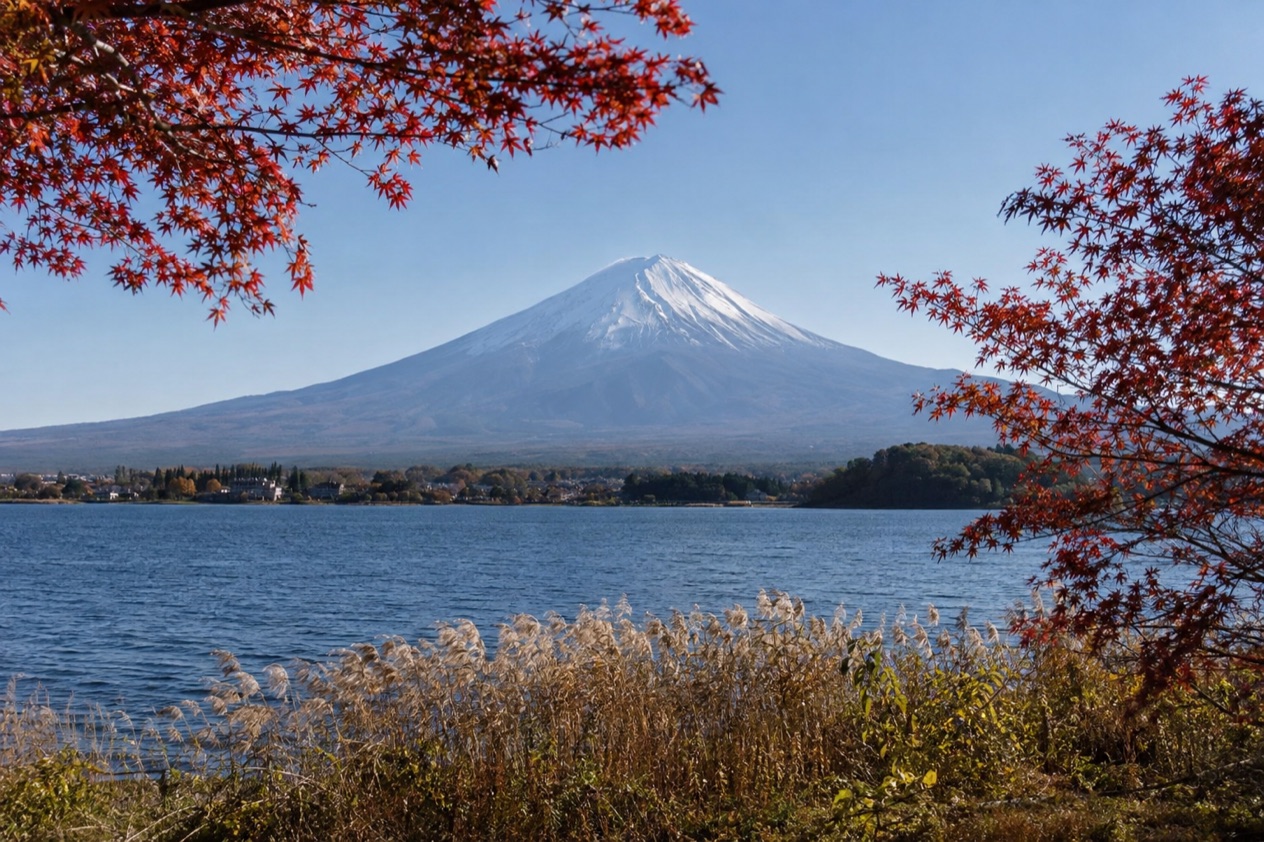
The Five Lakes region lies at the foot of the mountain, and it is where Fuji starts to feel close. Kawaguchiko, the lake whose weather figures appear later, is the one visitors know by name. The mountain rises above the far shore, and when the water is still you may see it doubled in the surface, with the cone reflected beneath the real one.
The light changes quickly here, so the same shoreline can look soft and silvery, then sharp and blue within an hour. In autumn and winter, a dusting of snow on the upper slopes makes the outline crisper still.
Promenades from the fifth station
Promenades depart from the fifth station, the point on the mountain where roads end and the climbing trails begin. Here you are no longer looking at Fuji from a distance but standing on it, among volcanic rock and low, wind-bent trees. The slope above you is bare and reddish, and the land below drops away into cloud or open valley, depending on the day.
The fifth station is also where the four climbing trails, Yoshida, Subashiri, Gotemba and Fujinomiya, take their separate routes upward. You can watch hikers set off, and sense the scale of the slope, without going further yourself.
Shizuoka and the foot of the mountain
Shizuoka also lies at the foot of Mount Fuji, which gives a view from the other side of the mountain than the Five Lakes. Here Fuji belongs to the city’s skyline and everyday life rather than to a resort landscape. The view is a reminder that the mountain is a neighbor to several communities, each with its own way of seeing it.
Combining Shizuoka with the lakes gives you two sides of the same mountain in one trip. The shapes differ with the angle, the foreground changes from water to city and farmland, and the mountain’s mood changes with them.
Hours, tickets and rules
Looking at Fuji from a lake, a window or a promenade has no gate and no hours of its own. The rules that matter belong to the climbing trails, and they are worth knowing even if you only plan to watch the mountain.
| Trail | Closed to hikers |
|---|---|
| Yoshida (Yamanashi), daily limit of 4,000 hikers | 4 p.m. to 3 a.m., except for guests in mountain lodges |
| Subashiri (Shizuoka) | 4 p.m. to 3 a.m., except for guests in mountain lodges |
| Gotemba (Shizuoka) | 4 p.m. to 3 a.m., except for guests in mountain lodges |
| Fujinomiya (Shizuoka) | 4 p.m. to 3 a.m., except for guests in mountain lodges |
The Yoshida route is the most popular way up, with a large parking area and many mountain huts. The climbing season ends on September 10th, and in winter the Yoshida, Subashiri and Gotemba trails are closed from the fifth station to the summit, while the Fujinomiya trail is closed from the sixth station to the summit.
Climbing from October to May is discouraged because of the cold and several high-profile deaths. Because Mount Fuji is a national park, it is illegal to camp above the fifth station. The official website for Mt. Fuji climbing carries the latest information for anyone planning to climb.
How to get to views of Mount Fuji
The mountain is about 62 miles southwest of Tokyo, which is why the capital can sometimes see it and why the nearest bases are close to its foot. The Five Lakes region and Shizuoka are the two places the Japan National Tourism Organization names at the base, and from either one you are already within sight of the cone.
For arrivals by air, Mt. Fuji Shizuoka Airport is the closest airport with scheduled international service, about 50 miles from the mountain. Tokyo’s Haneda Airport and Narita International Airport are each approximately three hours and 15 minutes from Mount Fuji.
Once you are at the foot of the mountain, the fifth station is the point from which the promenades depart, and it is also where the trails begin. Beyond these points, a choice among viewpoints is a choice of angle: the lakes for water and reflections, the fifth station for being on the slope itself, Shizuoka for the view from the other side, Tokyo for the distant silhouette.
When to visit views of Mount Fuji
January logs the most sunshine of the four, with cold, dry air and snow on the ground. April warms up, with showers arriving more often. July is humid and cloudier, and October is the wettest of the four.
| Month | Average high (°F) | Average low (°F) | Rain days | Sunshine (hours) | Summit average high (°F) |
|---|---|---|---|---|---|
| January | 41.9 | 21.7 | 4.9 | 212 | 4.5 |
| April | 61.0 | 38.7 | 8.5 | 186 | 21.4 |
| July | 81.0 | 64.4 | 11.7 | 148 | 46.4 |
| October | 64.9 | 47.7 | 10.1 | 134 | 33.3 |
July and August are the most popular period for hiking Fuji, when the huts and facilities are running and the weather is warmest. That is a climbing calendar, though, and a visitor who only wants views can plan around the sky instead. The mountain’s summit stays far colder than the lakeshore, even in midsummer, which is why snow can sit on the cone long after the valley has warmed.
Viewing from the lakes and promenades is a different matter. Plan for rain on some days and for cloud that can hide the cone, and keep a spare day if you can. January offers cold, bright conditions with snow at lake level, while April brings spring warmth with more showers.
Tips for your visit
Give Mount Fuji more than one look. A single morning may bring only cloud, and the mountain often emerges later, so a flexible plan serves you better than a tight one. A camera with a zoom helps from Tokyo or across a lake, and a warm layer is sensible, because the Kawaguchiko area is far cooler than Tokyo and the summit is colder still.
Combine the viewpoints rather than choosing one. The Five Lakes region gives you water, reflections and the lakeshore, the fifth station puts you on the slope, and Shizuoka gives the opposite side. Seeing the cone from two or three of these makes the shape feel real, because it changes with the angle in ways a single photograph cannot show.
If you would like to see the trails without hiking them, the fifth station promenades are the way to do it. You can watch the start of the Yoshida, Subashiri, Gotemba and Fujinomiya routes and imagine the path upward.
Hikers who plan a climb in season will find the Yoshida route with many huts along it. For everyone else, the best habit is the simple one: stop, look up, and take your time with the mountain.
Good to know before you go
October brings frequent rain around the lakes, and gray days are part of the season, so a rain jacket belongs in the bag. The upper mountain is cold well before winter, and the trails above the fifth station are not open to casual walkers once the climbing season ends. Mount Fuji is a World Heritage site and a place of worship for many, so keep voices low and leave nothing behind on the slopes.
Sources
- Japan National Tourism Organization, Mount Fuji guide (https://www.japan.travel/en/fuji-guide/), checked October 11, 2026
- Wikipedia, Mount Fuji (https://en.wikipedia.org/wiki/Mount_Fuji), checked October 11, 2026
- Official website for Mt. Fuji climbing, about the climb (https://www.fujisan-climb.jp/en/about/), checked October 11, 2026
- Japan Meteorological Agency (JMA), Normal values 1991-2020, monthly (https://www.data.jma.go.jp/stats/etrn/view/nml_sfc_ym.php?prec_no=49&block_no=47640), station Kawaguchiko, elevation 860 m, checked October 11, 2026
- Japan Meteorological Agency (JMA), Normal values 1991-2020, monthly (https://www.data.jma.go.jp/stats/etrn/view/nml_sfc_ym.php?prec_no=49&block_no=47639), station Fujisan, elevation 3,775 m, checked October 11, 2026
To plan your stay
- Best Time to Visit Mount Fuji and Lake Kawaguchi: Weather, Seasons, Autumn Leaves and Snow
- Where to Stay in Mount Fuji and Lake Kawaguchi: Lakeshore Hotels, Fujiyoshida, Mountain Lodges and Ryokan
- Mount Fuji and Lake Kawaguchi from Tokyo: Fuji Excursion, the Fujikyuko Line and Climbing Season
- Mount Fuji and Lake Kawaguchi in January: Winter Weather, New Year Traditions and What to Do