
Picture a street of wooden inns where guests in cotton robes drift from one bath house to the next, towels in hand, stopping for an onsen-boiled egg on the way. That is Kinosaki Onsen, a hot spring town in Hyogo Prefecture. It suits travelers who want a night or two built around soaking, slow walks and local food, reached by direct train from the Osaka area.
What is Kinosaki Onsen?
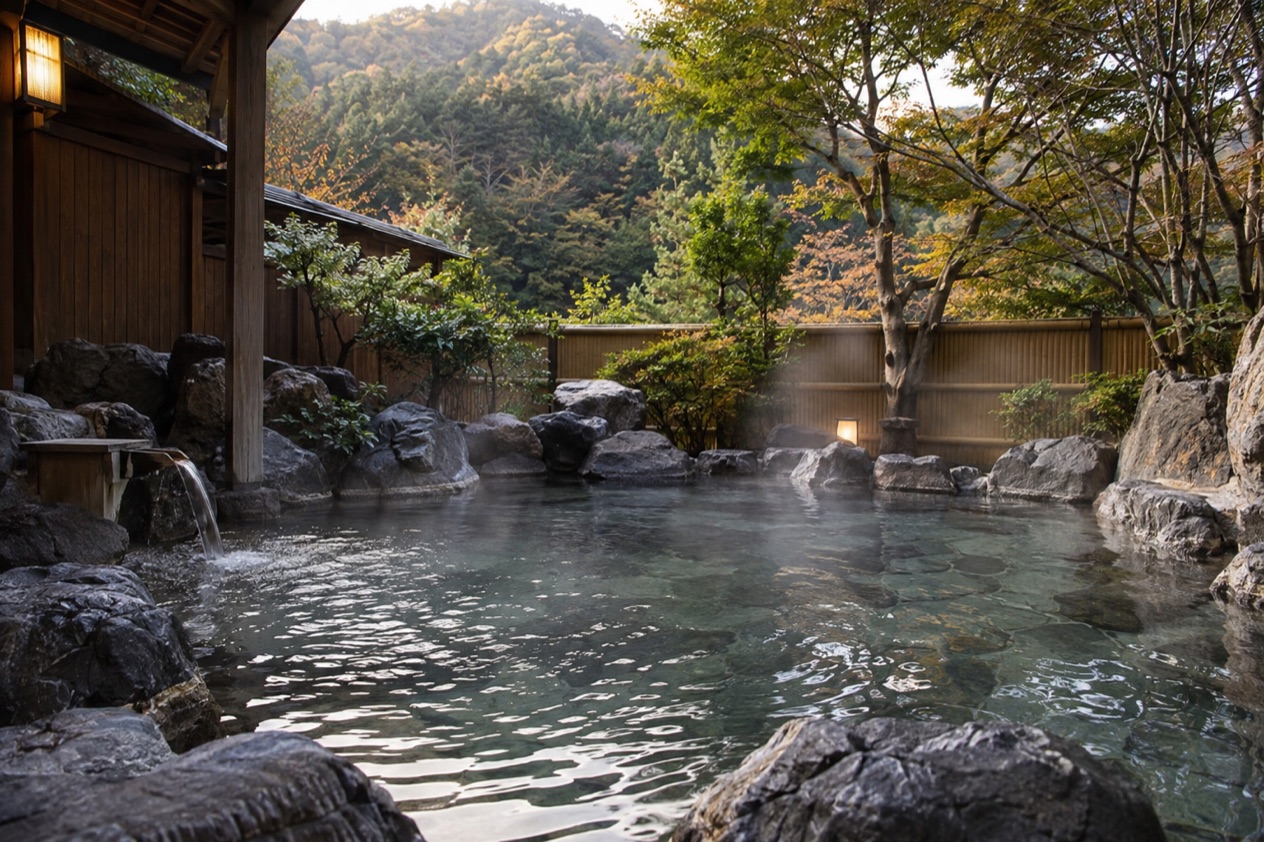
Kinosaki Onsen is a hot spring resort in Hyogo Prefecture, a town whose daily rhythm comes from its public bath houses rather than from any single sight. Its history as an onsen town stretches back 1,300 years, and the long habit of bathing here still shapes how the place feels, from the inns to the shops to the way people dress for a walk.
Administratively the town belongs to Toyooka, the city that includes Kinosaki. Administratively, Kinosaki is part of the city of Toyooka, which is also served by Tajima Airport. Once you arrive, the focus narrows to one street, the baths along it and the ryokan, the traditional inns, where visitors sleep.
The town built around its baths
What defines Kinosaki is a shared-bath culture. The town has seven public onsen bathhouses, and many ryokan guests make visiting them part of their stay. The result is a town where the street itself becomes the corridor between baths, and where an evening can mean several short soaks rather than one long one.
Each bath house has its own name and its own setting, and visitors often like to try more than one during a stay.
Beyond the baths: the ropeway and the straw craft museum
At the far end of the street, a ropeway carries visitors to the top of Mt. Taishi. From up there you look back over the town and out toward the coastline, and a temple named Onsenji stands on the summit. It gives the visit a different angle after the baths, a chance to see the rooftops and the layout of the valley you have been wandering through.
In town, the Kinosaki Straw Craft Museum is a place to see local straw work and to take part in a straw craft-making workshop. It is a hands-on stop that pairs naturally with a day of soaking, since you leave with something you made rather than only a memory of warm water.
What to eat in town
The shops and restaurants of Kinosaki lean on the surrounding region. Snow crab is one of the area’s specialties, sweet and delicate and served in many forms. Tajima beef, the regional wagyu, appears as steak, in hot pots and on grills. Both fit the mood of a ryokan dinner or a night at a small restaurant in the town.
Then there are the onsen-boiled eggs, cooked in the hot spring water itself. They make a light snack between baths, peeled and eaten standing in the street with a robe tied at the waist. Together, crab, beef and eggs give the town a menu that tastes of its place.
How do the public baths work?
The public baths work as a circuit: you stay in town, and you walk from bath house to bath house, often in a yukata, using the ones you like. The bath houses are Kouno-yu, Mandara-yu, Goshono-yu, Ichino-yu, Yanagi-yu, Jizou-yu and Satono-yu. The word yu simply means hot water, which explains why it ends so many of the names.
The free pass for ryokan guests
Tourists staying in many of the ryokan in Kinosaki can receive a free pass to every one of the public bath houses. That turns the whole town into an extension of the inn: the bath house down the street becomes, in effect, another bathroom, and you can choose among all of them rather than settling for one.
The word to hold onto is many, not all. Because the pass comes with the stay at many ryokan, the choice of lodging is where the bath plan really begins. A traveler who has set their heart on soaking through the whole circuit will want to confirm the pass when picking where to sleep.
Walking in a yukata
It is common for tourists staying in Kinosaki Onsen to walk around in yukata, the light cotton robe worn for bathing and relaxing. The habit has a practical side: it saves changing into your own clothes every time you use an onsen. You step out of your ryokan already dressed for the baths, and you stay that way between them.
It also gives the town its look. Along the street, groups of guests in yukata pass each other on their way to and from the bath houses, which makes the whole place feel like one long, shared ryokan corridor. Visitors who have never worn one often find that the robe quickly feels like the natural thing to wear here.
How a bath day tends to unfold
A typical stay is built around small trips on foot rather than one big outing. You might soak in one bath house, walk to another, stop for an egg or a cup of something warm, and return to the ryokan for dinner.
Between soaks, the ropeway to Mt. Taishi and the straw craft museum give the day other shapes when you want a break from the water.
How do you get there?
You get to Kinosaki Onsen mainly by direct train from the Osaka area, with a small airport at Toyooka as another way in. The train times are the figures travelers plan around, and they are worth seeing side by side.
| Route | Time |
|---|---|
| Direct Express train, Osaka to Toyooka | About 2.5 hours |
| Kounotori limited express, Shin-Osaka to Kinosaki Onsen | Approximately 2 hours and 45 minutes |
The Kounotori limited express
The Kounotori is a limited express operated by the West Japan Railway Company, known as JR West, and it runs between Shin-Osaka and Kinosaki Onsen. Its name means stork. The bird was chosen because it is the prefectural bird of Hyogo, and Toyooka has close ties to stork breeding programs, so the name points to the very place you are heading.
The service began on March 12, 2011, replacing the earlier Kitakinki services. It runs 14 services from Shin-Osaka and 13 back to Shin-Osaka each day. It belongs to the Kitakinki Big X Network of limited express trains, a family that also includes the Kinosaki, Hashidate, Maizuru and Hamakaze services.
A pass for Osaka and Kyoto
A Kansai WIDE Area Pass can be purchased to travel from Osaka or Kyoto to Kinosaki. For travelers already planning to move around the Kansai region, it is one of the ticket options connected with this trip, and it names both Osaka and Kyoto as starting points.
The trains themselves are of the electric multiple-unit type. Newer sets have run on the Kounotori since 2011, and later ones converted from earlier trainsets joined the service from October 31, 2015. For the traveler, that simply means the Kounotori is a long-running service that has been refreshed over the years.
Flying into Tajima Airport
Tajima Airport serves Toyooka and runs two direct flights a day to Osaka Itami Airport. Tajima Airport serves Toyooka and has two direct flights a day to Osaka Itami Airport.
Whether you arrive by rail or by air, the destination is the same. The city of Toyooka includes Kinosaki, and from there the visit turns to the street of baths, the ropeway at its far end and the inns where the free bath pass may be waiting.
Good to know before you go
Kinosaki rewards a stay of at least a night, since the town is built for walking between baths in the hours after check-in. Because the free pass comes with many ryokan rather than every one, the lodging you choose decides how the baths fit into your plans. Local specialties such as snow crab, Tajima beef and onsen-boiled eggs are sold in the shops and restaurants along the street, so a meal out is part of the town’s rhythm as much as a dinner at the inn.
Sources
- Wikipedia, Kinosaki Onsen (https://en.wikipedia.org/wiki/Kinosaki_Onsen), checked October 11, 2026
- Wikipedia, Kounotori (train) (https://en.wikipedia.org/wiki/Kounotori_(train)), checked October 11, 2026