
The first trains out of Tokyo carry hikers with daypacks, families with picnic bags and a few commuters heading the other way. Somewhere past the big stations of Kanagawa the city thins out, and the day’s destination comes into view: a seaside town of temples, wooded hills and a long-ago shogun’s capital. Kamakura is a day trip by rail from Tokyo, and the choice of line shapes how the morning feels.
How do you get to Kamakura from Tokyo?
By rail, and the route that works for people takes about 90 minutes from Shinjuku: the private Odakyu line to Fujisawa, then a change onto the Enoden line into Kamakura. The other main way is to stay on JR East, whose Yokosuka Line starts at Tokyo Station and runs south through Kanagawa Prefecture, with the Shonan-Shinjuku Line sharing part of that track.
What decides between them is where you start the morning and what you want from the ride. From Tokyo Station, the Yokosuka Line is the line that begins right there, so there is nothing to work out.
From Shinjuku, you can choose between a JR through train and the Odakyu and Enoden combination, which ends with a ride on the small Enoden line. A change at Fujisawa is part of that journey, but it keeps the route in one direction and ends in the middle of Kamakura’s temple district.
A second question is what you plan to do once you arrive. If your day is built around the temples and the old streets, any of these routes will do.
If you want to continue along the coast afterward, the Enoden line is part of the day itself, not just a way in. Japanese trains have a reputation for being always on time, so a plan built around a particular departure holds up better here than in many countries.
Kamakura is a city in Kanagawa Prefecture, in the Kanto region of Honshu. It was Japan’s de facto capital from 1185 to 1333, when the Kamakura shogunate ruled from here, and that history is what the day is about: temples set in the hills, a great bronze Buddha and quiet lanes between them. The train is the way in, and the ride is part of the pleasure of the day.
Ways to get to Kamakura from Tokyo
The Yokosuka Line from Tokyo Station
The Yokosuka Line is operated by JR East and connects Tokyo Station with Kurihama in Yokosuka, Kanagawa Prefecture. Officially the name belongs only to the stretch beyond Ofuna, but JR East calls the whole run from Tokyo the Yokosuka Line, and that run covers 45.5 miles. Kamakura sits along it, so you board at Tokyo Station and ride south without changing.
These are local trains that make all stops, and most have 11 cars, two of them Green (first class) cars. Some trains between Tokyo and Zushi run with 15 cars, and the first four cars are detached at Zushi if the train continues to Kurihama.
The practical point is to check that you are sitting in the part of the train that goes where you want. Trains also continue onto the Sobu Line toward Chiba, with some going as far as Narita Airport, so a Tokyo Station platform can hold trains pointed in very different directions.
This route suits anyone starting from central Tokyo, or arriving at Tokyo Station from elsewhere. It gives you a plain, direct ride with a seat on a train that stops at every station, which is a good way to watch the suburbs of Kanagawa slide by.
The Shonan-Shinjuku Line from Shinjuku
The Shonan-Shinjuku Line is a passenger service that began operating in December 2001. It has no track of its own. Instead it runs through shared sections of several JR lines, among them the Yokosuka and Tokaido Main Lines, and that is what lets a single train link Shinjuku with the line toward Kamakura.
It is a good fit for travelers staying in the Shinjuku area, since the train starts the day without a transfer to another company’s line. The service is well used, with a daily ridership of 478,836 recorded in 2015, so it is the kind of train that locals take as a matter of course. Station numbers were added to the line in August 2016, running from JS06 to JS24, and those signs help when you cannot read the station names in Japanese.
Odakyu to Fujisawa, then the Enoden
From Shinjuku, you can leave JR behind. The private Odakyu line runs to Fujisawa, and there you change onto the Enoden line, a small local railway that carries you to Kamakura. The whole journey takes about 90 minutes, a pace that gives you time to read, nap or look out of the window.
There is also the Enoshima-Kamakura Free Pass, which offers a round trip from Shinjuku and unlimited use of the Enoden line for one day. It does not include fares on local buses. The pass makes sense for a day that already includes the Enoden, because the line is where you spend much of your time.
This route suits travelers who like the idea of arriving on a small railway, and those who plan to move along the Enoden line during the day. It also spares you from retracing the same JR track on the way home.
Local and rapid trains, in plain terms
Two kinds of train matter in Japan for a trip like this. Local trains stop at every station, which makes them ideal for short distances. Rapid trains skip smaller stations and do not require a supplement. Knowing which one you have boarded explains why a ride feels slow or brisk, and why the same line can seem to run at different speeds.
In Tokyo you will find Japan Railways trains, Tokyo Metro lines and Toei Subway lines, among others. Each operates its own network, so a day that begins on a subway and continues on JR crosses from one company to another. That is normal, and the signs inside the stations tell you where to go.
Options compared
| Option | Starts from | Best for | What to know |
|---|---|---|---|
| Yokosuka Line (JR East) | Tokyo Station | A direct ride without a change | Local trains making all stops, most with 11 cars |
| Shonan-Shinjuku Line (JR East) | Shinjuku | Travelers staying near Shinjuku | Shares track with several JR lines and has no track of its own |
| Odakyu line, then Enoden line | Shinjuku | A journey on a small local railway, about 90 minutes | Change at Fujisawa, and the Enoshima-Kamakura Free Pass covers the Enoden for a day |
Seen side by side, the three routes differ less in what they reach than in how they feel. The JR lines keep you inside one company and, from Tokyo Station, ask for no change at all. The Odakyu and Enoden route trades that simplicity for a different ride, ending on a railway that feels closer to a tram than a commuter line.
Where you sleep matters more than any other factor. If your hotel is near Tokyo Station, the Yokosuka Line is the obvious start. If you are near Shinjuku, you have a real choice between JR and the Odakyu line. Neither is a mistake, and the train you can board with the least walking is usually the right one.
The return follows the same logic. You can come back on the line you took out, or switch, taking the Enoden one way and a JR train the other. Doing so lets you see more of the coast in a single day, and it avoids the feeling of repeating the same ride.
Making a day of it
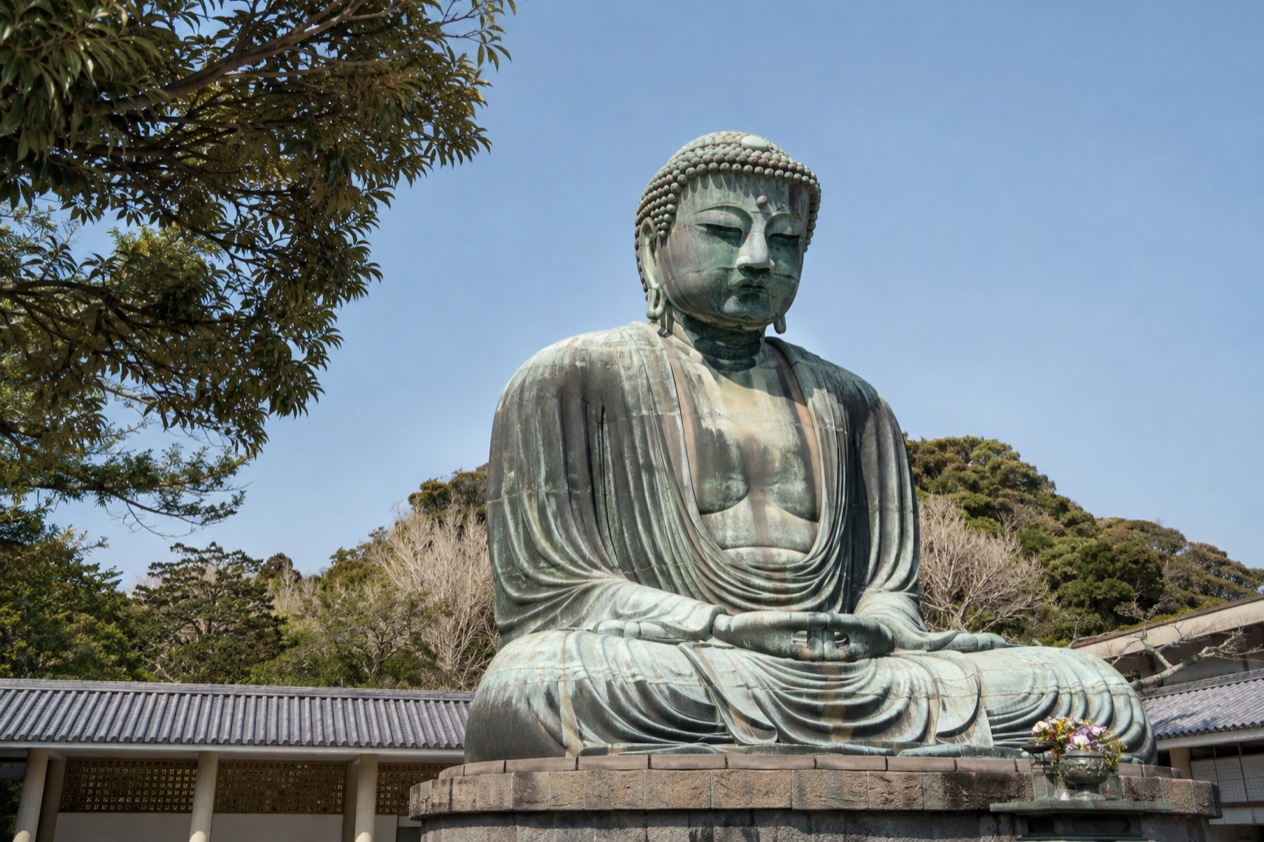
A day in Kamakura is a day of walking between temples, shrines and small shops, with a train ride at each end. The town was the seat of the shogunate from 1185, and its main sights still reflect that: Tsurugaoka Hachimangu, the shrine at the head of the main avenue, the Great Buddha at Kotoku-in, and the hillside temple of Hase-dera, whose garden and views over the bay draw people in. Linking them takes a day of unhurried walking and a ride or two on the Enoden.
A route through the town
Start near Kamakura Station, where Komachi-dori is a lane of food stalls and little shops selling sweets, tea and handmade goods. From there the avenue leads to Tsurugaoka Hachimangu, a shrine whose approach is lined with trees and dotted with ponds. It is a good place to slow down after the train.
The Great Buddha and Hase-dera lie in the Hase area, which is where the Enoden line comes in handy. Bamboo groves, mossy stone steps and small hillside shrines fill the gaps between the larger sights, and Kamakura rewards those who wander off the main path.
Food along the way
Kamakura is a coastal town, and its lunch tables lean toward the sea. Shirasu, tiny whitebait, appears as a topping on rice bowls or lightly cooked in dishes at local restaurants. Soba shops, tea houses with sweet bean desserts and bakeries tucked into side streets round out a day on foot. Coffee shops and small cafes sit in old wooden houses, a good excuse for a break between temples.
Street snacks on Komachi-dori make an easy way to eat while moving, and travelers fill the middle of the day with several small tastes instead of one long meal. Save room for something sweet in the afternoon, when the walking has opened your appetite again.
Extending the day toward the coast
The Enoden line also links Kamakura with the Enoshima area, so a day can end beside the water instead of back among the temples. Riding it near sunset, when the sea comes into view from the window, is a gentle way to close the trip. If your ticket is the Enoshima-Kamakura Free Pass, the Enoden is covered for the day, though local buses are not.
What to bring is simple: comfortable shoes for stone steps and hillside paths, a light layer for the changing weather, and a small bag so your hands stay free on the train. A town of temples means taking shoes off at some entrances, so socks without holes are a small kindness to yourself.
As for how long to stay, a day is enough to see the main temples and the Great Buddha. Those who like a slower pace can add a second day for the quieter temples in the hills, or for a longer stretch along the coast. Kamakura has just over 170,000 residents, and it feels like a town in which people actually live, not a theme park of the past.
Good to know before you go
Japan is a country where yen is the currency, and it is worth carrying some for small shops, snack stalls and the Enoden line, where a small purchase is part of the rhythm of the day. Because trains are reputed to run to the minute, a timetable is a tool you can lean on, and a missed connection at Fujisawa is less of a worry than it would be elsewhere.
Keep your belongings in front of you on crowded platforms, as you would in any big city, and take your time on stone steps at the temples, which can be uneven. When you leave, stations in Tokyo are laid out by operator, so keep track of whether you are looking for a JR gate or a private line before you head for the platform.
Sources
- Wikipedia, Shōnan-Shinjuku Line (https://en.wikipedia.org/wiki/Sh%C5%8Dnan-Shinjuku_Line), checked October 11, 2026
- Wikipedia, Yokosuka Line (https://en.wikipedia.org/wiki/Yokosuka_Line), checked October 11, 2026
- Wikipedia, Kamakura (https://en.wikipedia.org/wiki/Kamakura), checked October 11, 2026
- Wikivoyage, Kamakura (https://en.wikivoyage.org/wiki/Kamakura), checked October 11, 2026
- Japan National Tourism Organization, trains and buses (https://www.japan.travel/en/guide/how-to-travel-by-train-and-bus-in-japan/), checked October 11, 2026
- Japan National Tourism Organization, traveling by rail (https://www.japan.travel/en/guide/traveling-by-rail/), checked October 11, 2026
- Japan National Tourism Organization, getting around Japan: trains, subways, buses, taxis (https://www.japan.travel/en/plan/getting-around/), checked October 11, 2026