
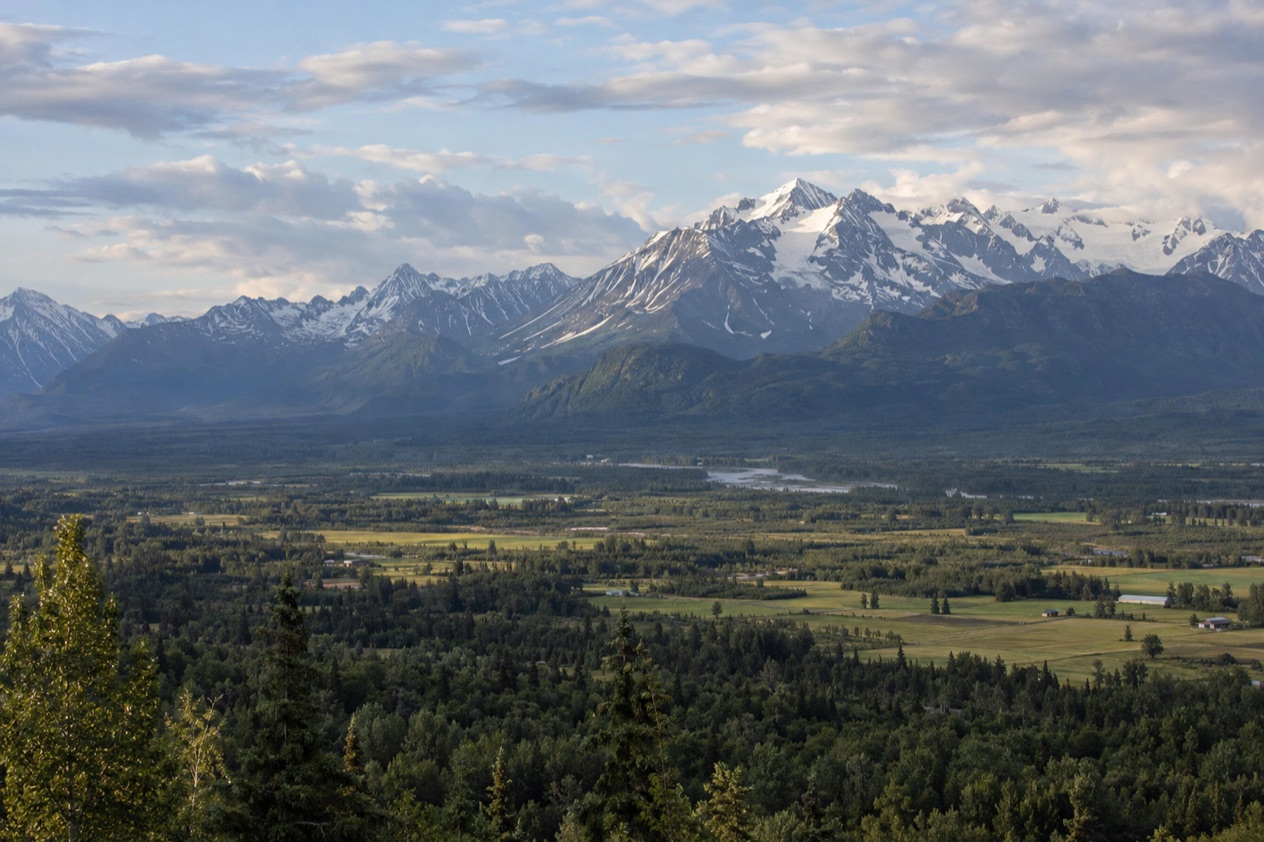
In Palmer, the fairgrounds sit at the foot of the Chugach Mountains, and the talk among the vegetable exhibits is about cabbages so large they need a forklift. A few miles away in Wasilla, the Iditarod’s headquarters keeps the memory of sled dog racing alive. These two Mat-Su Valley towns are Alaska’s farm-and-mountain country, a base for glaciers, trails and mining ruins, and a good fit for travelers who like a working valley more than a polished resort.
Where is Wasilla and Palmer and what is it like?
Wasilla and Palmer lie in the Matanuska-Susitna Valley of southcentral Alaska, north of Anchorage, and together they form the heart of the Mat-Su Valley. Wasilla is the borough’s largest incorporated community and sits on the Parks Highway, while Palmer, the borough seat, sits on the Glenn Highway. Both are ordinary, lived-in towns rather than tourist villages, and that is much of their appeal.
Wasilla is the last city of significant size on the Parks Highway going north, so it works as a stopping point for people driving toward Denali National Park or Fairbanks. It is also a commuter town: nearly one third of its residents make the 40-minute drive to work in Anchorage every day. Strip malls and big-box stores line the highway, but the town also has lakes, trailheads and the headquarters of the Iditarod Trail Sled Dog Race, which gives it a distinct identity in the sled dog world.
Palmer has a more rooted feel. The valley’s farming history goes back to the 1930s, when farmers settled here through a government project, and the borough is still one of the few agricultural areas in Alaska. Palmer is also the home of the National Tsunami Warning Center and of the Alaska State Fair, the town’s big annual moment.
The pace is unhurried and practical. People come for the mountains that frame the valley, the glaciers within a day’s drive and the trails that start close to town. Those who like a local base with easy access to the outdoors, and who do not mind driving between sights, will feel at home.
What is there to do in Wasilla and Palmer?
The reasons to come here are mountains, glaciers, local history and the state’s biggest fair. Each is reachable from town, and each feels different from the coastal Alaska of the cruise ports.
Hatcher Pass and Independence Mine
Hatcher Pass is a mountain pass through the southwest part of the Talkeetna Mountains, with the nearest cities, Palmer and Wasilla, about 12 miles to the south. At an elevation of 3,886 feet, it gives you open alpine country, rugged peaks and the old buildings of Independence Mine State Historical Park, set among those peaks. In summer it is a place for mountain hiking and for wandering the mine’s weathered structures.
The road over the pass is unpaved and minimally maintained for about 20 miles, and its central portion is usually closed by snow from late September to July. In winter and spring, the closed road is heavily used by snowmachines and skiers, and Nordic skiing is among the pursuits here. Treat it as a summer outing for the car and a winter outing for skis.
Glaciers: Matanuska and Knik
Matanuska Glacier is a valley glacier 27 miles long and 4 miles wide, and it is the largest glacier in the United States accessible by car. It lies near the Glenn Highway in Glacier View, about 100 miles northeast of Anchorage, within Matanuska Glacier State Recreation Site, a state park with trails and a small campground. The ice flows about a foot a day, a slow movement that is hard to feel but easy to appreciate when you stand beside something so large.
Knik Glacier is on the northern end of the Chugach Mountains, 50 miles east of Anchorage, and averages over 25 miles long, one of the largest glaciers in southcentral Alaska. It feeds the Knik River and has Lake George near its face, a National Natural Landmark. The lake once flooded in a yearly outburst until it ceased in 1967 as the glacier receded.
Iditarod history and the transportation museum
Wasilla is home to the headquarters of the Iditarod Trail Sled Dog Race, a race that runs from Willow through the Alaska Range and along the Bering Sea shore to Nome. It is a way to understand the culture of mushing, which still shapes the valley’s identity.
The Museum of Alaska Transportation and Industry, established in 1967, houses transportation and industrial remnants and tells the stories of the people and machines that opened Alaska. It suits anyone curious about how this huge state was built, from rail and road to the equipment that worked its land.
The Alaska State Fair
The fair runs for about 12 days in late August and early September, at the foot of the Chugach Mountains. It has amusement rides, food concessions, competitive exhibits, carnival games and live performances, and its signature sight is the display of world-record-sized cabbages and other vegetables. It is a good window into the valley’s farming roots. The Alaska Railroad has run a special train from Anchorage to Palmer only when the fair operates, but that train did not operate in 2021.
Lakes, canoe trails and state parks
Canoeists can paddle the Wasilla Lakes canoe trail, the Nancy Lakes canoe trail and Meadow Creek. Nancy Lake State Recreation Area is a place to relax by the water. The wider Mat-Su Valley holds 31 state parks and campgrounds, so there is plenty to explore beyond the main sights. Hikers also find routes at The Butte, Lazy Mountain and Crevasse Moraine.
How many days do you need in Wasilla and Palmer?
A long weekend covers the essentials, and a few more days let you add the glaciers and the valley’s farther corners. Because the sights are spread out along the highways, the real constraint is time in the car rather than time at each stop.
With two or three days you can see the Museum of Alaska Transportation and Industry and the Iditarod headquarters in Wasilla, spend a day in Hatcher Pass in the months when the road is open, and walk or paddle near town. A trail at The Butte or Lazy Mountain, or a paddle on the Wasilla Lakes, fits easily into a free afternoon.
With four or five days, add Matanuska Glacier, which sits about 100 miles from Anchorage and deserves a day of its own with time on the trails of the state recreation site. Knik Glacier and Lake George make another outing for those who like big landscapes. Eklutna Native Historical Park, with its Russian Orthodox church and the colorful miniature spirit houses on the graves of its children’s graveyard, is a thoughtful stop on the Glenn Highway on the way in or out.
A longer stay opens the northern end of the valley. Talkeetna, the starting point for mountaineers who climb Denali, is a short step beyond the main towns, and Denali State Park offers sweeping vistas. Travelers who are heading to Denali National Park or Fairbanks often pass through Wasilla on the way, and a night here can break up that drive.
Where to stay in Wasilla and Palmer
The choice comes down to which town matches your plans. Wasilla suits those who want a practical base on the Parks Highway, with the road to Denali and Fairbanks close at hand and the museum and the Iditarod headquarters in town. It is also the better pick if you are driving north the next morning or want to be close to the lakes and canoe trails.
Palmer suits travelers who prefer a smaller, farm-valley setting on the Glenn Highway, with the Alaska State Fair grounds and the mountains at the edge of town. It is a natural base for Hatcher Pass and for the road toward Matanuska Glacier. During the fair, in late August and early September, this is the town where the action is.
Outside the towns, the valley has other options. The Mat-Su Valley includes Big Lake, Houston, Willow, Sutton and Talkeetna, and its 31 state parks and campgrounds give campers many places to pitch a tent.
Talkeetna is worth considering if your trip leans toward Denali, since it serves as a tourist hotspot and the launch point for climbers. Willow, the Iditarod’s official restart location, fits those following the sled dog story. Whichever you choose, you will do a fair amount of driving, so pick the area closest to the activity that matters most to you.
How do you get to Wasilla and Palmer and get around?
Visitors arrive by road from Anchorage, and Ted Stevens Anchorage International Airport is about an hour away from Wasilla by car. Wasilla is roughly 43 miles northeast of Anchorage via the George Parks Highway, and Palmer is 42 miles northeast of the city on the Glenn Highway. Palmer Municipal Airport does not have regularly scheduled service, so the Anchorage airport is the gateway.
The Glenn Highway can be taken north from Anchorage, or south from its connection with the Tok Cutoff-Richardson Highway, to reach the borough. Wasilla’s position as the last city of significant size on the Parks Highway makes it a regular stop for drivers heading to Denali National Park, Fairbanks or other points north.
Getting around the valley means driving between towns and trailheads. Hatcher Pass lies about 12 miles south of Willow’s side and north of Palmer and Wasilla, and its road is unpaved and minimally maintained for about 20 miles. Matanuska Glacier is near the Glenn Highway in Glacier View, and Eklutna Native Historical Park is 9 miles south of the Glenn and Parks Highway junction, reached by a right exit on the southbound lane of the Glenn Highway.
For Eklutna Native Historical Park you can call toll-free +1-866-EKLUTNA (3558862). Beyond the road, the Alaska Railroad has run a special train from Anchorage to Palmer only when the Alaska State Fair operates.
When is the best time to visit Wasilla and Palmer?
Summer is the main season, and July shows why. In Palmer the average high is about 67.6°F and the average low about 50.7°F, with showers on around five days of the month.
That is comfortable weather for hiking The Butte, Lazy Mountain and Hatcher Pass, paddling the lakes and visiting the glaciers. The Hatcher Pass road is usually closed by snow from late September to July, so the heart of the pass is best planned for after the snow clears.
Late August and early September bring the Alaska State Fair to Palmer for about 12 days, which makes that stretch the most lively of the year for this valley. It is the moment for giant cabbages, rides, food stands and live music at the foot of the Chugach Mountains.
Winter is a different trip. January in Palmer has an average high near 22°F and a low near 8°F, with little precipitation, spread over only a couple of days.
It is cold, and the draw is Nordic skiing at Hatcher Pass, Moose Meadows and Government Peak, along with snowmachining on the closed pass road. Iditarod fans may also think of the race’s start in March, when the official restart takes place in Willow, the day after the ceremonial start in downtown Anchorage.
Good to know before you go
The valley is spread out, and many sights are reached by highway, so plan around driving. Seasonal closures matter most at Hatcher Pass, where the central road is usually closed by snow from late September to July. Winter air is cold enough that clothing deserves thought, and the summer gives a mild but changeable valley climate.
For Eklutna Native Historical Park, the church and the children’s spirit houses are a place to visit with respect, as they mark graves. The valley is home to Alaska’s farmland and its sled dog heritage, so a little curiosity about both repays the visit.
Sources
- Wikivoyage, Wasilla (https://en.wikivoyage.org/wiki/Wasilla), checked October 11, 2026
- Wikipedia, Wasilla, Alaska (https://en.wikipedia.org/wiki/Wasilla,_Alaska), checked October 11, 2026
- Wikipedia, Palmer, Alaska (https://en.wikipedia.org/wiki/Palmer,_Alaska), checked October 11, 2026
- Wikipedia, Mat-Su Valley (https://en.wikipedia.org/wiki/Mat-Su_Valley), checked October 11, 2026
- Wikivoyage, Matanuska-Susitna Borough (https://en.wikivoyage.org/wiki/Matanuska-Susitna_Borough), checked October 11, 2026
- Wikipedia, Matanuska-Susitna Borough, Alaska (https://en.wikipedia.org/wiki/Matanuska-Susitna_Borough,_Alaska), checked October 11, 2026
- Wikipedia, Matanuska Glacier (https://en.wikipedia.org/wiki/Matanuska_Glacier), checked October 11, 2026
- Wikipedia, Hatcher Pass (https://en.wikipedia.org/wiki/Hatcher_Pass), checked October 11, 2026
- Alaska State Parks, Mat-Su region (https://dnr.alaska.gov/parks/aspunits/matsu/matsuindex.htm), checked October 11, 2026
- Wikipedia, Alaska State Fair (https://en.wikipedia.org/wiki/Alaska_State_Fair), checked October 11, 2026
- Wikipedia, Knik Glacier (https://en.wikipedia.org/wiki/Knik_Glacier), checked October 11, 2026
- Wikipedia, Iditarod Trail Sled Dog Race (https://en.wikipedia.org/wiki/Iditarod_Trail_Sled_Dog_Race), checked October 11, 2026
- Wikipedia, Climate of Alaska (https://en.wikipedia.org/wiki/Climate_of_Alaska), checked October 11, 2026
- NOAA NCEI, U.S. Climate Normals 1991-2020, monthly (https://www.ncei.noaa.gov/access/services/data/v1?dataset=normals-monthly-1991-2020&stations=USW00025331), station Palmer Muni Ap, elevation 230 feet, checked October 11, 2026
All our pages
When to go
- Best Time to Visit Wasilla and Palmer: Summer Daylight, the State Fair, Weather and Seasons
- Wasilla and Palmer in January: Weather, Daylight, Northern Lights and Winter Outings
- Wasilla and Palmer in February: Weather, Northern Lights Chances and Things to Do
- Wasilla and Palmer in March: Iditarod Restart, Weather and Northern Lights Chances
- Wasilla and Palmer in April: Spring Breakup, Hatcher Pass, Weather and a Two-Day Plan
- Wasilla and Palmer in May: Weather, Long Days and What to Do in the Mat-Su Valley
- Wasilla and Palmer in June: Weather, Hatcher Pass, Knik Glacier and a Two-Day Plan
- Wasilla and Palmer in July: Weather, Long Evenings and What to Do
- Wasilla and Palmer in August: Alaska State Fair, Hatcher Pass and Weather
- Wasilla and Palmer in September: State Fair Season, Weather and What to Do
- Wasilla and Palmer in October: Hatcher Pass, Fall Light, Farm Valley Quiet and Northern Lights Nights
- Wasilla and Palmer in November: Weather, Aurora Nights and What to Do
- Wasilla and Palmer in December: Weather, Northern Lights and Winter Things to Do