
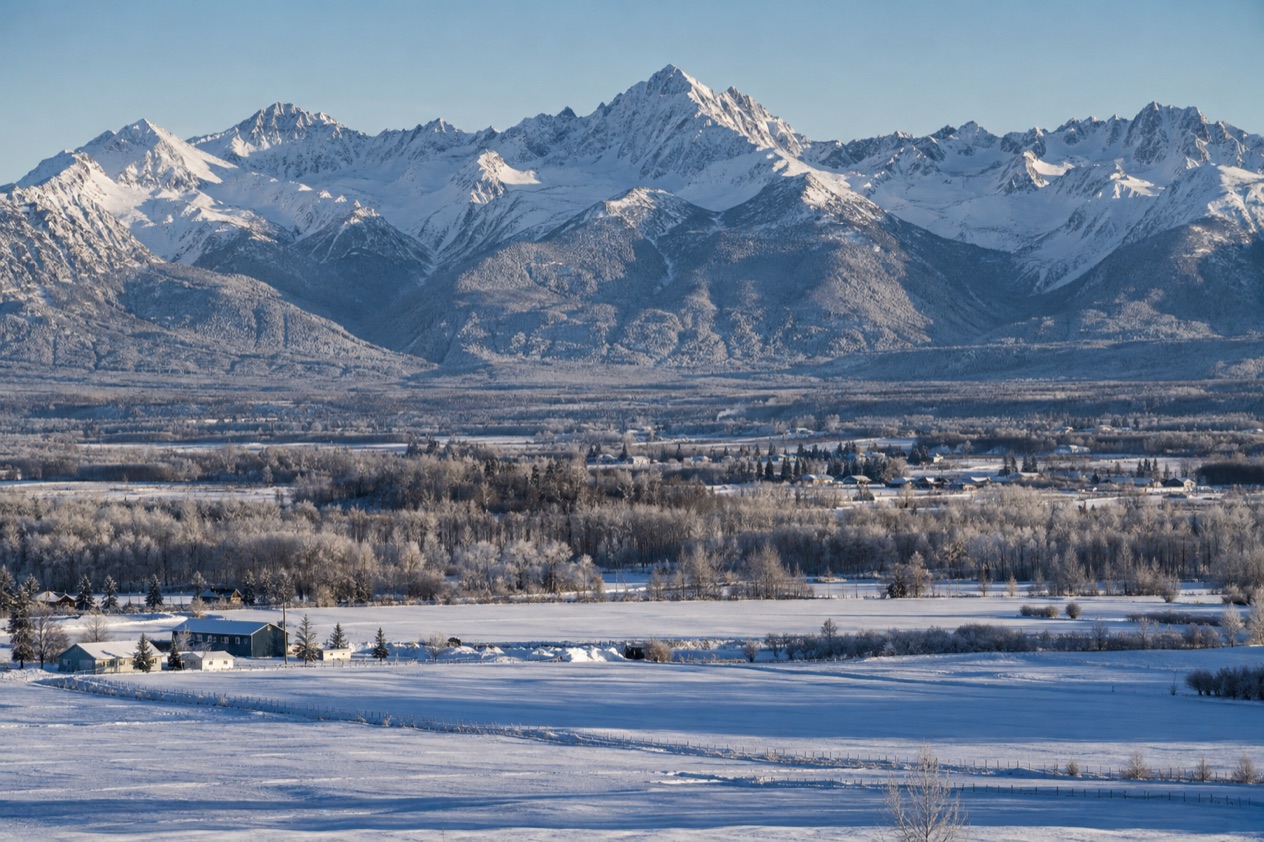
In January the Mat-Su Valley is quiet in the way snow makes a place quiet. Woodsmoke hangs over the neighborhoods, the mountains turn pink at the edges when the low sun finally clears them, and a hot drink in a café window feels like the main event of the afternoon. Wasilla and Palmer sit in the middle of this white, still country, and the month suits travelers who come for the cold, the early dark and the chance of green light overhead.
What is the weather like in Wasilla and Palmer in January?
January is cold, dry and short on daylight: well below freezing all day, with very little new precipitation and a sun that barely climbs over the horizon.
| Month | Average high (°F) | Average low (°F) | Precipitation (in) | Days with precipitation | Daylight on the 15th |
|---|---|---|---|---|---|
| December | 25.1 | 11.4 | 0.96 | 3.0 | 5 h 24 min |
| January | 22.4 | 8.3 | 0.65 | 2.1 | 6 h 13 min |
| February | 28.3 | 13.2 | 0.70 | 2.1 | 8 h 54 min |
January is the coldest of the three months, so the afternoon is no relief: the air stays well under freezing from breakfast to bedtime, and the nights are properly deep cold. Anything you do outside calls for real winter layers, and a hat and warm boots matter as much as the coat.
Precipitation is light, and it is mostly melted snow, falling on only a couple of days. That means most January days are dry and often clear, and fresh snow is a minor event instead of a daily pattern. A day with a gray sky and light flakes is a good day for a museum or a café. A clear day gives the crispest views of the mountain ranges that frame the valley.
Daylight is the real constraint. The sun is up for a little over six hours in mid-month, so mornings start in the dark and the afternoon fades early. The days are lengthening steadily, though, and by the end of the month you feel the difference. Plan the outdoor part of the day for the middle hours, and leave the evening for dinner, a warm room and a look at the sky.
What to do in Wasilla and Palmer in January
January here is for winter pleasures: dark skies, snowy scenery and the farm-and-mountain landscape of the Mat-Su Valley under snow. The valley is home to the towns of Palmer, Wasilla, Big Lake, Houston, Willow, Sutton and Talkeetna, and Wasilla is the largest incorporated community while Palmer is the borough seat. Palmer lies 42 miles northeast of Anchorage on the Glenn Highway, which makes the pair a base with a small-town feel and a big city close by.
The pace is slow, and that is part of the appeal. Days are spent in layers, with a walk when the sun is out, a long lunch, and then the early dark that invites you to settle into a warm room. If you came for the stillness of a northern winter, this is a place to find it without going far from services.
The northern lights from the valley
The aurora oval covers most of Alaska, and the Mat-Su Valley falls within that wide band. From late September through the middle of April the northern lights are active over Anchorage, and January sits in the middle of that stretch, so a dark clear night here may bring a display.
Auroras are a chance, never a promise. Cloud is what usually spoils a night, and the dry, often clear weather of the month gives you a fair shot.
The lights are caused by charged particles from the sun striking gases in the upper atmosphere, and they can glow green, red or purple. Activity tends to be stronger around the equinoxes than at midwinter, so January is a quieter point in the season, though still part of it.
A dark spot away from town lights helps, and the long nights of the month give you plenty of hours to try. Keep your layers on, because standing still under the sky in January cold is a different thing from walking in it.
Palmer and its farming past
Palmer is the place to understand why the valley looks the way it does. Farmers settled here in the 1930s through a government project, and the borough still counts among the few agricultural areas in Alaska. In January the fields are under snow, but the town keeps its story: this is where the Alaska State Fair is held each year, with its record-sized cabbages and other giant vegetables, so a winter walk through Palmer feels like seeing a stage between acts.
The town is also the headquarters of the National Tsunami Warning Center, an unexpected neighbor for a farming community far from the open ocean. Spend a slow hour on the main streets, stop for coffee or soup in a local café, and look at the mountains that stand over the town. It suits travelers who like to read a place through its history and its everyday life rather than through a list of sights.
Dog sledding and the glacier on the Glenn Highway
Dog sledding is a winter tradition in this part of Alaska, and in Anchorage the season typically runs from October through March, so January is right inside it. In Alaska, sled dogs traditionally pull side by side in pairs, and the sleds are the built-up type with a high rail on each side. If you want to see this culture, it is something to look for during the cold months, in a part of the state where mushing is part of the identity.
The Glenn Highway also leads to the Matanuska Glacier, a valley glacier 27 miles long and 4 miles wide, which lies near the highway about 100 miles northeast of Anchorage in Glacier View. It is the largest glacier in the United States that can be reached by car. In January the scene is a frozen, white landscape under a low sun, a reminder of the scale of the country that begins beyond the valley towns.
Eklutna Native Historical Park, south of the Glenn and Parks Highway junction, is another stop on the way between the valley and Anchorage. It is a place connected to the history of Alaska Native people in the area, and it adds a cultural stop to a winter route.
A two-day itinerary for Wasilla and Palmer in January
Day 1 begins late, because the sun is slow to rise. Take a long breakfast in a Wasilla café, then use the middle of the day, when the light is best and the air is at its mildest, for a winter walk and a look at the lakes and snowy fields around town. After a lunch of soup or a hot sandwich, spend the early afternoon indoors in a local shop or gallery, because the light fades fast.
As the dark arrives, settle in for a proper dinner, then go out to find a dark place for the sky. If the weather is clear, the aurora may appear, and if clouds roll in, a warm lounge and a book are no loss.
Day 2 moves to Palmer. Spend the late morning wandering the town center, with its farm-town character, and learn about the valley’s agricultural story.
Lunch can be at a café or a small restaurant, and then you can drive out along the Glenn Highway toward the glacier country for a look at the frozen landscape. If snow or low cloud arrives, turn the afternoon into a museum or café stop in town and keep the highway for a clearer day. Come back in time for an early dinner and another night under the sky.
Is Wasilla and Palmer busy in January?
January is a quiet month in the Mat-Su Valley, a time when the towns run at a winter pace. The big draw of the valley, the Alaska State Fair in Palmer, belongs to another part of the calendar, and the cold, short days of January call for few crowds on the streets.
What you find instead is a local rhythm: people in heavy coats, cars warming in the morning, and cafés full of regulars. Anchorage’s winter attractions, including the dog sledding season that runs through March and the aurora season that lasts until the middle of April, are within reach of the valley, so a trip here can be one half of a winter stay in Southcentral Alaska.
What to pack for Wasilla and Palmer in January
Pack for a long stay in the cold, since the average high stays well below freezing and the nights are colder still. Layers matter more than any single item.
- A heavy insulated coat, because even the warmest part of the day stays below freezing.
- Thermal base layers, to wear under everything while you wait for the sky at night.
- Insulated waterproof boots with good grip, for snowy sidewalks and parking lots.
- A warm hat, gloves and a scarf or neck gaiter, for mornings that begin in the dark.
- A camera or phone that you can handle with gloves on, in case the northern lights appear.
- Sunglasses, since low winter sun on snow can be bright on clear days.
Good to know before you go
The main thing to plan around in January is daylight, with just over six hours of it in mid-month. Do the outdoor part of the day in the middle hours and keep evenings for dinner and the sky.
The Glenn Highway connects Palmer and Wasilla with Anchorage, and it is also the route toward the Matanuska Glacier, so getting around is a matter of watching winter conditions on the day. The Denali National Park kennels, beyond the valley, keep a winter schedule that is useful if your trip extends north.
| Site | Open |
|---|---|
| Denali National Park kennels (late September through the winter) | Saturdays and Sundays, 1 pm to 4 pm |
Wasilla and Palmer in January vs December and February
December is slightly milder and a little wetter, but it has the shortest days of the winter, with barely five hours of light in mid-month. If you want the deepest, darkest feel of the season and the long nights for aurora watching, December gives you the most of both. January is colder, drier and a bit brighter.
February is the gentlest of the three, with warmer afternoons and almost nine hours of daylight in the middle of the month. That extra light changes how a day feels: you can do more outdoors and the sun stays with you much later. The aurora season is still on, and the dog sledding season in Anchorage still has time to run.
Choose December for the dark and the holiday feel, January for the quiet and the cold, and February if you want winter scenery with more light to enjoy it. Travelers who dislike the cold or the short days will do better in February, while those who want the full northern winter are well placed in January.
Is January a good time to visit Wasilla and Palmer?
Yes, for travelers who like winter and quiet, and who are happy to trade long days for dark skies and a slower pace. It does not suit anyone who wants to be outdoors for many hours, who dislikes the cold, or who is counting on the long days of summer.
If you love snow, early evenings by the window and the chance of an aurora, January in the Mat-Su Valley gives you that in a small-town setting, with Anchorage close by. Those who want hiking, boat trips or green fields should choose another time of year.
On arrival, start with the middle of the day, when the light is best, and save your night for the sky.
Sources
- NOAA NCEI, U.S. Climate Normals 1991-2020, monthly (https://www.ncei.noaa.gov/access/services/data/v1?dataset=normals-monthly-1991-2020&stations=USW00025331), station Palmer Muni Ap, elevation 230 feet, checked October 11, 2026
- Computed from the date and the latitude of the place (sunrise equation, solar elevation -0.833 degrees), October 11, 2026
- University of Alaska Fairbanks Geophysical Institute, Aurora forecast (https://www.gi.alaska.edu/monitors/aurora-forecast), checked October 11, 2026
- Wikivoyage, Northern lights (https://en.wikivoyage.org/wiki/Northern_lights), checked October 11, 2026
- Wikipedia, Aurora (https://en.wikipedia.org/wiki/Aurora), checked October 11, 2026
- Visit Anchorage, northern lights viewing (https://www.anchorage.net/winter/things-to-do/northern-lights-viewing/), checked October 11, 2026
- Visit Anchorage, dog sledding (https://www.anchorage.net/winter/things-to-do/dog-sledding/), checked October 11, 2026
- Wikipedia, Dog sled (https://en.wikipedia.org/wiki/Dog_sled), checked October 11, 2026
- National Park Service, Denali National Park & Preserve, plan your visit: kennels (https://www.nps.gov/dena/planyourvisit/kennels.htm), checked October 11, 2026
- National Park Service, Denali National Park & Preserve, plan your visit: winter activities (https://www.nps.gov/dena/planyourvisit/winter-activities.htm), checked October 11, 2026
- Wikipedia, Palmer, Alaska (https://en.wikipedia.org/wiki/Palmer,_Alaska), checked October 11, 2026
- Wikipedia, Mat-Su Valley (https://en.wikipedia.org/wiki/Mat-Su_Valley), checked October 11, 2026
- Wikivoyage, Matanuska-Susitna Borough (https://en.wikivoyage.org/wiki/Matanuska-Susitna_Borough), checked October 11, 2026
- Wikipedia, Matanuska-Susitna Borough, Alaska (https://en.wikipedia.org/wiki/Matanuska-Susitna_Borough,_Alaska), checked October 11, 2026
- Wikipedia, Matanuska Glacier (https://en.wikipedia.org/wiki/Matanuska_Glacier), checked October 11, 2026
- Wikipedia, Climate of Alaska (https://en.wikipedia.org/wiki/Climate_of_Alaska), checked October 11, 2026
To plan your stay
- Things to Do in Wasilla and Palmer: Iditarod Country, Hatcher Pass, Glaciers and the Alaska State Fair
- Where to Stay in Wasilla and Palmer: Parks Highway Base, Farm Country and Valley Towns
- Best Time to Visit Wasilla and Palmer: Summer Daylight, the State Fair, Weather and Seasons
- Wasilla and Palmer in February: Weather, Northern Lights Chances and Things to Do