
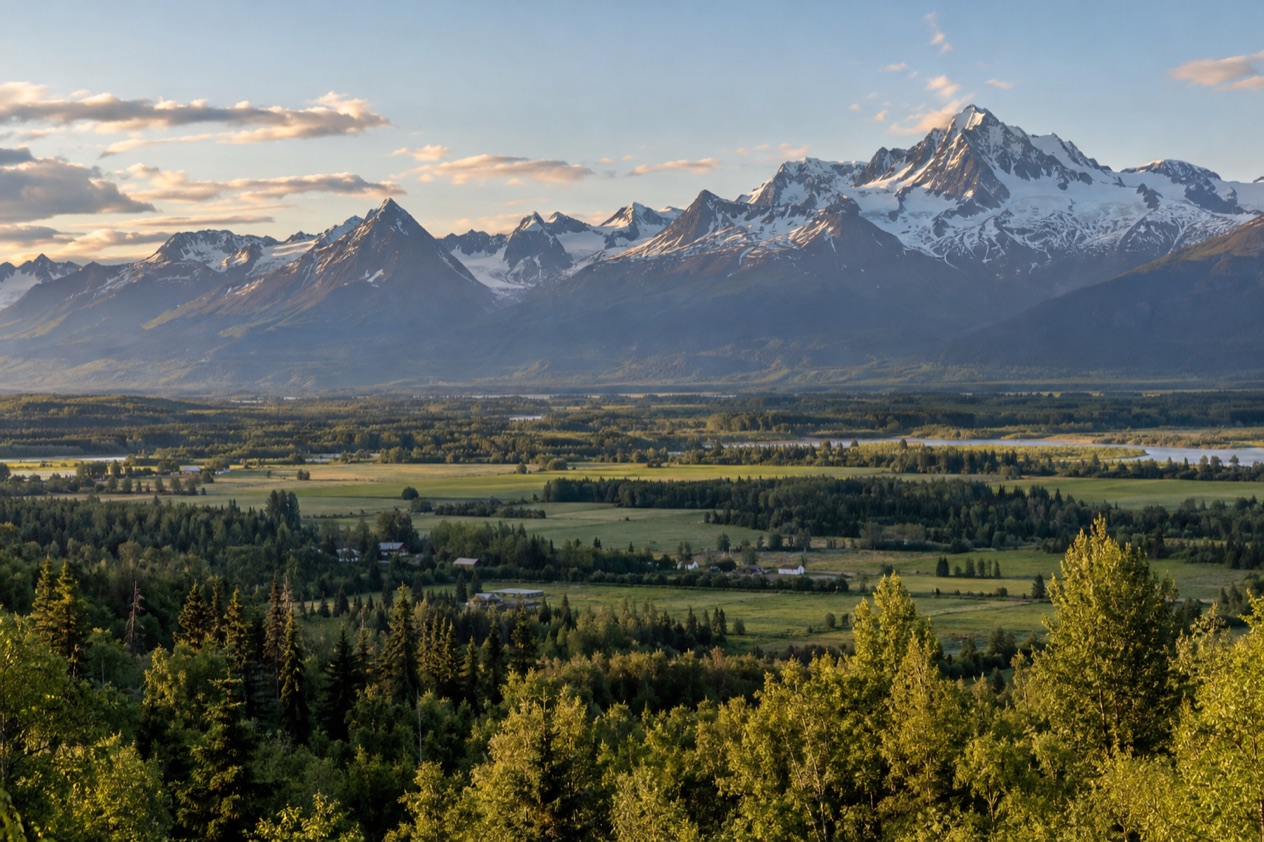
In August, the Matanuska-Susitna Valley smells of fried dough and hay, and the Chugach Mountains stand at the edge of the fairgrounds in Palmer while giant cabbages are carried in for judging. Evenings begin to cool, the light turns softer, and the valley shifts from the long bright days of high summer toward fall. It is the month to spend in Wasilla and Palmer for the state fair, the mountain road over Hatcher Pass and the first dark skies of the season.
What is the weather like in Wasilla and Palmer in August?
In Palmer, August is mild, with cool mornings and pleasant afternoons.
| Month | Average high (°F) | Average low (°F) | Precipitation (in) | Days with precipitation | Daylight on the 15th |
|---|---|---|---|---|---|
| July | 67.6 | 50.7 | 1.60 | 5.1 | 18 h 41 min |
| August | 64.6 | 48.2 | 2.32 | 6.2 | 16 h 02 min |
| September | 55.8 | 40.8 | 2.08 | 6.0 | 13 h 04 min |
Mornings feel crisp enough for a fleece or a light jacket, and by afternoon a T-shirt under a layer is usually enough when the clouds break. Evenings cool off quickly once the sun drops behind the mountains, so a sweater is welcome at a late fair night or a campfire.
Rain in August tends to arrive as showers rather than steady all-day downpours, and a few of the days will be gray and wet. It is wetter than July, so a light rain shell belongs in the daypack. In the mountains at Hatcher Pass, conditions can differ from the valley, so bring an extra layer for any trip up the road.
The light has already begun to shorten. Days are long enough for a full afternoon outing and a late dinner, yet the sky gets properly dark again at night, which matters for the northern lights later in the month.
What to do in Wasilla and Palmer in August
The Alaska State Fair is the event of the month. It is held in Palmer, at the foot of the Chugach Mountains in the Matanuska-Susitna Valley, and it runs for about 12 days from late August into early September. Everything else on the calendar tends to be arranged around it.
The Alaska State Fair in Palmer
The fair is the place to see why the valley’s growing season is a point of pride. Expect barns and exhibit halls, live music, rides, craft stalls and the oversized vegetables Alaska gardens are known for. Fair food is part of the day: fried treats, grilled meat on a stick, and a slice of pie or a cinnamon roll to eat while you walk.
Palmer is about one hour north of Anchorage, so visitors come over for the day, but staying in the valley lets you go in the morning before the grounds fill, and again after dinner when the lights come on. The mountains rising behind the midway make a good backdrop for photographs. Because the fair begins in the last part of August, travelers arriving early in the month will find the town in preparation mode rather than in full swing.
Bring a rain shell, since showers can pass over the grounds, and wear shoes you do not mind getting muddy. The fair suits families, food lovers and anyone curious about local farming and crafts.
Hatcher Pass and Independence Mine
Hatcher Pass is a mountain pass in the southwest part of the Talkeetna Mountains, about 12 miles from Palmer and Wasilla. It tops out at 3,886 feet, and the road over it is unpaved and minimally maintained for about 20 miles, so the drive is part of the adventure and calls for patience.
Independence Mine State Historical Park sits in the pass, surrounded by rugged peaks. Weather up here changes fast, so dress warmer than you would in town.
Knik Glacier and the river valley
Knik Glacier lies 50 miles east of Anchorage at the northern end of the Chugach Mountains. It averages over 25 miles long and over 5 miles across, one of the largest glaciers in southcentral Alaska, and it feeds the Knik River, which empties into the Knik Arm of Cook Inlet.
It is a good reminder, between fair days, that the valley is framed by big ice and big mountains.
The Mat-Su region holds 24 parks and more than 650,000 acres of land, so a day outside the fair and the pass can be filled with state park stops.
The northern lights are visible in Alaska, but a sighting is never a promise. The aurora can be seen from the middle of August through April over Anchorage, and Fairbanks’ season is roughly August 21 to April 21. Clear weather is the condition, and in the Mat-Su Valley you may get a chance on a night away from town lights, but it is never a promise.
A two-day itinerary for Wasilla and Palmer in August
Day 1 starts with a hearty breakfast in Wasilla at a local diner or coffee stand, with a fleece on, because mornings are cool. Head toward Palmer by late morning for a stroll through town and a lunch at a café, then spend the afternoon at the Alaska State Fair if it is running, wandering exhibit halls and barns first while the day is still bright.
Stay on for dinner among the food stalls and music as the light softens and the air cools. If rain sets in, keep your rain shell handy. After dark, step away from bright lights and look up, since the sky is dark enough again this month.
Day 2 is for the mountains. Drive up toward Hatcher Pass in the morning with layers and a rain shell, and give Independence Mine State Historical Park a long, unhurried visit among the old mining buildings and the peaks around them.
Return to the valley in the afternoon for a late lunch, then use the remaining daylight for a look toward Knik Glacier and the river. On a wet day, swap the pass for a slow loop of cafés and shops in Wasilla and Palmer, and keep the glacier view for when the clouds lift. Finish with an early supper and a quiet evening.
Is Wasilla and Palmer busy in August?
August is lively here mainly because of the Alaska State Fair, which brings crowds to Palmer for about 12 days from late August into early September.
Outside the fair, the valley keeps a relaxed pace, with the usual comings and goings of a region that sits about an hour from Anchorage. Fair days are the busiest, so the grounds feel quieter on early mornings. Expect more traffic around Palmer when the fair is on, and a calmer rhythm in Wasilla and on the roads into the mountains.
What to pack for Wasilla and Palmer in August
Pack for cool mornings, mild afternoons and changeable skies, with layers that suit both a fairground and a mountain pass.
- A light rain shell, because August brings showers on several days.
- A fleece or warm sweater for chilly mornings and evenings.
- Waterproof walking shoes for muddy fairgrounds and Independence Mine.
- A warmer layer for Hatcher Pass, where it is higher than the valley.
- A hat and light gloves for late nights outside.
- A camera for the mountains and the oversized vegetables at the fair.
Good to know before you go
The road over Hatcher Pass is unpaved and minimally maintained for about 20 miles, so plan the day around it and allow extra time. Daylight is still generous, yet it is shorter than in July, so start outings in the morning. The fair is in Palmer, about one hour north of Anchorage, and it fills the last part of the month.
Wasilla and Palmer in August vs July and September
Moving the trip to July brings warmer days, drier weather and the longest light of the three months, with nights too bright for aurora. The state fair has not started yet, so the valley is quieter on the event side, and the mountain road is a good outing in the longer evenings.
September is cooler and the light shortens quickly. The fair continues into early September. Expect jackets rather than fleeces, and a more autumnal feel in the valley. Choose July for the longest days and the warmest hours outdoors, August for the fair and the first dark nights, and September for crisp air and a better chance at the aurora after the fair ends.
Is August a good time to visit Wasilla and Palmer?
Yes, August is a good month for travelers who like a mix of fairground fun, mountain scenery and the first dark skies of the season.
It suits families, food lovers and anyone who enjoys a small-town event with a mountain backdrop. Travelers who want the warmest, driest days and the longest light may prefer July, and those chasing the aurora with the most dark hours may prefer September.
On arrival, settle into Palmer or Wasilla, get a look at the mountains, and decide whether the fair or Hatcher Pass comes first. What is special about August here is the turn of the season: giant vegetables under the Chugach, cool evenings, and the sky beginning to go dark again.
Sources
- NOAA NCEI, U.S. Climate Normals 1991-2020, monthly (https://www.ncei.noaa.gov/access/services/data/v1?dataset=normals-monthly-1991-2020&stations=USW00025331), station Palmer Muni Ap, elevation 230 feet, checked October 11, 2026
- Computed from the date and the latitude of the place (sunrise equation, solar elevation -0.833 degrees), October 11, 2026
- National Park Service, Lake Clark National Park & Preserve, plan your visit: conditions (https://www.nps.gov/lacl/planyourvisit/conditions.htm), checked October 11, 2026
- National Park Service, Katmai National Park & Preserve, plan your visit (https://www.nps.gov/katm/planyourvisit/index.htm), checked October 11, 2026
- Wikipedia, Alaska State Fair (https://en.wikipedia.org/wiki/Alaska_State_Fair), checked October 11, 2026
- University of Alaska Fairbanks Geophysical Institute, Aurora forecast (https://www.gi.alaska.edu/monitors/aurora-forecast), checked October 11, 2026
- Wikivoyage, Northern lights (https://en.wikivoyage.org/wiki/Northern_lights), checked October 11, 2026
- Wikipedia, Aurora (https://en.wikipedia.org/wiki/Aurora), checked October 11, 2026
- Visit Anchorage, northern lights viewing (https://www.anchorage.net/winter/things-to-do/northern-lights-viewing/), checked October 11, 2026
- Wikipedia, Hatcher Pass (https://en.wikipedia.org/wiki/Hatcher_Pass), checked October 11, 2026
- Alaska State Parks, Mat-Su region (https://dnr.alaska.gov/parks/aspunits/matsu/matsuindex.htm), checked October 11, 2026
- Wikipedia, Knik Glacier (https://en.wikipedia.org/wiki/Knik_Glacier), checked October 11, 2026
- Wikipedia, Iditarod Trail Sled Dog Race (https://en.wikipedia.org/wiki/Iditarod_Trail_Sled_Dog_Race), checked October 11, 2026
- Wikipedia, Climate of Alaska (https://en.wikipedia.org/wiki/Climate_of_Alaska), checked October 11, 2026
To plan your stay
- Things to Do in Wasilla and Palmer: Iditarod Country, Hatcher Pass, Glaciers and the Alaska State Fair
- Where to Stay in Wasilla and Palmer: Parks Highway Base, Farm Country and Valley Towns
- Best Time to Visit Wasilla and Palmer: Summer Daylight, the State Fair, Weather and Seasons
- Wasilla and Palmer in July: Weather, Long Evenings and What to Do