
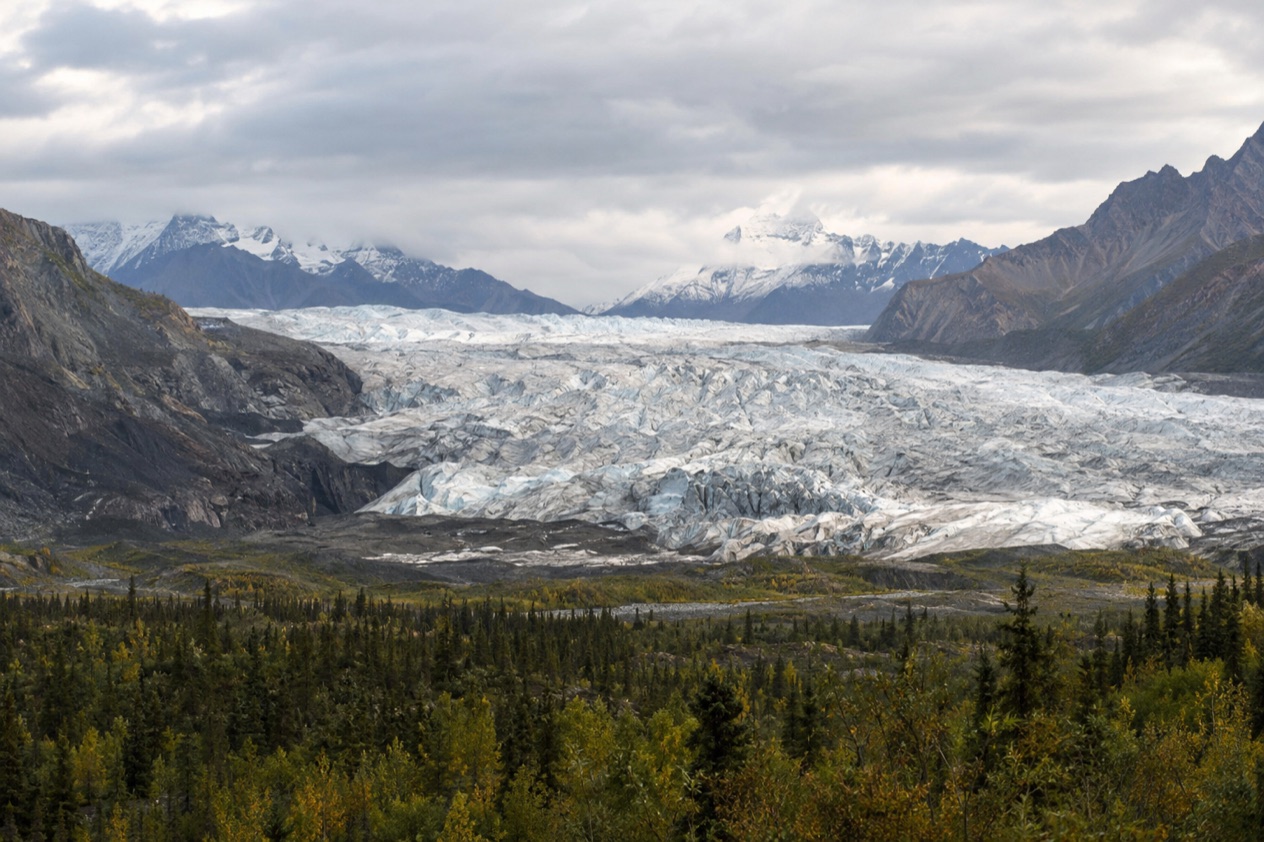
The road bends, the spruce thin out, and a long river of gray-blue ice appears between the mountains, wide enough that it looks like a frozen highway of its own. Dust-colored moraine lies across its surface, and meltwater streams carry the glacier’s silt down toward the valley. Matanuska Glacier is a big, open-air landscape you can reach from a paved road, and the visit rewards slow looking as much as walking.
Is visiting Matanuska Glacier worth it?
Yes, for anyone who wants to stand beside a real river of ice without chartering a plane or a boat, and especially for travelers driving out of Anchorage who like a day with a destination at the end of it. It is the largest glacier in the United States that can be reached by car, which says a lot about how rare this kind of access is.
What sets it apart from the other glaciers near Anchorage is the scale and the way you arrive. Knik Glacier is reached by ATV or flightseeing tour, and many Alaska glaciers need a boat.
Here the glacier is a valley glacier stretching 27 miles in length and 4 miles in width, and the trip is a drive up the Glenn Highway, with the Mat-Su Valley, its farms and its mountains as the lead-in. The glacier also flows, about a foot a day, so the ice you see is always slightly different from the ice someone saw last week.
It suits people who enjoy a landscape for its own sake: photographers, geology fans, families who want a real outing and road-trippers building a loop through the valley. It is less suited to anyone who wants a staffed, ticketed attraction with a visitor center feel. This is a wild piece of ground with a private landowner, a state recreation site and a toll bridge, and the visit has a bit of that frontier character.
What to see at Matanuska Glacier
The ice itself
The first thing you notice is how dirty and how beautiful the glacier is at the same time. Rock ground off the mountains rides on the surface in dark bands, while the exposed ice below shows shades of white, pale blue and deep blue-green where it is dense and clear. Meltwater cuts channels and small pools across the surface, and the ice edge breaks into ridges and hollows.
Look for the way the glacier is layered, with stripes that trace years of snowfall compressed into ice, and for the rumble or trickle of water inside it. Because this ice moves about a foot a day, the surface is never fixed, and crevasses open and close over time. It is a good place to understand what a glacier actually is: a slow river, not a static wall.
Matanuska Glacier State Recreation Site
The glacier sits within Matanuska Glacier State Recreation Site, an Alaska State Park with trails and a small campground. That gives the visit a home base of sorts, a place to look at the glacier from the ground with the mountains around you. The trails are where you get a sense of the terrain, the gravelly outwash, the stunted spruce and birch, and the river running below the ice.
Campers wake up with the glacier in view, and even if you are only passing through, the setting feels more like a wilderness camp than a roadside pullout. Bring a long lens if you photograph, because the ice face and the peaks behind it reward a patient eye more than a quick snapshot.
The Glenn Highway approach
Part of the sight is the road itself. The Glenn Highway began as the Palmer Road in the 1930s to reach the agricultural colony at Palmer, and it was completed to Glennallen during World War II as part of a military road and base building program. It is named for Captain Edwin Glenn, who led an 1898 U.S. Army expedition looking for a route to the Klondike gold fields.
Along the way the highway climbs through the divide between the Chugach and Talkeetna mountains, reaching its high point at Eureka Summit. You do not need to stop for the history, but knowing it makes the long drive feel like part of the outing rather than a transfer.
The Mat-Su Valley around the glacier
The valley was carved by glaciers, which left thousands of lakes, and the glacier you visit is a living remnant of the force that shaped everything you drove through. Rivers here are spawning grounds for chinook, coho, sockeye, pink and chum salmon, which gives the whole valley a strong fishing culture and a good reason to linger over a meal in Palmer or Wasilla.
Farm fields, big skies and mountain walls make the drive a pleasant lead-in. Reading the landscape as a story of ice, from the glacier at the end back to the lakes and valley floor, is the most rewarding way to see it.
Hours, tickets and rules
Matanuska Glacier has no single gate and no posted schedule in what we can confirm, so the cost that matters most is the private landowner’s tour requirement for first-time visitors. Reaching the state recreation site also involves a toll, which a private entity affiliated with Cook Inlet Region, Inc. charges on the only bridge between the site and Alaska Route 1.
| Site | Admission |
|---|---|
| Matanuska Glacier (private land) | $100 tour for first-time visitors |
The rules that apply are these. The private land owner requires tours for first-time visitors, and the toll is charged on the one bridge that connects Matanuska Glacier State Recreation Site to Alaska Route 1. The state recreation site itself has trails and a small campground.
How to get to Matanuska Glacier
The glacier lies near the Glenn Highway about 100 miles northeast of Anchorage, in Glacier View. From Anchorage the route leaves the city by the Glenn Highway, the same road that serves Palmer and Wasilla, and carries on past them toward the glacier.
Palmer and Wasilla sit 45 minutes from downtown Anchorage, and the glacier is an hour beyond Palmer. To reach Palmer, take the Glenn Highway north and follow the off-ramp toward Palmer. That makes Palmer the natural base or halfway stop, with the glacier as the push farther up the highway.
The Alaska Railroad’s Denali Star train serves Wasilla from Anchorage, Talkeetna, Denali and Fairbanks, which is useful for reaching the Mat-Su Valley, though it does not take you to the glacier. The Parks Highway passes through Wasilla, and the long freeway stretch that begins in north Anchorage ends there.
The last link is the bridge. The only bridge connecting Matanuska Glacier State Recreation Site to Alaska Route 1 is run by a private entity affiliated with Cook Inlet Region, Inc., and it charges a toll. Plan for that crossing as part of the approach.
When to visit Matanuska Glacier
Late August is a busy, cheerful moment in the valley: the Alaska State Fair takes place in Palmer then, with world-record-sized cabbages and other vegetables on display, and you-pick farms in the Palmer and Wasilla area are available in August or early September.
That makes late summer a good time to build a day around the glacier plus the valley’s farm country. Northern lights can be seen in the Palmer and Wasilla area from late August through mid-April, which is a chance rather than a promise, and a reason some travelers extend an outing into the evening.
The glacier itself changes slowly, about a foot a day, so no particular week shows you a different glacier. What changes is the mood of the valley around it: farm stands and fairground bustle at the end of summer, quieter fields and long clear nights later on. Pick the valley moment you like and let the glacier anchor the day.
Tips for your visit
Treat Matanuska Glacier as the anchor of a Mat-Su Valley day rather than a stop on its own. Start in Palmer, where you can see the farm country that grew from the agricultural colony the Palmer Road once served, and let the drive to the glacier be part of the pleasure.
Near Palmer and Wasilla, Independence Mine Historical State Park sits in Hatcher Pass in the Talkeetna Mountains between Willow and Palmer, and Hatcher Pass offers hiking in alpine tundra with wildflowers and ptarmigan. Bodenburg Butte is a family hike with views of Knik Glacier and Pioneer Peak, a good pairing for travelers with children who want a second view of ice from higher ground.
If you want a different glacier experience, Knik Glacier can be reached on an ATV or flightseeing tour, which makes an interesting contrast with the drive-up access here. Farther along the valley, Talkeetna is a tourist hotspot and the starting point for mountaineers who climb Denali, and the Mat-Su Valley counts 31 state parks and campgrounds, so there is plenty to string together.
Budget for the first-visit tour requirement and the bridge toll when you plan the day, and remember that the state recreation site has a small campground if you want to stay near the ice.
Good to know before you go
Money is the main practical matter here: a toll on the private bridge and a tour for first-time visitors on the private land. Beyond that, the glacier is a place for looking, listening and moving carefully around ice and meltwater. The ice shifts constantly, and a river of this size is never static.
Stock up in Palmer or Wasilla before heading up the highway, and keep in mind that the glacier sits at the end of a long drive. The Glenn Highway reaches Glennallen in total, so this is a road with plenty of scenery on every stretch, and the glacier is its most memorable stop.
Sources
- Wikipedia, Matanuska Glacier (https://en.wikipedia.org/wiki/Matanuska_Glacier), checked October 11, 2026
- Wikipedia, Glenn Highway (https://en.wikipedia.org/wiki/Glenn_Highway), checked October 11, 2026
- Alaska.org, dest palmer wasilla (https://www.alaska.org/destination/palmer-wasilla), checked October 11, 2026
- Wikipedia, Mat-Su Valley (https://en.wikipedia.org/wiki/Mat-Su_Valley), checked October 11, 2026