
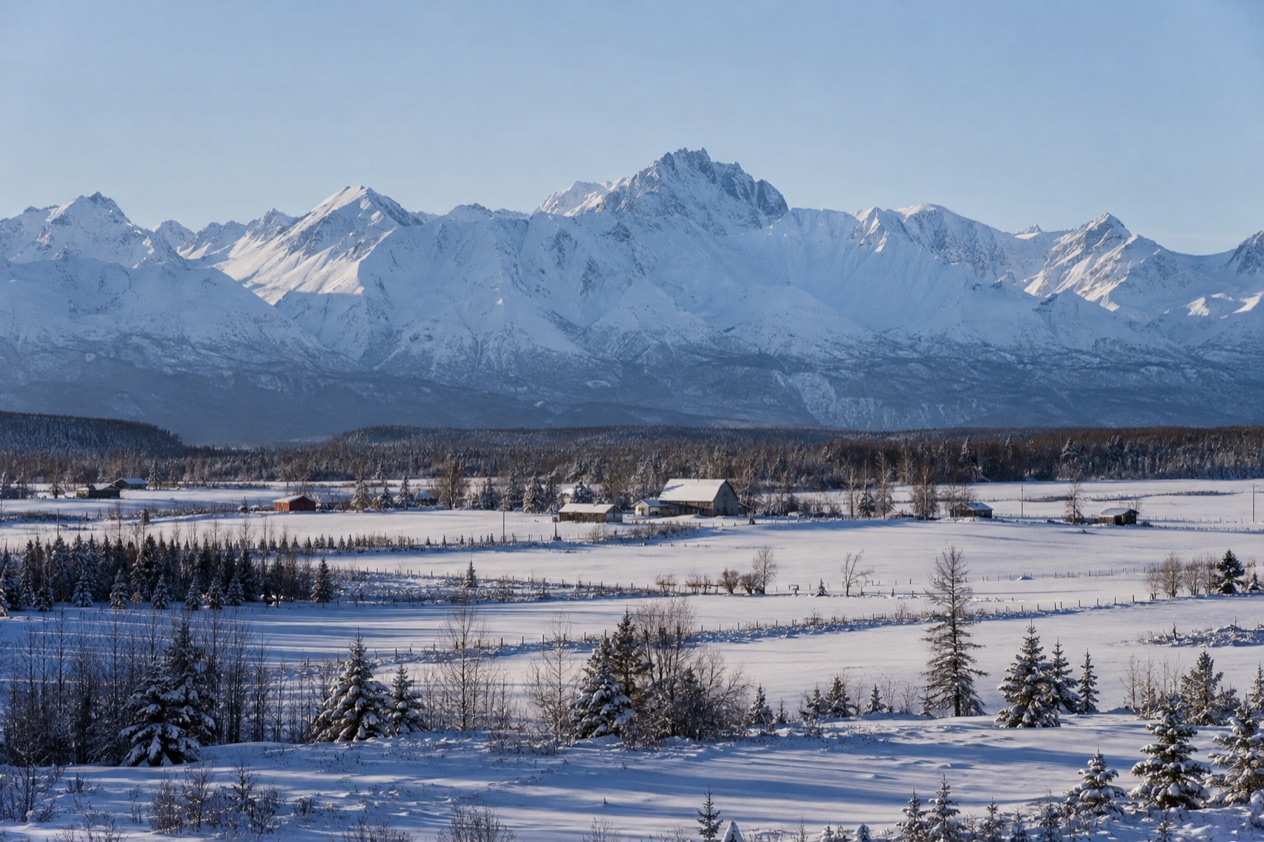
February in the Matanuska-Susitna Valley is a month of hard, bright cold, when snow squeaks underfoot and the Talkeetna and Chugach peaks stand sharp above the flat valley floor. Woodsmoke drifts from chimneys in Palmer, trucks idle outside coffee stands in Wasilla, and the afternoon light grows a little longer each week. It is a quiet, wintry month for people who want snow, big sky and a small-town Alaska pace.
What is the weather like in Wasilla and Palmer in February?
| Month | Average high (°F) | Average low (°F) | Precipitation (in) | Days with precipitation | Daylight on the 15th |
|---|---|---|---|---|---|
| January | 22.4 | 8.3 | 0.65 | 2.1 | 6 h 13 min |
| February | 28.3 | 13.2 | 0.70 | 2.1 | 8 h 54 min |
| March | 33.9 | 17.2 | 0.47 | 1.8 | 11 h 38 min |
February is cold and dry, with afternoons that stay below freezing and nights that drop well into the teens. Precipitation here comes mostly as snow, and it falls on only a couple of days in the month, so most days are about the cold itself rather than about weather moving through.
Mornings start deep in winter, with frost on every surface and breath that hangs in the air. By early afternoon the sun, when it shows, takes off just enough of the edge for a walk without feeling warm. Evenings turn cold again quickly, so you want layers that you can add as the light fades rather than one heavy coat.
The light is the real change from January. The day is now close to nine hours long, enough to plan a full outing in daylight and still be indoors by dark. Long winter dusks and clear nights also leave room for a chance at the aurora, which is more a matter of luck and clear sky than of any schedule.
What to do in Wasilla and Palmer in February
The month belongs to snow, dogs and dark skies. The valley sits in the heart of mushing country, and the great race of the Alaska winter, the Iditarod, restarts in Willow, the day after its ceremonial start in downtown Anchorage.
That restart usually falls in early March, so February is the lead-up, when the talk in feed stores and coffee shops turns to teams, trails and training runs. Anchorage’s Fur Rendezvous winter festival usually runs from late February into March, and it is the nearest big winter party to the valley.
Sled dogs are woven into local life, and the sled itself is distinct. In Alaska the dogs traditionally run side by side in pairs rather than in a fan, and the sleds are the built-up type with a high rail on each side. Dog sledding around Anchorage typically operates from October through March, so February sits inside that season, and the same winter culture runs through the valley towns.
Hatcher Pass and Independence Mine
Hatcher Pass is the mountain pass through the southwest part of the Talkeetna Mountains, reached from Palmer and Wasilla, which lie about twelve miles to the south of it. It rises to 3,886 feet, and that height is what makes it a snow world long after the valley floor has thinned out. The road over the pass is unpaved and minimally maintained for about twenty miles, which says a lot about the character of the place.
Independence Mine State Historical Park sits in the pass, ringed by rugged peaks, and the old mining buildings make a striking sight against snow and sky. In February the setting is about stillness: wind, white slopes and weathered timber. What you can reach on any given day depends on conditions, so treat the pass as a place to see in winter light rather than a fixed destination.
Chasing the aurora from the valley
The northern lights oval covers most of Alaska, and Anchorage’s season runs from the middle of August through April, so February falls well inside it. The valley’s long winter nights and open views toward the mountains suit a night out, though the aurora is always a chance and never a promise. The sky has to be clear, and the display has to be active.
Scientists note that activity tends to run higher around the equinoxes than in midwinter, so February is a good month to look but not the most active one. Dress for a long wait in the cold, bring patience, and take a hot drink if you have one. Even without lights, a clear February night in the valley is full of stars and silence.
Palmer and Wasilla in the cold
Palmer is the farming town of the valley, set below the Chugach Mountains, and its streets feel small and unhurried in winter. The fairgrounds that fill with crowds in late August and early September stand quiet, and the contrast is part of the pleasure. Wasilla is the busier of the two, a town of cafés, local shops and diners, where a warm booth and a plate of eggs or soup feels like the right winter ritual.
Both towns sit within a region of twenty-four parks and more than 650,000 acres of land, so almost any road out of town leads to white open country. Knik Glacier is a huge presence in the area, more than twenty-five miles long and one of the largest glaciers in southcentral Alaska, feeding the Knik River that empties into Cook Inlet. In February, its scale is something to appreciate on the map and in the landscape rather than a thing to plan too tightly.
Food in the valley is comfort food: chili, reindeer or beef sausage, chowder, big breakfasts, pie and strong coffee. Local bakeries and diners tend to fill with regulars on cold mornings, and the mood is neighborly. After a day in the snow, the best evening is simply a hot meal and an early night.
A two-day itinerary for Wasilla and Palmer in February
Day 1 is for the towns and the valley floor. Start late enough for the morning frost to ease, since the day gives about nine hours of light. Begin with breakfast at a diner or bakery in Wasilla, the sort of place with a counter, bottomless coffee and a window onto the snow.
By midday, drive on to Palmer and walk its quiet downtown, looking at the farm-town streets and the mountains standing behind them. Have lunch at a café or a family restaurant, and spend the early afternoon browsing local shops and galleries while the light is best. Come back as the sun lowers, when the peaks catch a pale glow.
In the evening, settle into a warm dinner, then step outside once the sky is dark. If it is clear, look for the aurora away from streetlights. If clouds close in, a long dinner and an early night are a fine plan.
Day 2 is for the mountains. Aim for Hatcher Pass and Independence Mine State Historical Park, starting in the morning so you have the most daylight in the high country. The pass is high, and the unpaved road is minimally maintained, so how far you get depends on the day. Walk around the mine buildings and take in the surrounding peaks.
If the weather turns or the road is not workable, switch to an indoor day: a long lunch, a museum or gallery stop in town, and a slow afternoon with coffee. Then return to the valley for supper and a second chance at the night sky.
Is Wasilla and Palmer busy in February?
The valley’s big crowd events belong to other months, and February is a winter month for the towns. What February offers is the winter calendar: the run-up to the Iditarod, whose official restart takes place in Willow the day after the ceremonial start in Anchorage.
Day to day, the pace is that of a cold-weather season, with locals going about their business and visitors drawn by snow, mountains and the northern lights.
What to pack for Wasilla and Palmer in February
Pack for temperatures that stay below freezing in the afternoon and fall into the teens at night, with layers you can add or shed as the day goes on.
- A warm insulated coat, for afternoons that stay below freezing.
- Base layers and a fleece, for the cold mornings and evenings.
- Insulated waterproof boots with good grip, for snow around the towns and in the pass.
- A hat, gloves and a scarf, for waiting outside on clear nights.
- Sunglasses, since low winter sun on snow is bright.
- A thermos, for hot drinks on an aurora night.
Good to know before you go
February daylight lasts almost nine hours, so plan outdoor outings for the middle of the day and keep evenings for dinner and the sky.
Wasilla and Palmer are the two bases here, and both are small towns, so allow time for slow meals and unhurried stops. If you want to watch the Iditarod’s start, remember that the ceremonial start is in downtown Anchorage and the official restart is in Willow the next day.
Wasilla and Palmer in February vs January and March
Moving the trip a month earlier brings the darkest part of the winter, with just over six hours of daylight on the middle of January and colder afternoons. It is the choice for people who want the longest nights and the deepest quiet. Moving a month later brings milder afternoons, a little less precipitation and nearly twelve hours of light by mid-March, which gives you far more room for outdoor days.
March is also when the Iditarod usually begins, so the race energy moves from rumor to reality. The aurora season continues, since Anchorage’s runs through April, and equinox activity tends to be stronger than in midwinter. The valley is still snowy, but the lengthening days begin to change how a day feels. Choose January for the deepest winter, March for more daylight and the race, and February for a balance of the two: snow and cold with enough light to be out for most of the day.
Is February a good time to visit Wasilla and Palmer?
Yes, for travelers who like real winter, small towns and a quiet landscape of snow and mountains. February suits people who are happy with cold, dry days, who enjoy diners and long dinners, and who want a chance at the northern lights. It also suits anyone curious about mushing country in the weeks before the great race.
It is a poorer fit for anyone who wants long, warm days, wide-open road access or the big summer events like the State Fair. If that is you, choose another season. On arrival, get oriented in Wasilla or Palmer, find out what the weather and the road allow in the mountains, and plan your outdoor time around the middle of the day.
What stays with you from February here is the combination of a small farm valley, snow-covered peaks and a sky that can fill with light on a clear night, all within a town-sized pace of life.
Sources
- NOAA NCEI, U.S. Climate Normals 1991-2020, monthly (https://www.ncei.noaa.gov/access/services/data/v1?dataset=normals-monthly-1991-2020&stations=USW00025331), station Palmer Muni Ap, elevation 230 feet, checked October 11, 2026
- Computed from the date and the latitude of the place (sunrise equation, solar elevation -0.833 degrees), October 11, 2026
- University of Alaska Fairbanks Geophysical Institute, Aurora forecast (https://www.gi.alaska.edu/monitors/aurora-forecast), checked October 11, 2026
- Wikivoyage, Northern lights (https://en.wikivoyage.org/wiki/Northern_lights), checked October 11, 2026
- Wikipedia, Aurora (https://en.wikipedia.org/wiki/Aurora), checked October 11, 2026
- Visit Anchorage, northern lights viewing (https://www.anchorage.net/winter/things-to-do/northern-lights-viewing/), checked October 11, 2026
- Visit Anchorage, dog sledding (https://www.anchorage.net/winter/things-to-do/dog-sledding/), checked October 11, 2026
- Wikipedia, Dog sled (https://en.wikipedia.org/wiki/Dog_sled), checked October 11, 2026
- National Park Service, Denali National Park & Preserve, plan your visit: kennels (https://www.nps.gov/dena/planyourvisit/kennels.htm), checked October 11, 2026
- National Park Service, Denali National Park & Preserve, plan your visit: winter activities (https://www.nps.gov/dena/planyourvisit/winter-activities.htm), checked October 11, 2026
- Wikipedia, Hatcher Pass (https://en.wikipedia.org/wiki/Hatcher_Pass), checked October 11, 2026
- Alaska State Parks, Mat-Su region (https://dnr.alaska.gov/parks/aspunits/matsu/matsuindex.htm), checked October 11, 2026
- Wikipedia, Alaska State Fair (https://en.wikipedia.org/wiki/Alaska_State_Fair), checked October 11, 2026
- Wikipedia, Knik Glacier (https://en.wikipedia.org/wiki/Knik_Glacier), checked October 11, 2026
- Wikipedia, Iditarod Trail Sled Dog Race (https://en.wikipedia.org/wiki/Iditarod_Trail_Sled_Dog_Race), checked October 11, 2026
- Wikipedia, Climate of Alaska (https://en.wikipedia.org/wiki/Climate_of_Alaska), checked October 11, 2026
To plan your stay
- Things to Do in Wasilla and Palmer: Iditarod Country, Hatcher Pass, Glaciers and the Alaska State Fair
- Where to Stay in Wasilla and Palmer: Parks Highway Base, Farm Country and Valley Towns
- Best Time to Visit Wasilla and Palmer: Summer Daylight, the State Fair, Weather and Seasons
- Wasilla and Palmer in January: Weather, Daylight, Northern Lights and Winter Outings