
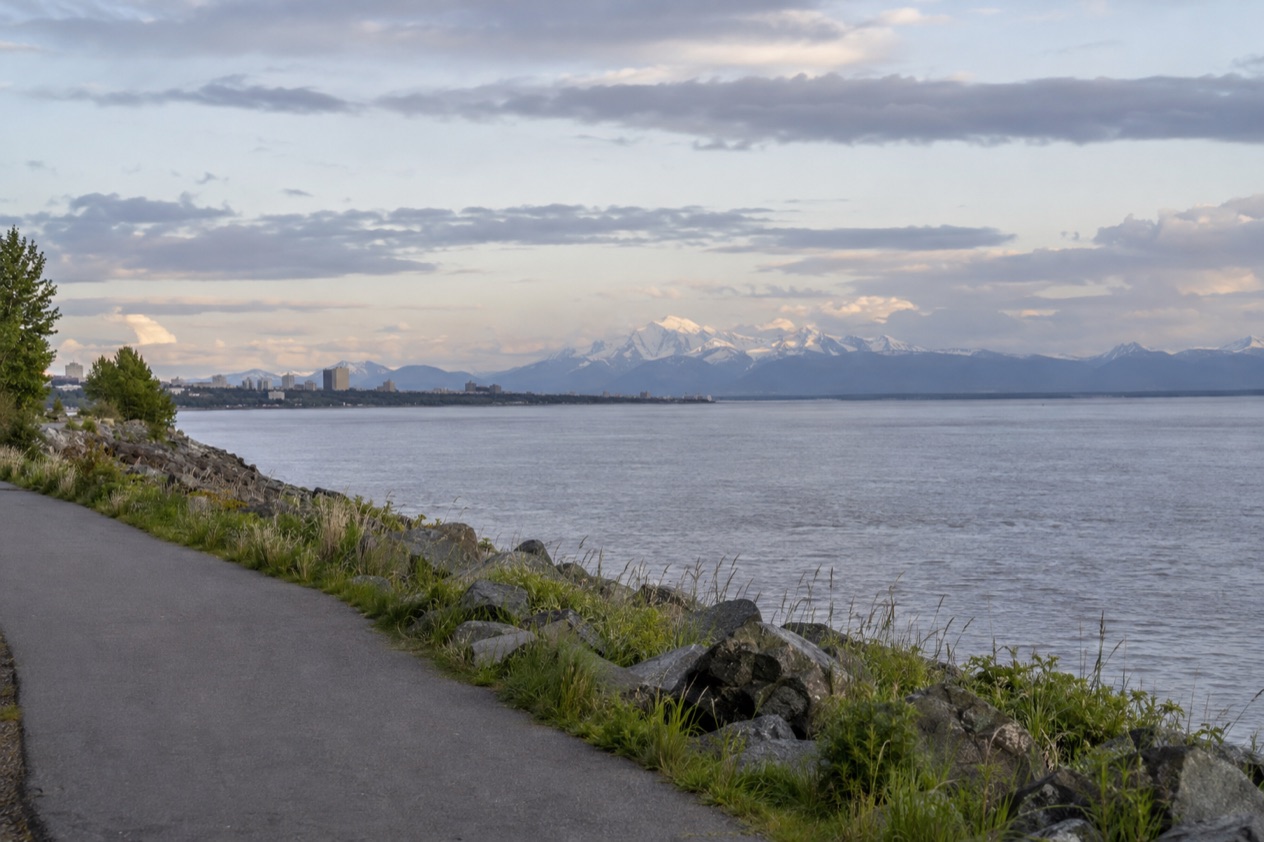
The first thing you notice on the Tony Knowles Coastal Trail is the water: the broad gray-silver expanse of Cook Inlet opening on one side, with spruce and birch crowding the other. Bicycles whir past, runners nod, and now and then a loon or a gull calls over the tide flats. This is Anchorage’s waterfront path, a long ribbon of shoreline that suits walkers, cyclists and anyone who wants the city’s edge of the wild without leaving town.
Is visiting the Tony Knowles Coastal Trail worth it?
Yes, if you want to see Anchorage from its shoreline rather than from a bus window, and it suits walkers, cyclists, photographers and curious families alike. The trail links downtown with the city’s western edge, so a single outing can take you from city streets to quiet woods and open inlet views.
What sets it apart from the mountain trails and the state park waterways that Anchorage is known for is how close it sits to everyday life.
You step onto the path and within minutes the city fades behind you, replaced by water, wind and birdsong. Anchorage lies at the head of Cook Inlet, and this trail is the place where you feel that geography most plainly.
It is also a place with a story. The land belongs to the traditional homelands of the Dena’ina Athabascan people, and the shoreline carries the memory of the great 1964 earthquake.
What to see at the Tony Knowles Coastal Trail
The trail is best taken as a string of different landscapes. Lagoon, woods, shoreline and park each have their own mood, and you can dip into one or follow several in a single outing.
Westchester Lagoon
Westchester Lagoon is one of the gentlest stretches, a sheltered pond rimmed with grasses where ducks, geese and other waterbirds gather. Families often stop here to watch the birds and let children run along the edge. The lagoon reflects the sky on still days, so it is a pleasant place to slow down and take photographs.
Look for nesting and feeding birds along the banks, and for the pale stretches of the inlet beyond. The lagoon pairs well with a snack from the neighborhood, then a walk further along the path. Wildlife here is a chance, not a promise, so go for the setting and treat any bird or moose sighting as a bonus.
Earthquake Park
Earthquake Park remembers the Good Friday earthquake of March 27, 1964, a magnitude 9.2 shock that killed 115 people in Anchorage and caused 116 million dollars in damage. Along this stretch the ground shows the scars of the disaster, now softened by trees and wild grasses. Interpretive signs describe what happened and how the land shifted.
The quiet here is striking. The hummocky, wooded terrain looks like ordinary forest until you read the panels and realize that the hills and hollows are the legacy of the ground giving way. It is a thoughtful pause on a day that otherwise may be about views and exercise, and it is a good moment to look out over the inlet.
Point Woronzof and the Cook Inlet shoreline
Where the trail meets the open inlet, the scene widens: tidal flats, distant mountains and big sky. On clear days you may glimpse far ranges across the water, and the light on the inlet changes by the hour. This is the place for photographs and long looks.
Admire the flats from the path, not from the mud. Tourists are warned not to walk on Anchorage’s mudflats because of the extreme tides and the fine glacial silt. The view is the reward, and it is generous enough from the trail itself.
Kincaid Park and the wooded end
The trail ends in the forested hills of Kincaid Park, where the mood turns from open shoreline to quiet woodland. Spruce and birch fill the air with a resinous scent, and side paths branch into the trees. The Anchorage area is home to both black bears and grizzlies as well as moose, so this is a stretch where you walk with your eyes open.
Even if you never see an animal, the shift in atmosphere is worth the trip. The coastal trail starts as a city amenity and finishes as a woodland escape, which is exactly what makes it such a satisfying line to follow.
Hours, tickets and rules
The trail is a path along the water, not a building with a front desk, so the rules that matter are about the ground you walk on and the animals you share it with. Think of it as an outdoor route you fit into your day rather than a ticketed attraction with a schedule.
The tide flats are the main thing to respect. Tourists are warned not to walk on Anchorage’s mudflats because of the extreme tides and the fine glacial silt, so keep to the path and enjoy the inlet from a distance. The silt looks firm, but it is the kind of ground that the warning exists for.
Wildlife is the second reminder. In the Anchorage Bowl the moose population is about 250 in summer and rises in winter, and moose are a hazard to drivers. Black bears and grizzlies also live in the Anchorage area. Treat the trail as shared territory, and let the animals have their space.
How to get to the Tony Knowles Coastal Trail
Visitors begin in Anchorage, in Southcentral Alaska, at the head of Cook Inlet. The trail runs through the city, so your base in or near downtown is your starting point.
If you arrive by air, Ted Stevens Anchorage International Airport is 5 miles southwest of downtown. In summer it has non-stop flights from many cities, including Seattle/Tacoma, Denver, Chicago O’Hare, Minneapolis and Los Angeles. From the airport, People Mover Route 40 serves both the North and South terminals and connects to the downtown Transit Center, which puts you in the city center.
If you come by train, the Alaska Railroad Depot is at 411 West 1st Ave in downtown Anchorage, and you can reach it by phone at +1 907 265-2494. The city began in 1915 as a tent settlement near Ship Creek when railroad construction began, so arriving by rail has its own sense of history. From downtown you can begin the trail and follow it along the shoreline.
When to visit the Tony Knowles Coastal Trail
The best time to visit Anchorage is between May and early September, and the trail follows the same rhythm. Summer brings long evenings, so you can walk after dinner and still have light. The sun sets just before midnight at the height of the season.
| Summer in Anchorage | Value |
|---|---|
| Average daytime high | 68°F |
| Average overnight low | 55°F |
| Maximum sunlight | 19½ hours |
Those figures mean comfortable layers by day and a real chill once the sun drops. A light jacket is useful, and the water-facing stretches can feel cooler than the streets behind them.
Time of day shapes the experience. Morning brings quiet paths and clear air, while evenings give long soft light over the inlet and the chance to watch the sky change. Anchorage also hosts festivals during the warm months, including the Summer Solstice celebrations and 4th of July events, which can add energy to the city around the trail.
Visitors in other months should adjust their plans and expectations, since the season described above is the one Anchorage’s visitor guidance points to. On bright starry nights in Anchorage the northern lights can sometimes be seen, a chance rather than a promise, and one more reason that evenings outdoors can be memorable.
Tips for your visit
Bring layers, since the inlet breeze can make the shoreline cooler than the city. Comfortable shoes suit the path, and a camera is useful for the water and mountain views. Because evenings stay light in summer, you can plan a late stroll without worrying about the dark.
Pair the trail with other parts of Anchorage. Downtown has museums, and Anchorage offers opportunities to learn about Indigenous cultures, including Dena’ina culture, which sits in the homeland of the Dena’ina Athabascan people.
Fishing for salmon at Ship Creek next to downtown is popular in the summer, and watching the anglers can round out a downtown visit. If you have more time, Anchorage offers hiking, wildlife viewing, glacier viewing and paddling in a vast state park, so the trail can be one chapter of a longer stay.
On the trail itself, keep your eyes open for moose and be mindful that bears live in the area. Stay on the path and keep away from the mudflats. For a family outing, the lagoon and the shoreline viewpoints give natural places to stop, snack and let everyone rest.
Good to know before you go
Anchorage is a city of 291,247 people at the 2020 census, so services, food and lodging are close at hand before or after your walk. The main safety habits are simple: stay off the mudflats, keep a respectful distance from wildlife and watch for moose near roads. Daylight is long in summer, which gives you plenty of time, but the evening chill arrives quickly, so keep a layer in your bag.
Sources
- Visit Anchorage, things to do (https://www.anchorage.net/things-to-do/), checked October 11, 2026
- Wikivoyage, Anchorage (https://en.wikivoyage.org/wiki/Anchorage), checked October 11, 2026
- Wikipedia, Anchorage, Alaska (https://en.wikipedia.org/wiki/Anchorage,_Alaska), checked October 11, 2026