
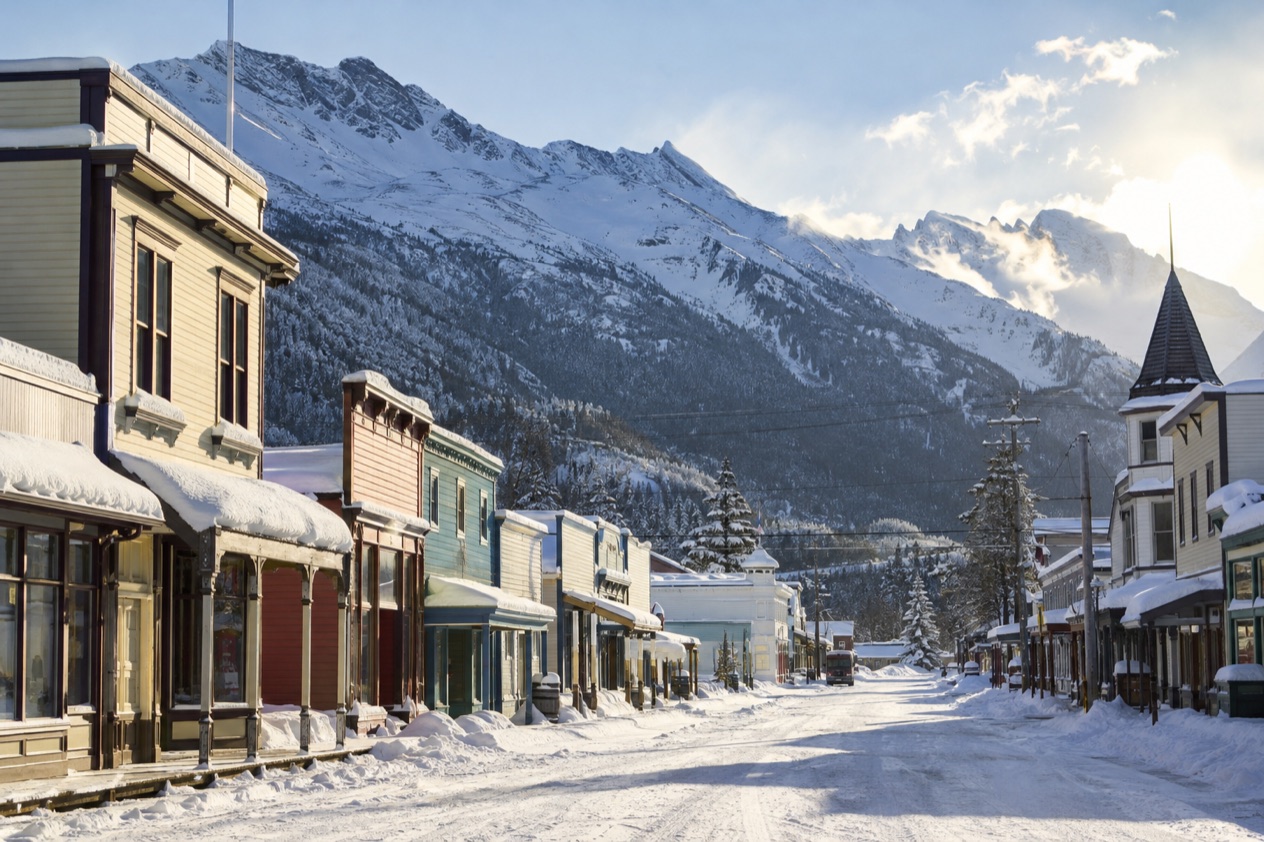
In March, boots knock on the plank boardwalks of Broadway with nobody else in earshot, and the false-front buildings stand against mountains that still wear their snow. Wind funnels down the street, the light lingers a little longer each evening, and the gold rush town has the feel of a place catching its breath between seasons. Skagway in March is for travelers who want its history and its mountain setting without the summer bustle.
What is the weather like in Skagway in March?
March in Skagway is cold but turning, with afternoons just above freezing, nights that still drop well into the twenties, and precipitation that comes as a mix of rain and melted snow.
| Month | Average high (°F) | Average low (°F) | Precipitation (in) | Days with precipitation | Daylight on the 15th |
|---|---|---|---|---|---|
| February | 34.7 | 25.1 | 1.47 | 3.7 | 9 h 11 min |
| March | 39.0 | 27.9 | 1.52 | 4.7 | 11 h 40 min |
| April | 49.3 | 35.2 | 1.24 | 3.8 | 14 h 25 min |
Mornings are the coldest part of the day, so the first walk down Broadway calls for a real winter coat, a hat and gloves. By afternoon the air softens and a sunny stretch can feel almost gentle, but the wind that moves through town can make a calm-looking day feel colder than the thermometer suggests. Evenings return quickly to frost, and the boardwalks and side streets can be slick where meltwater freezes again overnight.
Precipitation falls on fewer than five days in a typical March, so most days are dry, but when it comes it may be wet snow, cold rain or a mix of both. A waterproof shell and boots that keep out slush matter more than an umbrella. The daylight is the real gift of the month: the days are long enough to plan a full outing, with a bright start and light left over after dinner, and the mountains often show clearly when the clouds lift.
What to do in Skagway in March
The main thing to do in Skagway in March is to walk through the gold rush story at an unhurried pace. The town grew out of the Klondike stampede, and its center is still arranged around that history, with wooden storefronts, a long main street and the rail depot where so many prospectors arrived. With few other visitors around, you can stop at a window, read the old signs and look up at the peaks without stepping around a crowd.
This is not the month of festivals or wildlife spectacles for Skagway, and it is better to say so plainly. The pleasures are the quiet, the snow still sitting on the high ground, the lengthening evenings and the sense that the town belongs to the people who live there. A warm meal and a hot drink after a cold walk become part of the day’s rhythm.
The park visitor center and the gold rush story
Klondike Gold Rush National Historical Park is in Skagway itself, and the National Park Service suggests starting a visit at its visitor center. The center occupies the restored rail depot from 1898 at 2nd and Broadway, a building that already tells part of the story before you go inside. It is the natural first stop on a cold morning, a place to understand how the town and the trails beyond it fit together.
Inside, the theater shows the park film ‘Gold Fever: Race to the Klondike’, which runs 24 minutes and is a good way to get oriented before you walk the streets. Ranger chats are offered daily, with topics that vary, so ask at the desk what is on. The park also asks anyone visiting between October and May to read its winter visiting information first, which is worth doing before you arrive in March.
Broadway and the historic downtown
Broadway is the spine of the town, and in March it is a place to wander with no schedule. The boardwalks, old facades and small museums-in-buildings give a sense of the boom years, when the street was full of outfitters, saloons and hopeful travelers. Looking up the side streets, you see houses and mountain walls close behind them, a reminder of how small and enclosed the town is.
Walk it twice, once in the bright part of the day when the snow on the slopes catches the light, and once toward evening when the lamps come on and the street goes quiet. Snow and ice can make the planks slippery, so a slower pace suits the surface as well as the mood. Stop wherever something is open for a hot drink and a break from the wind.
The end of the road and the end of the ferry line
Skagway sits at an unusual geographic edge. It is the northern end of the Alaska Marine Highway System ferry network, and the only road out of town to the rest of the continent is Highway 98, which runs to Whitehorse in the Yukon by way of Carcross. Standing on the waterfront and looking at the mountains, you can feel how this small place became the gateway to the interior.
The White Pass and Yukon Route railroad, once part of the mining era, now runs purely for the tourist trade during the summer months. In March it is a landmark to know about rather than a ride to take, and its history is still part of what you read and hear in town. The depot area and the story of the line make a good thread to follow on a quiet afternoon walk.
Between the park, the boardwalks and the waterfront, the month rewards patience. Plan outdoor time for the middle of the day when the air is warmest, keep indoor stops for the coldest hours, and leave room for the evening light. There are no festival dates to organize your days around, and that is much of the appeal.
A two-day itinerary for Skagway in March
Day 1 starts with the history. Dress for a cold morning and walk to the park visitor center at the old rail depot, where the film and a ranger chat give you the outline of the Klondike story. Then go slowly along Broadway, reading the buildings and ducking into any place that is open to warm up. The reason for this order is simple: the center sets the scene, and the street then makes sense.
Take lunch at a café or a pub, whichever has its door open, then use the warmest part of the afternoon for the waterfront. This is the time to look at the mountains, the harbor and the end of the ferry line, and to think about the highway that leaves town for the Yukon. As the light fades, return to the center for a sit-down dinner and an early evening.
Day 2 is for the side streets and the edges of town. Begin with a late breakfast, then walk the residential blocks behind Broadway, where small houses sit beneath steep slopes and the town feels lived in rather than staged.
Take a camera and look for the contrast of old wood, snow and rock. If rain or wet snow comes in, return to the visitor center and see what ranger programs are offered that day, or stay inside with a long coffee and the history you picked up on Day 1.
Spend the afternoon in whatever is open, then make the most of the long evening light with a final walk down Broadway before dinner. The daylight is long enough in March that the second day does not need to be rushed, and ending early still leaves a bright hour or two to enjoy.
Is Skagway busy in March?
No, March is a quiet month in Skagway, a town of fewer than a thousand people whose population doubles in the summer tourist season to handle the visitors. March is not that season, and you feel it in the streets, which belong largely to residents.
Skagway is a popular stop for cruise ships, and the tourist trade is a big part of its business, but the White Pass and Yukon Route railroad runs for visitors during the summer months. In March the town is therefore at a different pace. You can stand in the middle of Broadway and hear the wind rather than a crowd, and the park visitor center is a place for unhurried questions to a ranger.
For a visitor, the quiet means the town is easy to read and easy to photograph. It also means that the offerings are narrower, which is part of the trade-off. Plan around the park, the streets and the landscape, and treat anything beyond that as a bonus.
What to pack for Skagway in March
Pack for cold mornings, a few damp days and a lot of walking on boardwalks that can be slick. Layers do most of the work, because the day moves from frost to a milder afternoon.
- A warm insulated coat, for the mornings that start in the twenties.
- A waterproof shell, because precipitation can arrive as rain or wet snow.
- Waterproof boots with good grip, for slush and icy planks.
- A hat and gloves, since the wind makes standing around cold.
- Warm base layers, for evenings that return to frost after a mild afternoon.
- A camera or phone you can use with gloves, for the mountains and the old facades.
Good to know before you go
The main thing to understand about March is that Skagway is a small town at the end of the road. It is the northern terminus of the Alaska Marine Highway System ferry network, and the only road to the rest of the continent is Highway 98, which leads to Whitehorse by way of Carcross. The White Pass and Yukon Route railroad operates in the summer months, so it is not a March plan.
The park suggests that anyone visiting between October and May read its winter visiting information, and the visitor center at 2nd and Broadway is the best first stop once you are in town.
Skagway in March vs February and April
Going four weeks earlier, to February, means a colder, darker version of the same town. The days are noticeably shorter, the nights deeper into the twenties and the afternoons stay near the cold end of the range. It suits travelers who want the deepest quiet and are comfortable bundled up, but the daylight leaves less room for wandering.
Going four weeks later, to April, brings a clear shift toward spring. Afternoons are well into the forties, evenings stay out of the deep freeze, and the light stretches far into the evening. Days with precipitation stay few, and the town starts to feel like it is waking up as the summer season approaches, though the busiest period of the year has not arrived.
If you want the winter feel with enough daylight to do things, March is the middle path. Choose February for the starkest cold and quiet, April for a gentler walking month, and March if you want snowy mountains, a quiet street and comfortable hours of light in the same trip.
Is March a good time to visit Skagway?
Yes, March is a good time for travelers who like quiet towns, history and cold, bright days, and it is not the right month for anyone who wants a full summer program of rides and tours.
You will enjoy it if you like reading buildings, talking with a ranger, walking a main street without a crowd and watching snowy peaks change color over the harbor. You should choose another month if you want the railroad, a busy waterfront or warm weather for long outdoor days. The cold, the wind and the slick boardwalks need a little patience.
On arrival, go first to the park visitor center in the old rail depot, watch the film and ask what the ranger chat is that day. Then walk Broadway with that story in your head. What is special about March in Skagway is that you meet the gold rush town in its plainest form, with wooden fronts, a cold wind off the water and the mountains standing close behind the last house.
Sources
- NOAA NCEI, U.S. Climate Normals 1991-2020, monthly (https://www.ncei.noaa.gov/access/services/data/v1?dataset=normals-monthly-1991-2020&stations=USW00025335), station Skagway Ap, elevation 20 feet, checked October 11, 2026
- Computed from the date and the latitude of the place (sunrise equation, solar elevation -0.833 degrees), October 11, 2026
- Wikipedia, Southeast Alaska (https://en.wikipedia.org/wiki/Southeast_Alaska), checked October 11, 2026
- Wikivoyage, Skagway (https://en.wikivoyage.org/wiki/Skagway), checked October 11, 2026
- Wikipedia, Skagway, Alaska (https://en.wikipedia.org/wiki/Skagway,_Alaska), checked October 11, 2026
- National Park Service, Klondike Gold Rush National Historical Park (Skagway), plan your visit (https://www.nps.gov/klgo/planyourvisit/index.htm), checked October 11, 2026
- Wikipedia, Climate of Alaska (https://en.wikipedia.org/wiki/Climate_of_Alaska), checked October 11, 2026
To plan your stay
- Things to Do in Skagway: Gold Rush History, the White Pass Railway and Dyea
- Where to Stay in Skagway: Broadway, the Port and Rail Depot, and the Highway 98 Side
- Skagway from Juneau: The Ferry Route, Highway 98 and a Day in Town
- Know Before You Go to Skagway: Ferry and Highway Access, Klondike Park, Weather and Bears