
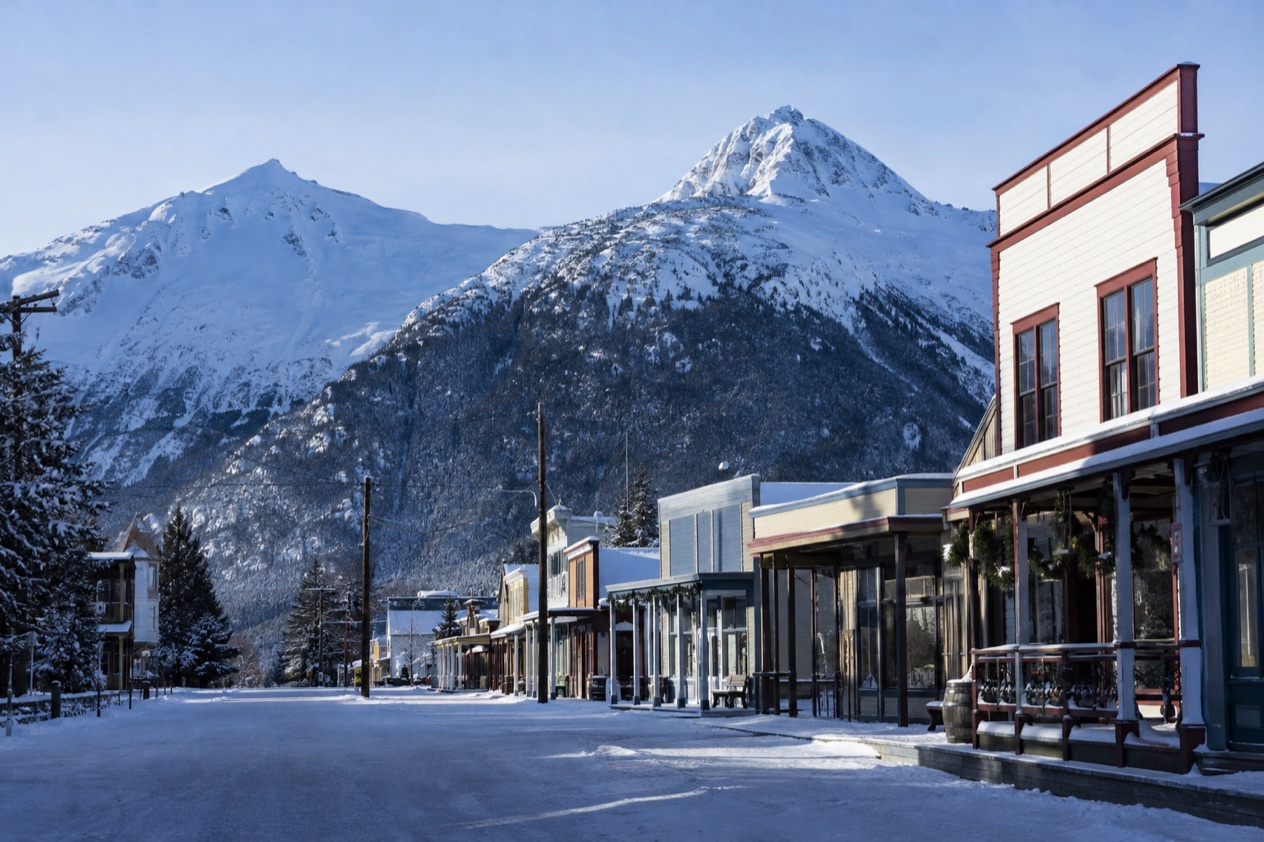
In January, the boardwalks of Skagway belong to the people who live here. Wooden storefronts from the gold rush stand quiet under short gray-blue days, and the mountains close in on both sides of the valley.
The summer crowds are long gone, and what remains is a small Southeastern Alaska town you can walk end to end, with its history lying close to the surface. January here suits travelers who like winter stillness and a slow look at the Klondike story.
What is the weather like in Skagway in January?
January in Skagway is cold but not extreme, with afternoons hovering just below freezing and nights in the low 20s, and precipitation that is modest compared with much of the Inside Passage.
| Month | Average high (°F) | Average low (°F) | Precipitation (in) | Days with precipitation | Daylight on the 15th |
|---|---|---|---|---|---|
| December | 33.8 | 25.7 | 2.78 | 6.8 | 6 h 07 min |
| January | 30.7 | 22.2 | 2.17 | 5.8 | 6 h 48 min |
| February | 34.7 | 25.1 | 1.47 | 3.7 | 9 h 11 min |
A typical day starts well under freezing and warms only slightly by the afternoon, so the hours around midday are the kindest for walking the streets. Precipitation, whether rain or melted snow, shows up on a minority of days, which leaves a fair number of dry spells for getting outdoors.
What this means in practice: dress in layers, with a warm insulated coat, a hat and gloves, and waterproof footwear for slush or wet boardwalks. Evenings feel colder once the light fades, so keep the warmest layer for after dark.
The light is short but already lengthening. Daylight lasts under seven hours in mid-January, so the day has a compact shape: a late sunrise, a low-slung afternoon and an early evening. Plan outdoor strolls for the middle of the day and save museums and meals for the dark hours.
What to do in Skagway in January
January is the month for the history of Skagway rather than its summer spectacle. The town grew out of the Klondike gold rush, and its Historic District, with gold rush boom town buildings, is part of Klondike Gold Rush National Historical Park. Walking the boardwalks in the cold, with few people around, gives you a sense of the place that the busy months rarely allow.
The park itself invites winter visitors. Its guidance for the period between October and May is to read up on visiting during the winter, so it is worth doing that before you arrive, since the cold season has its own rhythm in town.
The National Park Visitor Center and its film
Start at the visitor center, which sits in the restored 1898 rail depot at 2nd and Broadway. The park recommends beginning your visit here to learn about programs, tours and the film, and in the cold this old depot is a natural first stop. The building itself is part of the story, a reminder of the railroad era that shaped the town.
Inside, the theater shows Gold Fever: Race to the Klondike, a 24-minute film that sets the scene for everything else you will see on the streets. Ranger chats are offered daily on varying topics, so ask at the desk what is on. Seeing the film first makes the facades outside read differently, and it is a good way to spend a gray hour.
The Historic District and the park museums
The gold rush buildings along the main street are the heart of the town, and they are a pleasure to walk when nobody is hurrying past. Look at the old false fronts, the weathered timber and the narrow doorways, and picture the boom town that rose here almost overnight. The mountains standing close on either side give the street a hemmed-in, intimate feel in winter.
The National Park Service runs four museums in Skagway that cover Klondike Gold Rush history, which gives you indoor options when the wind picks up. Take it slowly, since the compact town is easy to cover and the pleasure is in lingering.
The railroad depot and the quiet harbor
The White Pass and Yukon Route narrow gauge railroad began as part of the area’s mining past and now operates purely for the tourist trade during the summer months. In January it is not a thing to ride, but the story is part of the town, and the depot area still tells it. Skagway is also the northern terminus of the Alaska Marine Highway ferry network, so the harbor has its own role in how the town connects to the world.
A walk toward the waterfront in the middle of the day, when the light is best, shows you how small and enclosed the town is. The cold air and the stillness make it a reflective stroll, with the mountains rising straight up from the water’s edge.
As for food and drink, expect the cozy kind of winter stop: a warm room, a hot drink and a meal after the early dark. The town is small, so choose a place that feels welcoming and let the evening run slowly.
A two-day itinerary for Skagway in January
Day 1 begins with a late breakfast, since the sun rises late and the cold is sharpest early. Mid-morning, head to the National Park Visitor Center in the old rail depot, watch the 24-minute film and ask about the daily ranger chat. This gives you the story before you see the streets.
Around midday, when the air is at its warmest, walk the Historic District and look closely at the gold rush buildings. Have lunch in a warm café or restaurant, then spend the early afternoon in one of the park museums. As the light drops, settle in for a long dinner, which suits the early dark.
Day 2 can start the same unhurried way, with a walk toward the harbor to see where the ferry network ends and the mountains meet the water. Dress warmly, because the waterfront feels colder than the sheltered streets, and keep the outing to the brightest part of the day.
Spend the afternoon in a second park museum or return to an exhibit you want to see more of. If the weather turns wet or snowy, that is your indoor plan, with the museums and a long warm lunch carrying the day. Finish with a quiet evening meal in town.
Is Skagway busy in January?
No, January is the quiet part of Skagway’s year, when the town sits far from its summer rhythm.
The population doubles in the summer tourist season to handle the large number of summer visitors, and cruise ships are a big part of the town’s business. In January that machine is idle, and the White Pass and Yukon Route operates only in the summer months. What remains is a town of fewer than a thousand people going about winter life. For the traveler, that means unhurried streets and a calm pace, with the park visitor center as the natural anchor for the day.
What to pack for Skagway in January
Pack for cold days near freezing, with a chance of wet snow or rain, and plan on spending real time outdoors in the middle of the day.
- An insulated winter coat, because afternoons stay just below freezing.
- Warm layers underneath, for nights in the low 20s.
- Waterproof boots with good grip, for wet or slushy boardwalks.
- A hat and gloves for the walks between museums.
- A waterproof shell for the days with rain or melted snow.
Good to know before you go
The main thing to know is that Skagway in January is a winter town. Daylight lasts under seven hours in mid-month, so plan your outdoor time around midday.
The railroad runs only in the summer months, and the park advises reading up on winter visits between October and May. Highway 98 is the only road from Skagway to the rest of the continent, leading to Whitehorse in the Yukon via Carcross, and the Alaska Marine Highway ferry network ends here.
Skagway in January vs December and February
Moving earlier to December means slightly milder afternoons but even less daylight, about six hours in mid-month, with more days of precipitation. It is the darkest stretch, so it suits those who love the deep winter mood.
Moving later to February brings noticeably more light, over nine hours in mid-month, and the driest of the three months, with fewer days of precipitation and slightly warmer afternoons. It is the easier month for walking outdoors. Choose December for the darkest, coziest atmosphere, February for more daylight and drier days, and January if you want a balance, with the light already returning but the town still deeply quiet.
Is January a good time to visit Skagway?
Yes, for travelers who want gold rush history, a nearly empty town and the calm of winter. It suits people who enjoy museums, slow walks and warm rooms, and who accept short days and cold air.
It is a poor fit for anyone hoping to ride the White Pass and Yukon Route, which operates in the summer months, or to see the town in its busy cruise-season mode. On arrival, go first to the visitor center in the old rail depot, watch the film and ask about the daily ranger chat. What is special about January here is the stillness: the old false fronts and the boardwalks, with the mountains close around you, and almost nobody else on the street.
Sources
- NOAA NCEI, U.S. Climate Normals 1991-2020, monthly (https://www.ncei.noaa.gov/access/services/data/v1?dataset=normals-monthly-1991-2020&stations=USW00025335), station Skagway Ap, elevation 20 feet, checked October 11, 2026
- Computed from the date and the latitude of the place (sunrise equation, solar elevation -0.833 degrees), October 11, 2026
- Wikivoyage, Skagway (https://en.wikivoyage.org/wiki/Skagway), checked October 11, 2026
- Wikipedia, Skagway, Alaska (https://en.wikipedia.org/wiki/Skagway,_Alaska), checked October 11, 2026
- National Park Service, Klondike Gold Rush National Historical Park (Skagway), plan your visit (https://www.nps.gov/klgo/planyourvisit/index.htm), checked October 11, 2026
- Wikipedia, Climate of Alaska (https://en.wikipedia.org/wiki/Climate_of_Alaska), checked October 11, 2026
To plan your stay
- Things to Do in Skagway: Gold Rush History, the White Pass Railway and Dyea
- Where to Stay in Skagway: Broadway, the Port and Rail Depot, and the Highway 98 Side
- Skagway from Juneau: The Ferry Route, Highway 98 and a Day in Town
- Know Before You Go to Skagway: Ferry and Highway Access, Klondike Park, Weather and Bears