
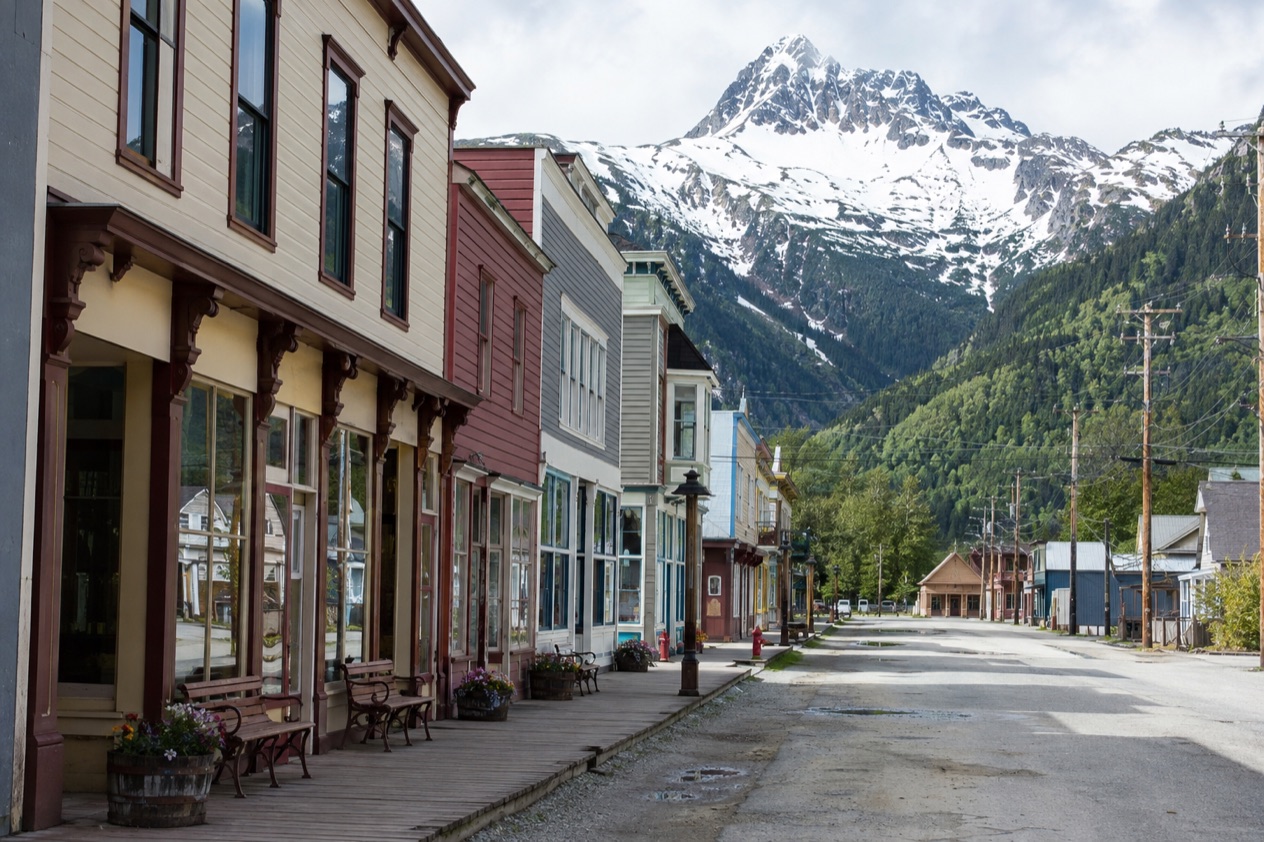
In Skagway, the whistle of a narrow-gauge train echoes off the mountain walls and the wooden storefronts of the old gold rush main street fill with people reading plaques and licking ice cream. Come back months later and the same street is hushed, with snow on the rooftops and a few cars idling outside the post office.
When is the best time to visit Skagway?
Travelers who want a quieter town and are happy with short days can look at the months on either side of that stretch.
For sightseeing, June and July bring the longest days and the driest stretch of the year. Mornings are cool and afternoons pleasant enough for a long wander through the Historic District, whose gold rush boom town buildings are part of Klondike Gold Rush National Historical Park. The White Pass and Yukon Route narrow gauge railroad now runs purely for the tourist trade in the summer months, so this is the time to ride it out of the port.
For hiking and the outdoors, the official Chilkoot Trail season, when rangers are on duty and a trail crew is on site, usually begins in late May and ends in early September. August brings a first hint of fall weather, with more days of rain, so pack for both.
For the quiet seasons, think of the shoulder months of May and September, or the true winter. The crowds that double the town’s population in summer are gone, and what remains is a small town of fewer than a thousand people going about its year. Families will find summer the easiest fit with school calendars and with the ranger chats, the park film and the train, all of which give children something to look at and do.
Skagway weather by month
Skagway has a cool, damp coastal climate, with mild summers and a cold winter, and the table gives the full picture for each month.
| Month | Average high (°F) | Average low (°F) | Precipitation (in) | Days with precipitation | Daylight on the 15th |
|---|---|---|---|---|---|
| January | 30.7 | 22.2 | 2.17 | 5.8 | 6 h 48 min |
| February | 34.7 | 25.1 | 1.47 | 3.7 | 9 h 11 min |
| March | 39.0 | 27.9 | 1.52 | 4.7 | 11 h 40 min |
| April | 49.3 | 35.2 | 1.24 | 3.8 | 14 h 25 min |
| May | 58.1 | 42.7 | 1.07 | 3.4 | 16 h 57 min |
| June | 62.9 | 49.3 | 1.16 | 3.4 | 18 h 36 min |
| July | 64.5 | 52.0 | 1.38 | 4.6 | 17 h 58 min |
| August | 63.4 | 51.0 | 2.35 | 7.2 | 15 h 40 min |
| September | 57.0 | 46.1 | 3.89 | 9.4 | 12 h 59 min |
| October | 48.1 | 38.9 | 3.60 | 9.3 | 10 h 20 min |
| November | 38.0 | 29.8 | 2.55 | 7.1 | 7 h 44 min |
| December | 33.8 | 25.7 | 2.78 | 6.8 | 6 h 07 min |
The year has two clear halves. A fleece and a light waterproof shell are usually enough, and the long light means a dinner can be followed by another walk down the street.
From late summer on, the rain returns in earnest. September and October are the wettest months, and rain falls on a good share of their days, so a proper rain jacket and shoes that handle wet boardwalks matter more than extra sweaters.
What is there to do in Skagway in each season?
Summer: trains, trails and the gold rush town
Summer is when everything is in motion. The White Pass and Yukon Route climbs out of the port on its way toward Carcross, and the railroad’s original line, from Skagway to Whitehorse, covered 107 miles before the section that is currently active was cut back. The sightseeing here is as much about the narrow gauge and the mountain scenery as about the history behind it.
In town, start at the National Park Service visitor center in the restored 1898 rail depot at 2nd and Broadway. The park film, Gold Fever: Race to the Klondike, runs 24 minutes, and ranger chats are offered daily on changing topics. Four park museums in Skagway cover the gold rush, and you can also simply explore the Historic District on your own without a guide, or pick from the commercial tours the town offers.
Hikers head for Dyea and the Chilkoot Trail, which runs from the ghost town to Bennett, British Columbia. The prospectors who crossed it hauled a year’s supply of food each, a requirement set by Canadian authorities, and standing at the start of the trail gives a feeling for the scale of that effort.
Fall and winter: a small town on its own
Fall brings rain, cooler air and a town that gradually exhales. September can still be a good month for museums, short days of wandering and a calmer main street, though showers are frequent. As October arrives, anyone planning a visit to the national historical park between October and May is pointed to the park’s own guidance on visiting in winter, so it is worth reading before you go.
Winter is for travelers who like emptiness, cold air and low light. The days are short, and the railroad that carries tourists in summer is not the reason to come. Highway 98, the only road out of Skagway, leads to Whitehorse via Carcross, and the Alaska Marine Highway ferry network ends here, which says something about how remote the town feels once the ships have gone.
Spring: the thaw and the first light
Spring arrives fast, with daylight racing ahead of the temperature. April is cool but already bright for much of the day, and by May the light is long and the air has turned mild. Spring suits those who prefer an unhurried town to a crowded one, with the history and the mountain scenery already in place and the main summer season about to start.
When is Skagway cheapest and least crowded?
Skagway is quietest outside the summer tourist season, when the population is back to its small year-round size instead of doubling. The peak weeks fall in the heart of summer, when cruise ships make the port a regular stop and the tourist trade is a big part of the town’s business. The main street can feel busy then, and tours and trains are in demand.
Step outside that stretch and the town changes. Late spring and early fall have a calmer feel, with room to linger in the museums and a main street where you can stop and read the plaques without being jostled. Rooms and tours are easier to arrange when fewer people are in town, and restaurants and shops have time to talk.
Winter is the quietest of all. The trade-off is that the summer rail excursions, the ranger-supported hiking season on the Chilkoot Trail and the long evenings are not part of the experience. You will have the town almost to yourself, and you will need to plan around short days, cold and the winter guidance the park offers.
Which months should you avoid in Skagway?
No month is bad in itself, but deep winter is the one to skip if you want the railroad, the Chilkoot Trail season and long days, and September and October are the ones to skip if you dislike rain.
The months of long daylight run from spring into summer, with the longest days in June. That is when the narrow-gauge railroad operates for tourists and when the trail has rangers and a trail crew on duty. Nothing in these months asks you to hurry, since the light lasts well into the evening and the weather is most settled.
From the end of summer through the fall, the weather turns damp and the days shorten steadily. Rain falls on many days, the mountains are often wrapped in cloud, and the hiking season ends in early September. It is a fine time for museums and a slower pace, but not for anyone counting on clear views.
In winter, from roughly November through February, the days are short and cold, and the summer tourist services are not what you come for. Sightseeing is limited to what you can do around the town, and the park asks winter visitors to look at its cold-season guidance first. Anyone drawn by the stillness will find it, and anyone wanting a full program of tours will be disappointed.
Festivals and events in Skagway through the year
Summer: Independence Day and the trail season
Summer is the season that shapes the town’s calendar. The Fourth of July is a fixed holiday, and in a town of fewer than a thousand year-round residents, a national day with the summer visitors in town feels like a community gathering, with flags on the old storefronts and people gathered along the main street.
Alongside the holiday, the season itself works like an event. The official Chilkoot Trail hiking season opens in late May and closes in early September, and the narrow gauge train runs through the summer months. These are less festivals than the rhythm of the year, but they give summer its sense of occasion, with hikers arriving at Dyea and the whistle of the train sounding through the valley.
Fall and winter: Christmas and a quieter calendar
When the summer visitors leave, the calendar in Skagway turns inward. Christmas on December 25 is the main marker of winter, and in a small town with short days, lights in the windows and a few gatherings matter more than any large event. New Year’s Day follows, and the long nights give the season a particular atmosphere.
Winter is also when the history feels closest. The gold rush story told in summer by rangers and museums sits just under the surface of the quiet town, and for those who come in the cold months, the park’s winter-visit guidance explains what they can do around the Historic District.
Spring: the return of the season
Spring has no single festival to mark it, but it has a clear moment: the point in late May when the Chilkoot Trail’s official season begins and the town starts to fill again. Shopkeepers open their doors, the trail crew arrives, and the rail yard wakes up for another summer.
For travelers, that makes spring a time of anticipation. The days are growing rapidly, the air is mild, and the history is already in place, with the visitor center, the museums and the old buildings there to be explored before the season is in full swing.
Sources
- NOAA NCEI, U.S. Climate Normals 1991-2020, monthly (https://www.ncei.noaa.gov/access/services/data/v1?dataset=normals-monthly-1991-2020&stations=USW00025335), station Skagway Ap, elevation 20 feet, checked October 11, 2026
- Computed from the date and the latitude of the place (sunrise equation, solar elevation -0.833 degrees), October 11, 2026
- Skagway Convention and Visitors Bureau (https://www.skagway.com/), checked October 11, 2026
- Skagway, things to do (https://www.skagway.com/things-to-do), checked October 11, 2026
- Wikivoyage, Skagway (https://en.wikivoyage.org/wiki/Skagway), checked October 11, 2026
- Wikipedia, Skagway, Alaska (https://en.wikipedia.org/wiki/Skagway,_Alaska), checked October 11, 2026
- National Park Service, Klondike Gold Rush National Historical Park (Skagway), plan your visit (https://www.nps.gov/klgo/planyourvisit/index.htm), checked October 11, 2026
- White Pass and Yukon Route Railway, Skagway (https://www.wpyr.com/), checked October 11, 2026
- Wikipedia, White Pass and Yukon Route (https://en.wikipedia.org/wiki/White_Pass_and_Yukon_Route), checked October 11, 2026
- Wikipedia, Chilkoot Trail (https://en.wikipedia.org/wiki/Chilkoot_Trail), checked October 11, 2026
- Wikipedia, Klondike Gold Rush (https://en.wikipedia.org/wiki/Klondike_Gold_Rush), checked October 11, 2026
- Wikipedia, Southeast Alaska (https://en.wikipedia.org/wiki/Southeast_Alaska), checked October 11, 2026
- Wikipedia, Climate of Alaska (https://en.wikipedia.org/wiki/Climate_of_Alaska), checked October 11, 2026
To plan your stay
- Things to Do in Skagway: Gold Rush History, the White Pass Railway and Dyea
- Where to Stay in Skagway: Broadway, the Port and Rail Depot, and the Highway 98 Side
- Skagway from Juneau: The Ferry Route, Highway 98 and a Day in Town
- Know Before You Go to Skagway: Ferry and Highway Access, Klondike Park, Weather and Bears