
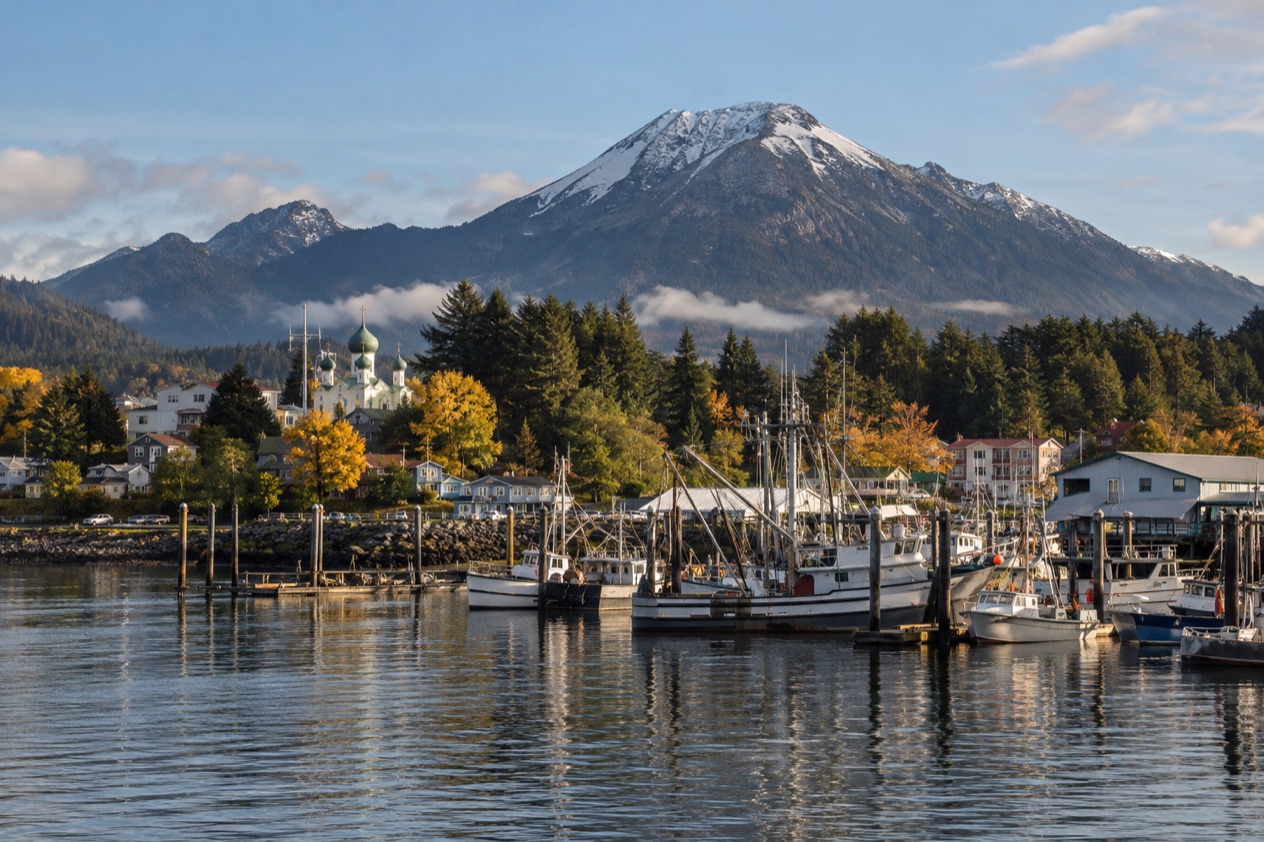
On a September morning in Sitka, fog lifts off the water of Sitka Sound while the onion dome of St. Michael’s rises above wet streets and fishing boats rumble out of the harbor beneath spruce-covered hills. The long light of high summer is slipping away and the rain is settling back in, which gives the town a lived-in, unhurried feel.
What is the weather like in Sitka in September?
September in Sitka is cool, damp and increasingly gray, with rain on most days and a noticeable step down from August.
| Month | Average high (°F) | Average low (°F) | Precipitation (in) | Days with precipitation | Daylight on the 15th |
|---|---|---|---|---|---|
| August | 61.8 | 52.9 | 7.25 | 13.3 | 15 h 19 min |
| September | 57.9 | 48.5 | 11.69 | 17.5 | 12 h 54 min |
| October | 50.8 | 41.9 | 11.78 | 19.1 | 10 h 30 min |
Afternoons are cool enough for a sweater under a rain shell, and mornings start a little chillier, so layers you can peel off and put back on suit the day better than one heavy coat. Rain tends to arrive as drizzle and steady gray spells rather than as a single downpour, with clearer breaks between them when the hills across the water come out of the cloud. Sitka sits in a temperate rainforest, and September is when that becomes obvious.
The light shifts at both ends of the day. Evenings close in earlier than they did in summer, so dinner is often eaten after dark and a walk along the harbor happens under streetlamps. When the clouds do part, the low autumn sun lights up the water and the wet roofs of downtown. Figures like these belong to the airport weather record, so a hillside trail can feel wetter and cooler than the town itself.
What to do in Sitka in September
September in Sitka is a month for indoor-outdoor sightseeing, where you alternate between museum rooms, covered porches and forest paths, and the weather decides the order. Few things on the calendar crowd the days. The week-long Alaska Day Festival, with its reenactment of the ceremony marking the signing of the Alaska purchase, is built around October 18, so September is the lead-up rather than the event.
The town rewards a slow pace. Fishing boats tie up in the harbors, gulls and eagles work the docks, and people in rain gear greet each other in the coffee shops.
Seafood is the natural thing to eat here: salmon, halibut and other local catch show up as chowder, fish and chips and smoked fish, which are good against a damp afternoon. Mount Edgecumbe, the dormant volcano across the sound, appears and disappears with the cloud.
Sitka National Historical Park and the Russian Bishop’s House
Sitka National Historical Park is a protected area on the edge of town, and a damp September day suits it. Spruce and hemlock close overhead, the ground is soft with needles, and the forest trails run past carved totem poles that look darker and richer in wet weather. The park also includes the Russian Bishop’s House, which the National Park Service has restored.
The Russian Bishop’s House stands at 501 Lincoln Street and is a historic house museum and National Historic Landmark, built in 1841 to 1843. Parts of it once served as a schoolhouse. Inside, you walk through rooms that show how clergy and students lived in Russian-era Sitka. It is an indoor stop for a rainy hour, followed by the trees when the rain eases.
Alaska Raptor Center
The Alaska Raptor Center is a sanctuary set in the Tongass National Forest at Sitka. It takes in injured birds each year, and you see the work of caring for them: eagles and other birds of prey up close, in aviaries among tall conifers. Seeing a bald eagle at close range gives a sense of scale that a bird on a distant snag never does.
Plan it for the part of the day when the sky is at its grayest, since much of the visit is under cover of the forest and the birds are as striking in drizzle as in sun. Binoculars are not needed here, but a waterproof jacket and shoes that handle wet gravel and boards are.
Downtown on foot
Downtown Sitka is compact and made for wandering. St. Michael’s Cathedral, the Russian Orthodox church with its green dome, anchors the main street, and the lanes around it hold small museums, bookshops, galleries and cafés. The Sheldon Jackson Museum holds Alaska Native collections, including the work of the Tlingit, the Indigenous people of this part of the coast.
Castle Hill, above the harbor, is where the Alaska flag-raising ceremony took place, and its viewpoint looks over rooftops and islands when the cloud lifts. In the evening the working harbors, Crescent and Eliason, are good for a walk among masts and nets, and a window seat at a seafood restaurant makes the rain part of the show.
When the rain stays heavy, switch to cover: museums, bookstores, a long lunch, a coffee shop with a view of the water. Sitka is built for this, and the town loses little when the weather turns.
A two-day itinerary for Sitka in September
Day 1 belongs to downtown and the park. Start with breakfast at a café on the main street, then walk to the Russian Bishop’s House on Lincoln Street while the morning is still cool and quiet. St.
Have a bowl of chowder or fish and chips for lunch, then spend the afternoon in Sitka National Historical Park among the totem poles and spruce, when the light under the trees is softest. Finish up on Castle Hill for the view and walk the harbors as evening falls, since the light fades earlier than in summer.
Dinner is local seafood. If the rain turns steady, trade the forest path for the museum rooms and take the park in shorter bursts.
Day 2 is for birds, collections and the water. Begin at the Alaska Raptor Center in the Tongass National Forest, where the aviaries are as good in mist as in sun. Come back to town for lunch at a small café or a harbor-side restaurant.
Spend the afternoon at the Sheldon Jackson Museum, whose Alaska Native collections make a good indoor choice if the sky has opened. If it has not, walk the waterfront with binoculars, since eagles, gulls and sea birds are common along the docks. For the evening, find a pub or restaurant with a window on the harbor and settle in for the long dark.
Is Sitka busy in September?
Sitka stays a working fishing town in September, and visitors are one part of its rhythm rather than all of it.
Norwegian’s Alaska cruises list Sitka among their ports of call, so ships can be part of the town’s life, and the streets near the water are where you notice them. Away from that stretch, the forest paths, the museum rooms and the harbors have the feel of a place getting back to its own pace as the days shorten.
Royal Caribbean’s 7-night Alaska Adventure from Seattle sails from June through August, so that itinerary falls outside this month. For September, the useful point is the shape of the day: fewer long summer evenings, more time at a window with a hot drink, and a town that feels settled.
What to pack for Sitka in September
Pack for rain first and cool air second, because most days mix the two and the forest and harbor are outdoors.
- A waterproof jacket with a hood, since drizzle is the usual form of rain.
- Rain pants for forest paths and a wet harbor.
- Warm layers such as a fleece or wool sweater for cool mornings and evenings.
- Waterproof shoes with good grip for wet boards and needle-covered trails.
- A hat and light gloves for the walk back after dark.
- Binoculars for eagles and sea birds along the water.
Good to know before you go
The main thing to plan around in September is the light: the day is a little under thirteen hours on the 15th, so you do the outdoor stops in the daytime and keep museums and dinner for the evening. Sitka is reached by air or by sea. The Alaska Marine Highway System offers a Sailing Calendar that lays out ferry schedules by month, port or vessel, and a Sailing Search tool where you enter a port and a date if the calendar does not give what you need.
With a rain-heavy month, keep a flexible plan, since one gray stretch can push an outdoor visit to the next day and a museum visit forward.
Sitka in September vs August and October
Moving the trip earlier to August buys more daylight and a drier, milder stretch, so forest and harbor walks are easier to fit around the weather. The change from August to September is the first real turn toward autumn, with cooler air, more rain and shorter days. If you want long evenings and the best odds of clear water views, August is the better choice.
Moving later to October brings the Alaska Day Festival, with its reenactment ceremony and interpretive programs built around October 18. The days are shorter, the rain falls on more days and the air is colder, so the trip becomes more about museums, cafés and the festival than about trails. October suits travelers who care about the town’s history more than the scenery.
September is the middle path. It suits those who want the forest and the harbors but accept rain gear as part of the outing, and those who prefer a town in a settled mood to one in high summer. If you want the festival, go in October. If you want the longest light, go in August.
Is September a good time to visit Sitka?
Yes, September is a good time for travelers who like history, forest and a damp, atmospheric town, and who are happy with rain gear and a full coffee cup.
It suits people who enjoy museums and small historic houses, who like to walk under big trees even in drizzle, and who want a town that feels more local than seasonal. It is less suited to anyone counting on dry weather for long outdoor days, or on long evenings of light after dinner. For that, another month fits better.
On arrival, start with the Russian Bishop’s House and the park, since these set the story of the town and work in almost any weather. Then let the forecast pick the rest of the days, with the Raptor Center and the downtown museums as the fallbacks. Sitka in September is a place where the rain is part of the scene, where the forest smells of wet spruce, and where a hot bowl of chowder at the end of the afternoon is the right reward.
Sources
- NOAA NCEI, U.S. Climate Normals 1991-2020, monthly (https://www.ncei.noaa.gov/access/services/data/v1?dataset=normals-monthly-1991-2020&stations=USW00025333), station Sitka Airport, elevation 14 feet, checked October 11, 2026
- Computed from the date and the latitude of the place (sunrise equation, solar elevation -0.833 degrees), October 11, 2026
- Princess Cruises, Alaska cruises (https://www.princess.com/en-us/cruise-destinations/alaska-cruises), checked October 11, 2026
- Holland America Line, Alaska cruises (https://www.hollandamerica.com/en/us/cruise-destinations/alaska-cruises), checked October 11, 2026
- Norwegian Cruise Line, Alaska cruises (https://www.ncl.com/cruise-destinations/alaska-cruises), checked October 11, 2026
- Royal Caribbean, Alaska cruises (https://www.royalcaribbean.com/cruise-destinations/alaska-cruises), checked October 11, 2026
- Alaska Department of Transportation, Alaska Marine Highway System, Schedules (https://dot.alaska.gov/amhs/schedules.shtml), checked October 11, 2026
- Alaska Raptor Center, Sitka (https://www.alaskaraptor.org/), checked October 11, 2026
- Wikipedia, Russian Bishop%27s House (https://en.wikipedia.org/wiki/Russian_Bishop%27s_House), checked October 11, 2026
- Wikipedia, Tlingit (https://en.wikipedia.org/wiki/Tlingit), checked October 11, 2026
- Wikipedia, Southeast Alaska (https://en.wikipedia.org/wiki/Southeast_Alaska), checked October 11, 2026
- Wikipedia, Sitka, Alaska (https://en.wikipedia.org/wiki/Sitka,_Alaska), checked October 11, 2026
- Wikipedia, Climate of Alaska (https://en.wikipedia.org/wiki/Climate_of_Alaska), checked October 11, 2026
To plan your stay
- Things to Do in Sitka: Russian History, Totem Parks, Wildlife and Fresh Seafood
- Where to Stay in Sitka: Downtown, the Historical Park Side and the Airport Island
- Sitka from Juneau: Ferry, Flights and What to Do on Arrival
- Day Trips from Sitka: Totem Park, the Russian Bishop's House, the Raptor Center and Sitka Sound