
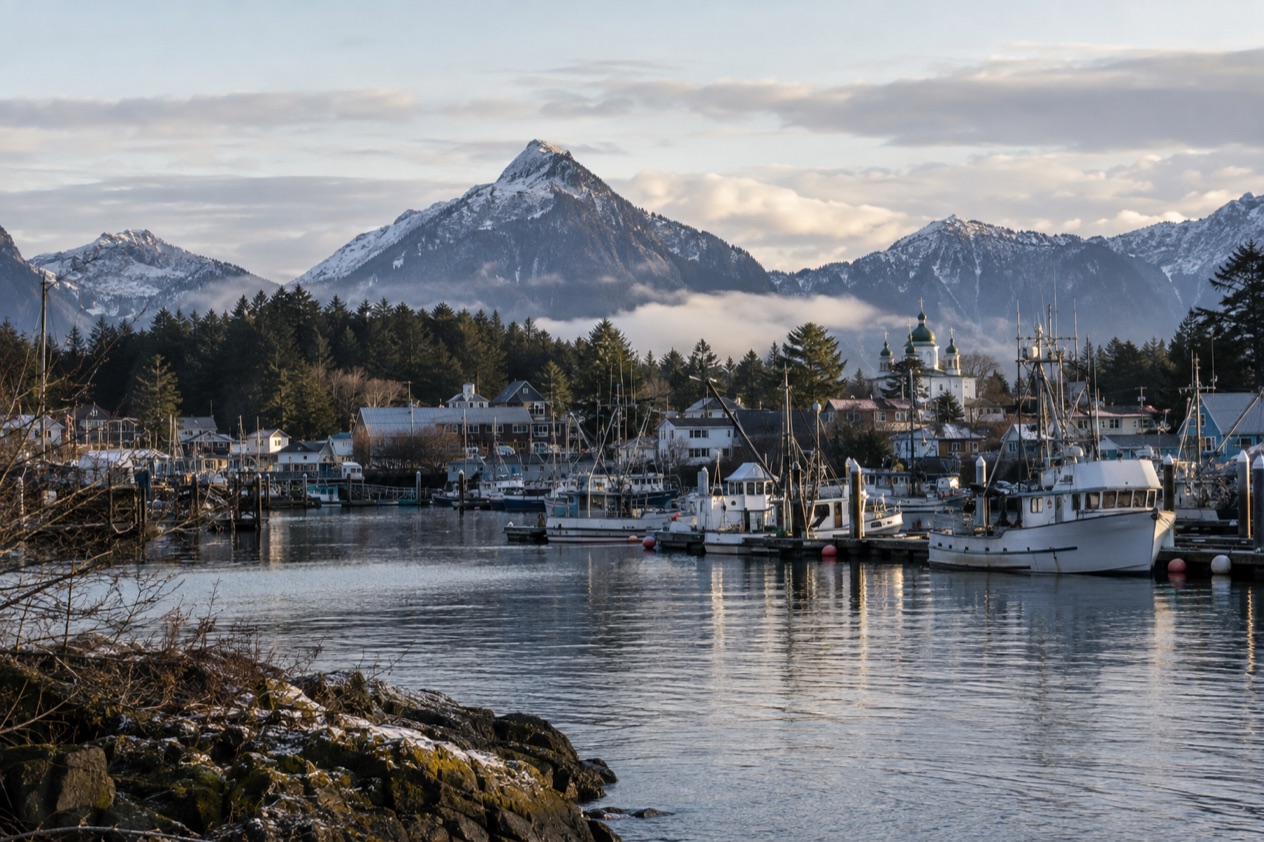
In October, Sitka smells of wet spruce and woodsmoke, and the light comes in low and silver across the water of the sound. Boots shine on the sidewalks, the harbor is quieter, and the old Russian and Tlingit story of the town feels close under the clouds. It is a month for people who like moody coastal weather, forest walks and museums, and who plan their days around the rain rather than against it.
What is the weather like in Sitka in October?
October in Sitka is cool, damp and gray more often than not, with rain falling on most days and the daylight shrinking fast.
| Month | Average high (°F) | Average low (°F) | Precipitation (in) | Days with precipitation | Daylight on the 15th |
|---|---|---|---|---|---|
| September | 57.9 | 48.5 | 11.69 | 17.5 | 12 h 54 min |
| October | 50.8 | 41.9 | 11.78 | 19.1 | 10 h 30 min |
| November | 44.3 | 35.8 | 9.91 | 17.0 | 8 h 09 min |
Afternoons reach the low 50s, which feels fine for walking if you are dressed for it, and mornings and evenings are chilly enough for a warm hat. Rain arrives as steady drizzle, passing showers and the occasional heavy soak, and on most days at least a little falls. A dry hour often turns up between showers, so the trick is to be flexible and to keep a rain shell within reach.
The light is the other thing to plan around. Days are noticeably shorter than a month earlier, so the forest trails and the waterfront are best done in the middle of the day, and evenings belong to restaurants, bars and museums.
When the clouds lift, the low sun gives the harbor, the mountains and the wet pavement a soft, glowing look. The water around Sitka is cold, so the sound is for looking at, not for swimming.
What to do in Sitka in October
October suits Sitka’s quieter, indoor-and-forest side. The town sits on Baranof Island, facing Sitka Sound, and its history is layered: Tlingit homeland, then the Russian colonial capital, then American Alaska. A rainy afternoon is a good time to follow all three threads, and a break in the clouds is a good time to be outside among the trees.
Sitka National Historical Park
The park is the heart of a visit and the place that most rewards a gray day. It sits at 106 Metlakatla Street, and its wooded pathways run for two miles. Along them stand many replica totem poles, and the park also holds totem poles obtained from Haida and Tlingit. Under tall spruce and hemlock the rain feels softer, the moss glows green, and the whole scene suits October’s mood.
The path follows Kaasdahéen, the Indian River, and the tidelands where sea stars and crabs can be found. During spawning season you can see salmon swimming up the river, so keep an eye on the water as you walk. The park preserves a landscape that drew Tlingit, Russians and Americans, and sometimes led to conflict between them, which gives the walk real weight.
The visitor center is the place to step in when the weather turns. Many of the artifacts displayed there are owned by Tlingit clans and are still used for ceremonial purposes, which makes them living objects rather than museum pieces. You can explore ceremonial and traditional objects from both Tlingit and Russian Orthodox cultures.
The Russian Bishop’s House
The Russian Bishop’s House is part of the national historical park and a natural stop for a drizzly day. Museum exhibits explain Russian activities in Alaska, and the furnished second floor shows how the household lived. It is a small, close look at the colonial era, quite different from the open-air totem park.
Pair it with a stroll through town afterward. The streets are quieter in October, and you can look at the harbor, the onion-domed Russian Orthodox church that gives downtown its skyline, and the shops without much of a crowd. A cup of something hot in a café is the natural way to dry out.
Sitka Sound and the waterfront
Sitka Sound is the body of water the town faces, bordered by Baranof Island and Kruzof Island and open to the Pacific. In the early 19th century it was a major center of the maritime fur trade, and standing on the shore it is easy to see why ships came here. In October the sound is often gray and moody, with islands fading into cloud.
Walk the waterfront near the harbor to watch working boats come and go and the light change over the water. Seafood is the food of the town, and a bowl of chowder or a plate of fish on a chilly evening fits the season. Wildlife is always a chance rather than a promise, so look, but do not count on it.
Arriving by air is simple to picture: the airport has a single terminal and a single runway on a causeway off Japonski Island, and Alaska Airlines serves it year-round. Coming in over the water on a clear October afternoon is itself a good first look at the town.
A two-day itinerary for Sitka in October
Day 1 is for the national historical park. Start mid-morning, once there is real daylight, and walk the wooded pathway past the totem poles with the river beside you. Take your time at the water, where salmon may be spawning, and look at the tidelands before heading into the visitor center to see the clan-owned objects out of the weather.
Have lunch in a simple café in town, then spend the afternoon in the Russian Bishop’s House with its exhibits and furnished upstairs rooms. With only about ten and a half hours of daylight, keep the outdoor part in the middle of the day. Evening is for a seafood dinner and a warm drink.
Day 2 belongs to the harbor and the sound. Walk the waterfront in the morning light, watch the boats, and look out across Sitka Sound toward the islands. Then wander downtown, stopping at the shops and the Russian Orthodox church that marks the center of town.
If the rain settles in, stay indoors longer: browse the shops, linger over a long lunch, and return to the visitor center for anything you missed. If a dry window opens, take it for one more look at the water before the early dusk. Finish with a quiet dinner at a local restaurant.
Is Sitka busy in October?
Sitka is quieter in October, and the pace is that of a small coastal town settling into the dark, wet months. The wooded park paths and the waterfront feel unhurried, and you can spend time at an exhibit without being jostled.
Air service continues all year with Alaska Airlines, so the town stays reachable. The main change is atmosphere: fewer people on the trails, more locals in the cafés, and evenings that turn indoors early. It is a good month for travelers who prefer a place to feel lived-in rather than staged.
What to pack for Sitka in October
Pack for steady damp and cool air, with layers you can add or shed as clouds come and go.
- A waterproof jacket with a hood, because rain falls on most days.
- Waterproof boots, for wet forest paths and the riverside.
- Warm layers such as fleece or wool, for chilly mornings and evenings.
- A warm hat and light gloves, for the low temperatures after dark.
- Rain pants, for longer walks under dripping trees.
- A small daypack cover, to keep a camera and phone dry.
Good to know before you go
October days are short, so plan outdoor time around the middle of the day and keep evenings for dining and museums. Alaska Airlines flies to Sitka all year, and the airport sits on a causeway off Japonski Island. Wet weather is the norm, so build a few indoor options into each day, such as the visitor center and the Russian Bishop’s House.
Sitka in October vs September and November
Going a month earlier gives you a warmer, brighter Sitka. September has about two and a half more hours of daylight than October, and afternoons that feel noticeably milder. It suits travelers who want longer outdoor days and a bit more margin on the trails.
Going a month later means colder air, much shorter days and a stronger sense of winter closing in. November is a little less wet overall, but the light is thin and the mornings are cold. It suits those who want the quietest, most atmospheric version of the town and do not mind dark afternoons.
October sits between the two: still comfortable for forest walks in a good jacket, with enough daylight for a full day if you start sensibly. Choose September for light and warmth, November for solitude, and October for a balance of both.
Is October a good time to visit Sitka?
Yes, if you enjoy a rainy coastal town, forest walks and history, October is a rewarding time in Sitka. It suits travelers who bring good rain gear and a flexible plan, and who like places with a quieter feel.
It is less right for anyone who wants long, bright days or a dry stretch of outdoor adventures. On arrival, head to Sitka National Historical Park first, so you meet the totem poles, the river and the rain forest while the light is best. What is special about October here is the mood: moss and spruce dripping in the gray light, a salmon stream that may still be moving, and a town that turns to its stories and its hot drinks as the dark arrives early.
Sources
- NOAA NCEI, U.S. Climate Normals 1991-2020, monthly (https://www.ncei.noaa.gov/access/services/data/v1?dataset=normals-monthly-1991-2020&stations=USW00025333), station Sitka Airport, elevation 14 feet, checked October 11, 2026
- Computed from the date and the latitude of the place (sunrise equation, solar elevation -0.833 degrees), October 11, 2026
- Wikipedia, Sitka National Historical Park (https://en.wikipedia.org/wiki/Sitka_National_Historical_Park), checked October 11, 2026
- Wikipedia, Sitka Rocky Gutierrez Airport (https://en.wikipedia.org/wiki/Sitka_Rocky_Gutierrez_Airport), checked October 11, 2026
- Wikipedia, Sitka Sound (https://en.wikipedia.org/wiki/Sitka_Sound), checked October 11, 2026
- National Park Service, Sitka National Historical Park, plan your visit (https://www.nps.gov/sitk/planyourvisit/index.htm), checked October 11, 2026
- Wikipedia, Climate of Alaska (https://en.wikipedia.org/wiki/Climate_of_Alaska), checked October 11, 2026
To plan your stay
- Things to Do in Sitka: Russian History, Totem Parks, Wildlife and Fresh Seafood
- Where to Stay in Sitka: Downtown, the Historical Park Side and the Airport Island
- Sitka from Juneau: Ferry, Flights and What to Do on Arrival
- Day Trips from Sitka: Totem Park, the Russian Bishop's House, the Raptor Center and Sitka Sound