
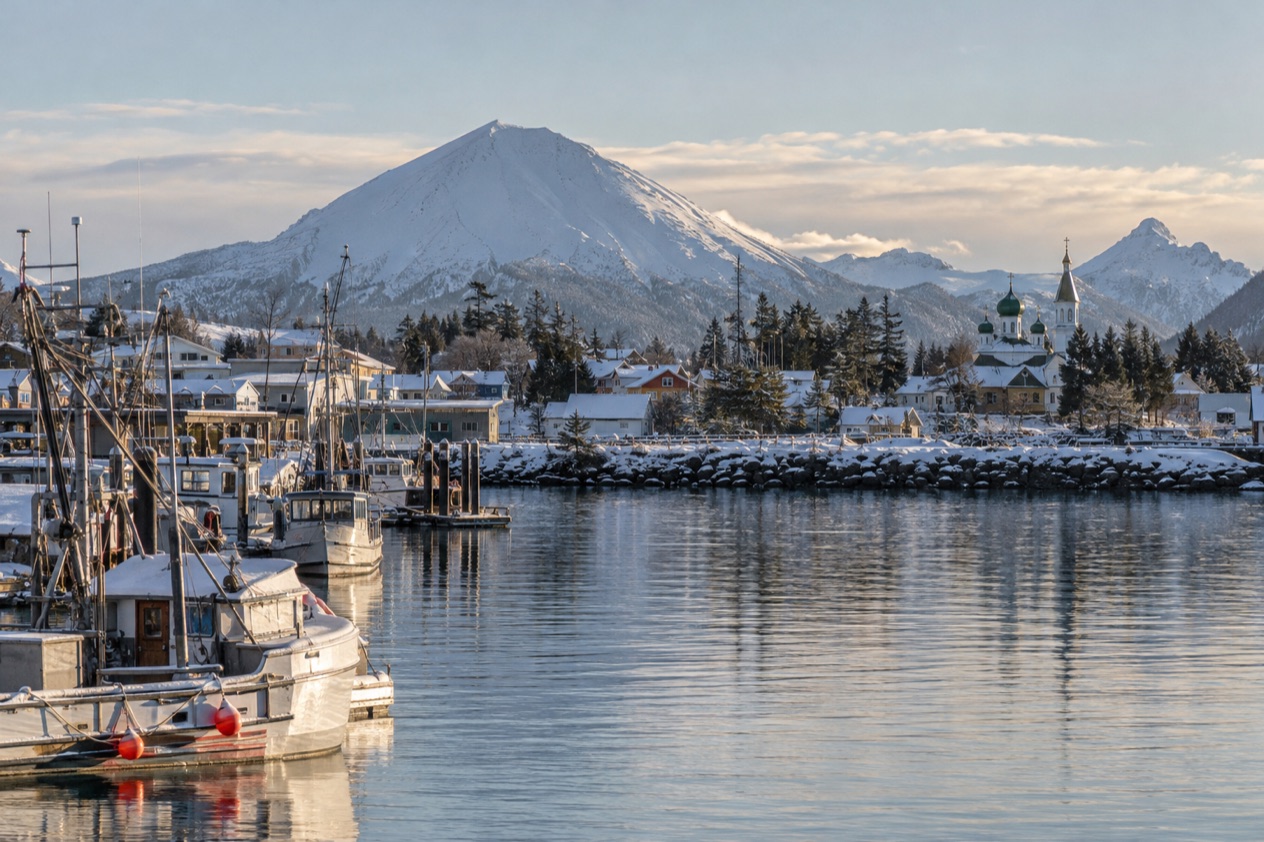
In February, Sitka wakes to wet roofs and low clouds that sit on the mountains behind the harbor. Totem poles stand dark and glistening in the rain forest, and the smell of spruce and salt hangs over the waterfront. The town is quiet, the pace is slow, and the month suits travelers who like museums, forest walks and a hot drink after a damp afternoon.
What is the weather like in Sitka in February?
February in Sitka is cool, damp and gray more often than not, with temperatures that hover just above freezing at night and a little higher by day.
| Month | Average high (°F) | Average low (°F) | Precipitation (in) | Days with precipitation | Daylight on the 15th |
|---|---|---|---|---|---|
| January | 40.5 | 32.4 | 8.22 | 15.4 | 7 h 21 min |
| February | 41.2 | 32.1 | 5.93 | 11.6 | 9 h 27 min |
| March | 42.5 | 32.5 | 5.60 | 12.6 | 11 h 42 min |
Sitka has a humid maritime climate with a small temperature range between seasons, so winter here is more about water than cold. Mornings start near freezing, which can leave a slick film on boardwalks and steps, and afternoons climb only a few degrees. Rain arrives as steady drizzle or passing showers, and some of the precipitation can fall as wet snow.
Layers and rain gear matter more than a heavy parka. A waterproof shell over a fleece or wool sweater handles most days, and shoes with grip are worth having on wet pavement and forest paths. The light is returning fast: by the middle of the month the days are noticeably longer than in January, so there is time for a walk after breakfast and another before dusk.
Evenings are cold and damp, the kind that make a warm café, a pub or a lamplit room feel earned.
What to do in Sitka in February
February is a month for the indoor and forest-edge sights of Sitka, the places that look better wet. The town grew from Tlingit land, then Russian America, and both layers show up within a few blocks of each other. With few crowds, you can take your time in each place and talk with the people who work there.
Walk the waterfront first to get your bearings. Fishing boats rock in the harbor, gulls and eagles work the docks, and the mountains rise straight behind the roofs. On a gray day the scene has a moody, northern feel that photographs well.
Sitka National Historical Park
The park is where Sitka’s story is easiest to read. It protects a temperate rain forest of towering spruce and hemlock, with tidelands where sea stars and crabs show at low water, and Kaasdahéen (Indian River) running through. The forest is most atmospheric when mist hangs between the trunks, which suits February well.
The visitor center is the place to go inside when the rain sets in. Many of the artifacts on display are owned by Tlingit clans and are still used for ceremonial purposes, which makes them living objects rather than museum pieces. Take time with them and with the Tlingit history the center tells.
Pair a forest walk with the visitor center so that wet weather never wrecks the plan. Wear waterproof shoes, since the paths stay damp, and keep your camera in a pocket for the totem poles.
Russian Bishop’s House
At 501 Lincoln Street, the Russian Bishop’s House is a historic house museum and a National Historic Landmark, built in 1841 to 1843. It is part of Sitka National Historical Park, and it shows Russian activities in Alaska through museum exhibits and a furnished second floor.
Rooms with period furnishings are a good use of a cold, wet hour, and they give context to the onion-domed church that anchors the town center. This is a stop for travelers who like to see how people actually lived, not only read about it.
Alaska Raptor Center
The Alaska Raptor Center is a sanctuary in the Tongass National Forest in Sitka, and it admits birds every year. It is a good winter outing because the focus is on the birds, and the forest setting is lovely in mist.
Go for the chance to see eagles, owls and other raptors up close, and to learn why they end up in care. Dress for forest dampness even if part of the visit is indoors.
When the rain pauses, linger outside. Boots, a hat and a warm layer will keep you comfortable on the gray days that define the month. Coffee and a bowl of chowder in town afterward make a fitting end to the afternoon.
A two-day itinerary for Sitka in February
Day 1 starts at the waterfront in the soft morning light, which comes later in February than in spring, so there is no need to rush out. Have breakfast at a harbor-side café, then walk the town center to the Russian Bishop’s House and its furnished rooms. Take lunch at a casual spot serving local seafood, then head to Sitka National Historical Park for the visitor center and the Tlingit artifacts.
In the afternoon, take the forest paths along Kaasdahéen (Indian River) while there is still light, since days are short. Return to town for a quiet dinner and a warm drink. If the rain turns heavy, linger longer at the visitor center and skip the long walk.
Day 2 belongs to the Alaska Raptor Center in the Tongass National Forest. Go in the morning, when the day is freshest, and spend unhurried time with the birds. Wear a waterproof shell and sturdy shoes.
Return to town for lunch, then spend the afternoon on a slow waterfront wander, browsing shops and watching boats in the harbor. Choose a bookshop or a coffee house as your rain card, and finish with a relaxed dinner at a seafood restaurant or pub.
Is Sitka busy in February?
No, February is a quiet month in Sitka, with the town running at a winter pace and the sights largely to yourself. Without crowds, conversations at the visitor center, the museum and the cafés tend to be longer and more relaxed.
What it means in practice is a calm waterfront, open sidewalks and a town that belongs mostly to residents. Visitors who come now are usually here for history, forest and quiet rather than a packed schedule.
What to pack for Sitka in February
Sitka’s weather guidance is to bring rain gear and layered clothing at any time of year, and February puts that advice to work.
- A waterproof jacket with a hood, for steady drizzle on the waterfront and in the forest.
- Waterproof shoes with good tread, for wet boardwalks and muddy paths.
- A fleece or wool midlayer, since days stay cool and damp.
- A warm hat and gloves, for near-freezing mornings.
- Rain pants, if you plan long forest walks.
- A small daypack cover, to keep a camera dry.
Good to know before you go
February days are short, with about nine and a half hours of daylight in the middle of the month, so plan outdoor stops for the middle of the day and keep evenings for dinner and indoor time. Forecasts for Sitka National Historical Park are available from the National Weather Service, and they are worth a look each morning because the weather changes quickly. Keep one indoor stop in reserve for each day.
Sitka in February vs January and March
Going a month earlier means shorter days and more rain. January brings the most wet days of the three months and only about seven hours of daylight, so there is less time outdoors and more reason to stay in museums and cafés.
Going a month later brings longer days and a little more warmth. March has more than eleven hours of light and slightly milder afternoons, which makes forest walks and waterfront strolls easier to fit in. Rain is still common, so the gear list stays the same.
Travelers who want the longest evenings and the most outdoor time should lean toward March. Those who like the quietest town and a moody winter atmosphere will be happy with February, and January suits people who mostly want to stay inside.
Is February a good time to visit Sitka?
Yes, February is a good time for travelers who like quiet, history and wet forest, and less so for anyone who needs sunshine or long outdoor days.
It suits people drawn to Tlingit heritage, Russian-era history and the stillness of a small coastal town. If you want big views every day or lots of daylight, another month will serve you better.
On arrival, start at Sitka National Historical Park, where the visitor center and the forest give you the story of the place in a single outing. February in Sitka is the town at home, with Tlingit-owned artifacts, a furnished bishop’s house and rain on the spruce.
Sources
- NOAA NCEI, U.S. Climate Normals 1991-2020, monthly (https://www.ncei.noaa.gov/access/services/data/v1?dataset=normals-monthly-1991-2020&stations=USW00025333), station Sitka Airport, elevation 14 feet, checked October 11, 2026
- Computed from the date and the latitude of the place (sunrise equation, solar elevation -0.833 degrees), October 11, 2026
- National Park Service, Sitka National Historical Park, plan your visit: things2do (https://www.nps.gov/sitk/planyourvisit/things2do.htm), checked October 11, 2026
- National Park Service, Sitka National Historical Park, plan your visit: weather (https://www.nps.gov/sitk/planyourvisit/weather.htm), checked October 11, 2026
- Alaska Raptor Center, Sitka (https://www.alaskaraptor.org/), checked October 11, 2026
- Wikipedia, Russian Bishop%27s House (https://en.wikipedia.org/wiki/Russian_Bishop%27s_House), checked October 11, 2026
- Wikipedia, Tlingit (https://en.wikipedia.org/wiki/Tlingit), checked October 11, 2026
- Wikipedia, Climate of Alaska (https://en.wikipedia.org/wiki/Climate_of_Alaska), checked October 11, 2026
To plan your stay
- Things to Do in Sitka: Russian History, Totem Parks, Wildlife and Fresh Seafood
- Where to Stay in Sitka: Downtown, the Historical Park Side and the Airport Island
- Sitka from Juneau: Ferry, Flights and What to Do on Arrival
- Day Trips from Sitka: Totem Park, the Russian Bishop's House, the Raptor Center and Sitka Sound