
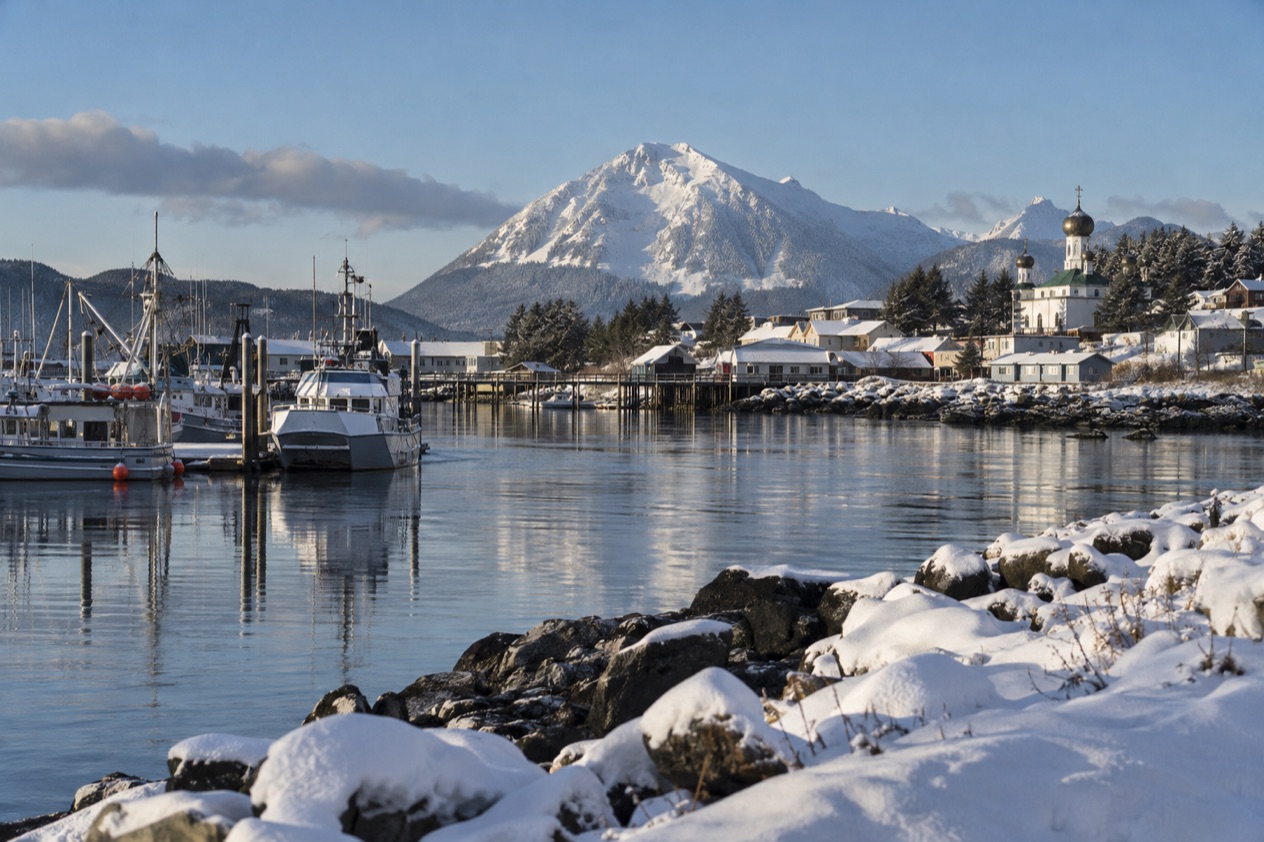
In December, rain drips from the spruce along the paths of Sitka, the totem poles stand dark and glistening among the trees, and the lights of the harbor come on early in the afternoon. The town sits on Baranof Island beside Sitka Sound, and in this month it turns inward, to warm cafés, long dusks and the history that fills its streets. It is a season for travelers who like moody weather, quiet walks and a place with Tlingit and Russian roots.
What is the weather like in Sitka in December?
December in Sitka is cold, damp and dark, though the ocean keeps the air from the deep freeze you might expect this far north: days hover just above freezing and nights drop to around it.
| Month | Average high (°F) | Average low (°F) | Precipitation (in) | Days with precipitation | Daylight on the 15th |
|---|---|---|---|---|---|
| November | 44.3 | 35.8 | 9.91 | 17.0 | 8 h 09 min |
| December | 41.5 | 33.4 | 8.43 | 16.1 | 6 h 46 min |
| January | 40.5 | 32.4 | 8.22 | 15.4 | 7 h 21 min |
Rain, and now and then wet snow, falls on most days of the month, so the weather is something you plan around rather than wait out. Sitka has an oceanic climate with abundant precipitation, and the town sees snow in winter, about 33 inches over a whole season.
Mornings start late and cold, with the light arriving slowly. Daylight is short, so the middle of the day is the time to be outside, and afternoons fade quickly into evening. Plan walks for the bright hours and save the rest for a café table, a museum bench or a long dinner.
Layers matter more than any single heavy coat. A waterproof shell, a warm mid-layer and shoes that stay dry on wet ground will carry you through a day outdoors, and a hat and gloves earn their place at night when the air sits near freezing.
What to do in Sitka in December
The best of Sitka in December is its history, told on foot among trees and in old buildings. This is a town where Tlingit, Russian and American stories overlap in a small space, and the wet, quiet season suits a slow look at all three. Cold rain makes the forest smell of cedar and spruce, and the totem poles seem to belong to the weather.
Sitka is not a month-by-month festival town in winter, so the pleasures are quieter ones: warming up with something hot after a walk, browsing the town’s shops and galleries, reading the plaques on the old streets and watching the harbor go blue and then black at dusk. Come ready to be outdoors in short bursts and indoors in long, comfortable ones.
Sitka National Historical Park
Sitka National Historical Park is the anchor of any visit, located at 106 Metlakatla Street on Baranof Island. It preserves a landscape that drew Tlingit, Russians and Americans, and sometimes led to conflict between them. That layered story is told in the trees and along the shoreline as much as in any exhibit.
Many replica totem poles stand along two miles of wooded pathways, and visitors can wander among poles obtained from Haida and Tlingit carvers. In December’s gray light, with wet bark and moss around you, the carved figures read with striking clarity. Wear waterproof shoes, since a path under dripping branches stays damp for days.
The park also lets you explore ceremonial and traditional objects from Tlingit and Russian Orthodox cultures. This is the place to spend your best daylight hours, and it pairs well with an afternoon of slower, indoor exploring afterward.
The Russian Bishop’s House
The Russian Bishop’s House is part of the national historical park, restored by the National Park Service, and parts of it once served as a schoolhouse. It is a window on the Russian era in Sitka, when the town was a hub of the maritime fur trade and an outpost of the Russian Orthodox Church.
Looking at the building from outside, with the wet street and winter sky behind it, is a good way to picture how far from anywhere this place once felt. It suits travelers who like architecture and stories of daily life, the sort of stop that makes more sense after the forest walk than before it.
Sitka Sound and the harbor
Sitka Sound is the body of water at the town’s doorstep, bordered by Baranof Island and Kruzof Island and open to the Pacific Ocean. In the early 19th century it was a major locus of the maritime fur trade, which is why so many of the town’s stories begin at the water.
In December the water is a place to look at rather than enter. Stand on the waterfront at dusk, when low clouds hang over the islands and the harbor lights reflect on dark water, and the history of the sound is easy to feel. The cold air makes a short waterfront stroll bracing, and a warm place to go afterward makes it pleasant.
Outside the park and the waterfront, the town’s own streets reward a slow wander between rain showers: small shops, galleries, bookstores and the café windows fogged with steam. The pace is unhurried, and that is the point of coming this month.
A two-day itinerary for Sitka in December
Day 1 belongs to the forest and the totem poles, because daylight is short and the park paths want the brightest hours. Start the morning with a hot breakfast at a café in town while the sky lightens, then head to Sitka National Historical Park once there is real light under the trees. Walk the wooded pathways among the totem poles and follow the Indian River as far as feels comfortable.
Midday is for lunch at a casual spot in town, something warm like a bowl of soup or a seafood plate, and a chance to dry out. Evening belongs to a sit-down dinner in a restaurant near the harbor.
Day 2 turns to the town and the water. Begin at the Russian Bishop’s House, where the Russian chapter of Sitka’s story comes to life, then walk the old streets and look into shops and galleries.
In the afternoon, walk to the waterfront on Sitka Sound and watch the light fade over the islands. Daylight lasts only a bit more than six and a half hours around mid-month, so keep dinner unhurried, and finish with a warm drink somewhere with a window onto the dark harbor.
Is Sitka busy in December?
December is a slow, quiet-paced month for Sitka in terms of how the days feel, with the short daylight setting the rhythm: people move through the town in the middle hours and settle in early. The airport has air service operated year-round by Alaska Airlines, so the town stays connected throughout the winter.
Beyond that, the season means a town that lives at a local pace, with shorter days and the focus on indoor places in the evening. Treat the daylight as your schedule and plan the outdoor parts of each day around it.
What to pack for Sitka in December
Sitka’s December means wet, near-freezing air and long dark evenings, so pack for steady drizzle and for standing around outdoors in the cold.
- A waterproof jacket and pants, because rain or wet snow falls on most days.
- Warm layers such as fleece or wool, for days that stay near freezing.
- Waterproof shoes with good grip, for damp forest paths and wet streets.
- A hat and gloves, for evenings by the harbor.
- A small day pack with a dry bag, to keep a camera and phone safe from the drizzle.
- A headlamp or small flashlight, for walking back after dark.
Good to know before you go
Sitka sits on Baranof Island, and the airport, with a single terminal and a single runway on a causeway off Japonski Island, has year-round service by Alaska Airlines. In December the main thing to respect is the daylight: with under seven hours of it mid-month, you have to fit outdoor plans into a narrow window. Keep the indoor places and the evening meals as your backup plan for rain.
Sitka in December vs November and January
Moving the trip to November gives you noticeably more daylight and slightly milder air, though it is also a rainier month with more wet days. The afternoons are longer, which suits more time in the forest at Sitka National Historical Park, and the mood is still that of late fall rather than deep winter.
January is a touch colder than December, with a little less precipitation and fewer wet days, and the light has begun to return, with a bit more daylight than mid-December. It feels like the deepest part of winter but with a hint of the lengthening days to come.
Travelers who want the most daylight for walking should lean toward November. Those who like the darkest, coziest feel of the season, with early evenings and the town at its most inward, should stay with December. January suits anyone who wants winter’s chill but hopes for the days to start stretching.
Is December a good time to visit Sitka?
December is a good time to visit Sitka for travelers who love moody weather, history and unhurried days, and a poor fit for anyone who needs long daylight or dry skies for outdoor plans. It rewards people who enjoy a cold drizzle, a warm room and a good story.
History lovers will do well here, since the town’s best offerings are the Tlingit and Russian stories told at Sitka National Historical Park and the Russian Bishop’s House. Photographers who like wet, dark forest and low light will find plenty to work with. Travelers who rely on views, long hikes or big outdoor days would do better in another month.
On arrival, spend your first bright hours in the park among the totem poles, before the early dusk takes the light. What makes December in Sitka special is the combination of a rainy forest, carved poles and an old harbor town glowing at the edge of a dark sound.
Sources
- NOAA NCEI, U.S. Climate Normals 1991-2020, monthly (https://www.ncei.noaa.gov/access/services/data/v1?dataset=normals-monthly-1991-2020&stations=USW00025333), station Sitka Airport, elevation 14 feet, checked October 11, 2026
- Computed from the date and the latitude of the place (sunrise equation, solar elevation -0.833 degrees), October 11, 2026
- Wikipedia, Sitka, Alaska (https://en.wikipedia.org/wiki/Sitka,_Alaska), checked October 11, 2026
- Wikipedia, Sitka National Historical Park (https://en.wikipedia.org/wiki/Sitka_National_Historical_Park), checked October 11, 2026
- Wikipedia, Sitka Rocky Gutierrez Airport (https://en.wikipedia.org/wiki/Sitka_Rocky_Gutierrez_Airport), checked October 11, 2026
- Wikipedia, Sitka Sound (https://en.wikipedia.org/wiki/Sitka_Sound), checked October 11, 2026
- National Park Service, Sitka National Historical Park, plan your visit (https://www.nps.gov/sitk/planyourvisit/index.htm), checked October 11, 2026
- Wikipedia, Climate of Alaska (https://en.wikipedia.org/wiki/Climate_of_Alaska), checked October 11, 2026
To plan your stay
- Things to Do in Sitka: Russian History, Totem Parks, Wildlife and Fresh Seafood
- Where to Stay in Sitka: Downtown, the Historical Park Side and the Airport Island
- Sitka from Juneau: Ferry, Flights and What to Do on Arrival
- Day Trips from Sitka: Totem Park, the Russian Bishop's House, the Raptor Center and Sitka Sound