
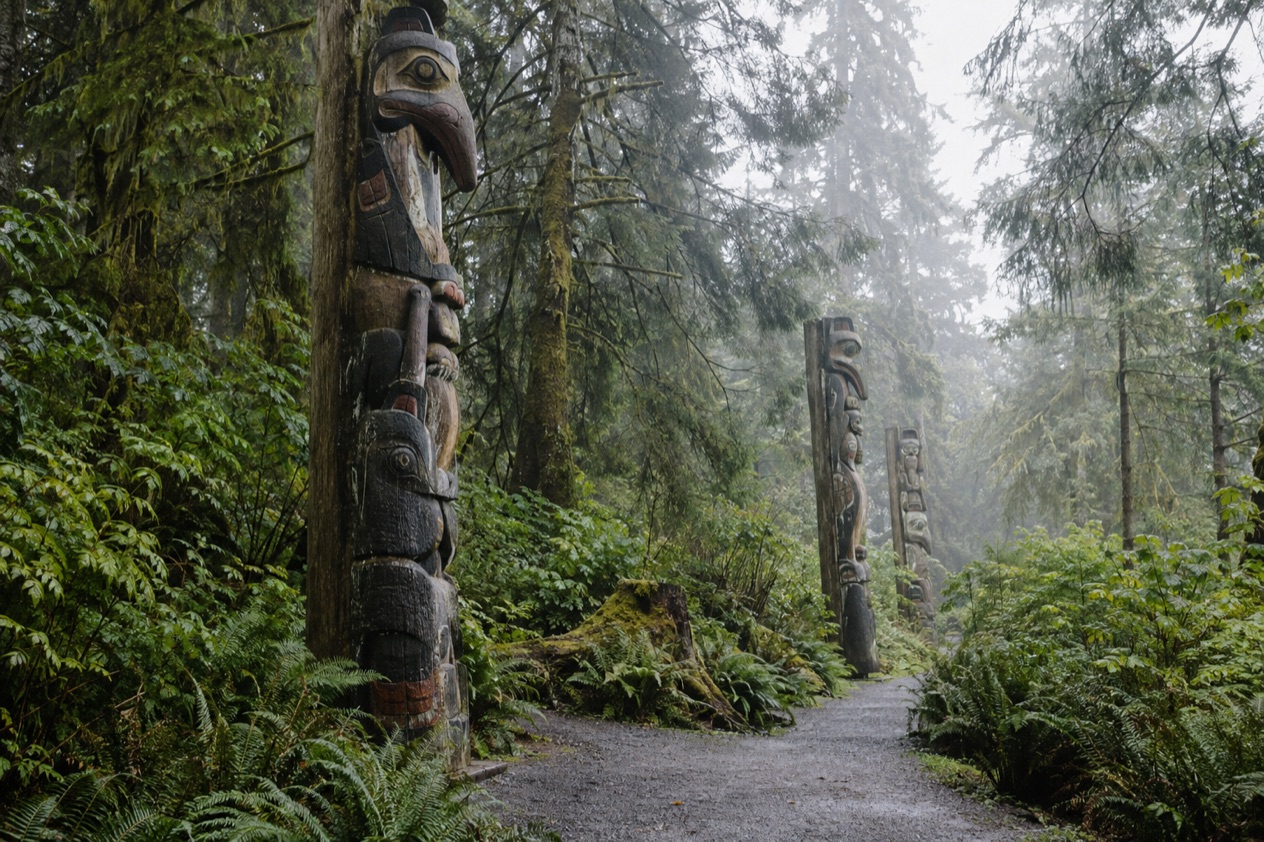
Under the spruce and hemlock beside Sitka Sound, the first thing you notice is the quiet, then the carved faces of totem poles standing among the trunks, dark and wet with rain. Kaasdahéen, the Indian River, runs clear beside the paths and slides out toward a beach of the sound.
This is a small park with a large story, a place where Tlingit, Russian and American histories meet in one stretch of rainforest. It suits a slow visit on foot, with a museum stop on either end.
Is visiting Sitka National Historical Park worth it?
Yes, if you like a trip that combines history, Native art and a walk in a temperate rainforest, and you are happy to spend it at a gentle pace rather than chasing a headline sight. The park is a good match for curious adults, for families with children who enjoy earning a Junior Ranger badge, and for anyone who wants to understand Sitka before wandering its downtown streets.
What sets it apart from other places in Southeast Alaska is how much it holds in a small area. In one visit you can stand on the site of the Battle of 1804 between Russians and Tlingit, which prepared the way for America’s purchase of Alaska from Russia. You can look at ceremonial objects that Tlingit clans still own and use.
You can walk through a historic Russian bishop’s residence, and then step outside into a forest and estuary where salmon, otters and berries are part of the scenery. The park preserves a landscape that drew Tlingit, Russians and Americans, and sometimes brought them into conflict, and you feel that layering as you move from building to trail.
It is also Alaska’s oldest national park unit, a point the park’s own Junior Ranger materials make a point of. Rain is part of the visit, and a gray, dripping morning actually suits the mossy forest and the carved poles.
What to see at Sitka National Historical Park
The visitor center and its Tlingit collections
The visitor center is the natural first stop, and it sets the tone for everything outside. Many of the artifacts displayed here are owned by Tlingit clans and are still used for ceremonial purposes, which changes how you look at them. These are not relics behind glass but living objects lent to the park, and the displays about clan crests, Raven and Eagle moieties and the stories carved into wood make more sense once you have seen them in this setting.
Art demonstrations are part of what the park offers, and the museum space also tells the story of the Battle of 1804 and the decades of Russian settlement that followed. When the center is closed, the park film can be watched on a computer or mobile device.
The Totem Trail and the poles of historic Totem Park
The totem poles stand along the wooded pathways, placed so that each one appears out of the trees as you round a bend. The park’s collection includes poles obtained from Haida and Tlingit, and many of those you see along the trails are replicas. Tlingit clans display heraldic crests on poles, canoes, feast dishes and house posts, so look for the animal figures stacked one above another, each a clan emblem or a story.
The collection has an unusual story of how it came to be, and rangers lead scheduled activities about historic Totem Park. Walking the Totem Trail loop slowly, with the sound of the water close by, is the heart of the visit.
The Russian Bishop’s House
Built in 1841 to 1843, this two-story log house was the home and administrative center of Ivan Veniaminov, the first Bishop of Alaska. It is a National Historic Landmark and now a unit of the park. Museum exhibits fill the ground floor, and the furnished second floor shows how Russian activities in Alaska were carried out from a domestic setting, with the rooms arranged as a bishop’s household.
The house has had other lives too. Its first floor served as an inn for a time, and in the 1920s the ground floor housed a printing operation that produced the Sitka Sun and the Sitka Tribune.
The Old School, a two-story wood-frame building from 1897 that once held a kindergarten and a girls’ school, stands beside the main house. The house is open on ranger-guided tours. When tours are unavailable, a virtual tour and the film Russian Bishop’s House: An Icon Reborn can be watched online.
Indian River, the forest and the tidelands
The natural side of the park is a temperate rain forest of towering spruce and hemlock, with tidelands where sea stars and crabs can be seen and the Indian River winding through. The park describes a forest and estuary rich with salmon, berries, otters and timber. During spawning season, you may see salmon swimming up the river.
Brown bears also come to the Indian River corridor to find food, especially when salmon are in the water, so this is a stretch of path where you stay aware of your surroundings. The trails, the Riverview Trail among them, run along the river and out toward the beach of Sitka Sound.
Hours, tickets and rules
Entering the park costs nothing, since an entrance pass is not required. The visitor center keeps its own hours and seasons, and the Russian Bishop’s House opens to the public on ranger-guided tours. The park film and a virtual tour of the house stay available online when the buildings are closed.
| Site | Open |
|---|---|
| Park grounds and trails | Two miles of trails along Sitka Sound and the Indian River |
| Visitor center | Hours and seasons set by the park, with the park film online when closed |
| Russian Bishop’s House | Ranger-guided tours |
| Ranger-led programs | Typically May through September |
Pets are allowed on the trails and grounds, but they must stay on a leash no longer than six feet, and you must pick up waste and put it in a trash can. Only service animals are allowed inside the federal buildings.
The leash rule helps prevent potentially lethal conflicts between visitors and wildlife. Brown bears are very active near the visitor center during parts of the year, and the park asks visitors to know how to travel safely in bear country.
How to get to Sitka National Historical Park
Sitka sits on Baranof Island and can only be reached by air or sea, since no roads connect it to the mainland. The park is in the southeast panhandle of Alaska, at 106 Metlakatla Street in town, and the Russian Bishop’s House stands separately at 501 Lincoln Street.
By air
Daily jet and air taxi service reaches Sitka’s airport. The airport is one mile from downtown Sitka and 1.5 miles from the park, and taxi and hotel shuttle service is available.
By ferry
Regular ferry service from Sitka runs to Juneau and other Inside Passage destinations on the Alaska Marine Highway System. The ferry terminal is six miles from downtown, at the end of Halibut Point Road near Starrigavan and the Old Sitka Historical Site, and taxi service is available from the terminal.
By cruise ship or private boat
Cruise ships may dock at the cruise terminal, seven miles from downtown, or at one of the downtown harbors, or anchor offshore and tender passengers ashore. Private boaters can moor at five harbors operated by the Sitka Harbor Department: Crescent Harbor, Sealing Cove, ANB Harbor, Old Thomsen Harbor and Eliason Harbor.
On foot once you are in town
Most of the park, including the Russian Bishop’s House, the visitor center, the Totem Trail loop, the Riverview Trail and the Russian Memorial Trail loop, is an easy walk from downtown Sitka. It takes people about 10 minutes to walk between the visitor center and the Russian Bishop’s House.
When to visit Sitka National Historical Park
Ranger-led programs are typically offered from May through September, so those months bring the most to do, with scheduled talks on historic Totem Park, the Battle of 1804 and Russian exploration and settlement. Activities and events vary with the season, and the park calendar lists them.
Sitka has a humid maritime climate with heavy precipitation and a small temperature range between seasons. Even so, summer afternoons are cool, with an average daily high of 55°F in July and August.
The wettest months run from September through November, and October brings an average of 14.8 inches of precipitation. That is a season for rain gear and a slower walk, and the forest looks its darkest and greenest then. Winters range from the high teens to the 40s, with an average daily low of 31°F in January.
Time of day matters for wildlife. Bears are most common at dusk and dawn, and they often visit the Indian River corridor when salmon are in the water. During spawning season you may see salmon in the river. The park’s current conditions carry seasonal updates, including information about bear activity.
Tips for your visit
Dress for the damp. The park recommends water resistant and breathable clothing even in summer, or limiting time outdoors, to reduce the risk of hypothermia, and visitors to Sitka should bring rain gear and layers at any time of year. With about 90 inches of precipitation falling at the airport in an average year, mostly as rain, a hooded jacket is the one item to count on.
The park covers 113 acres of rainforest and has two miles of well-maintained trails, which wind along the beach of Sitka Sound and beside the banks of the Indian River. The trails are wheelchair-friendly, which makes the park an option for visitors with limited mobility. Start at the visitor center to see the collections, walk the Totem Trail, then follow the path along the river toward the water.
Families can have children become Junior Rangers, a program open to kids of all ages. The official NPS app offers trip planning information and self-guided tours, and it can be downloaded where you have wifi and used offline. Hiking trails also run in and around the park for those who want to keep walking after the loops, and the Russian Memorial Trail loop gives another stretch of forest.
Pair the park with the Russian Bishop’s House for the full story, and add the Old Sitka Historical Site near the ferry terminal if you have time for a longer outing. With a dog, keep the leash short and remember that only service animals may enter the buildings.
Good to know before you go
There is no entrance charge, so the budget for the park is simply your time. Brown bears are unlikely to be encountered, but basic bear safety knowledge is expected, especially near the river and around the visitor center at the edges of the day.
The Tlingit objects in the visitor center belong to living clans, so look closely and with respect. The park’s alerts and conditions page carries updates on what is open and on bear activity.
Sources
- National Park Service, Sitka National Historical Park, plan your visit: basicinfo (https://www.nps.gov/sitk/planyourvisit/basicinfo.htm), checked October 11, 2026
- National Park Service, Sitka National Historical Park, plan your visit: conditions (https://www.nps.gov/sitk/planyourvisit/conditions.htm), checked October 11, 2026
- National Park Service, Sitka National Historical Park, plan your visit: directions (https://www.nps.gov/sitk/planyourvisit/directions.htm), checked October 11, 2026
- National Park Service, Sitka National Historical Park, plan your visit: fees (https://www.nps.gov/sitk/planyourvisit/fees.htm), checked October 11, 2026
- National Park Service, Sitka National Historical Park, plan your visit: hours (https://www.nps.gov/sitk/planyourvisit/hours.htm), checked October 11, 2026
- National Park Service, Sitka National Historical Park, plan your visit: pets (https://www.nps.gov/sitk/planyourvisit/pets.htm), checked October 11, 2026
- National Park Service, Sitka National Historical Park, plan your visit: safety (https://www.nps.gov/sitk/planyourvisit/safety.htm), checked October 11, 2026
- National Park Service, Sitka National Historical Park, plan your visit: things2do (https://www.nps.gov/sitk/planyourvisit/things2do.htm), checked October 11, 2026
- National Park Service, Sitka National Historical Park, plan your visit: tripideas (https://www.nps.gov/sitk/planyourvisit/tripideas.htm), checked October 11, 2026
- National Park Service, Sitka National Historical Park, plan your visit: weather (https://www.nps.gov/sitk/planyourvisit/weather.htm), checked October 11, 2026
- Wikipedia, Sitka National Historical Park (https://en.wikipedia.org/wiki/Sitka_National_Historical_Park), checked October 11, 2026
- Wikipedia, Russian Bishop%27s House (https://en.wikipedia.org/wiki/Russian_Bishop%27s_House), checked October 11, 2026
- Wikipedia, Tlingit (https://en.wikipedia.org/wiki/Tlingit), checked October 11, 2026