
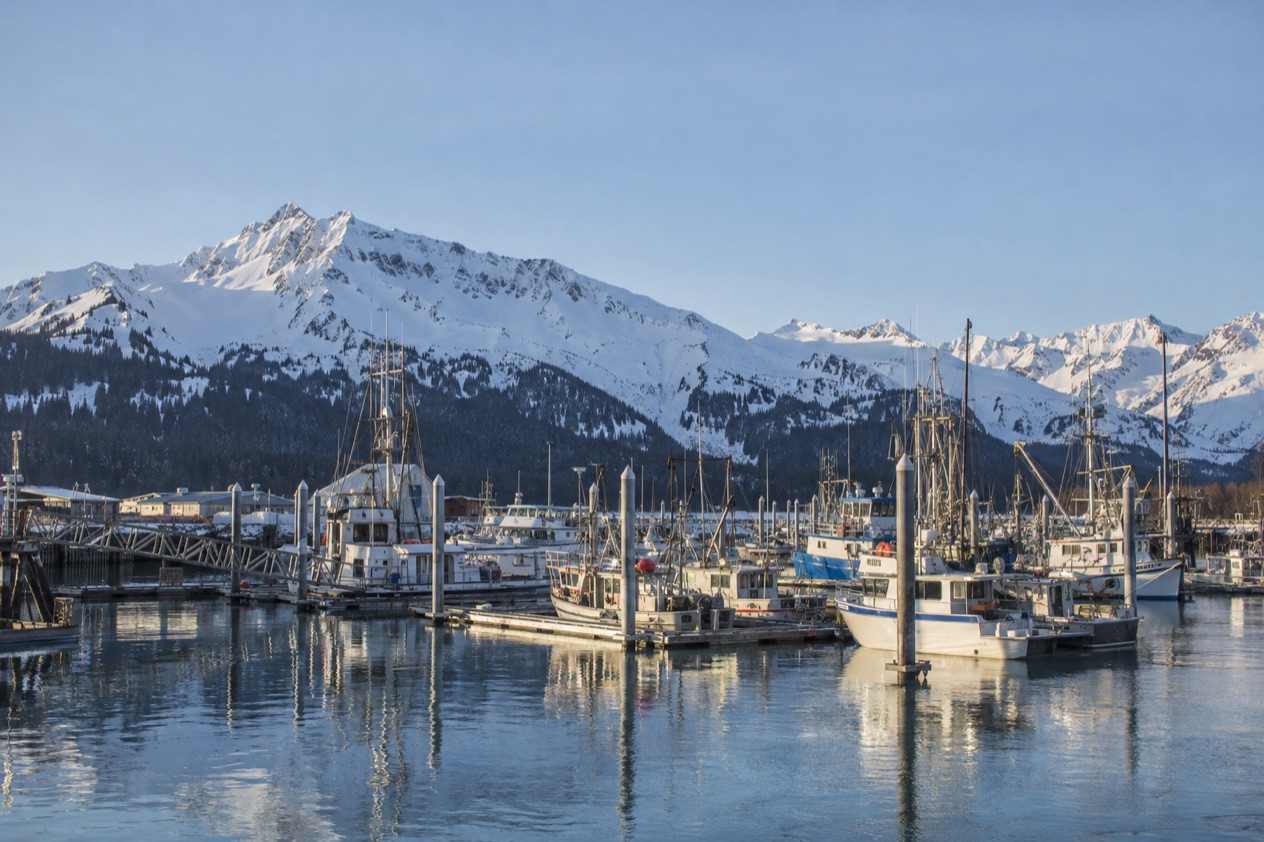
In March, Seward feels like a harbor town waking up slowly. Fishing boats rock at their moorings, steam rises from coffee cups on the sidewalk, and the mountains around Resurrection Bay still wear their winter white right down to the shore.
The days are stretching again, so the evenings no longer arrive in the middle of the afternoon. It is a month for crisp walks, snow-country recreation and a town that is not yet in its summer rush.
What is the weather like in Seward in March?
March in Seward is cold but no longer deep winter: afternoons hover just above freezing, nights drop back into the 20s, and precipitation falls on fewer days than in February.
| Month | Average high (°F) | Average low (°F) | Precipitation (in) | Days with precipitation | Daylight on the 15th |
|---|---|---|---|---|---|
| February | 34.3 | 23.5 | 6.35 | 9.7 | 9 h 06 min |
| March | 37.3 | 24.9 | 3.85 | 7.8 | 11 h 39 min |
| April | 45.4 | 32.2 | 4.29 | 9.3 | 14 h 29 min |
Mornings start frosty, so the first walk of the day along the waterfront calls for a real winter coat, a hat and gloves. By afternoon the air softens a little, enough that you can unzip a layer in the sun, but it never turns mild. Because the precipitation counts both rain and melted snow, a gray day can bring either, and the line between the two can shift within a single afternoon.
Compared with February, March is drier, and that shows in how the days feel. There are more stretches when the clouds lift off the peaks and the whole bay opens up in front of you. The light is the other big change: the day now lasts a little over eleven and a half hours, so you can plan a full outing and still be back in town while it is bright.
Wet snow and slush on the sidewalks are common in a coastal town like this, so waterproof boots with real grip matter more than a fashionable coat. Evenings are cold enough that you will want your warm layer back on for dinner, and a hat stays useful long after dark.
What to do in Seward in March
March in Seward is about winter recreation, a harbor town between seasons and the scenery of a fjord edged in snow. The summer rhythm has not started: the farmers market, for example, belongs to Saturdays from June to early September, so this month the pleasures are quieter and more physical. You walk, you look, you warm up with something hot and you go out again.
Exit Glacier in its winter clothes
Exit Glacier is the one part of Kenai Fjords National Park that you can reach by road, along a spur road that leaves the Seward Highway. It stays accessible all year, but once snow arrives, usually in mid-November, the road closes to cars and the area changes character. It then opens to snow machines, dogsleds, fat-tire bicycles and cross-country skiers, and that is the version of the place that belongs to a winter month.
A system of hiking trails leads from the Exit Glacier area to the terminus of the glacier and on up to the Harding Icefield. In the snow season the landscape is simple and graphic: white valley floor, dark spruce, the blue-gray tongue of ice at the end.
If you ski or ride a fat-tire bike, this is the place to do it. If you do not, the wide, silent scene still rewards anyone who walks or glides in as far as they feel comfortable.
Bring more layers than you think you need, because standing still beside a glacier feels colder than moving through town. Plan the outing for the brightest part of the day, since the light fades earlier than in the long days that arrive later in spring.
The harbor and Resurrection Bay
The waterfront is the town’s living room. Walk the small boat harbor in the morning and you will see crews hosing down decks, gulls lined up on pilings and the bay stretching away between steep, snowy mountains. The water is far too cold to think about getting in, but it is a wonderful thing to watch, flat and pewter-colored on still mornings and choppy on windy ones.
Resurrection Bay is also where you feel the geography. The national park lies west of town, and most of it can only be seen from the water or the air, which makes the view down the bay a reminder of how much wild country sits beyond the last road. On a clear afternoon the peaks pick up a pink edge as the day closes, a good moment for a slow stroll back toward downtown.
Downtown streets, cafés and a hot meal
Downtown Seward is compact, a few blocks of storefronts, murals, galleries and cafés that you can cover on foot between outdoor stops. March is a good month for this kind of wandering because you duck in and out of warm rooms without a line. Expect the comfort food of a fishing town: chowder, halibut or salmon on the plate, a burger after a cold day and strong coffee at every turn.
Indoor stops help fill the gaps when the weather turns. The Alaska SeaLife Center and the town’s small museum are the kinds of places people head for when the wind picks up. For an evening, a table near the harbor with a bowl of something hot makes a fine end to a day spent mostly outdoors.
Seward is also the end of the line for the Coastal Classic Train from Anchorage through Girdwood, a route that winds along Turnagain Arm where the Chugach Range mountains plunge directly to the sea. National Geographic Traveler ranked it among the Top Ten Train Rides in North America, and it is part of what gives the town its sense of being a destination at the end of the tracks.
A two-day itinerary for Seward in March
Day 1 belongs to the waterfront and the glacier. Start late enough that the frost has softened, with a hot drink downtown, then walk the small boat harbor while the light is still low and soft on the bay. Daylight is a little under twelve hours, so keep the outdoors for the middle of the day and save indoor time for the edges.
After a chowder or sandwich lunch in a harbor-side café, go to the Exit Glacier area in the early afternoon. Walk or ski in as far as feels right, look at the glacier’s end from the trail and turn around while the sky is still bright. Dress for standing still in the cold, and come back to town for a seafood dinner somewhere warm.
Day 2 stays in town and on the shore. Begin with a slow breakfast, then explore the downtown blocks, the murals and the galleries, which are pleasant to browse when the air outside is sharp. Walk toward the bay for a second look at the mountains at midday, when the light is at its fullest.
The rain card is simple: if snow or rain sets in, spend the afternoon indoors at the Alaska SeaLife Center or the local museum, then settle into a café with a book until dinner.
Is Seward busy in March?
March is not the season when Seward is at its busiest, and the pace of the town reflects that. The farmers market, which runs on Saturdays from June 14 through September 6 in the alley next to The Ranting Raven, is a summer event and is not part of a March visit.
What fills the month instead is outdoor recreation around Exit Glacier, where snow machines, dogsleds, fat-tire bicycles and cross-country skiers take over once the road closes to cars. The town itself has the feel of a place working at a calmer speed, with room to stroll, linger over a table and take in the harbor without much of a crowd.
The Seward events calendar lets anyone submit an event online, so small local gatherings can turn up on short notice. It is worth a look as the month approaches.
What to pack for Seward in March
Pack for cold, damp days that are brighter than midwinter ones, with a plan to be outside for long stretches near the water and on snow.
- An insulated, waterproof coat, because precipitation can arrive as rain or wet snow.
- Waterproof boots with good grip for slushy sidewalks and the Exit Glacier area.
- Warm base layers for skiing, biking or standing beside the glacier.
- A hat and gloves, since mornings and evenings stay cold.
- Sunglasses, because bright snow and low sun can be glaring.
- A small daypack for layers you shed in the afternoon.
Good to know before you go
The main thing to know is how the seasons shape access. Exit Glacier is open all year, but once snow arrives, usually in mid-November, the road is closed to cars and used for winter recreation, so plan your visit around skiing, biking or walking in rather than driving up.
Daylight lasts a little over eleven and a half hours in the middle of the month, which is enough for a full outdoor day but not a late one. The national park lies west of town and the road reaches only Exit Glacier, so most of the wider park stays out of reach by car.
Seward in March vs February and April
Moving the trip four weeks earlier puts you in the darkest and wettest of the three months, with the shortest days and the most days of rain or snow. The town is most wintry then, which suits those who want the deepest snow and the quietest streets but gives you less daylight for outings.
Moving four weeks later brings a clear change in feel: the days grow long, temperatures climb above freezing by day, and the lower ground starts to lose its snow. Precipitation falls on more days again, but it is more likely to be rain than snow. The town has more of a spring mood, though the summer events, like the farmers market, are still weeks away.
Choose February if deep winter and the longest nights are what you are after, and April if you want longer days and a softer edge to the cold. March sits in between: brighter than February, still wintry enough for the snow recreation around Exit Glacier, and drier than either neighbor in the count of days.
Is March a good time to visit Seward?
Yes, for travelers who want a quiet, snowy coastal town and are happy to spend time outdoors in the cold. March suits skiers, fat-tire riders and walkers, photographers who like a white and blue palette, and anyone who prefers a calm harbor to a crowded one.
It is a poorer fit for anyone counting on summer events like the farmers market or a warm, leisurely stroll in shirtsleeves. If your idea of Alaska is long evenings and green hillsides, another month will serve you better.
On arrival, head first to the waterfront for a look at the bay while the light is good, then plan your Exit Glacier outing for the brightest part of the following day. What is special about March here is the mix: a working harbor, snow on the mountains right down to the water, and days just long enough to be out in all of it.
Sources
- NOAA NCEI, U.S. Climate Normals 1991-2020, monthly (https://www.ncei.noaa.gov/access/services/data/v1?dataset=normals-monthly-1991-2020&stations=USW00026438), station Seward Ap, elevation 22 feet, checked October 11, 2026
- Computed from the date and the latitude of the place (sunrise equation, solar elevation -0.833 degrees), October 11, 2026
- Wikipedia, Kenai Fjords National Park (https://en.wikipedia.org/wiki/Kenai_Fjords_National_Park), checked October 11, 2026
- Wikipedia, Exit Glacier (https://en.wikipedia.org/wiki/Exit_Glacier), checked October 11, 2026
- Seward, Silver Salmon Derby and events (https://www.seward.com/events/), checked October 11, 2026
- Alaska Railroad, Coastal Classic (https://www.alaskarailroad.com/ride-a-train/our-trains/coastal-classic), checked October 11, 2026
- Wikipedia, Kenai Peninsula (https://en.wikipedia.org/wiki/Kenai_Peninsula), checked October 11, 2026
- Wikipedia, Climate of Alaska (https://en.wikipedia.org/wiki/Climate_of_Alaska), checked October 11, 2026
To plan your stay
- Things to Do in Seward: Exit Glacier, the SeaLife Center, Kenai Fjords Boat Trips and Fishing
- Where to Stay in Seward: Downtown, the Boat Harbor, Mt. Marathon Streets and Lodges Outside Town
- Seward from Anchorage: the Seward Highway, the Coastal Classic Train and the Park Connection Bus
- Know Before You Go to Seward: Getting There, Weather, Bears and Local Habits