
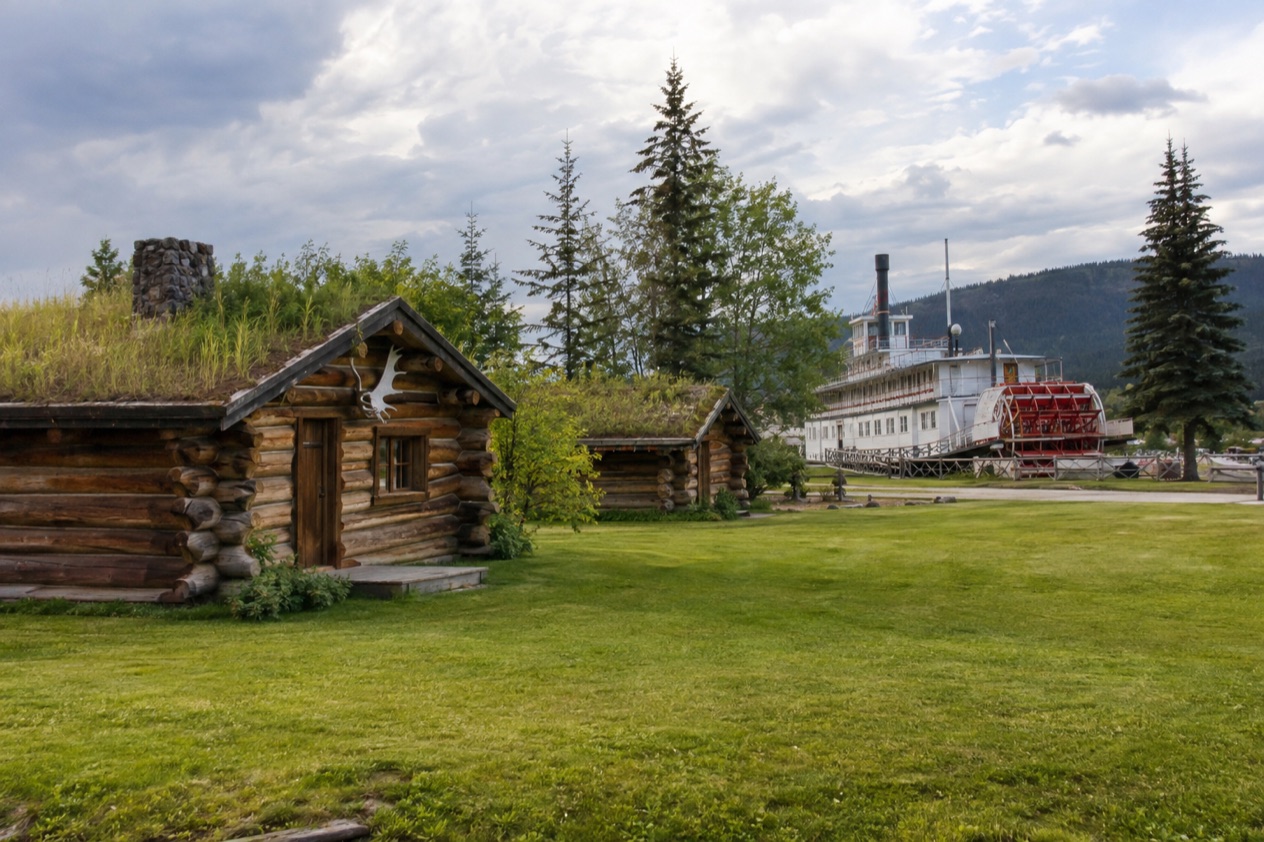
You walk in past old log cabins with their porches propped up by time, and a wooden riverboat looms beyond the lawn like something left behind by the Yukon gold rush. Children run toward the carousel and the miniature train while their parents drift toward the museums.
Is visiting Pioneer Park worth it?
Yes, if you want to understand how Fairbanks became a town, and it suits families, history lovers and anyone with a slow afternoon to fill. It is less a single attraction than a small village of attractions, and you decide how deep to go: a stroll among the cabins, a museum or two, a ride, a snack on a bench.
Fairbanks was founded when E. T. Barnette set up a trading post on the Chena River, and the gold seekers who followed lived in just the kind of cabins you see here.
Some of those buildings were moved from elsewhere in town, so you step inside real rooms where people once cooked, slept and waited out the cold. Alongside the cabins sit Alaska Native cultural exhibits, aviation history and a riverboat, so the story is wider than gold alone.
The park also pairs well with what the rest of Fairbanks offers. It is a gentle counterweight to days spent chasing the aurora or heading out on the river, and it gives a context for the city’s art, theater and music scene, which runs year-round.
What to see at Pioneer Park
Gold Rush Town
The heart of the park is a street of historic cabins and frontier-style buildings, gathered from around Fairbanks and set along a boardwalk-style lane. The rooms have been turned into little shops and displays, and the doorways are low, the logs dark with age. Look for the details that make the era real: the small windows, the stovepipes, the tools hanging on walls.
Take your time on this lane. It is the best place to picture what the town was like in its first years after it was founded, when the whole place was a trading post and a scatter of tents and cabins on the river bank. Shops here often sell Alaska-made crafts and souvenirs, which makes it a natural spot to look for something to take home.
The SS Nenana
The big white sternwheeler is the landmark you notice first. The Nenana was a working riverboat, built to carry passengers and freight along Interior Alaska’s rivers in the days before roads reached the towns. Seeing a boat this size on dry ground gives you a sense of how important the rivers were as highways, and of how much cargo a settlement needed to survive a long winter.
Walk around the hull to take in its wooden decks and the paddlewheel at the back, and look for the interior details of the cabins and the pilot’s area if the boat is open to walk through. It is a good photograph from the lawn, especially in the long light of a summer evening.
The museums
Several small museums share the grounds. One tells the story of the town’s pioneers through photographs, tools and household objects. Another is devoted to the Native peoples of Alaska, including the Athabascan peoples of the Interior, with a focus on culture, clothing and ways of life. A third covers aviation, a subject that matters in a state where planes still reach many communities the roads do not.
These are modest in scale and quick to move through in a relaxed way, so pick the one or two that match your curiosity rather than trying to see everything. Local museums across the Interior share the history, stories and local ways of life, and the ones here are a friendly introduction before you go deeper elsewhere.
Rides, theater and open lawns
Between the buildings there is room to breathe. A carousel, a miniature railroad and a playground give younger visitors their own reasons to come, and wide lawns invite a picnic. A theater on the grounds has long staged a lively, tongue-in-cheek show about the gold rush era, the kind of evening entertainment that fits the park’s spirit.
Even if you skip every ticketed attraction, the grounds are pleasant to wander. Listen for the train whistle, the music from the theater and the chatter of families, and you will have a sense of where Fairbanks goes to relax on a summer day.
Hours, tickets and rules
Pioneer Park is really many small operations under one roof of trees, so the museums, the rides, the shops and the theater each keep their own schedules and prices. The most direct way to learn what is open and what each costs on the day you plan to visit is the Explore Fairbanks visitor information line at (907) 456-5774.
What you can count on is the light. In June the sun is up from about 3 AM until a quarter to one at night, and it never gets fully dark, so a visit can stretch well into the evening if the buildings are open. In winter the sun is up only from 10:45 AM to 2:45 PM, which makes the short days a very different experience, and a park of outdoor lanes and open lawns is a different place when the temperature is far below freezing.
Fairbanks has no sales tax, so the price on a souvenir or a snack is the price you pay at the register. Beyond that, treat each building as its own stop and let the staff at each door tell you how things work there.
How to get to Pioneer Park
Pioneer Park is in Fairbanks itself, so getting there starts with getting to Fairbanks. Fairbanks International Airport sits three miles southwest of the central business district, and it has domestic flights from Chicago, Dallas, Denver, Minneapolis and Seattle-Tacoma, operated by airlines including Alaska Airlines and Horizon Air, American, Delta and United.
From Anchorage, the drive up Highway 3, the George Parks Highway, takes about 7 to 8 hours in summer with stops, and it passes through Denali National Park. That makes the road a trip in itself, and travelers use it to tie Fairbanks to a visit to Denali.
In summer the Alaska Railroad also runs tourist trains to and from Fairbanks, which gives a rail option for the same corridor. Once you are in town, the park is one of several places clustered in and around the city, along with the Chena River, so it fits into a day that also includes a stroll downtown or a riverside stop.
When to visit Pioneer Park
Summer is the season that gives the park its best atmosphere. Fairbanks has a midnight sun season, with the sun shining nearly 24 hours a day around the solstice, and July is warm by local standards, with a normal monthly mean of 62.9 °F. Long, bright evenings make it easy to linger among the cabins and on the lawns well after a typical dinner hour.
Time your visit to the city’s summer events if you can. The Midnight Sun Festival, a free street fair downtown, is held on the Saturday closest to June 21, with live music on three stages, gold panning and pony rides.
The same weekend brings the Midnight Sun Run, which starts at 10 p.m., and the Midnight Sun Baseball Game, which pauses at the half-inning closest to midnight for the Alaska Flag Song. Golden Days arrives each year in mid-July, a celebration of the town’s gold rush heritage that suits a day among the park’s old cabins.
Winter is a different mood. January has a normal monthly mean of −8.3 °F, and Fairbanks is the coldest city in the United States among those with at least 10,000 people.
That is the season for the northern lights, which are best seen between September and mid-April on cold clear nights. If you come then, a park walk is a short break in a day built around the night sky, not the main event.
As for the time of day, aim for whenever the buildings you care about are open, then let the evening light carry you through the lawns and the riverboat. In June there is no hurry to leave.
Tips for your visit
Plan the park as a relaxed outing rather than a checklist. Choose a museum or two, wander the cabin lane, take a look at the sternwheeler and leave time to sit. The mix of history and play means the day works for travelers of different ages, as long as you let everyone follow their own interest.
Pair it with the rest of town. Fairbanks offers classic and contemporary art, theater and music events and exhibitions year-round, and local museums and visitor centers in Interior Alaska share the history, stories and local ways of life. After the park, a look at the Chena River gives you the water that first drew Barnette’s trading post here.
If you have extra time, the town of North Pole is near Fairbanks and offers adventure in authentic Alaskan style, which makes a good change of pace after a day of history. Businesses in Fairbanks can also provide equipment for adventures in Interior Alaska, so a quiet park afternoon can sit between more active days.
For autumn and winter evenings, remember that the northern lights are visible on average more than 200 days per year in the vicinity of Fairbanks. A visit to the park by day and a night watching the sky makes a pleasant pairing in the cold months.
Good to know before you go
Fairbanks is a town of about 32,515 people at the last census, the second-largest city in Alaska, and the park reflects its scale: friendly, easygoing and built around the community. Because there is no sales tax, prices at the park’s shops and food stands are the prices you see.
Daylight changes everything here, with the sun up from 10:45 AM to 2:45 PM in winter and barely setting in June, so plan your day around the light of the month you travel. For up-to-date visitor information, the Explore Fairbanks line is open to questions at (907) 456-5774.
Sources
- Explore Fairbanks, things to do (https://www.explorefairbanks.com/things-to-do/), checked October 11, 2026
- Explore Fairbanks, summer and solstice events (https://www.explorefairbanks.com/events/summer-and-solstice-events/), checked October 11, 2026
- Wikivoyage, Fairbanks (https://en.wikivoyage.org/wiki/Fairbanks), checked October 11, 2026
- Wikipedia, Fairbanks, Alaska (https://en.wikipedia.org/wiki/Fairbanks,_Alaska), checked October 11, 2026