
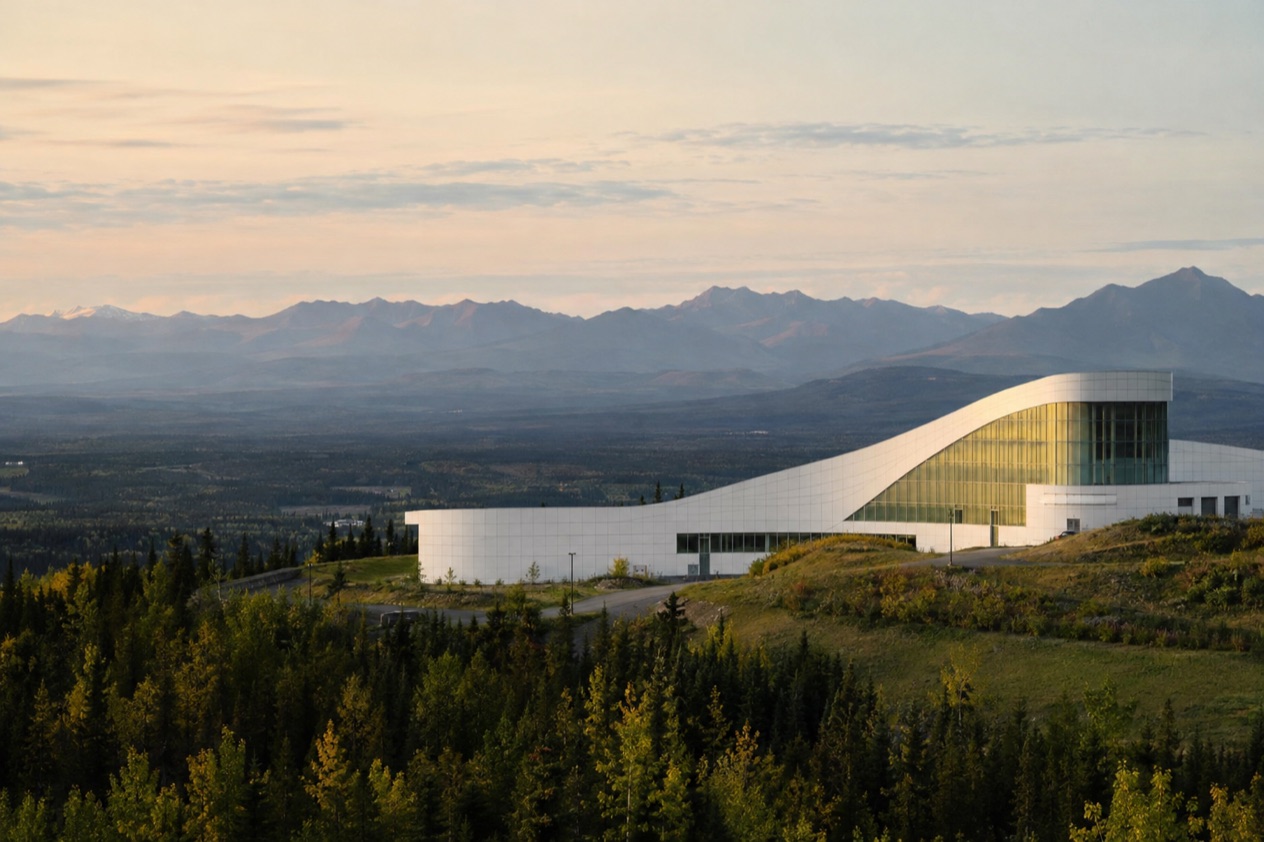
You come up the hill on the UAF campus and the building appears before you reach the door, its sweeping lines meant to echo the glaciers, ridges and big skies of the Interior. Inside, the galleries move from ancient animals to Alaska Native art, and the light changes from room to room. This is the University of Alaska Museum of the North in Fairbanks, a good stop for travelers who want the story of Alaska told in one place before they head out to see the country itself.
Is visiting the University of Alaska Museum of the North worth it?
Yes, especially if you want to understand the land and the people of Alaska before or after you see them outdoors, and it suits curious adults, school-age children, art lovers and anyone with a rainy or bitterly cold afternoon to fill. The museum gathers Alaska Native cultures, natural wonders, wildlife and Arctic dinosaurs under one roof, so a single visit covers ground that would otherwise take a week of driving.
What sets it apart from the other places in Fairbanks that share local history is its range. Local museums and visitor centers in Interior Alaska tell the story of the region’s history and ways of life, and they do it well, but this museum is also a place of research.
You can learn about the work of museum scientists, then step into galleries where two thousand years of Alaska art hang beside fossils and mounted animals. It is a museum of science, art and culture at once, which makes it useful on a trip where you may not get to every corner of the state.
It also works as a counterweight to the rest of a Fairbanks stay. Most days there are spent on rivers, trails or under a wide sky, and the museum gives names, deep time and human stories to what you are looking at out the window. Travelers find that the landscape makes more sense after an hour among the exhibits.
What to see at the University of Alaska Museum of the North
Alaska Native cultures and 2,000 years of art
The cultural galleries are the heart of the visit. Alaska Native peoples have lived across this enormous state for thousands of years, from the Interior to the coasts and the Arctic, and the museum presents their clothing, tools and carving as the work of skilled makers, not as relics. Look for the details of how things were made, the stitching, the shaping of bone and ivory, the patterns that carry meaning.
The museum also traces two thousand years of Alaska art, so you can follow how forms and ideas pass from older traditions into painting, sculpture and contemporary work. Give the art galleries unhurried time. They reward slow looking and often show how closely the art is tied to the animals and seasons around it.
Wildlife and natural wonders
The natural history galleries bring the animals of Alaska close enough to study in detail, which is something no trail can promise. Among the mounted animals, Otto the brown bear has long been a favorite of visitors, and the displays help you picture how large these animals are and how different species fit into the Interior and the Arctic.
Alongside the animals you will find the story of the land itself, the geology, the cold and the long swings of light that shape life here. It is a good place to learn what you are looking at before you go out to look for it, and to put names to the creatures you may glimpse from a road or a river later in your trip.
Arctic dinosaurs and museum research
Dinosaurs in the Arctic surprise people, and the museum makes the case that this was once a very different place. The Arctic dinosaur displays show that animals lived in the far north long before the ice, and they connect to the ice age creatures that followed.
The museum is also a working research institution, and visitors can learn about the work of its scientists. That gives the displays a living quality, since the people who dig, classify and study these specimens are part of the same building. Read the interpretive panels here, because they often explain how a discovery was made and why it matters.
The building and its original exhibits
The architecture is part of the attraction, and the museum advertises original exhibits alongside breathtaking design. Walk through the lobby and the stairways with your eyes up and notice how the shapes and the big windows connect the inside to the landscape beyond the glass.
Bus 142, the bus that became widely known through the story of Chris McCandless, is not on public view. It is in offsite storage while funds are raised for an outdoor exhibition site, so do not plan your visit around seeing it.
Hours, tickets and rules
The museum opens its doors every day of the week, so there is no closed day to plan around. Admission sales stop half an hour before the building closes, which means arriving late in the afternoon cuts into your time inside. The visit is built for wandering at your own pace, from gallery to gallery.
| Site | Open |
|---|---|
| University of Alaska Museum of the North | Daily, 9 AM to 5:30 PM (admission sales close at 5 PM) |
The one rule the museum makes plain concerns Bus 142, which is not currently on public view and is kept in offsite storage. No other rules on photography, tripods, drones or bags are set out here, so enjoy the galleries and follow any signs you meet inside the building.
How to get to the University of Alaska Museum of the North
The museum sits on the UAF campus at 1962 Yukon Drive in Fairbanks, so you are heading to the university grounds, not downtown. Fairbanks is a town in interior Alaska with a population of about thirty-one thousand, and it is Alaska’s second-largest city, which tells you how compact the area around the campus is by Alaska standards.
Visitors arrive in Fairbanks by air. Fairbanks International Airport has domestic flights from Chicago, Dallas, Denver, Minneapolis and Seattle-Tacoma, operated by airlines including Alaska Airlines and Horizon Air, American Airlines, Delta and United. From the airport you continue to the campus address above.
If you are coming overland from Anchorage, the route is Highway 3, the George Parks Highway, which passes through Denali National Park. The drive takes about seven to eight hours in summer with stops. That makes the museum a natural reward at the end of the road, a place to stretch your legs and spend an unhurried afternoon after a long day behind the wheel. For local questions about getting around Fairbanks, the Explore Fairbanks visitor information line answers by phone at (907) 456-5774.
When to visit the University of Alaska Museum of the North
The museum is open daily, so the real question is what you want your day to feel like. Mornings, when the doors open, are a natural time to take the galleries in order, with fresh energy for the cultural and art rooms. Later in the day you can drift back to whatever caught your eye. Remember that admission sales stop before closing, so a late arrival leaves you rushed.
Season shapes the rest of your day in Fairbanks. In summer, Fairbanks has a season of nearly 24 hours of sun, and in June the sun is up from about 3 AM and it never gets fully dark. That means you can visit the museum in the afternoon and still have a long evening outside, on the Chena River or on a trail, with plenty of light left.
In winter the situation reverses. The sun is up only from about 10:45 AM to 2:45 PM, so the museum is a welcome indoor stop in a short day.
Fairbanks also has an aurora season, and the northern lights are best seen between September and mid-April on cold, clear nights. Seeing them is a chance, never a promise, but a day in the galleries followed by a night outside is a satisfying way to spend a cold-season visit.
Because the museum is indoors, it suits any month you happen to be in town. Treat it as the anchor of a rainy summer afternoon or a deep-winter day, and plan your outdoor time around the light.
Tips for your visit
Plan on unhurried time. Read the panels about the museum’s scientists, since they explain how the specimens in the cases were found and studied.
Arrive well before admission sales close, since the doors lock the ticket counter half an hour before the building shuts. If you want to look closely at the art galleries, start there and let the rest of the museum fill the remaining time. Look up at the architecture on your way through, and take a moment at the windows.
Combine the museum with the rest of Fairbanks. Local museums and visitor centers in Interior Alaska share the region’s history and ways of life, and Fairbanks hosts classic and contemporary art, theater and music events and exhibitions throughout the year, so the museum fits into a day of culture. You can also turn to the outdoors: the Chena River is there to explore, and businesses in Fairbanks can provide equipment for adventures in Interior Alaska.
Visitors with extra time can head to the town of North Pole, which is near Fairbanks and offers adventure in authentic Alaskan style. On a cold, clear evening in the aurora season, you might finish your day by stepping outside after dark and looking up.
Do not go looking for Bus 142 in the galleries. It is in offsite storage while funds are raised for an outdoor exhibition site, so put your attention on the exhibits that are on view.
Good to know before you go
There is no sales tax in Fairbanks, so the price you see on a tag in town is the price you pay at the register. The galleries are open every day of the week, which makes the museum a dependable choice whenever you arrive in Fairbanks.
Sources
- University of Alaska Museum of the North (https://www.uaf.edu/museum/), checked October 11, 2026
- Explore Fairbanks, things to do (https://www.explorefairbanks.com/things-to-do/), checked October 11, 2026
- Wikivoyage, Fairbanks (https://en.wikivoyage.org/wiki/Fairbanks), checked October 11, 2026