
The road ends at a river, and the last stretch is on foot, across a footbridge with the sound of glacial water rushing underneath. On the far side sits McCarthy, a village of false-front buildings and dirt streets, and farther up the valley the red mill buildings of Kennecott cling to a hillside above a glacier. This is the end of the line in the middle of Wrangell-St. Elias National Park, a place for travelers who like their history rough-edged and their landscapes enormous.
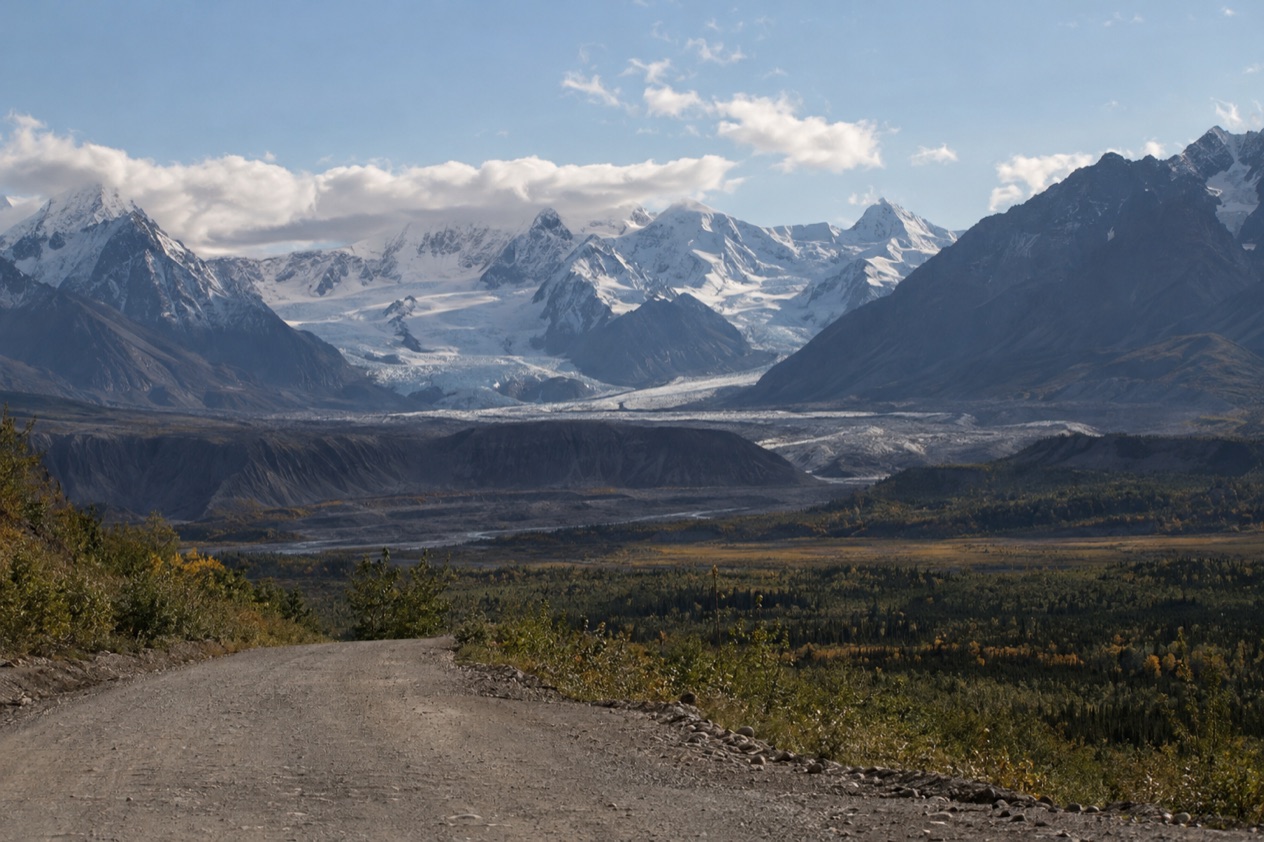
Where is McCarthy and Kennecott and what is it like?
McCarthy and Kennecott sit in the center of Wrangell-St. Elias National Park and Preserve, in south central Alaska, at the foot of the Wrangell Mountains. McCarthy is a small village, a census-designated place in the Copper River Census Area, and Kennecott is the old copper-mining settlement beside the Kennicott Glacier, a sister village to McCarthy. Together they form one of the quietest corners of the state, reached by a single gravel road and then a footbridge.
The two places have different moods. McCarthy is the living village, with a population that has grown from a handful of residents to just over a hundred in the last decade.
Kennecott is the ghost town, the preserved ruin of a company town that operated from 1903 to 1938 and now forms a National Historic Landmark district. Its buildings still hold the relics of the Gold Rush era’s copper boom, and the old mill rises fourteen stories against the mountainside.
The pace here is set by the road and the weather, not by a schedule. Park services are scattered across a landscape larger than Vermont and New Hampshire combined, and travel times between them are long, which is part of the appeal and part of the challenge. Visitor services are limited, access takes effort, and the weather varies widely.
That makes McCarthy a natural fit for people who enjoy history, big mountain scenery and the slow arrival that comes with a long drive. It suits travelers who like to wander through old buildings, talk with the few people who live here and look up at glaciers. It may not suit anyone who wants paved roads, a long list of services or a place that can be seen in an hour on the way to somewhere else.
The setting is also a World Heritage site. The park around the village holds some of the biggest glaciers on the continent, and the mountains behind town give the whole valley a sense of scale that photographs rarely manage to carry.
What is there to do in McCarthy and Kennecott?
The reasons to come are the ghost town, the glacier, the village and the drive itself. What sets McCarthy apart from other Alaska destinations is that its main attraction is a piece of industrial history set inside wilderness, not a view you can take in from a parking lot.
The Kennecott mill town
Kennecott was a copper-mining operation that ran from 1903 to 1938, and the abandoned mine and mill buildings now make up a National Historic Landmark district. The tall concentration mill is the centerpiece, a fourteen-story structure that dominates the slope, with smaller buildings, bunkhouses and rusting equipment scattered around it. Walking the old settlement is a way to read how a company town was laid out, where ore came down, where people lived and how the whole operation hung on a mountain.
Kennecott-based tour groups lead guided tours of the mill, which is the way to understand what you are looking at. A guide turns a wall of weathered timber into a story about crushing, sorting and the long haul of ore to the coast. Wear sturdy shoes, bring a camera, and allow time to wander the grounds before or after a tour.
Glacier hiking and ice climbing
The Kennicott Glacier lies right beside the old mining camp, and glacier hiking and ice climbing are among the activities visitors come for. Putting crampons on and walking onto the ice gives a close view of blue crevasses, meltwater channels and the gravel-covered surface that makes this glacier look like a rocky field from a distance.
Local guide services offer these hikes if you would like route-finding assistance. That matters, because the park’s backcountry has no maintained trails, and hazards include river crossings, glacier travel, thick brush, rock fall and extreme weather. Going with a guide is a way to see the ice without having to read the terrain yourself.
The village of McCarthy
McCarthy itself rewards an unhurried afternoon. The historic town has the look of a frontier settlement, with weathered wooden storefronts along dirt streets and mountains standing in every gap between the buildings. It is a place to sit outside, talk with whoever is nearby and watch the shuttle vans come and go during the tourist season.
The village is also where the walk begins. Visitors can cross on foot from the end of the road in about fifteen minutes, which makes arrival feel like a small ceremony, a deliberate step from the highway world into a place that keeps its own pace.
The McCarthy Road
The drive in is one of the reasons people talk about McCarthy. The McCarthy Road is a gravel road of 60 miles that begins at the Copper River near Chitina, and it follows part of the original rail bed of the Copper River Northwestern Railway, which carried copper ore from Kennecott to Cordova until 1938. You are driving the path of the ore.
The road has a reputation for potholes, washouts, railroad spikes and flat tires, though it is usually suitable for passenger vehicles. Drivers can check current conditions with Park Headquarters at (907) 822-5234. Treat the road as part of the trip and let the scenery set the speed.
How many days do you need in McCarthy and Kennecott?
Two to three days is a sensible stay, because the drive in is long and the place is worth more than a quick look. A single day trip is possible in principle, but the road alone would take most of it, and the village and the old mill reward slower attention.
With a short stay, the plan is simple. One day goes to arriving, crossing the footbridge and settling into McCarthy, and one day to Kennecott, with a guided mill tour and time to walk the old settlement. If you have the energy left, a guided glacier hike turns that second day into something larger. A third day gives room for a second look at the village, a slower morning or another guided outing.
A longer stay changes the character of the trip. Guided glacier hikes and ice climbing become options rather than squeezed-in extras, and there is time to let weather decide the order of things. In a landscape where conditions vary widely, a spare day is a kind of insurance.
The route in also offers stops that can stretch a trip. Copper Center, just outside the park boundaries, has the main Wrangell-St. Elias Visitor Center, with views of the Wrangell Mountains, the Boreal Forest Trail and a Copper River bluff overlook near the building. It is about an hour from Chitina, where the McCarthy Road begins, so it fits naturally on the way in or out.
For travelers with more time and a different appetite, the park holds other districts. The Nabesna Road is a 42-mile unpaved road between the Mentasta and Wrangell Mountains, reached from the Tok Cutoff Highway and the town of Slana.
The Yakutat and Coastal Area at the park’s southern end has 155 miles of coastline, glaciers and temperate rainforest meeting the ocean, and it is accessible only by plane or boat. Those are separate trips, though, not additions to a McCarthy weekend.
Where to stay in McCarthy and Kennecott
Where to stay comes down to which part of the map you want to wake up in: the village of McCarthy, the old mining settlement of Kennecott, or the gateway area around Copper Center before the gravel begins. Each gives a different feel for the trip, and the distances between them are part of the choice.
McCarthy suits travelers who want to be in the village itself, close to the footbridge, the shuttle stops and the historic main street. It is the natural base for people who like the idea of walking out of a door into a small frontier-era town and spending evenings among its wooden buildings.
Kennecott suits those who want to be among the mill buildings and beside the glacier. Staying in the ghost town itself puts the old mine at your doorstep for guided tours and early or late wandering, when the settlement is quiet. Kennecott lies inside Wrangell-St. Elias National Park and Preserve beside the Kennicott Glacier, and the setting is its main advantage.
Copper Center works as a staging point rather than a base for McCarthy. It is near the main visitor center and sits along the Richardson and Edgerton Highways in the Copper River Valley, just outside the park. Travelers who split the long drive from Anchorage or Fairbanks might overnight along that approach, then cover the final miles toward the footbridge the next day.
Whatever you choose, the park’s services are spread across long distances, and some facilities lie outside the park boundaries. Think of lodging as part of the route rather than a separate decision, and let the length of the drive help decide where the night should fall.
How do you get to McCarthy and Kennecott and get around?
You reach McCarthy by road, driving the McCarthy Road, the spur of the Edgerton Highway that starts at Chitina. The drive from Anchorage takes approximately 7 hours, and from Fairbanks approximately 8 hours. The last 2 hours are on the gravel McCarthy Road, which is described as scenic and rugged.
The stretch from the main park visitor center in Copper Center to Chitina is a one-hour drive, and from the visitor center to Kennecott the one-way travel time is 4 hours. There is no entry gate on the McCarthy Road, and the park charges no entrance fee, so the journey is simply a matter of continuing down the road until it ends.
The road is the main challenge. It is notorious for potholes, washouts, railroad spikes and flat tires, though it is usually suitable for passenger vehicles. Because it follows part of the old Copper River Northwestern Railway bed, the surface carries traces of the railroad era. Call Park Headquarters at (907) 822-5234 to hear about current conditions before you set out.
At the end of the road you continue on foot. Visitors can walk to McCarthy in about 15 minutes from the end of the road, and during the tourist season shuttle vans and buses run from the bridge to both McCarthy and Kennecott. The route to Kennecott passes through the same corridor, so everything beyond the bridge is reached from this one point.
Once you are in the valley, getting around is mostly a matter of walking and using the seasonal shuttles. The backcountry beyond is another matter.
There are no maintained trails, bridges and log crossings are virtually non-existent, and most routes require numerous creek and river crossings in extremely cold water. Satellite phones and satellite messengers are the only way to communicate from the backcountry. For most visitors, the way into that terrain is with a local guide.
When is the best time to visit McCarthy and Kennecott?
The park visitor centers are open in summer, from mid-May through mid-September, and that stretch is the natural window for a trip. The shuttle vans and buses between the footbridge and the two villages run during the tourist season, and guided mill tours and glacier outings are part of the same warm-weather rhythm.
Outside that window, the picture changes. The Wrangell-St. Elias visitor centers are closed from October through April, though the park itself is open year-round. Visitor services are limited at any time of year, and from October to April they thin further. A winter visit is a different kind of trip, quieter and more self-reliant, and it is not one to plan casually.
Weather varies widely in this part of Alaska, and the backcountry hazards, including extreme weather, rock fall, mudslides and avalanches, are real in any season.
Because McCarthy is small and the road is long, the best months are the ones when the services you came for are actually running. Summer, between mid-May and mid-September, gives you the shuttles, the mill tours and the staffed visitor centers in one trip.
Good to know before you go
Wrangell-St. Elias charges no entrance fee, and there is no gate on the McCarthy Road. The gate at the Copper Center visitor center closes at 5 pm year-round. Satellite phones and messengers are the only way to communicate from the backcountry, so plan any off-road outing with a guide.
Alaskan waters are extremely cold, and river crossings demand real skill. Check road conditions at (907) 822-5234 before the final drive, and remember that the park’s services and facilities can be separated by as much as 260 miles.
Sources
- Alaska.org, dest mccarthy (https://www.alaska.org/destination/mccarthy), checked October 11, 2026
- Wikivoyage, McCarthy (https://en.wikivoyage.org/wiki/McCarthy), checked October 11, 2026
- Wikipedia, McCarthy, Alaska (https://en.wikipedia.org/wiki/McCarthy,_Alaska), checked October 11, 2026
- National Park Service, Wrangell – St. Elias National Park & Preserve, plan your visit: backcountry (https://www.nps.gov/wrst/planyourvisit/backcountry.htm), checked October 11, 2026
- National Park Service, Wrangell – St. Elias National Park & Preserve, plan your visit: basicinfo (https://www.nps.gov/wrst/planyourvisit/basicinfo.htm), checked October 11, 2026
- National Park Service, Wrangell – St. Elias National Park & Preserve, plan your visit: conditions (https://www.nps.gov/wrst/planyourvisit/conditions.htm), checked October 11, 2026
- National Park Service, Wrangell – St. Elias National Park & Preserve, plan your visit: copper center area (https://www.nps.gov/wrst/planyourvisit/copper-center-area.htm), checked October 11, 2026
- National Park Service, Wrangell – St. Elias National Park & Preserve, plan your visit: fees (https://www.nps.gov/wrst/planyourvisit/fees.htm), checked October 11, 2026
- National Park Service, Wrangell – St. Elias National Park & Preserve, plan your visit: travel times between visitor services areas (https://www.nps.gov/wrst/planyourvisit/travel-times-between-visitor-services-areas.htm), checked October 11, 2026
- National Park Service, Wrangell – St. Elias National Park & Preserve, plan your visit: yakutat and coast (https://www.nps.gov/wrst/planyourvisit/yakutat-and-coast.htm), checked October 11, 2026
- Wikipedia, Kennecott, Alaska (https://en.wikipedia.org/wiki/Kennecott,_Alaska), checked October 11, 2026
- Wikipedia, Wrangell–St. Elias National Park and Preserve (https://en.wikipedia.org/wiki/Wrangell–St._Elias_National_Park_and_Preserve), checked October 11, 2026
- Wikivoyage, Wrangell-St. Elias National Park (https://en.wikivoyage.org/wiki/Wrangell-St._Elias_National_Park), checked October 11, 2026
- Wikipedia, Climate of Alaska (https://en.wikipedia.org/wiki/Climate_of_Alaska), checked October 11, 2026