
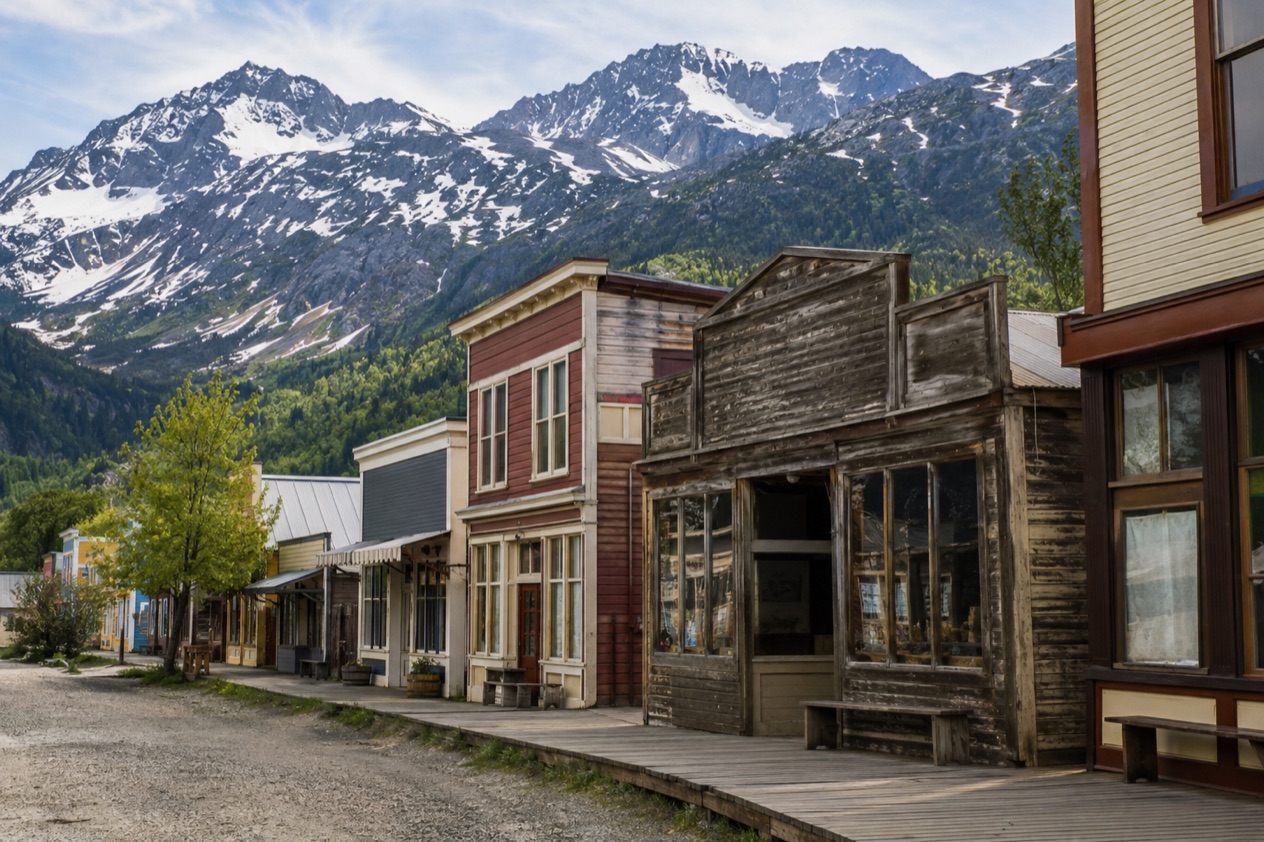
You step off the dock in Skagway and the town is already talking about 1898. Wooden boardwalks run along Broadway, false-front buildings line the street, and the old railroad depot at Second and Broadway serves as the park’s front door.
Is visiting Klondike Gold Rush National Historical Park worth it?
Yes, for anyone who likes history told on the spot where it happened, and especially for cruise passengers, families with kids who like badges and stamps, and hikers drawn to the Chilkoot Trail. The park commemorates the Klondike Gold Rush of 1897-98, and in Skagway you walk through it rather than read about it behind glass.
What sets it apart from the museums and historic towns you may know is how much of the story is still standing. The park owns 21 restored buildings in Skagway, set inside a historic district of about 100 buildings from the gold rush era. Entry costs nothing, the museums are free, and ranger programs are free too. Add Dyea, a boomtown that is now a green natural area, and the trailhead of the route that around 22,000 prospectors took toward the Yukon, and you get a visit that moves between town streets, a river valley and a mountain pass in the same story.
By summer 1898 Skagway held between 15,000 and 20,000 people, which made it the largest city in Alaska. Today it is a small town that swells in the tourist season, and the park gives it a backbone of real history under the souvenir shops.
What to see at Klondike Gold Rush National Historical Park
The visitor center and the historic district
Start in the restored rail depot at Second and Broadway, finished in December 1898. This is where you learn about the day’s programs, stamp your National Parks Passport and settle into the theater for ‘Gold Fever: Race to the Klondike,’ a 24-minute film that sets up the whole rush. Ranger chats are held daily on changing topics, sometimes in the theater and sometimes outside, and rangers tend to talk about what they care about most, which makes them livelier than a script.
Then step out onto the boardwalks. The self-guided walking tour of park buildings is .64 mile long, and the free NPS App can be downloaded to guide it. Look for the Mascot Saloon, which opened during the gold rush and closed with local prohibition in 1916. The boardwalks are uneven and slick when wet, so watch your feet.
Museums and Jeff. Smiths Parlor
Four National Park Service museums in Skagway cover gold rush history. One of them occupies the bottom floor of the White Pass & Yukon Route Railway Administration Building. The Skagway City Museum, at 7th and Spring Street, is another stop for a look at local life beyond the rush itself.
A daily tour of Jeff. Smiths Parlor Museum meets at 1 pm at 2nd Avenue and Broadway. It is limited to 14 people and needs free same-day timed-entry tickets from the visitor center, so it makes sense to stop there early in your day. The Moore Homestead is a quieter stop, telling of the first European American settlers in the area.
Dyea and the Chilkoot Trail
Dyea was a boomtown, and today it is a lush natural area where nature and history meet. Sections of the Dyea Townsite trails have been closed indefinitely after seasonal flooding of the Taiya River since 2018, and more erosion is expected, so obey the closure for your own safety.
The Chilkoot Trail begins here, 33 miles long, ending at Bennett, British Columbia, and nicknamed the meanest 33 miles in history. It is also called the world’s longest museum. Chilkoot Pass roughly marks the halfway point and the international border, and crossing the border at the pass in either direction is illegal.
Hours, tickets and rules
The park charges no entrance fee, and its museums and ranger programs are free. Outdoor exhibits are open year-round, and from October 1 to April 15 the park runs with limited services. The one thing that costs money is camping in Dyea.
| Site | Open | Admission |
|---|---|---|
| Park entrance and museums | Outdoor exhibits year-round, limited services October 1 to April 15 | Free |
| Ranger programs | Ranger chats daily | Free |
| Jeff. Smiths Parlor Museum tour | Daily at 1 pm, 14 people maximum, timed-entry ticket from the Visitor Center | Free |
| Dyea Campground | First come, first served, no reservations | $10 per site, per night |
The park no longer offers any ranger-led walking tours, so the historic district is walked on your own. The Chilkoot Trail needs a permit. Between June 1 and September 12 every overnight hiker must hold a validated permit, reserved on Recreation.gov for the U.S. side and printed ahead.
To validate it, everyone in the group attends a mandatory safety orientation at the Trail Center in Skagway, and the U.S. side fee is nonrefundable. Camping on the trail is allowed only in the designated campgrounds. Please follow the Dyea Townsite trail closure.
How to get to Klondike Gold Rush National Historical Park
Skagway sits at the northernmost point of the Inside Passage in Southeast Alaska, and you can reach it by air, sea or land. The visitor center is at 2nd and Broadway in the old White Pass & Yukon Route Depot, less than half a mile from all of the docks and three quarters of a mile from the airport.
By sea
Cruise ships dock daily in the summer season and typically stay 8 hours, which is the window cruise passengers have for the park. The Alaska Marine Highway state ferry also serves Skagway, with arrivals daily in summer (weather dependent) and several times a week in winter. Most ferries can carry large recreational vehicles. In winter the ferry schedule links Skagway with Haines and Juneau.
By air and by road
Alaska Seaplanes operates charter flights from Skagway to Juneau and other southeast Alaska towns several times a day. By road, the Klondike Highway is a 100-mile stretch connecting Skagway to Whitehorse, capital of the Yukon, so it involves international travel.
From Whitehorse, drivers can connect to the Alaska-Canadian Highway and on to highways leading to the lower 48. The Klondike Highway from Whitehorse is kept open year-round, and travelers should check current conditions with the Alaska State DOT and Yukon 511.
Once you are in town
Free all-day parking is available in an unpaved lot at Spring Street and 2nd Avenue, one block down from the visitor center, though it can fill on busy event days and holiday weekends. The Municipality of Skagway offers the SMART bus for a small fare for those needing mobility assistance. The Chilkoot Trailhead is on the U.S. side, north of the Dyea townsite, about 10 miles from Skagway, and reached by road.
When to visit Klondike Gold Rush National Historical Park
Summer, from early May to late September, is when the town is at full volume. Skagway is then a major cruise port that can see up to 11,000 visitors a day, and the population of the town doubles to handle the crowds. Boardwalks, museums and ranger chats are all part of that busy rhythm, and the Days of ’98 Show plays in the Fraternal Order of Eagles Hall.
Time of day matters in that season. Ships dock daily and stay about 8 hours, so the middle of the day tends to bring the people onto Broadway.
Visiting the museums and the film at the opening of the day, or leaning on the Dyea side while the main street is packed, are ways to find a calmer rhythm. The Jeff. Smiths Parlor tour at 1 pm sits right in the busy part of the day, so pick up your ticket early.
From October to April, Skagway is a quiet community and park operations are reduced. The park is still open, with limited services from October 1 to April 15, and outdoor exhibits stay open all year. Lodging, food services and equipment rentals in town are available year-round.
Snow cover and temperatures are highly variable in winter, and the park encourages snowshoers and cross-country skiers to go with a partner or group. For the Chilkoot Trail, the summer permit season runs June 1 to September 12.
Tips for your visit
Begin at the visitor center, where programs, tours and the film are laid out, and pick up your Jeff. Smiths Parlor ticket if you want that 1 pm tour. Then follow the self-guided walking tour of the park’s buildings with the free NPS App. Wear shoes with grip, because slips, trips and falls are the most common hazard in Skagway and the wooden boardwalks get slick when wet.
Bring extra layers, rain gear and a first aid kit, even on short hikes. Skagway has hiking trails ranging from 1 to 7 miles, with views of waterfalls, lakes and fjords. You are in bear country in the wilderness, on the trail and in town, and sightings on trails around Skagway are rare but not unheard of, so practice bear safety. The Chilkoot Trail has limited cell phone and GPS coverage.
Families can have children earn a Junior Ranger badge. Kids can plan their activities and collect their badges at the Pantheon Saloon further up Broadway, or visit the Junior Ranger Activity Center. For anyone staying more than a day, the National Park Service campground in Dyea suits a trip with multiple days in Skagway.
Combine the park with the White Pass and Yukon Route narrow gauge railroad, which starts at the port and now runs purely for the tourist trade during the summer months. Hikers heading up the Chilkoot should pick up permits and register for Customs at the Trail Center at 520 Broadway, jointly staffed by the National Park Service and Parks Canada.
Good to know before you go
Dial 911 for emergencies in town. Skagway has a medical clinic but no doctors on staff, and the nearest hospital is a mediflight to Juneau, 90 miles south, which is a good reason to take the trail hazards seriously. The park’s mailing address is P.O.
Box 517, Skagway, AK 99840. If you are traveling between October and May, the park’s winter visit information is worth a read before you plan, and for anything about the Dyea Townsite trail closure, contact the park.
Sources
- National Park Service, Klondike Gold Rush National Historical Park (Skagway), plan your visit: basicinfo (https://www.nps.gov/klgo/planyourvisit/basicinfo.htm), checked October 11, 2026
- National Park Service, Klondike Gold Rush National Historical Park (Skagway), plan your visit: conditions (https://www.nps.gov/klgo/planyourvisit/conditions.htm), checked October 11, 2026
- National Park Service, Klondike Gold Rush National Historical Park (Skagway), plan your visit: directions (https://www.nps.gov/klgo/planyourvisit/directions.htm), checked October 11, 2026
- National Park Service, Klondike Gold Rush National Historical Park (Skagway), plan your visit: fees (https://www.nps.gov/klgo/planyourvisit/fees.htm), checked October 11, 2026
- National Park Service, Klondike Gold Rush National Historical Park (Skagway), plan your visit: placestogo (https://www.nps.gov/klgo/planyourvisit/placestogo.htm), checked October 11, 2026
- National Park Service, Klondike Gold Rush National Historical Park (Skagway), plan your visit: planning your hike (https://www.nps.gov/klgo/planyourvisit/planning-your-hike.htm), checked October 11, 2026
- National Park Service, Klondike Gold Rush National Historical Park (Skagway), plan your visit: safety (https://www.nps.gov/klgo/planyourvisit/safety.htm), checked October 11, 2026
- National Park Service, Klondike Gold Rush National Historical Park (Skagway), plan your visit: things2do (https://www.nps.gov/klgo/planyourvisit/things2do.htm), checked October 11, 2026
- National Park Service, Klondike Gold Rush National Historical Park (Skagway), plan your visit: wintervisits (https://www.nps.gov/klgo/planyourvisit/wintervisits.htm), checked October 11, 2026
- Wikipedia, Klondike Gold Rush National Historical Park (https://en.wikipedia.org/wiki/Klondike_Gold_Rush_National_Historical_Park), checked October 11, 2026
- Wikipedia, Skagway, Alaska (https://en.wikipedia.org/wiki/Skagway,_Alaska), checked October 11, 2026