
In March, the boardwalks of Ketchikan are wet and quiet, and the smell of cedar, salt and diesel drifts up from the harbor where fishing boats rock at their slips. Mist hangs on the forested slopes right behind the downtown streets, and the totem poles stand dark and shining in the rain. It is late winter turning toward spring in Alaska’s rain-soaked southern gateway, a month for travelers who like their towns unhurried and their scenery moody.
What is the weather like in Ketchikan in March?
March in Ketchikan is cool, damp and gray more often than not, with temperatures that stay above freezing by day and dip to the edge of it at night.
| Month | Average high (°F) | Average low (°F) | Precipitation (in) | Days with precipitation | Daylight on the 15th |
|---|---|---|---|---|---|
| February | 40.9 | 31.5 | 11.80 | 12.9 | 9 h 37 min |
| March | 43.6 | 32.4 | 10.98 | 16.0 | 11 h 43 min |
| April | 49.8 | 37.2 | 10.25 | 14.2 | 14 h 04 min |
Rain is the main character. More than half the days of the month bring some, and it tends to arrive as steady drizzle, passing showers or a long gray soak rather than a single dramatic downpour.
Some days, now and then, the cloud lifts and the mountains across the channel appear in sharp detail, and those breaks are worth stepping outside for.
Mornings are chilly, with the low sitting just above freezing, and afternoons are raw rather than cold, the kind of air that cuts through cotton. A waterproof shell, a warm mid-layer and a hat do more than a heavy parka. By evening the damp returns, and a warm restaurant or a hot drink after dark feels earned.
The light is the quiet gift of the month. Day and night are close to even now, and the evenings are noticeably longer than they were in February, which gives you time for a late afternoon walk along the waterfront. Even under cloud, the light is soft and silvery, and it flatters the wet cedar and the painted wooden storefronts.
What to do in Ketchikan in March
March in Ketchikan is about the town itself: its totem poles, its boardwalks, its fishing harbor and the forest pressing in from every side. Ketchikan is one of the three largest cities in Southeast Alaska, yet it feels like a place where people live first and visitors come second. This is the month to walk slowly, duck into a café when the rain thickens and take in the Native art and fishing heritage without a crowd.
Ketchikan carries the nickname Salmon Capital of the World, and the harbor shows why. Working boats, floatplanes and gear piled on the docks give the waterfront a practical air that no souvenir shop can fake. Watching the harbor from a bench or a café window, with a mug of something hot, is a perfectly good morning in the rain.
Totem Bight State Historical Park
Totem Bight sits at Mile 10.5 of the North Tongass Highway, north of town, on a stretch of coastline covered by 33 acres of forest. Carved poles and a clan house stand in a clearing facing the water, and the setting does as much as the carving itself. In the March damp, the colors on the poles deepen and the moss on the surrounding trees glows green.
The historic site within the park, only a part of its grounds, was added to the National Register of Historic Places in 1970. Bring a rain shell and take your time reading the figures on each pole, since the animals and crests are the whole point. The forest path through the trees is part of the experience, and the quiet of a gray March day suits it.
Creek Street and the downtown waterfront
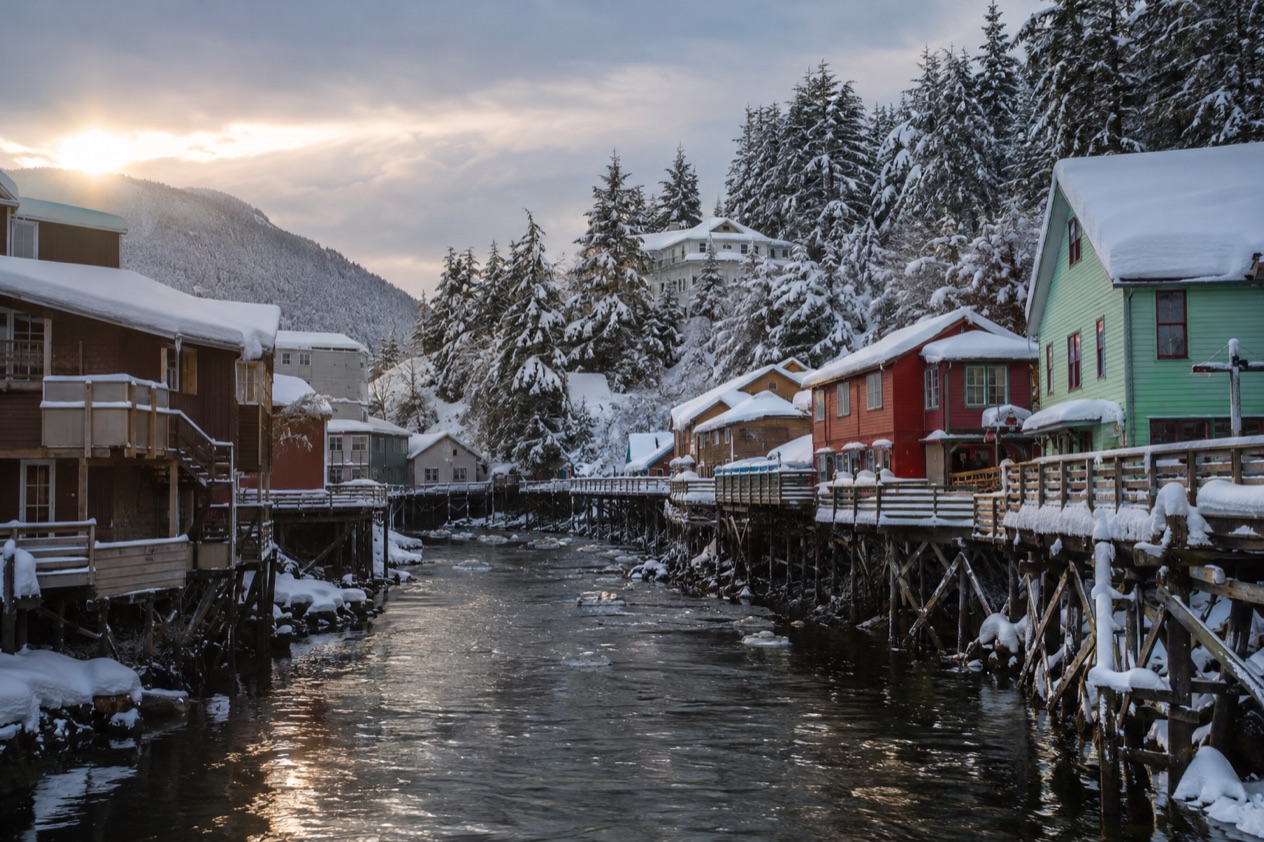
Creek Street is the postcard corner of Ketchikan, a boardwalk of wooden houses built over the water of Ketchikan Creek. Its past as the old red-light district gives the street some of its stories, and today the buildings hold small galleries and shops. In March, with fewer people on the planks, you can hear the creek running beneath your feet.
From there, the downtown streets are close together and made for wandering. Look for murals, totem poles standing on street corners, the Totem Heritage Center and the Tongass Historical Museum for the story of the Tlingit, Haida and Tsimshian peoples and of the fishing and timber economy that built the town. These are the places to pick when the rain settles in for the afternoon.
Metlakatla and the islands across the water
Metlakatla lies on Annette Island, about 16 miles south of Ketchikan, and travelers usually reach it by the Alaska Marine Highway ferry. It is a community with its own Tsimshian history and a quieter rhythm than any town on the main road system. For a traveler with spare days, the crossing itself, with water and forested islands in every direction, is part of the draw.
Prince of Wales Island is another name on the Ketchikan map. It is one of the islands of the Alexander Archipelago, with Craig as its largest community and a ferry terminal at Hollis. Both are places to think about if you are staying longer than a weekend and want to see more of the Panhandle than the town offers.
Around Ketchikan, the Tongass National Forest is the backdrop to everything. It is the largest national forest in the United States, covering 16.7 million acres of islands, fjords, glaciers and peaks, and its headquarters are in Ketchikan. In March, the forest is dripping and green, and even a short look at it from the edge of town explains why people here talk about rain with affection.
Food in a fishing town is a pleasure at any time of year. Look for seafood chowder, halibut and salmon on menus, a bakery for something warm in the morning and a pub for a pint after dark. A bowl of hot soup and a window seat above the harbor is a very Ketchikan way to spend a wet afternoon.
There is no big festival to build a March trip around, and that is part of its character. What you get instead is a town in its working rhythm, the rain on the roofs and the long evenings stretching a little further each week. For travelers who want to see Ketchikan as the people who live there do, that is the whole appeal.
A two-day itinerary for Ketchikan in March
Day 1 starts on the downtown waterfront, where the harbor wakes up before the shops do. Have breakfast at a bakery or a diner, then walk the streets near the water to see the murals, the street-corner totem poles and the working boats. By late morning, move on to Creek Street, when the boardwalk is quiet and the creek is loud.
After a lunch of chowder or fish at a harbor-side restaurant, head up the North Tongass Highway to Totem Bight State Historical Park for the afternoon. The light is soft in the afternoon and the forest is at its darkest green. Return to town for dinner at a pub or a seafood restaurant, then an early night after the damp air.
Day 2 begins with a slow breakfast and a turn through the Tongass Historical Museum and the Totem Heritage Center, which also serve as the rain plan if the weather has turned heavy. These are the places that explain what you saw the day before, and they are a comfortable way to spend the middle of a wet morning.
If the clouds lift, spend the afternoon on the forest edge near town, where the Tongass begins almost at the last street. If the rain stays, browse the galleries and shops, and stop for a long coffee or an early dinner. An evening at a restaurant overlooking the harbor, as the light fades later than it did a month ago, is a quiet way to close the trip.
Is Ketchikan busy in March?
March is a quiet month in Ketchikan, one in which the town belongs mostly to its residents. The streets near the waterfront are unhurried, and you can take your time on Creek Street and at the poles without waiting for a space.
What this means in practice is a slower pace and more room to move. Restaurants and cafés serve a local crowd, and the people who work in the shops have time to talk. Opening hours and seasonal services vary by business, so a traveler who wants a particular museum, tour or ferry should look at that place’s own schedule rather than assume it is running.
What to pack for Ketchikan in March
Pack for rain first and cold second, since damp air is the thing that gets through.
- A waterproof jacket with a hood, because rain falls on most days of the month.
- Waterproof shoes or boots with good grip, for wet boardwalks and forest paths.
- A warm mid-layer such as fleece or wool, for chilly mornings near freezing.
- A hat and light gloves, for the raw air on the waterfront.
- A small daypack cover or dry bag, to keep a camera and phone dry.
- An extra pair of socks, since feet stay wet longer than anything else.
Good to know before you go
Plan around the weather, not against it. The days are close to even in length, so there is time for outdoor stops in the middle of the day and a cozy evening afterward.
Totem Bight lies north of town along the North Tongass Highway, while Metlakatla and Prince of Wales Island sit across the water, so build the days around one outing at a time. The Forest Service has its headquarters in Ketchikan, which makes it the place to ask about the Tongass.
Ketchikan in March vs February and April
Going four weeks earlier, to February, means the shortest days of the three months, with chillier air and the dark arriving early. The town is most local then, and the rain and cold are a little less forgiving. It suits travelers who want the deepest winter quiet and do not mind a short day.
Going four weeks later, to April, brings noticeably warmer air and long evenings, with the days stretching to more than fourteen hours of light. The rain continues but the town starts to feel like it is shaking off the winter, and there is more time for walks after dinner. It suits travelers who want to be outdoors a bit longer and are ready for a livelier mood.
March sits between the two. It is the better choice for travelers who want the quiet of the off-season but with a day that is already close to even. Choose February for the deepest calm, April for more light and warmth, and March for a balance of the two.
Is March a good time to visit Ketchikan?
Yes, for travelers who enjoy a moody, rainy, local-feeling town and do not need sunshine to be happy. March suits people who like museums, Native art, a good bowl of chowder and a forest walk in a light drizzle. It is a month for photographers who love wet, dark greens and for anyone who would rather have the boardwalks to themselves.
It is not the right month for anyone who wants warm afternoons, dry trails or a trip built entirely around outdoor adventure. If the rain would spoil your mood, another month will serve you better. On arrival, start with the waterfront and Creek Street to get your bearings, then head to Totem Bight on the first dry spell.
What makes March in Ketchikan special is the way the town shows its everyday self. The poles shine in the wet, the harbor works, the evenings lengthen a little each week and the forest drips green behind every street.
Sources
- NOAA NCEI, U.S. Climate Normals 1991-2020, monthly (https://www.ncei.noaa.gov/access/services/data/v1?dataset=normals-monthly-1991-2020&stations=USW00025325), station Ketchikan Intl Ap, elevation 76 feet, checked October 11, 2026
- Computed from the date and the latitude of the place (sunrise equation, solar elevation -0.833 degrees), October 11, 2026
- Wikipedia, Totem Bight State Historical Park (https://en.wikipedia.org/wiki/Totem_Bight_State_Historical_Park), checked October 11, 2026
- Wikipedia, Prince of Wales Island (Alaska) (https://en.wikipedia.org/wiki/Prince_of_Wales_Island_(Alaska)), checked October 11, 2026
- Wikipedia, Metlakatla, Alaska (https://en.wikipedia.org/wiki/Metlakatla,_Alaska), checked October 11, 2026
- Wikipedia, Tongass National Forest (https://en.wikipedia.org/wiki/Tongass_National_Forest), checked October 11, 2026
- Wikipedia, Southeast Alaska (https://en.wikipedia.org/wiki/Southeast_Alaska), checked October 11, 2026
- Wikipedia, Climate of Alaska (https://en.wikipedia.org/wiki/Climate_of_Alaska), checked October 11, 2026
To plan your stay
- Things to Do in Ketchikan: Totem Poles, Creek Street, Misty Fjords and Fresh Seafood
- Where to Stay in Ketchikan: Downtown, Ward Cove and How to Choose Your Base
- Ketchikan from Seattle: Ferry from Bellingham, Flights, Cruise Docks and What to Do on Arrival
- Know Before You Go to Ketchikan: Rain, Cruise Docks, Bears and Local Customs