
In December, Ketchikan’s waterfront shines wet and dark by mid-afternoon, with holiday lights reflected in the puddles and the harbor, and the steep streets smell of woodsmoke and coffee. Cloud hangs low on the forested hills behind town, and the rain becomes part of the scenery. It is a month for travelers who like a rainforest town at its most inward, with cozy cafés, carved poles shining in the wet and plenty of time to walk.
What is the weather like in Ketchikan in December?
December in Ketchikan is cold, wet and dark, though the temperature stays close to freezing rather than far below it. Rain is the normal state of things, and the days are short.
| Month | Average high (°F) | Average low (°F) | Precipitation (in) | Days with precipitation | Daylight on the 15th |
|---|---|---|---|---|---|
| November | 43.7 | 35.6 | 17.07 | 19.5 | 8 h 25 min |
| December | 40.2 | 32.6 | 16.27 | 17.7 | 7 h 09 min |
| January | 39.7 | 31.5 | 16.17 | 17.1 | 7 h 41 min |
Mornings start near freezing, and the afternoons barely warm beyond a chilly raw damp. That is the kind of cold that gets through a thin jacket, so a warm base layer under a waterproof shell matters more than a heavy parka. Some of the precipitation may fall as wet snow, but in town it is mostly rain, and it often comes as a steady drizzle rather than a dramatic downpour.
More days than not bring something wet, so plan around it rather than waiting it out. Daylight is a little over seven hours at mid-month, which means a late, soft sunrise and an early dusk, and the light has a low, slanting quality even when it is gray.
Evenings are for lit windows, restaurants and warm interiors. In practice that means a hat, gloves and boots with real grip for wet boardwalks and sloping sidewalks.
What to do in Ketchikan in December
The best of Ketchikan in December is slow and close to the ground: totem poles in the rain, a stroll along a boardwalk street, a long lunch of local seafood, and an evening with the town’s holiday lights. Ketchikan is one of the largest cities in Southeast Alaska, so it has real restaurants, a working harbor and a year-round community, and the pace in winter belongs to the people who live here.
The season suits indoor stops and short outdoor ones strung together. Think of the day as a series of dry-or-not-dry windows, each filled with a museum, a café, a carving or a view. Christmas decorations go up around town, and the dark afternoons give the lights something to work against.
Totem Bight State Historical Park
Totem Bight sits at Mile 10.5 of the North Tongass Highway, north of Ketchikan, on 33 acres of coastal forest. It is a collection of carved poles and a clan house set among spruce and hemlock, with the water just beyond the trees. The historic site within the park is listed on the National Register of Historic Places.
In December the place feels very different from a bright summer day. The poles stand dark and glossy with rain, the moss glows green, and the forest is quiet enough that you hear water dripping from the branches. The painted colors read more strongly against the gray, and the low light makes the carved faces seem to lean out of the wood.
It suits anyone who wants the cultural heart of the area, and it rewards slow looking. Bring waterproof footwear, because the paths through the trees are soggy this time of year, and leave time for the stretch between the poles and the shoreline.
Creek Street and the downtown waterfront
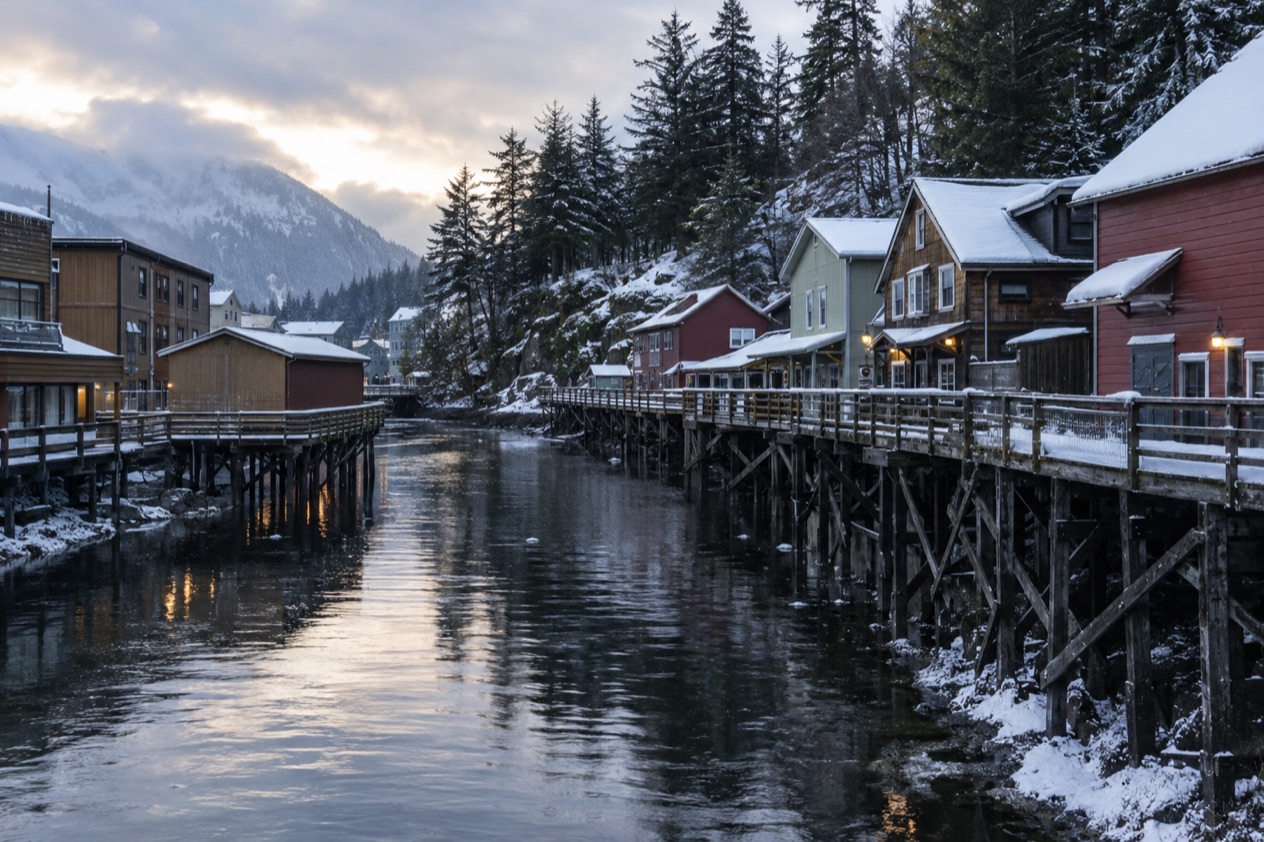
Creek Street is the boardwalk row of colorful wooden buildings on pilings above the creek, and it is the picture people carry of Ketchikan. In winter it is calm, the creek runs loud with the rain, and the shops and galleries that stay open feel like small refuges. Wet boards can be slick, so the pace is naturally slower.
Along the downtown waterfront, the town spreads between the harbor and the steep hillside, with stairways and narrow streets climbing between houses. Pair a walk here with a museum stop when the rain gets serious.
Museums, culture and the Tongass
Ketchikan is also the base for the Tongass National Forest, the largest national forest in the country, which spreads over the islands, fjords and glaciers of Southeast Alaska. The Forest Service administers it from offices right in Ketchikan, and the town’s interpretive and historical museums are good ways to understand the forest and the Native peoples who have lived beside it for generations, among them the Tlingit, Haida and Tsimshian.
These indoor stops are what December asks for. You can spend a gray afternoon learning how cedar becomes a pole or a canoe, how salmon shaped the economy, and how the town grew up on the water.
Food leans on the sea. Look for halibut, salmon, crab and chowder on winter menus, plus warm baked goods and strong coffee when you come in from the damp. Smoked salmon is a natural souvenir and a good picnic item if there is a dry hour.
Farther afield, Metlakatla lies on Annette Island, about 16 miles south of Ketchikan, and travelers usually reach it by Alaska Marine Highway ferry. Prince of Wales Island, in the Alexander Archipelago, has Craig as its largest community and a ferry terminal at Hollis. Both are places to know about, but December days are short, so treat them as a different kind of trip rather than a quick add-on.
A two-day itinerary for Ketchikan in December
Day 1 is for downtown and the culture of the place. Start with coffee and a bakery breakfast near the waterfront while the light slowly comes up behind the cloud. Walk Creek Street while it is quiet, peek into the galleries, and then keep to the compact streets near the harbor so you can duck inside at the first heavy rain.
Midday belongs to a museum and a seafood lunch, a bowl of chowder or a fish plate in a warm dining room. In the afternoon, when the light is already fading, take a slow loop up the staircase streets for views over the harbor and the lit-up waterfront. Dinner at a pub or a restaurant with a window onto the water closes the day.
Day 2 goes to the forest and the poles. Head out on the North Tongass Highway toward Totem Bight in the early part of the day, because daylight is short and the carvings look best while there is still some brightness in the sky. Give yourself time on the paths, then follow the shoreline and the trees back to the water.
After lunch, return to town for the indoor hours: a second museum or the visitor and forest interpretive stops, a coffee stop and some shopping for smoked fish or local crafts. Rain card for either day: stay in the museums, cafés and galleries, and let the afternoon become a long meal. Evening is for a last dinner and a look at the lights.
Is Ketchikan busy in December?
No, December is a quiet month in Ketchikan, and the town belongs mostly to its residents. Even so, Ketchikan is one of the largest cities in Southeast Alaska, so it keeps its restaurants, shops and harbor life going through the dark months.
What that means for a visitor is a slower rhythm: space on the boardwalks, time to talk with shopkeepers, and a town that feels lived in rather than staged. Some seasonal businesses will not be open in winter, so what you find is the everyday town, with its holiday decorations and its community events. Short days push most activity into the middle hours, and evenings revolve around restaurants, pubs and home.
What to pack for Ketchikan in December
Pack for wet cold rather than deep cold, and for lots of walking on damp surfaces. Layers matter more than a single heavy coat.
- A waterproof jacket with a hood, because rain falls on most days.
- Waterproof pants, for boardwalks, forest paths and waiting for a ride.
- Waterproof boots with good grip, since wood and stairs get slick.
- Warm layers such as wool or fleece, for mornings near freezing.
- A hat and gloves, for the raw damp of the afternoon.
- A small headlamp or flashlight, for the early dusk.
Good to know before you go
Daylight is the thing to plan around in December: a little over seven hours at mid-month means you do your outdoor stops in the middle of the day and keep evenings for dining. Some seasonal tours and shops close for winter, and holiday days may change what is open, so build your days around the places that stay put, such as the museums, the waterfront and the park with the totem poles.
Getting around is easiest to think of in terms of places: downtown is compact, Totem Bight lies along the North Tongass Highway, and Metlakatla and Prince of Wales Island are separate island trips. Rain gear matters more than any other piece of preparation.
Ketchikan in December vs November and January
Moving the trip four weeks earlier gives you a bit more daylight and slightly milder air, and the rain falls on even more days. November is still gray and wet, but the hours of light are noticeably longer, so a museum morning and a forest afternoon fit together more comfortably. The holiday mood is not yet in the streets, though, and the town feels closer to autumn than to winter.
Moving four weeks later brings a touch more cold and the daylight begins to stretch again, with a few more minutes each week. January is slightly less wet and the holiday decorations are coming down, so the town settles into plain winter. The mood is calmer and less festive, and it suits anyone who wants quiet more than lights.
Choose December if you want the holiday atmosphere, with lights in the wet dark and a warm café around every corner. Choose November if you want more hours of light for the forest and the poles, and choose January if you prefer a stripped-down winter and less in the way of seasonal decoration.
Is December a good time to visit Ketchikan?
Yes, for travelers who enjoy a quiet rainforest town in winter and do not mind short, wet days. It is a month for slow walks, museums, seafood and carved poles glistening in the rain, not for long outdoor expeditions.
You will love December here if you like cozy interiors, moody light and a town at its own pace. If you want long days, boat trips and wide-open scenery, another month will serve you better. Come with realistic expectations about the weather and a good waterproof layer, and the town rewards you.
On arrival, drop your bags and head straight for the waterfront and Creek Street while there is still daylight, then plan the totem poles for the next morning. What makes December special in Ketchikan is the combination of dark, glossy cedar and a harbor lit up for the holidays, with rain falling softly on both.
Sources
- NOAA NCEI, U.S. Climate Normals 1991-2020, monthly (https://www.ncei.noaa.gov/access/services/data/v1?dataset=normals-monthly-1991-2020&stations=USW00025325), station Ketchikan Intl Ap, elevation 76 feet, checked October 11, 2026
- Computed from the date and the latitude of the place (sunrise equation, solar elevation -0.833 degrees), October 11, 2026
- Wikipedia, Totem Bight State Historical Park (https://en.wikipedia.org/wiki/Totem_Bight_State_Historical_Park), checked October 11, 2026
- Wikipedia, Prince of Wales Island (Alaska) (https://en.wikipedia.org/wiki/Prince_of_Wales_Island_(Alaska)), checked October 11, 2026
- Wikipedia, Metlakatla, Alaska (https://en.wikipedia.org/wiki/Metlakatla,_Alaska), checked October 11, 2026
- Wikipedia, Tongass National Forest (https://en.wikipedia.org/wiki/Tongass_National_Forest), checked October 11, 2026
- Wikipedia, Southeast Alaska (https://en.wikipedia.org/wiki/Southeast_Alaska), checked October 11, 2026
- Wikipedia, Climate of Alaska (https://en.wikipedia.org/wiki/Climate_of_Alaska), checked October 11, 2026
To plan your stay
- Things to Do in Ketchikan: Totem Poles, Creek Street, Misty Fjords and Fresh Seafood
- Where to Stay in Ketchikan: Downtown, Ward Cove and How to Choose Your Base
- Ketchikan from Seattle: Ferry from Bellingham, Flights, Cruise Docks and What to Do on Arrival
- Know Before You Go to Ketchikan: Rain, Cruise Docks, Bears and Local Customs