
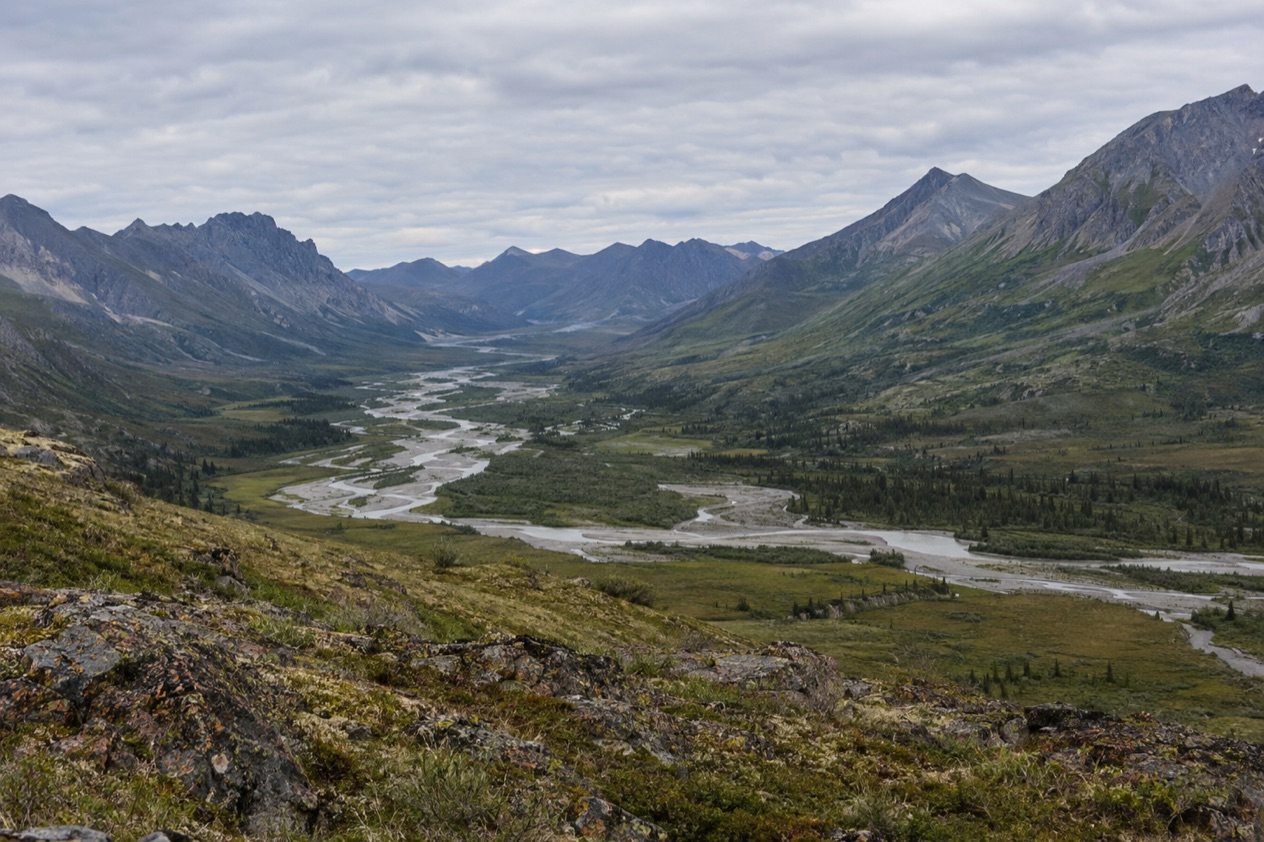
You step out of a small floatplane onto a gravel bar, the engine noise fades, and for a while there is nothing to hear but a river. No sign, no trail, no building: only mountains, tundra and spruce running off in every direction. Gates of the Arctic is a park you walk into on your own terms, built for people who want solitude and are ready to earn it.
Is visiting Gates of the Arctic National Park worth it?
It is worth it for self-reliant travelers who want wilderness with nothing in between, and not for anyone who wants a visitor center, a lodge or a marked path. The park sits entirely north of the Arctic Circle in the central Brooks Range, and it protects towering mountains, tundra, boreal forest, coastal plains, icy rivers and lakes. The National Park Service describes the experience as solitude, self-reliance and nature on its own terms, and that is an accurate summary.
What sets it apart from other Alaska parks is the absence of everything. There are no roads, no trails, no established campsites and no services, and cell phones do not work.
It is the northernmost national park in the country and the least visited, so the reward is quiet on a scale that is hard to find even elsewhere in Alaska. The cost is planning: you arrive by air or on foot, you carry your own food in a bear-resistant container, and you accept that the weather decides when planes fly.
If that sounds like a chore, there is a gentler way in. Local air taxis offer flight-seeing trips, day trips and overnight camp-outs at remote spots, which gives you a taste of the Brooks Range without a week of route-finding.
What to see at Gates of the Arctic National Park
There is no list of viewpoints here, because the park is the view.
The rivers of the Brooks Range
Six national Wild and Scenic Rivers run through the park: the Alatna, the John, the Kobuk, the North Fork of the Koyukuk, the Tinayguk and part of the Noatak. They are the natural highways of this country, cutting valleys through the mountains and drawing the eye along gravel bars and willow thickets. Many backcountry trips are built around one of them.
Look for the way the water changes the land: braided channels in wide valleys, clear cold pools below tundra banks, and spruce forest thinning out toward the treeless slopes. Rivers also mean crossings, which the park lists as a real part of reaching it on foot, so they are as much a challenge as a scenery.
Tundra, mountains and forest on foot
Walking here means picking your own line across open country. Experienced hikers consider six miles a good day’s travel, which tells you how much effort the terrain asks for: tussocks, willow, bogs and creek crossings, with no path to follow. The reward is long open views over ridges and valleys where you may not see another person.
The ecosystem is fragile, with a short growing season and permafrost, so every footprint matters. Antlers and fossils stay where you find them (antlers give small mammals calcium), and picking plants or flowers is illegal. Cabins, caches, traplines and fishnets you may come across belong to someone and should be left alone.
Anaktuvuk Pass and the Native heritage of the land
Anaktuvuk Pass is a village with a ranger station, and you can walk into the park from its airstrip. Descendants of the area’s ancient residents still use the land and its resources for subsistence, so this is a living landscape and not an empty one. If you pass through, be sensitive to local life and ask before photographing people.
Native land surrounds the airstrip for several miles. You may cross it to reach the park, but ask permission before camping there. Prehistoric or historic sites you spot should be left undisturbed and reported to park staff.
Hours, tickets and rules
Gates of the Arctic has no entrance fee and no gate, and no permit is needed to enter, though certain activities may require one. The one staffed place nearby that keeps seasonal hours is the Arctic Interagency Visitor Center in Coldfoot, open from late May to early September. The ranger stations in Bettles and Anaktuvuk Pass and the Public Lands Information Center in Fairbanks are the other places to pick up a bear container and a briefing.
| Site | Open | Admission |
|---|---|---|
| Gates of the Arctic National Park and Preserve | Always accessible, no gate | Free |
| Arctic Interagency Visitor Center, Coldfoot | Late May to early September | Free |
Rules the park states: groups are limited to 10 people, and nonprofit, educational, commercial or guided groups must contact the park several months before travel for permits. Bear-resistant food containers are required for overnight visits and can be borrowed free, first come, first served. Pets must be leashed or physically restrained at all times.
Campfires are allowed only on durable surfaces, except in emergencies. Human waste goes in a cat hole 6 to 8 inches deep and 200 feet from any water. Firearms are legal but may be discharged only in defense of life or property. Removing most natural objects and cultural artifacts is illegal.
How to get to Gates of the Arctic National Park
There are no roads or trails into the park, so you fly or hike in, and access begins in Fairbanks. Visitors go by air taxi in small aircraft fitted with floats or tundra tires, which land on lakes, rivers and gravel bars deep in the Brooks Range.
Flying in from Fairbanks
Several small airlines in Fairbanks run daily flights to the gateway communities of Bettles and Anaktuvuk Pass, and flag stops to Coldfoot. Anaktuvuk Pass is the same: no road, a daily flight from Fairbanks, and a walk into the park from the airstrip.
From those villages, air taxis take you farther. They offer flight-seeing, day trips and overnight camp-outs, and they can also carry visitors to neighboring Kobuk Valley National Park for a passport stamp. Air taxis often cannot fly in bad weather, so bring extra food and leave room in your schedule for weather days.
Hiking in from the Dalton Highway
Coldfoot is 280 miles north of Fairbanks on the Dalton Highway, a mostly unpaved, two-lane industrial road with no amenities or services. The highway comes within five miles of the park’s eastern boundary, but reaching the park from the road takes a river crossing. There are no trails from any location, and river crossings are necessary both from the Dalton Highway and from Anaktuvuk Pass.
Informal ATV trails exist to and from Anaktuvuk Pass, but they are not park trails. Whichever way you go, you are navigating by map and judgment.
When to visit Gates of the Arctic National Park
June through August is the best and safest time to visit. Those are the months when hiking, river travel and flights make the most sense, and when the Coldfoot visitor center, open from late May to early September, is staffed for a briefing. The park’s growing season is short, so summer is also when the tundra and forest are most alive.
April, May and September are described as bearable for hearty souls. Snow can fall at any time of year, so a summer trip still needs warm, waterproof layers and a plan for a gray, cold spell. Weather also decides air taxi flying, which means a day in camp is part of the schedule and not a failure.
There is no hour-by-hour rhythm of crowds here, since the park is the least visited in the country. The practical timing is seasonal: pick the months when planes fly reliably, and give yourself spare days at both ends of the trip.
Tips for your visit
Start with the orientation. The park asks visitors to stop at a visitor center for a backcountry briefing on weather, fire, wildlife, bear safety and Leave No Trace, and to fill out the voluntary backcountry registration form and leave it with a dependable person. Commercial transporters must make sure their clients can receive that briefing from rangers before entering.
Pack as if no one can reach you quickly, because that is true. Cell phones do not work, and the National Park Service recommends two forms of communication, such as a satellite phone or satellite messaging device.
Visitors must be able to care for themselves and their partners and to extract themselves in an emergency. Bring extra food for weather days and a bear-resistant container, which you can borrow at Bettles, Coldfoot, Anaktuvuk Pass or Fairbanks.
Plan distance modestly: six miles is a good day for experienced hikers. For a first look at the park without a long trek, a flight-seeing trip or an air taxi day trip is the option the park names.
There are no developed lodgings or campsites, though camping is allowed throughout the park, and it may be restricted by easements where you cross Native Corporation lands. Hunting is a separate matter: sport hunting is allowed only in the preserve portion, and in the park only subsistence hunting by local rural residents is permitted.
Good to know before you go
There are no amenities or services in the preserve, so everything you need comes in with you and goes out with you. Practice Leave No Trace, keep a respectful distance from private cabins and caches, and read the park’s bear safety information before you leave. Fairbanks is where the park headquarters sits and where the planning starts. No fees are charged to enter, so there is nothing to pay at the park itself.
Sources
- National Park Service, Gates of the Arctic National Park & Preserve, plan your visit: backpackingandhiking (https://www.nps.gov/gaar/planyourvisit/backpackingandhiking.htm), checked October 11, 2026
- National Park Service, Gates of the Arctic National Park & Preserve, plan your visit: basicinfo (https://www.nps.gov/gaar/planyourvisit/basicinfo.htm), checked October 11, 2026
- National Park Service, Gates of the Arctic National Park & Preserve, plan your visit: bcorientation (https://www.nps.gov/gaar/planyourvisit/bcorientation.htm), checked October 11, 2026
- National Park Service, Gates of the Arctic National Park & Preserve, plan your visit: conditions (https://www.nps.gov/gaar/planyourvisit/conditions.htm), checked October 11, 2026
- National Park Service, Gates of the Arctic National Park & Preserve, plan your visit: directions (https://www.nps.gov/gaar/planyourvisit/directions.htm), checked October 11, 2026
- National Park Service, Gates of the Arctic National Park & Preserve, plan your visit: fees (https://www.nps.gov/gaar/planyourvisit/fees.htm), checked October 11, 2026
- Wikipedia, Gates of the Arctic National Park and Preserve (https://en.wikipedia.org/wiki/Gates_of_the_Arctic_National_Park_and_Preserve), checked October 11, 2026
- Wikivoyage, Gates of the Arctic National Park (https://en.wikivoyage.org/wiki/Gates_of_the_Arctic_National_Park), checked October 11, 2026