
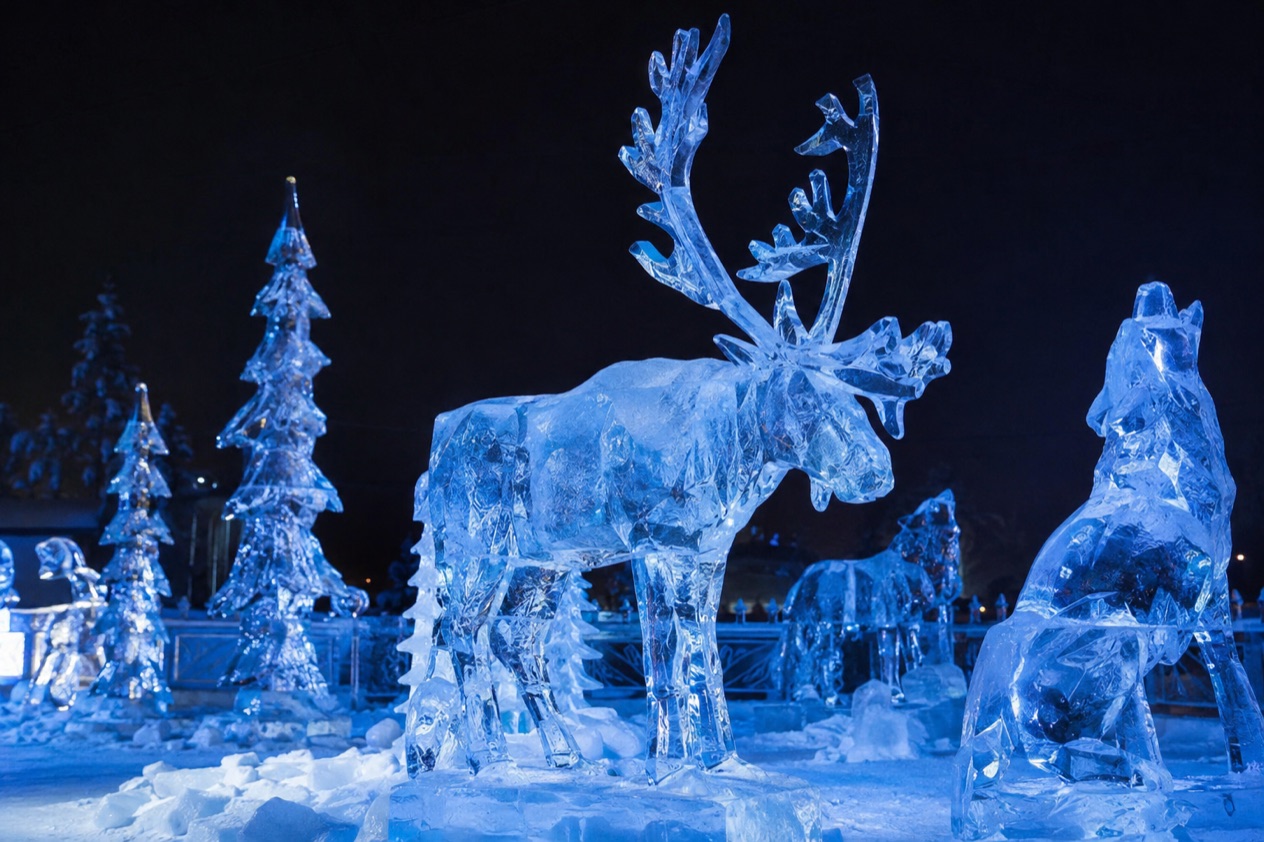
On a Fairbanks night in late winter, the fairgrounds glow with colored light, and blocks of ice the size of small cars slowly turn into dragons, dancers and horses under the carvers’ chisels. Visitors wander between the sculptures with cold cheeks and steaming cups, and children vanish down ice slides. The World Ice Art Championships is Fairbanks’s big winter event for sculpture, and it unfolds over several weeks from mid-February into March.
What are the World Ice Art Championships?
The World Ice Art Championships is an ice sculpting contest in Fairbanks, produced by Ice Alaska, a non-profit corporation started in 1989. The contest is the largest of its kind in the world, attended by more than 100 sculptors from 30 countries every year. Carvers arrive from far-off places to work in a medium that disappears each spring, and that gives the whole event a feel of something made to be seen now.
Ice Alaska runs the event, and the tourism side of Fairbanks describes more than 80 ice sculptures by international carvers on display during the championships. The sculptures are the heart of the visit, but the grounds also hold a park built for children, so the day suits people who are not in a hurry.
The competitions, block by block
The contest is divided by the amount of ice each artist or team receives, and the differences shape what you see. The Single Block Classic is open to 30 contestants. Each artist gets one block of ice measuring 6 by 4 by 3 feet, roughly 1,720 pounds, and 48 hours to make a sculpture. Single block pieces tend to be a single concentrated idea, finished within a couple of days.
The Double Block Classic is open to 25 teams of two artists. Each team receives two of those blocks, roughly 3,440 pounds of ice, and 72 hours. The Multi-Block Classic is the grand format: 15 teams of four artists, each with nine blocks, roughly 15,490 pounds, and 132 hours. Work at that scale is a joint effort, with sections stacked and joined into large sculptures.
| Competition | Entrants | Blocks per entry | Time to carve |
|---|---|---|---|
| Single Block Classic | 30 contestants | 1 block (about 1,720 lbs) | 48 hours |
| Double Block Classic | 25 teams of 2 | 2 blocks (about 3,440 lbs) | 72 hours |
| Multi-Block Classic | 15 teams of 4 | 9 blocks (about 15,490 lbs) | 132 hours |
The Youth Classic
Young carvers have their own competition. The Youth Classic is open to students in grades 8 through 12, with teams of one or two carvers. It is held during the week of school spring break, usually the second week of March, so it comes after the main adult contests.
It is a good reminder that this is a community event as much as an international one. Local teenagers work in the same medium as the visiting masters, and the Youth Classic closes the competition calendar.
Recent winners
In the 2026 Multi-block Competition, the Philippines took first place, Mongolia second and the USA third. In the Double Block Competition, Mongolia took first and second places, and Japan took third. In the Single Block Competition, Mongolia swept all top three places.
Where and when are they held?
The championships are held in Fairbanks, and since 2018 they have taken place at the Tanana Valley State Fairgrounds. The event begins in mid-February and, weather permitting, lasts until the end of March. Ice art sculptures are displayed around Fairbanks from mid-February to the end of March, so the season stretches across the late-winter weeks.
Because the sculptures are made of ice, the weather decides how long they last. Carving happens first, and the finished work stays on view for as long as conditions allow, which is why the end of the season is described with a “weather permitting”.
The 2027 schedule
In 2027 the competitions follow one another in a clear sequence, each one ending with an Awards Night. The Multi Block Competition opens first, and the Double Block and Single Block rounds follow. All times are Alaska Standard Time.
| Event (2027) | Starts | Ends | Awards Night |
|---|---|---|---|
| Multi Block Competition | Monday, February 15, 8 AM | Saturday, February 20, 8 PM | Sunday, February 21, 8 PM |
| Double Block Competition | Tuesday, February 23, 8 AM | Thursday, February 25, 8 PM | Friday, February 26, 8 PM |
| Single Block Competition | Sunday, February 28, 8 AM | Tuesday, March 2, 8 PM | Wednesday, March 3, 8 PM |
| Fairbanks Open | Sunday, February 28, 8 AM | Tuesday, March 2, 8 PM | Wednesday, March 3, 8 PM |
| Youth Classic | Competition Tuesday, March 9, 10 AM (registration and class Monday, March 8, 1 PM to 6 PM) | Thursday, March 11, 6 PM | Friday, March 12, 7 PM |
The Fairbanks Open runs at the same time as the Single Block Competition, so the last days of February and the first days of March are a busy stretch on the fairgrounds. Anyone who wants to watch carvers at work, rather than only the finished pieces, can aim for the competition days between the starting and ending times in the table.
Other winter events in the same weeks
The ice season overlaps with other winter happenings. Denali Winterfest runs from the end of February to the beginning of March in Denali National Park, with dog sledding, a 5K race, snowshoeing, hiking and park ranger programs.
In mid-March, the Open North American Championship sled dog race takes place in Fairbanks. Teams race two 20.9-mile heats and one 28.6-mile heat. For travelers who like to combine sculpture with sled dogs, the late-winter calendar gives both. For a different winter mood, the Winter Solstice Celebration in Downtown Fairbanks takes place during the week of December 21, with fireworks that cannot be seen in the summertime.
What can visitors see?
Visitors see ice sculptures by carvers from around the world, ice slides and an ice playground, all set up on the fairgrounds. The tourism side of Fairbanks counts more than 80 ice sculptures by international carvers, and the International Ice Art Classic is described as featuring numerous sculptures, ice slides and an ice playground.
The sculptures
The main attraction is the ice itself. Single block pieces are compact, and the multi-block entries rise much larger, built from nine blocks by a team of four. Walking among them, you can compare how different carvers treat the same material: some leave the ice clear and glassy, others cut it into fine detail.
The sculptures are shown on the fairgrounds, and ice art is displayed around Fairbanks from mid-February to the end of March. Standing beside a block that weighs well over a ton before it is carved gives a sense of scale that photographs rarely catch.
The Kids Park
The event features a Kids Park sculpted out of ice. It includes ice slides, an ice maze, an ice rink and spinning cups.
For families, the park gives the visit a rhythm: a stroll among the carvings, then a stop at the slides or the maze. It also makes the outing easy to pace for people who tire of looking at sculpture.
Watching the carving and the awards
Because each competition has set carving hours, the grounds look different depending on the day. At the start, blocks stand untouched. Midway, chips fly and shapes emerge. By the end, finished works wait for the judges and for Awards Night, when the winners are announced. Ice Alaska’s toll-free number is 1 (833) 4ICEART (442-3278), for anyone who wants to ask the organizers about the event.
Good to know before you go
The sculptures are made of ice and the event is held in late winter, so the calendar depends on the weather, and the end of March is only reached if conditions permit. The 2027 dates above are given in Alaska Standard Time. A visit to the fairgrounds is an outdoor visit in a Fairbanks winter, so plan the day around cold and the daylight hours rather than around a long single stretch outside.
Sources
- Ice Alaska, World Ice Art Championships (https://icealaska.com/), checked October 11, 2026
- Wikipedia, World Ice Art Championships (https://en.wikipedia.org/wiki/World_Ice_Art_Championships), checked October 11, 2026
- Explore Fairbanks, winter events (https://www.explorefairbanks.com/events/winter-events/), checked October 11, 2026
To plan your stay
- Alaska State Fair: Giant Cabbages, Fair Food, Exhibits and Getting to Palmer
- Fur Rendezvous (Fur Rondy): Sled Dog Races, Reindeer Run, Outhouse Races and Dates
- Iditarod Sled Dog Race: Anchorage Start, the Trail to Nome and How to Follow It
- Nenana Ice Classic: The Tripod, the Ticket Window and How Visitors Can Join In