
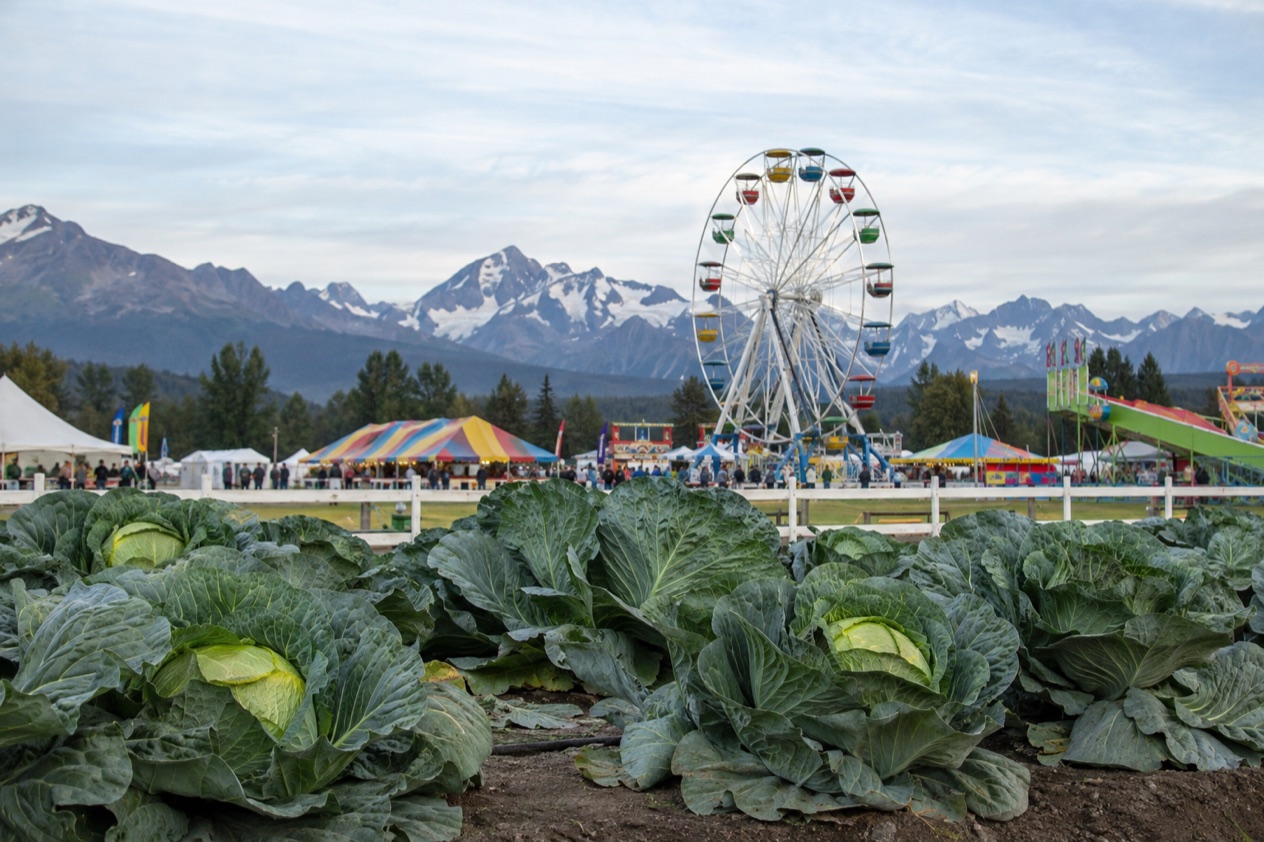
Under the Chugach Mountains, a crowd gathers around a scale where a cabbage far too big to lift by hand is being weighed, and the announcer is calling out the numbers. Corn dogs, gyros and funnel cake scent the air, and the Ferris wheel turns behind the vegetable barns. That is the Alaska State Fair in Palmer, an annual late-summer gathering for travelers who want to see how Alaskans grow, bake, build and celebrate.
What is the Alaska State Fair?
The Alaska State Fair is an annual event in Palmer that combines a classic American fair with a showcase of Alaska’s farming valley. There are amusement rides, carnival games, food concessions, live performances and competitive exhibits, all gathered on one set of fairgrounds with mountains for a backdrop.
It is a fair of two moods. One is the bright, noisy midway, with rides and games and the sound of live music drifting between buildings. The other is quieter and more local: long rows of jars, quilts, flowers and photographs that neighbors have worked on all year, each with a ribbon or a hopeful tag.
The giant vegetables
The fair is famous for its record-setting giant vegetables, and the cabbage is the star. The Giant Cabbage Weigh-Off has been an official event since 1995, and it draws growers who have coaxed their heads of cabbage to enormous size in the long summer light of the Matanuska-Susitna Valley.
Watching a weigh-off is a pleasure even if you have never grown anything. The vegetables are hauled in, lined up and measured against one another, and the growers stand by with the pride of people who have babied a plant since spring. Pumpkins, squash and other oversized produce share the stage, so a walk through the exhibit halls often feels like visiting a garden built for giants.
| Year | Cabbage result |
|---|---|
| 2008 | 79.1 lb, first place and a $2,000 prize for Scott Robb |
| 2012 | 138.25 lb, a record-setting cabbage |
Competitions beyond the garden
The contest list is wide. Categories include artwork, baking, canning, ceramics, dance, fiber and fleece, flowers, gardening, handiwork, home-brewing, livestock, music, photography, quilting and woodworking. That mix tells you what the fair is really about: a community showing off the skills of long winters and short, productive summers.
For a visitor, the exhibit buildings are the part of the fair that feels most specific to Alaska. You can study a prize quilt stitch by stitch, look at jars of canned salmon and preserves lined up like jewels, and see livestock being prepared for judging. It is slower than the midway, and it is where conversations with local exhibitors tend to start.
Where and when is it held?
The Alaska State Fair is held on the state fairgrounds in Palmer, at the foot of the Chugach Mountains in the Matanuska-Susitna Valley. It runs for about 12 days in late August and early September, so it marks the turn from summer toward fall.
Palmer and the fairgrounds
Palmer is a city in the Matanuska-Susitna Borough, on the Glenn Highway, 42 miles northeast of Anchorage. It is a farming town at heart, and the fair is its big annual moment. The fairgrounds also hold Hermon Brothers Field, where the Mat-Su Miners, a collegiate summer baseball team, play their home games.
The setting is part of the appeal. Peaks rise behind the rides and barns, and the valley around the fairgrounds is the same farmland that grows the entries inside. Palmer is also home to the National Tsunami Warning Center, a quiet bit of trivia for a town best known to visitors for cabbages.
Dates and the turn of the season
The fair arrives as summer in the valley is winding down. Exact dates shift from one year to the next, so think of it as a late-August event that stretches into early September. For the Palmer and Wasilla area, that timing overlaps with the you-pick farm season in August or early September, so a fair visit pairs naturally with fresh produce.
It also overlaps with the start of the northern lights season in the Palmer and Wasilla area, which runs from late August through mid-April. That is a chance rather than a promise, but it means a late evening after the fair may offer a look at the sky.
Getting to Palmer from Anchorage
Palmer lies about one hour north of Anchorage. To drive, take the Glenn Highway north and follow the off-ramp toward Palmer. Palmer Municipal Airport has no regularly scheduled service, so most arrivals are by road.
The Alaska Railroad has run a special train from Anchorage to Palmer, but only when the fair operates, and it did not run in 2021. If you want to ride it, that is a question for the railroad for the dates of your trip.
Wasilla sits on the Parks Highway, and the Alaska Railroad’s Denali Star train serves it from Anchorage, Talkeetna, Denali and Fairbanks. Palmer and Wasilla are each about 45 minutes from downtown Anchorage, which makes them natural neighbors for a combined day or a short stay.
What can visitors do?
Visitors can eat, ride, watch, shop and wander through exhibits, and the fair is big enough to fill a whole day. The range runs from the carnival midway to livestock barns, with live performances in between.
Eating your way through the grounds
Between 50 and 70 food vendors typically attend, serving hot dogs, pizza, burgers, nachos, gyros and Alaskan seafood. The classic fair strategy is to graze: one stand for something fried, another for something sweet, and a seafood plate when you want a taste of the state.
Alaskan seafood is the item that sets the menu apart from fairs elsewhere. Pair it with a walk through the exhibit halls, where canned and baked entries show what the same kitchens can do at home. Eating is also an easy way to rest between rides and shows.
Rides, games, music and shopping
The midway has amusement rides and carnival games, with live performances adding music and dance through the days. Children usually head straight for the rides, while adults tend to drift toward the stages and the produce barns. The fair works well for a mixed group because each person can follow a different thread and meet up for a snack.
More than 400 retail stalls and vendors set up each year, selling items that are not food. Browsing them is a pleasant way to pass an hour, and the booths range widely, so it is worth walking the rows once before buying anything.
Around Palmer and Wasilla
A fair day can become a valley day. Hatcher Pass, a state park with Independence Mine, lies about 22 miles north of Palmer, and Independence Mine Historical State Park sits in the Talkeetna Mountains between Willow and Palmer. Matanuska Glacier is an hour beyond Palmer for those who want ice and mountains instead of rides.
Closer to the fair, you-pick farms in the Palmer and Wasilla area are open in August or early September, and Bodenburg Butte is a family hike with views of Knik Glacier and Pioneer Peak. Any of these can balance a day of crowds and noise with something quieter, and they show the valley that grows the fair’s famous giants.
Good to know before you go
The fair is a late-summer outing with a changing date window, so plan around a mix of food, exhibits and stage time rather than a rigid schedule. Bring an appetite and some patience for the barns, where the best details are on the tags and ribbons. Since the Alaska Railroad’s fair train runs only when the fair does, the road from Anchorage is the dependable thread of the plan, and Palmer’s farms, hikes and mountains give a second day somewhere to go.
Sources
- Wikipedia, Alaska State Fair (https://en.wikipedia.org/wiki/Alaska_State_Fair), checked October 11, 2026
- Wikipedia, Palmer, Alaska (https://en.wikipedia.org/wiki/Palmer,_Alaska), checked October 11, 2026
- Alaska.org, dest palmer wasilla (https://www.alaska.org/destination/palmer-wasilla), checked October 11, 2026
To plan your stay
- Fur Rendezvous (Fur Rondy): Sled Dog Races, Reindeer Run, Outhouse Races and Dates
- Iditarod Sled Dog Race: Anchorage Start, the Trail to Nome and How to Follow It
- Nenana Ice Classic: The Tripod, the Ticket Window and How Visitors Can Join In
- World Ice Art Championships: Fairbanks Dates, Competitions and What to See