
THE AZORES · JUNE · SÃO MIGUEL NORMALS
June on São Miguel opens with the longest days of the Azorean year and a sea that has not caught up to them. The official normals for Ponta Delgada give the month a 72.3°F average high, a 62.2°F average low and 1.75 inches of rain. Daylight on June 15 runs 14 hours and 49 minutes. The water averages 69.5°F, which is a swim rather than a lounge.
What the month hands you is the summer whale cast: sperm whales, sei whales, other baleen whales and spotted dolphins are the frequent visitors now, while the blue whales of late winter are a different trip altogether. What it withholds is certainty. In an average June, 6.6 days record at least 0.04 inch of rain and 1.3 days record 0.39 inch or more, and on an island 62.1 km long (about 39 miles) the sky over Ribeira Grande is not the sky at Vista do Rei.
THE MONTH AT A GLANCE · AZORES · JUNE
June buys you 14 hours 49 minutes of daylight, a 69.5°F sea and the summer cetacean lineup, at the cost of a month that still records rain on about seven days.
AVG HIGH 72.3°F · SEA 69.5°F · 6.6 RAIN DAYS · IPMA 1991-2020, PONTA DELGADA
Go for: sperm whales, sei whales and spotted dolphins on a three-hour boat, evenings with sun after 8pm, and a Furnas thermal soak that works in any weather.
Think twice before: planning a beach week. July runs 4.2°F warmer in the air and 3.6°F warmer in the water, with 1.02 inches of rain against June’s 1.75.
Climate: IPMA station 513, Ponta Delgada Observatório, 1991-2020 · Sea: Open-Meteo Marine, 2015-2024 · full sources at the end
On this page
- Azores weather in June72.3°F highs, 6.6 rain days
- Sea temperature in June69.5°F, and how it is measured
- Crowds, prices and the tourist taxWhere June sits before the peak
- Whale watching in JuneSperm and sei whales, three-hour trips
- A two-day plan for São MiguelSete Cidades, Furnas, hour by hour
- June vs May and JulyThe three months in one table
- Is June a good time to visit the Azores?Strong for whales and light, weak for beaches
The figure that catches people out is the sea. June’s 69.5°F sits closer to May’s 65.9°F than to July’s 73.1°F, because the ocean warms weeks behind the air. Daylight works the other way: it peaks this month, and no later month improves on it.
Azores weather in June: average highs, lows and rain days
| Measure | June value | Source |
|---|---|---|
| Average high | 72.3°F (22.4°C) | IPMA 1991-2020 |
| Average low | 62.2°F (16.8°C) | IPMA 1991-2020 |
| Monthly rainfall | 1.75 in (44.5 mm) | IPMA 1991-2020 |
| Days with 0.04 in (1 mm) or more | 6.6 | IPMA 1991-2020 |
| Days with 0.39 in (10 mm) or more | 1.3 | IPMA 1991-2020 |
| Sea surface, mean of daily maxima | 69.5°F (20.8°C) | Open-Meteo Marine, 2015-2024 |
| Daylight, June 15 | 14h 49m · 6:18am to 9:07pm | sunrise-sunset.org |
Those numbers come from a thermometer. IPMA, the Portuguese national weather service, publishes 1991-2020 normals for station 513, the Ponta Delgada Observatório, at 35 meters on the south coast of São Miguel: a 72.3°F average high, a 62.2°F average low, 1.75 inches of rain for the month. Read them as a coastal reading. Pico da Vara tops out at 1,105 meters on the same island, high ground is colder and far wetter, and the north coast keeps its own weather. Pack for a mountain trail on a Ponta Delgada figure and you will be cold.
6.6 days in an average June record at least 1 mm of rain, which is 0.04 inch, and 1.3 of those days reach 10 mm, or 0.39 inch. The thresholds are IPMA’s own, lower than the 0.10 inch that US climate tables usually count from, so a June wet-day figure here and a wet-day figure for Orlando are not the same measurement. In practice, 1.75 inches spread over 6.6 days reads as showers that cross and clear, plus roughly one day in the month when the rain settles and picks your indoor plan for you.
The gap between a 72.3°F afternoon and a 62.2°F night is about ten degrees, narrow by island standards and real enough after dark by the water. A fleece and a rain shell carry the month. Both come out again at altitude, because the Lagoa do Fogo rim stands high enough to be windier and several degrees cooler than the coastal station that produced the table above. Our packing guide handles the rest of the bag.
On June 15 the sun clears the horizon at 6:18am and sets at 9:07pm in local clock time, since the islands run on UTC through the summer. That is 14 hours and 49 minutes of usable light, the annual maximum, and it reshapes a day: a three-hour boat in the morning still leaves a whole afternoon for a crater lake and an hour of low sun over the water after 8pm. Plan the drive back from Sete Cidades for 8:30pm and you still see the road.
Can you swim in the Azores in June? A 69.5°F sea, measured as daily maxima
The 69.5°F comes from the Open-Meteo Marine dataset, averaged over the Junes of 2015 to 2024, and it is built from daily maxima. That detail changes how you read it: the figure describes the warmest stretch of an average day, a shade above what a 24-hour mean would report. Treat it as the afternoon best case and not as the temperature of a 7am dip before the boat.
At 69.5°F you get in with intent and then stay in. It is 3.6°F warmer than the same water in May and 3.6°F cooler than in July, which is the whole argument for shifting a swimming trip four weeks later. For repeated snorkeling most people want a shorty. Children cool faster, so keep water sessions short. Swimming with the resident common and bottlenose dolphins is permitted in the Azores, and both species are present in any month, so June costs you nothing there.
On wind and swell our sources are silent. The IPMA normals cover temperature and rain, the marine dataset covers water temperature, and no June wave height appears anywhere in them, so none appears here. What the regional tourism board does publish is practical: a trip out lasts about three hours, and the official recommendation sets a minimum age of five, on the grounds that a sea an adult calls calm can be hard on a small child. Take that as the honest sea-state warning for the month.
How busy are the Azores in June? Crowds, booking windows and the Ponta Delgada tourist tax
June sits on the ramp toward the high summer. Air links thicken through the spring, the school-holiday wall lands in July, and the month before it collects travelers who want the long evenings ahead of the peak. None of our sources carries a monthly rate series for the archipelago, so no price here is a quote. Where a number appears, it is marked as an estimate, and the country-level view lives in the 12-month verdict.
Rooms are usually findable in June. Boat seats and rental cars are the pinch points, because both are capacity items on one island and both get bought by the same long-weekend traffic. We would lock the whale trip and the car six to eight weeks out (est.), then let the room follow. The flights guide handles the transatlantic leg and the car rules the driving side.
Ponta Delgada has charged a municipal tourist tax since January 2025. Its rate leaflet sits behind a login on the city platform, so treat these figures as unconfirmed: press reports and host guides agree on €2 per person per night for guests aged 13 and over, capped at three consecutive nights, about €6 a head. Under-13s, medical stays, disability of 60 percent or more and Azores residents are exempt. Ask your property to quote it in writing. Caps differ across Portugal, and the cap decides the bill: Porto takes €3 a night up to seven nights, €21, against €6 here.
The one line where paying more changes the month is the water. With 6.6 wet days and 1.3 soaking ones in an average June, buy two mornings on the boat on separate days rather than one, and get the cancellation rule in writing before you pay. A car is the second line: the crater-lake lookouts and the Furnas valley sit at opposite ends of a 62.1 km island, and a rental removes the timetable question entirely. Budget frames for the whole trip sit in what Portugal costs.
Things to do in the Azores in June: whales, Furnas thermal pools and the tea factories
Whale watching runs all year in the Azores, and the month decides the cast. June puts you in the summer set: sperm whales, sei whales, other baleen whales and spotted dolphins are the frequent sightings, while blue whales belong to the end of winter. These waters form one of the largest whale sanctuaries in the world, with more than 20 cetacean species recorded, about a third of all species that exist. The 14 hours 49 minutes of daylight also let you stack a three-hour boat and a full afternoon inland into one day, which May’s shorter evenings make tighter.
The named targets: Terra Nostra Park at Furnas, a thermal pool inside a botanical garden, priced at around €16 for a visiting adult against about €12.80 for a resident, with under-6s free. Those figures need a caveat: the park’s own pages returned an error and the regional tourism portal refused automated reading, so take them as an order of magnitude and confirm at the gate. For the same reason we publish no opening hours for the park, for Poça da Beija and its ferrous mud, or for the Gorreana and Porto Formoso tea museum-factories, unique in Europe. Call ahead.
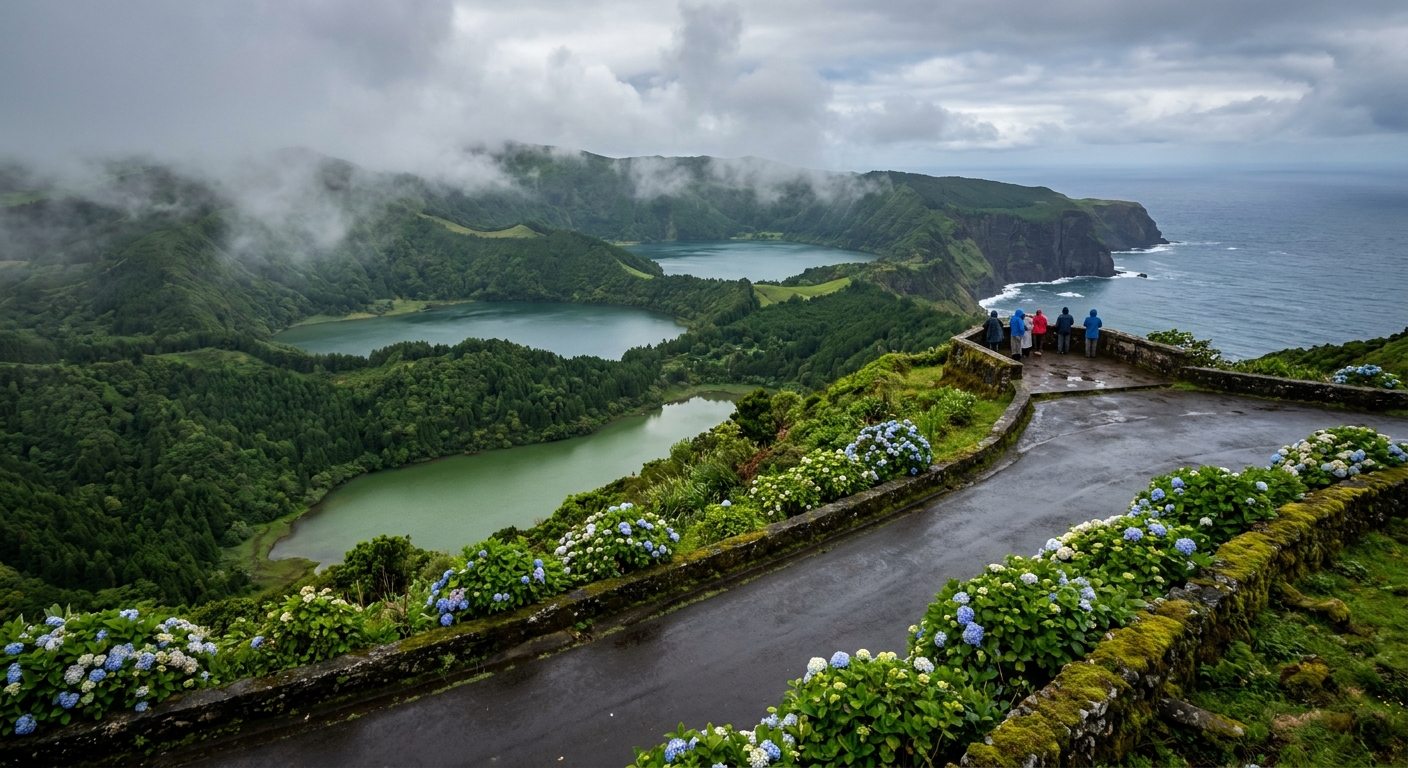
Free in June: the lookouts. Vista do Rei over the Green and Blue lakes of Sete Cidades, and the wilder, higher Lagoa do Fogo, appear in no ticket schedule we could read, so budget the drive and nothing else. The Caldeiras of Ribeira Grande put fumaroles and an 1811 thermal building among trees at the roadside. And Ponta Delgada itself, capital of the island since 1546, after the 1522 earthquake wrecked Vila Franca do Campo, costs a walk.
The Azores in June: a two-day plan for São Miguel
Day one belongs to the light. Take the earliest boat the operator will sell you, about three hours out and back before lunch, with the summer lineup of sperm whales, sei whales and spotted dolphins on the card. Eat in Ponta Delgada. Drive up to Vista do Rei in the early afternoon, when the caldera cloud usually thins, then continue to Lagoa do Fogo for the second lake. At 7pm you still hold two hours of sun, which is enough for a swim in a 69.5°F sea and a slow return.
Day two goes east to Furnas: the valley carries dozens of thermal springs, fumaroles and carbonated water, so start with Poça da Beija or the Terra Nostra pool, then take the tea road home through Gorreana, growing tea since 1883, with the Caldeiras of Ribeira Grande as the last stop. If the sky delivers one of the 1.3 heavy rain days, this plan barely blinks, since thermal water is warm in the rain and the tea factory is indoor. Trade the lookouts for the mud pool when the rim is in cloud, and keep the clear morning for Sete Cidades.
The Azores in June vs May and July: 72.3°F against 68.4°F and 76.5°F
| Measure | May | June | July |
|---|---|---|---|
| Average high | 68.4°F | 72.3°F | 76.5°F |
| Average low | 58.3°F | 62.2°F | 66.0°F |
| Rainfall | 2.40 in | 1.75 in | 1.02 in |
| Days with 0.04 in (1 mm) or more | 8.7 | 6.6 | 4.8 |
| Sea surface, mean of daily maxima | 65.9°F | 69.5°F | 73.1°F |
From May to July the average high climbs 8.1°F, from 68.4°F to 76.5°F, and the water climbs 7.2°F, from 65.9°F to 73.1°F. June lands between the two, 3.9°F above May and 4.2°F below July in the air. Rain runs the other direction: 2.40 inches in May, 1.75 in June, 1.02 in July, with wet days falling from 8.7 to 6.6 to 4.8. All three columns come from the same IPMA station and the same 1991-2020 period, which is why they can be compared line for line.
Shift four weeks earlier and May gives you emptier lookouts and a longer hydrangea season for two more wet days and a 65.9°F sea. Shift four weeks later and July gives you the warmest water of the summer so far and the driest month of the three, at the price of company on the trails and on the boats. June’s own trade is specific: the year’s longest days against a sea that is still three and a half degrees behind July.
Is June a good time to visit the Azores?
Yes, with one condition. June works when the trip is built around boats, trails and evening light: 72.3°F afternoons, 6.6 wet days and 14 hours 49 minutes of daylight make a strong hiking-and-whales month. It underdelivers when the trip is built around swimming, because 69.5°F at its warmest hour is a brisk sea for anyone expecting Algarve water. Families traveling with a child under five should read the boat’s age recommendation before booking a thing.
If the water is the point, July is the month to shift to: 76.5°F air, 73.1°F water, 1.02 inches of rain across 4.8 wet days. You pay in company and in price, and we have no rate series to size that by. If quiet outranks warmth, May keeps 68.4°F highs and 8.7 wet days, with the boats already running and the same resident dolphins offshore.
What no other month combines is this: the longest day of the Azorean year, 14 hours 49 minutes on the 15th, over a sea already holding sperm whales, sei whales and dolphins you are allowed to swim with.
The last word
Book the water first. Almost everything else on São Miguel can be rearranged around a forecast, but a three-hour boat on a calm morning is the thing June runs out of, and two attempts on separate days beat one. Then respect the island’s scale: 137,856 residents at the 2011 census, more than half of all Azoreans, spread across 744.7 square kilometers that measure 15.8 km at their widest. Distances look modest on the map and drive long in cloud. Give the biggest island four nights and let the 9:07pm sunset earn its keep.
Sources & data for this guide
- June normals (high 72.3°F, low 62.2°F, 1.75 in), and May and July columns · IPMA, climatological normals 1991-2020, station 513 Ponta Delgada Observatório, altitude 35.0 m · checked Sep 13, 2026
- Rain-day counts at the 1 mm and 10 mm thresholds (6.6 and 1.3 days) · IPMA, same station and period; thresholds are not the 0.10 in used by US tables · checked Sep 13, 2026
- Sea surface 69.5°F, mean of daily maxima 2015-2024 · Open-Meteo Marine API · checked Sep 13, 2026
- Daylight 14h 49m, sunrise 6:18 and sunset 9:07 on June 15 (UTC, which is Azores summer clock time) · sunrise-sunset.org · checked Sep 13, 2026
- Whale and dolphin season, three-hour trips, age 5 recommendation, sanctuary and 20+ species · Visit Azores (official regional tourism board), Whale Watching pages · checked Sep 13, 2026
- São Miguel geography (62.1 km, 15.8 km, 744.7 km², Pico da Vara 1,105 m, 137,856 residents at the 2011 census), Ponta Delgada capital since 1546, Furnas thermal spots, Gorreana and Porto Formoso · Visit Azores, São Miguel pages · checked Sep 13, 2026
- Terra Nostra Park prices (about €16 visitor, €12.80 resident, under-6s free) are RESERVED: parqueterranostra.com returned 404 on its visit pages and turismo.azores.gov.pt returned 403 to our reading · attempted Sept 8, 2026
- Ponta Delgada tourist tax: the municipal platform taxaturistica.cm-pontadelgada.pt confirms the tax exists since January 2025, and its rate leaflet is behind authentication; the €2 per night, three-night cap and exemptions come from Jornal de Notícias and Correio dos Açores · read Sept 9, 2026
- Porto (€3 a night, 7-night cap) and Funchal (€2, 7 nights) cross-checked against municipal sources · Sept 9, 2026
- Editorial admission: no month-by-month occupancy or rate series for the Azores was available to us, so crowd and price statements are reasoning, and booking-window figures are flagged (est.).