
You step off a late flight into Anchorage and find the concourse busy with people in fleece and hiking boots, while outside the windows cargo jets taxi past in a steady line. That mix of visitors and freight is the character of Ted Stevens Anchorage International Airport, the main gateway to Southcentral Alaska. It sits close to downtown, has two terminals, and is easy to understand once you know which one your airline uses.
What is Anchorage’s airport?
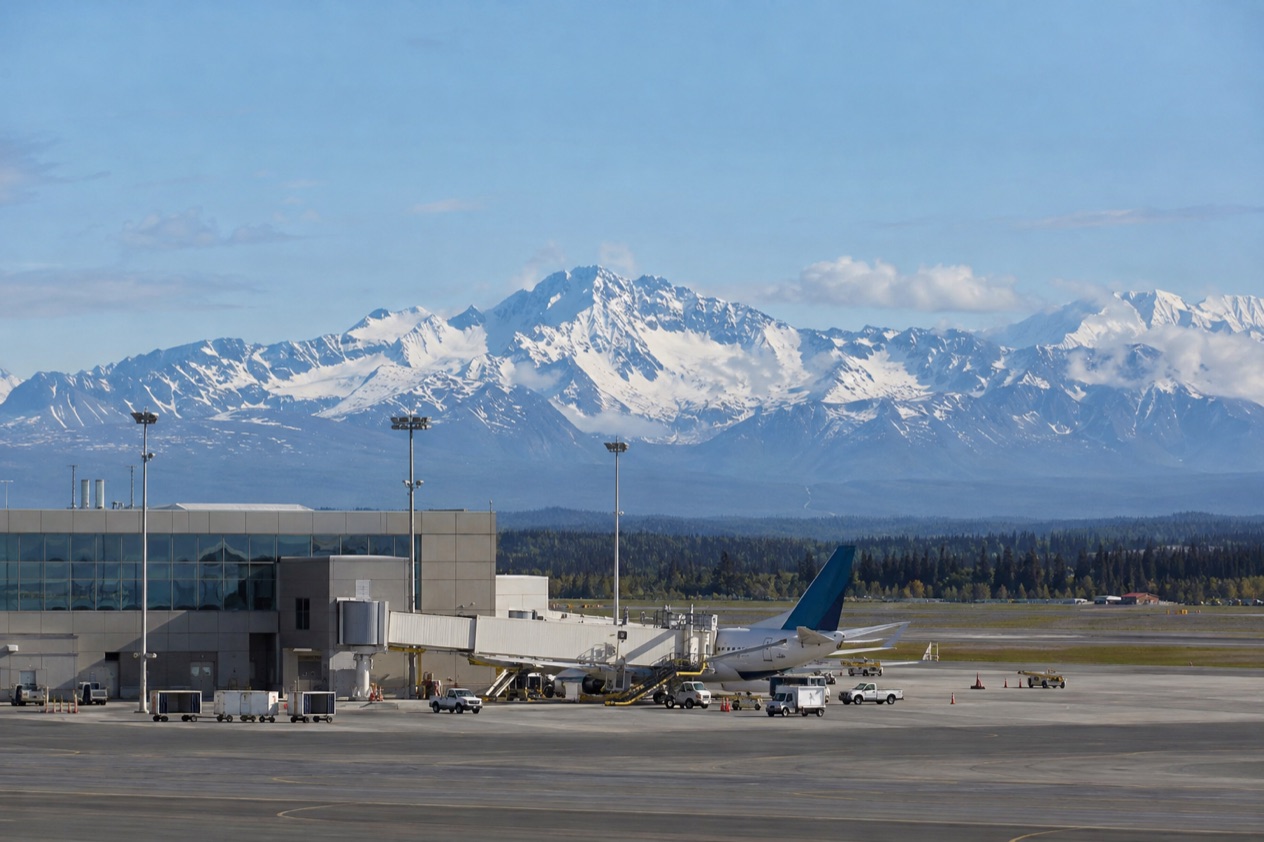
Anchorage’s airport is Ted Stevens Anchorage International Airport, known by its code ANC, and it sits about 5 miles southwest of downtown Anchorage. The address is 5000 W. International Airport Rd. That closeness to the city is unusual for a major airport, and it means you can go from the runway to a downtown coffee in a short stretch of your day.
It is also far more than a passenger airport. It ranks as the world’s third busiest for cargo traffic, and the freight side shapes much of what you see from the windows: wide-body freighters lined up on the aprons, and a landscape of hangars and sorting buildings. Anchorage itself lies at the head of Cook Inlet in Southcentral Alaska, and the Port of Alaska receives 95 percent of all goods destined for the state, so the airport and the port together keep shelves stocked across Alaska.
Two terminals, thirty-two gates
The airport has two terminals. The South Terminal handles domestic flights and has 24 gates, and it is where most travelers arrive and depart. The North Terminal is the international one, with 8 gates, and it serves Condor arrivals, international seasonal charter flights and military flights.
In practice, if you are flying a regular scheduled airline, you will almost certainly be in the South Terminal. The North Terminal matters if you are on a seasonal charter or meeting someone who is arriving on one. Check your boarding pass or confirmation for the terminal before you leave your hotel.
A working airport, and a seaplane base next door
Three asphalt or asphalt and concrete runways serve the airport, the longest of them 12,400 feet. There is also a single helipad. Right beside the airport, Lake Hood Seaplane Base is the busiest seaplane base in the world, so small floatplanes are a regular sight and sound around the area.
Cargo is the other constant. FedEx Express runs the largest cargo facility on the field, employing more than 1,200 people, while the UPS hub moves parcels around the clock in its own right. You may notice the freighters more than the passenger jets on some evenings.
| Airport detail | Figure |
|---|---|
| Distance from downtown Anchorage | 5 miles southwest |
| Terminals | 2 (South and North) |
| Gates | 32 (24 South, 8 North) |
| Runways | 3 (10,600 ft, 12,400 ft, 10,865 ft) |
| Helipad | 1 (100 by 100 ft) |
Before you fly out
The airport reminds travelers that they may need a Real ID or another acceptable ID to fly. If your driver’s license is not one of those, sort out an alternative form of identification before you head to the terminal, so that the security line is not where you find out.
What airlines fly from it?
A good handful of passenger airlines fly from Anchorage, and nearly all of them use the South Terminal. Air Canada, Alaska Airlines, American Airlines, Delta Air Lines, Sun Country Airlines and United Airlines operate from there, along with Condor and Discover Airlines for departures.
South Terminal airlines
The South Terminal is the domestic building, and its roster mixes the big U.S. carriers with Air Canada. Alaska Airlines has a special place here, since Anchorage is one of its hubs. For many travelers coming from the Lower 48, a flight on one of these airlines is how a trip to Alaska begins.
Condor and Discover Airlines are listed for departures from this terminal. Condor is a case worth knowing about: its departures leave from the South Terminal, but its arrivals come into the North Terminal. If you are meeting a Condor passenger, go to the international building rather than the domestic one.
| Terminal | Airlines and flights served |
|---|---|
| South Terminal (domestic) | Air Canada, Alaska Airlines, American Airlines, Condor (departures), Delta Air Lines, Discover Airlines (departures), Sun Country Airlines, United Airlines |
| North Terminal (international) | Condor arrivals, international seasonal charter flights, military flights |
Cargo carriers and hub airlines
Anchorage is a hub for Alaska Airlines, and also for the cargo operators Atlas Air, FedEx Express, Polar Air Cargo and UPS Airlines. You will not board any of the freight carriers, but they explain the scale of the field and the constant traffic of big jets.
FedEx Express can handle as many as 13,400 packages per hour at its facility, and the UPS hub handles about 5,000 parcels per hour. Those numbers help explain why the airport ranks so high among the world’s cargo airports, even though most visitors only see the passenger side.
International and charter flights
The North Terminal handles all international seasonal charter flights. If your trip is booked as part of a charter, your paperwork will tell you the terminal. Military flights also use the North Terminal, which keeps them apart from the regular domestic traffic in the South Terminal.
For most travelers the rule of thumb is simple: scheduled domestic airline, South Terminal. Charter, Condor arrival or international seasonal flight, North Terminal.
How do you get to town?
Downtown Anchorage is about 5 miles northeast of the airport, which makes it one of the closest city centers to a major airport you will find anywhere. The airport is on the edge of the Anchorage Bowl, and the city’s main grid of streets, hotels and restaurants lies just beyond it.
What you reach from the airport
Anchorage is a city of 291,247 people at the last census, set at the head of Cook Inlet in Southcentral Alaska. It began in 1915 as a tent city near Ship Creek when Alaska Railroad construction started, and the creek is still part of the downtown scene. Fishing for salmon there next to downtown is popular in summer.
Because the city sits so near the airport, even a layover can include a look at downtown. The rest of Southcentral Alaska fans out from here, and Anchorage is the usual place to begin or end a trip.
Wildlife on the road
Moose are a real part of Anchorage life. In the Anchorage Bowl the summer moose population is about 250, rising to 1,000 in winter, and they are a hazard to drivers. If you are behind the wheel after landing, keep that in mind, especially on the roads around town.
The Anchorage area is also home to approximately 250 black bears and 60 grizzly bears. They are a reason the city feels close to the wild, even with an airport and a downtown a few minutes apart.
A warning about the mudflats
Tourists are warned not to walk on Anchorage’s mudflats because of extreme tides and fine glacial silt. The flats can look like an inviting shortcut along the water, and they are not one. Look at the inlet from the shore and stay off the mud.
A city shaped by a quake
The Good Friday earthquake of March 27, 1964, with a magnitude of 9.2, killed 115 people and caused $116 million in damages in Anchorage. It is part of the story the city tells about itself, and it is worth a thought as you drive in from the airport through a city that rebuilt itself.
Good to know before you go
Keep your ID in order before you reach the checkpoint, since the airport reminds travelers they may need a Real ID or another acceptable form of identification to fly. Stay off the mudflats, and watch for moose if you drive away from the terminal. Lake Hood Seaplane Base next door is worth a glance from the road if you like to watch floatplanes come and go.
Sources
- Ted Stevens Anchorage International Airport (https://www.ancairport.com/), checked October 11, 2026
- Wikipedia, Anchorage, Alaska (https://en.wikipedia.org/wiki/Anchorage,_Alaska), checked October 11, 2026
To plan your stay
- Best Time to Visit Anchorage: Long Summer Days, Northern Lights, Weather by Month and Festivals
- Things to Do in Anchorage: Museums, Alaska Native Heritage, Chugach Trails and Day Trips
- Where to Stay in Anchorage: Downtown, Eagle River, Girdwood and Lodging Types
- Know Before You Go to Anchorage: Weather, Wildlife, Getting Around and Local Habits