
Late in the afternoon on Arawak Cay, the fryers start to hiss, the conch gets pounded and chopped, and the smell of lime and hot oil drifts over the painted stalls. A few minutes away, cruise ships slide into the harbor while locals settle onto the benches along the Western Esplanade. Nassau is the Bahamian capital, a mix of colonial forts, pastel government buildings, street food and long white beaches, for travelers who like a city with a bit of history behind the sunbathing.
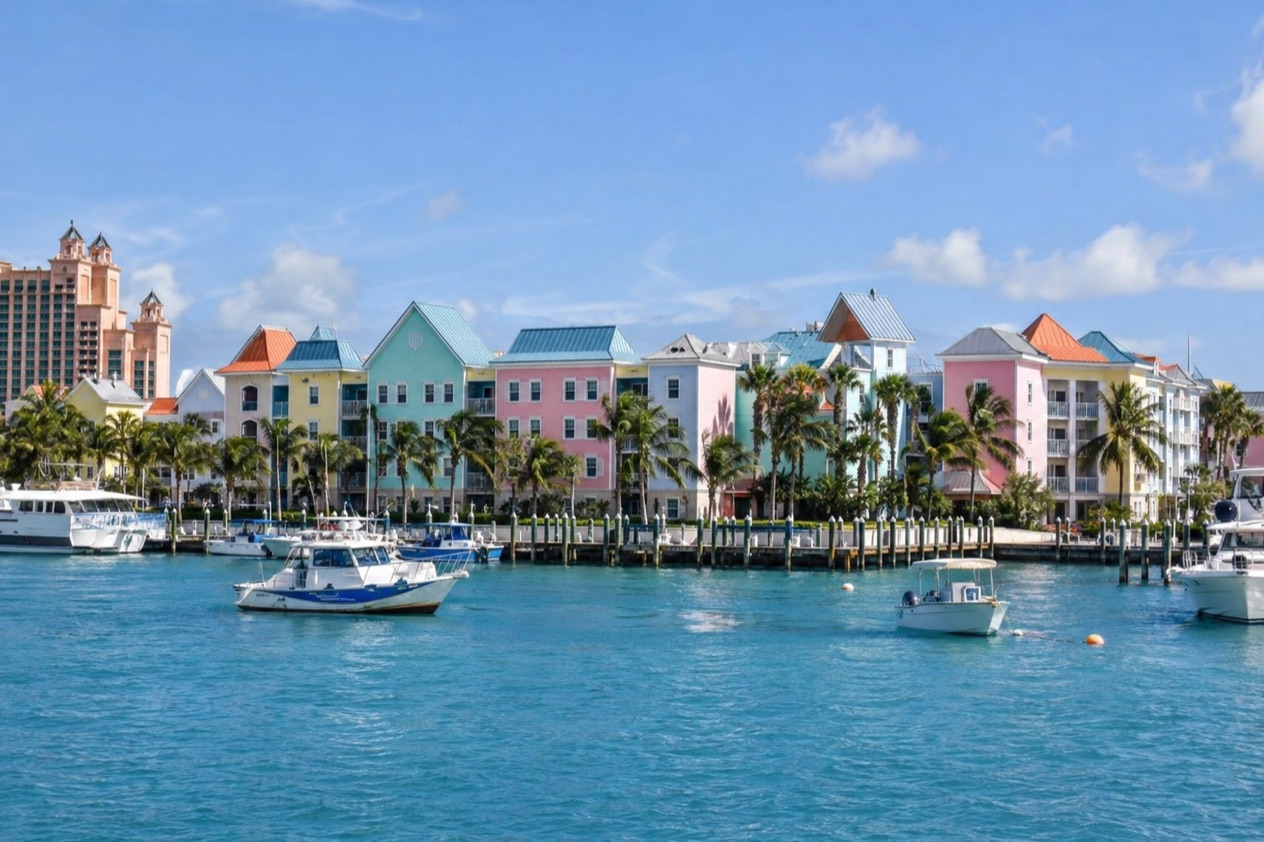
Where is Nassau and what is it like?
Nassau sits on the northern shore of New Providence, an island in the Atlantic Ocean that is the most populous in the Bahamas, and it is the capital of the country. Paradise Island lies just across the harbor, joined to the city by a bridge, and Cable Beach stretches along the coast to the west. Miami is roughly 180 miles to the west-northwest, which is why so many Americans treat the city as an easy escape.
New Providence is flat, with a highest point of only 16 feet, so the island is all sea light and open sky rather than hills. The island is about 21 miles long and a little under 7 miles wide, and nearly all of that length is lived in. Nassau is not a sleepy cay. It is a working capital with traffic, government offices, courthouses and schools, and the tourist district sits right beside them.
Downtown, Bay Street is the center of shopping, dining and nightlife, and cruise passengers pour off the ships onto it each day. Walk a few blocks uphill and the mood changes to old stone steps, pink-and-white colonial mansions and quiet lanes. Government House, the residence of the Governor General, sits on Mount Fitzwilliam, pink and white, and is one of the easiest buildings to pick out.
The city suits travelers who want variety in a short trip: a fort in the morning, a conch salad at lunch, a beach in the afternoon, a rum tasting at the end. It suits people looking for a castaway island less well.
The pace is busy, the center fills with cruise crowds, and the quieter Bahamian experience lies on other islands. Most crime in the country occurs in Nassau, and the area south of Shirley Street known as Over the Hill has gang violence, so visitors keep to the tourist areas.
What is there to do in Nassau?
Nassau packs history, food, beaches and a small art and rum scene into one compact capital. That mix is what sets it apart from the quieter out islands, where the draw is almost entirely the water.
Forts and the Queen’s Staircase
Fort Fincastle stands on Bennet’s Hill above the old town. It was built of cut limestone around 1793 in the shape of a paddle-wheel steamer, and from the ramparts you look over the rooftops and the harbor. Guided tours are offered daily, and the staff tell the story of the fort and the governor it was named for.
The Queen’s Staircase is part of the same historic complex. It is a limestone stairway carved out of solid rock by enslaved laborers in the 1790s, rising 102 feet through a cool, narrow cut lined with ferns and palms. Only 65 steps show today because the bottom one lies under the paved path. It was named later in honor of Queen Victoria.
Fort Charlotte is the biggest of the forts on the island, west of downtown and just off West Bay Street. It is really a complex of three parts, Fort Charlotte, Fort Stanley and Fort D’Arcy, with a moat, drawbridge, casemates dug into the rock and views across the harbor to Paradise Island. These forts never saw serious battle, which makes them pleasant places to wander rather than somber ones.
| Site | Open |
|---|---|
| Fort Fincastle (guided tours) | Daily, 8 a.m. to 4 p.m. |
The Fish Fry and Bahamian food
Arawak Cay, known to Bahamians as the Fish Fry, is the place for authentic local food. Stalls serve conch cracked (battered and fried), steamed, stewed, as fritters, in chowder, or as conch salad, made with diced raw conch, onions, sweet pepper, tomatoes and lime, with pineapple and mango in the tropical version. Drinks include sky juice and the Bahama Mama.
If seafood is not your thing, several stalls cook chicken, steak and pork chops. Beyond the Fish Fry, a new generation of chefs is updating classics like seafood stew and fried conch, and bartenders are adding tamarind, soursop and smoked pineapple to craft cocktails. Saturday farmers markets, including the one on Gladstone Road, add fruit, baked goods and local products to the picture.
Beaches, from Junkanoo to Cable Beach
Junkanoo Beach, also called the Western Esplanade, runs beside Arawak Cay a few minutes on foot from the cruise dock. Benches look out on ships entering the harbor, and on Saturdays Bahamians host cookouts and fund-raisers there. Spring breakers like it too, so it has a lively, social feel.
Cable Beach lies a few miles west of downtown and covers two and a half miles of sand. It takes its name from an 1892 submarine telegraph cable that came ashore here, and it has been a hotel district since the 1950s. Today it has resorts, a golf course, nightlife and the largest casino in the Bahamas, plus the usual water sports and plenty of room for sunbathing.
Rum, murals and a boat to Blue Lagoon Island
John Watling’s Distillery sits on the Buena Vista Estate, which dates to 1789, and it is the only rum distillery in the Bahamas. The rum is made from hand-cut sugarcane molasses from neighboring islands, produced in small batches and aged in barrels. Nearby, a mural walk takes in works like Once Upon a Time near the distillery, and the White Crown Pigeon at the National Art Gallery of the Bahamas.
Blue Lagoon Island, also called Salt Cay, lies about three miles northeast of Nassau. It is a private island with dolphin and sea lion encounters, a hidden lagoon, beaches and snorkeling off the shore. A package includes the round-trip boat transfer, lunch and the inflatable aqua park, and paddleboards, kayaks and snorkel gear can be rented there.
How many days do you need in Nassau?
A long weekend is enough to see the essentials of Nassau, and a week gives you room to add beaches and boat trips without hurrying. The city is compact, so a short stay can cover a lot.
With two or three days, start with the old town: Fort Fincastle and the Queen’s Staircase in the morning, a stroll along Bay Street and the Straw Market for handbags and other Bahamian-made goods, and dinner or a cocktail in the cluster of bars and restaurants downtown, which are all within walking distance of one another. Spend the next day on the western side with Fort Charlotte, Junkanoo Beach and an evening at the Fish Fry on Arawak Cay.
A third or fourth day opens up the rest of the island. Take a beach day on Cable Beach, tour John Watling’s Distillery, or spend a morning on Saturday at one of the farmers markets. The market on Gladstone Road is open Saturdays, and the Doongalik market in the season that runs from late August or early September to mid-May has food for everyone, vegans included.
With a week, add a boat day to Blue Lagoon Island and time on Paradise Island, which is linked to Nassau by a bridge. You will also have room to slow down: a long lunch of conch in several forms, a mural walk, a lazy afternoon on the benches at Junkanoo Beach watching the ships. Because Nassau is the gateway to the country, a longer trip can also include a flight or boat to another island, though each of those deserves its own few days.
Where to stay in Nassau
Nassau offers three main bases: downtown, Cable Beach and Paradise Island. Each gives a quite different holiday, and the island is small enough that you can move between them easily.
Downtown suits travelers who want history and street life on their doorstep. Bay Street, the forts, the Straw Market and the harbor are close, and the bars and restaurants are within walking distance of each other, so evenings need no cab.
It is busiest when cruise ships are in port, and Bambu and The Pub sit close to the cruise port. Visible police and closed-circuit cameras are part of the downtown scene, and the Royal Bahamas Police Force has a Tourism Policing Unit.
Cable Beach, a few miles west, is the resort strip. It has five first-class or luxury resorts, a golf course, a casino, nightlife and two and a half miles of beach, and it is the natural choice for a trip built around sand and water sports. Pompey Market is also found here.
Paradise Island is the third option, across the bridge over Nassau Harbour. It is home to the Atlantis Resort, and no jitney bus goes there, which is worth knowing if you plan to move around independently. Travelers renting a vacation property anywhere on the island should stay alert, especially where there is no private security.
How do you get to Nassau and get around?
Most visitors arrive by air at Lynden Pindling International Airport, the largest and busiest in the Bahamas and the main international gateway, or by ship at the country’s largest and busiest cruise port. The airport lies in western New Providence, about 10 miles west of downtown, and it offers U.S. Border Preclearance, so travelers returning to the States clear that step before leaving. It is a hub for Bahamasair, Western Air, Flamingo Air, Southern Air Charter and Pineapple Air.
At the airport, taxis wait outside the U.S., International and Domestic terminals at any time. Transfers can also be arranged through an extensive list of livery and tour operators, and car rental desks, including Avis and Budget, offer a wide selection of vehicles for exploring New Providence.
Around town, downtown is a place to walk. Many of the main sights are within walking distance of the cruise port, and Junkanoo Beach is a few minutes on foot from the dock. Jitney buses run on the island but stop operating between 6 and 7 p.m. each day, so evenings call for another way home.
To reach Blue Lagoon Island you take a boat. The package for that island includes the round-trip transfer, so the logistics are handled for you.
When is the best time to visit Nassau?
The winter months, roughly December through April, are the most comfortable for sightseeing. January brings highs around 79°F, lows in the mid-60s and about four rain days, and the sea hovers in the upper 70s, so days suit forts and markets and evenings are cool enough for a sweater. It is a good season for walking the hill above downtown and eating outside at the Fish Fry.
Summer is hot and wetter. July highs reach about 91°F with lows in the mid-70s, and rain falls on around twelve days of the month, usually in showers rather than all-day gray.
The sea is bathtub-warm in the high 80s, which makes beach days easy, but the middle of the day is best spent in shade or at the water. The wet season runs from May through October, with daytime highs in the mid-80s to around 90.
Hurricane season runs from June 1 to November 30, which covers the late summer and fall. Spring is also the time Junkanoo Beach fills with spring breakers, and the Doongalik farmers market closes in mid-May. For markets and a festive city, the cooler months between late autumn and spring offer the most going on.
Good to know before you go
The U.S. State Department rates the Bahamas Level 2, “Exercise increased caution”, and says most crime occurs in Nassau on New Providence and in Freeport on Grand Bahama.
Be careful with souvenirs. Most Cuban cigars sold in Nassau are counterfeit, so buy only from a reputable, dedicated tobacconist. Free pastimes do exist, including fishing in the canal at Coral Harbour. Because the Atlantic hurricane season runs from June 1 to November 30, a trip in those months deserves a flexible plan.
Sources
- Bahamas Ministry of Tourism, Investments & Aviation (bahamas.com), Nassau and Paradise Island (New Providence) (https://www.bahamas.com/islands/nassau-paradise-island), checked October 10, 2026
- Wikipedia, Nassau, Bahamas (https://en.wikipedia.org/wiki/Nassau,_Bahamas), checked October 10, 2026
- Wikivoyage, Nassau travel guide (https://en.wikivoyage.org/wiki/Nassau), checked October 10, 2026
- Wikipedia, New Providence (https://en.wikipedia.org/wiki/New_Providence), checked October 10, 2026
- Bahamas Ministry of Tourism, Nassau and Paradise Island (https://www.bahamas.com/islands/nassau-paradise-island), checked October 10, 2026
- Bahamas Ministry of Tourism, Investments & Aviation (bahamas.com), travel blog, what to do in Nassau (https://www.bahamas.com/blog/top-10-things-to-do-in-nassau), checked October 10, 2026
- Bahamas Ministry of Tourism, Investments & Aviation (bahamas.com), travel blog, safety downtown Nassau (https://www.bahamas.com/blog/downtown-nassau-safe-for-tourists), checked October 10, 2026
- Bahamas Ministry of Tourism, Investments & Aviation (bahamas.com), travel blog, Nassau forts (https://www.bahamas.com/blog/historic-forts-of-nassau), checked October 10, 2026
- Bahamas Ministry of Tourism, Investments & Aviation (bahamas.com), travel blog, farmers markets (https://www.bahamas.com/blog/four-farmers-markets-in-nassau-you-should-check-out), checked October 10, 2026
- Bahamas Ministry of Tourism, Investments & Aviation (bahamas.com), travel blog, Arawak Cay fish fry (https://www.bahamas.com/blog/fish-fry), checked October 10, 2026
- Bahamas Ministry of Tourism, Investments & Aviation (bahamas.com), travel blog, free things to do in Nassau (https://www.bahamas.com/blog/five-free-things-to-do-in-nassau), checked October 10, 2026
- Bahamas Ministry of Tourism, Investments & Aviation (bahamas.com), travel blog, Nassau murals (https://www.bahamas.com/blog/nassaus-most-insta-worthy-street-art-murals), checked October 10, 2026
- Bahamas Ministry of Tourism, Investments & Aviation (bahamas.com), travel blog, nightlife by island (https://www.bahamas.com/blog/bahamian-nightlife-and-where-to-go), checked October 10, 2026
- Bahamas Ministry of Tourism, Investments & Aviation (bahamas.com), John Watlings Nassau (https://www.bahamas.com/experiences/john-watlings-nassau), checked October 10, 2026
- Bahamas Ministry of Tourism, Investments & Aviation (bahamas.com), Culinary Revolution Nassau (https://www.bahamas.com/experiences/culinary-revolution-nassau), checked October 10, 2026
- Wikipedia, Queen%27s Staircase (https://en.wikipedia.org/wiki/Queen%27s_Staircase), checked October 10, 2026
- Bahamas Ministry of Tourism, Investments & Aviation (bahamas.com), Queens Staircase (https://www.bahamas.com/natural-wonders/queens-staircase), checked October 10, 2026
- Bahamas Ministry of Tourism, Investments & Aviation (bahamas.com), Fort Fincastle (https://www.bahamas.com/natural-wonders/fort-fincastle), checked October 10, 2026
- Bahamas Ministry of Tourism, Investments & Aviation (bahamas.com), Fort Charlotte (https://www.bahamas.com/natural-wonders/fort-charlotte), checked October 10, 2026
- Bahamas Ministry of Tourism, Investments & Aviation (bahamas.com), Junkanoo Beach (https://www.bahamas.com/natural-wonders/junkanoo-beach), checked October 10, 2026
- Bahamas Ministry of Tourism, Investments & Aviation (bahamas.com), Blue Lagoon Island (https://www.bahamas.com/natural-wonders/blue-lagoon-island), checked October 10, 2026
- Wikipedia, Blue Lagoon Island (https://en.wikipedia.org/wiki/Blue_Lagoon_Island), checked October 10, 2026
- Wikipedia, Cable Beach, Bahamas (https://en.wikipedia.org/wiki/Cable_Beach,_Bahamas), checked October 10, 2026
- Bahamas Ministry of Tourism, Investments & Aviation (bahamas.com), Cable Beach (https://www.bahamas.com/natural-wonders/cable-beach), checked October 10, 2026
- Wikipedia, Lynden Pindling International Airport (https://en.wikipedia.org/wiki/Lynden_Pindling_International_Airport), checked October 10, 2026
- Wikipedia, Geography of the Bahamas (https://en.wikipedia.org/wiki/Geography_of_the_Bahamas), checked October 10, 2026
- NOAA NCEI, GHCN-Daily station BF000078073 (Nassau Airport), normals 1991-2020 computed from the daily record (https://www.ncei.noaa.gov/access/services/data/v1?dataset=daily-summaries&stations=BF000078073), checked October 10, 2026
- Open-Meteo Marine API, average 2015-2024, checked October 10, 2026
- U.S. Department of State, The Bahamas Travel Information, Safety and security (https://travel.state.gov/), checked October 10, 2026
- Lynden Pindling International Airport, Renting a car (https://nassaulpia.com/to-from/renting-a-car/), checked October 10, 2026
- Lynden Pindling International Airport, Transportation options (https://nassaulpia.com/to-from/transportation-options/), checked October 10, 2026
- U.S. Department of State, The Bahamas Travel Advisory, Level 2 (https://travel.state.gov/), checked October 10, 2026
- NOAA National Hurricane Center, Climatology (https://www.nhc.noaa.gov/climo/), checked October 10, 2026
All our pages
When to go
- Best Time to Visit Nassau: Weather by Month, Hurricane Season, Beaches and Junkanoo
- Nassau in January: Junkanoo, Weather, Beaches and a Two-Day Plan
- Nassau in February: Weather, the Sea, Crawfish Season and What to Do
- Nassau in March: Weather, Crawfish Season, Forts and a Two-Day Plan
- Nassau in April: Weather, Sea, Fish Fry and a Two-Day Plan
- Nassau in May: Weather, Sea Temperature, Downtown Sights and a Two-Day Plan
- Nassau in June: Weather, Sea Swims, Forts and Bahamian Food
- Nassau in July: Summer Heat, Warm Water, Independence Season and What to Do
- Nassau in August: Weather, Crawfish Season, Beaches and What to Do
- Nassau in September: Weather, Swimming, Crawfish and a Two-Day Plan
- Nassau in October: Weather, Crawfish Season, Swimming and a Two-Day Plan
- Nassau in November: Weather, Sea Temperature, Fish Fry Food and a Two-Day Plan
- Nassau in December: Junkanoo, Christmas Lights, Weather and Things to Do
Things to do
- Things to Do in Nassau: Forts, the Fish Fry, Beaches and Blue Lagoon Island
- Day Trips from Nassau: Blue Lagoon, Exuma Pigs, Harbour Island and Fort Charlotte
- 3 Days in Nassau: Forts, the Fish Fry, Cable Beach and a Day on Blue Lagoon Island
- Nassau Airport to Downtown Nassau: Taxis, Rental Cars, Transfers and Arrival Steps
Where to stay
Getting there
- Nassau from the United States: Flights, Cruises, Airport Transfers and Getting Around
- Nassau Airport (NAS): Arrival, Taxis to Your Hotel and U.S. Preclearance
- Nassau Airport to Atlantis and Paradise Island: Taxis, Transfers, Rental Cars and Arrivals
- Nassau Airport to Cable Beach and Baha Mar: Taxis, Transfers, Rental Cars and Arrival Steps