
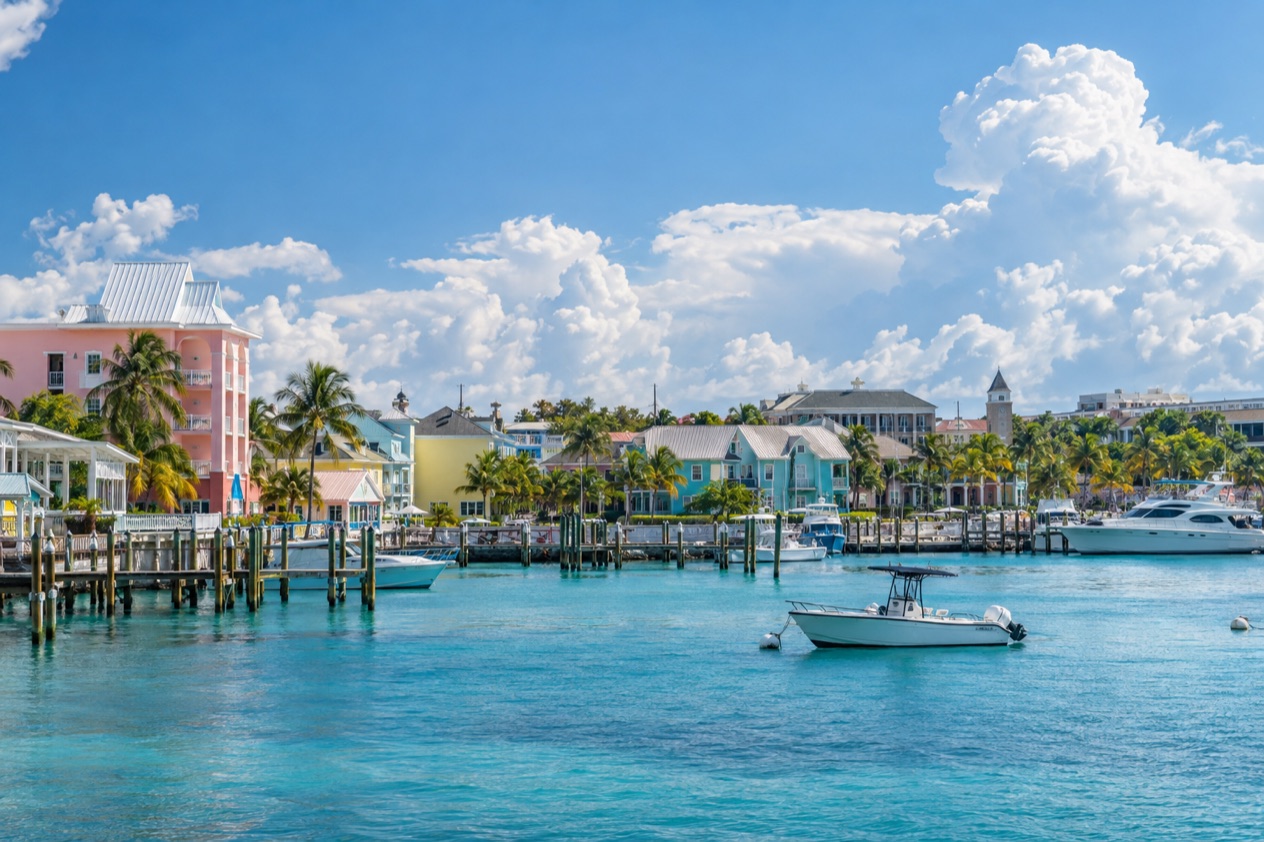
Early on a June morning, the pastel buildings along Bay Street are still in shade, the harbor is flat and bright, and someone is already cracking conch at a stand near Arawak Cay. By noon the heat has settled over the city like a lid, and everyone drifts toward water or air conditioning. June in Nassau is the start of the long, hot, green summer, with a warm sea, long evenings and a food scene that keeps getting more inventive.
What is the weather like in Nassau in June?
Hot, humid and a little showery: June in Nassau is full summer, a clear step up from May, with the heat of the day held in check only by the trade breeze off the water.
| Month | Average high (°F) | Average low (°F) | Rain days | Sea (°F) |
|---|---|---|---|---|
| May | 86.5 | 72.0 | 7.5 | 82.6 |
| June | 89.1 | 75.1 | 12.4 | 85.3 |
| July | 90.8 | 76.4 | 12.4 | 87.8 |
Mornings are the kindest hours, bright and already warm but with a breeze that makes a walk through the old town pleasant. In the early afternoon, the sun beats down hard, so most folks seek out shade, something cold to drink, or the water. The light is high and white at midday, then softens to gold well before the evening.
Rain in June tends to come as short, heavy showers or a stormy late afternoon, often clearing quickly and leaving the streets steaming. Some days pass completely dry, others bring a couple of downpours, and the month is clearly wetter than May. The rain is rarely a reason to cancel a day, only to reorder it.
You can have dinner outdoors in a T-shirt or a sundress since the evenings remain warm, but the dampness gives the air a heavy feel. Wear light, breathable cotton or linen, and keep a thin layer for restaurants that run their air conditioning hard. The sea is as warm as a bathtub by late month, which shapes most of what you do.
Can you swim in Nassau in June?
Yes, the sea is warm enough in June for a long swim, and you will not need more than a swimsuit to get in.
How the water looks changes daily and differs between one section of beach and the next, just as it does all around any island shoreline, so check the surf before you go in. Junkanoo Beach, also called the Western Esplanade, sits beside Arawak Cay and Long Wharf near downtown, and it is the stretch most visitors to the city find first. On Blue Lagoon Island, about three miles northeast of Nassau, visitors can swim in a hidden lagoon and snorkel off the beach to see coral reefs with tropical fish.
Bring reef-friendly sunscreen, a rash guard if you burn easily, and water shoes for rocky entries. A mask and snorkel are worth packing if you plan to go in at Blue Lagoon Island. Plan your swim for the morning or late afternoon, when the sun is gentler on your shoulders, and keep midday for shade and a long lunch.
What to do in Nassau in June
June is a month for doing the outdoors early and the indoors at noon. The city rewards a slow schedule: sightseeing on foot before the heat builds, a long lunch in the shade, the water in the afternoon, and dinner when the air cools.
It is also a good time to eat, because Nassau’s kitchens are in the middle of a reinvention. Chefs on New Providence are updating Bahamian classics with modern technique, and the bars give familiar cocktails a distinct Bahamian edge.
The streets in June feel relaxed and a little sleepy at midday, then pick up again toward evening. Ships tie up at the cruise dock and downtown fills with day visitors, then empties again late afternoon. Straw markets, pastel storefronts and the old government buildings make for pleasant wandering in the morning hours.
Fort Fincastle and the Queen’s Staircase
The Queen’s Staircase is in the Fort Fincastle Historic Complex, hewn out of solid limestone rock by slaves between 1793 and 1794. It has 65 steps, though it originally had 66, and it climbs between high rock walls draped with ferns and tropical growth that stay cool and green well into the morning. The story goes that it gave a direct route from the fort down to the city.
Fort Fincastle itself sits atop Bennet’s Hill, built of cut limestone around 1793 in the shape of a paddle-wheel steamer, to protect the old town and its harbor. From the top you look out over rooftops, the harbor and the water beyond.
Go early, before the sun climbs, since the stone holds heat and there is little shade at the summit. Pair it with a slow walk back down into the old town for coffee.
Fort Charlotte and the harbor view
Fort Charlotte is the largest fort on New Providence, covering 100 acres, and it stands one mile west of downtown, just off West Bay Street. It is a spread of stone walls, ramparts and old cannon on grassy ground, with plenty of room to wander and an impressive view of Paradise Island, Nassau and the harbor.
It suits families who like space to roam and anyone who enjoys history with a view. In June the sun is intense on the open ramparts, so plan the visit for the morning or the last hours of the day, when the light turns warm over the harbor. Bring a hat and water.
A day on Blue Lagoon Island
About three miles northeast of Nassau sits Blue Lagoon Island, which many people also call Salt Cay. It is the place for a full beach day: white-sand shores for sunbathing, a hidden lagoon to swim in, and snorkeling off the beach among coral reefs and tropical fish. Paths wind through vegetation that is habitat for nesting birds.
The island is also home to dolphins and sea lions at Dolphin Encounters, which is the main draw for many families. With the sea at its warmest of the early summer, June is a fine month to spend hours in the water here. Bring a hat, a rash guard and plenty of sunscreen, since the sun on the sand is strong.
Eating your way through Nassau
Fried conch, cracked and golden, and seafood stew are the dishes to know, and in Nassau both are being reinvented by a new generation of tastemakers. You can find a classic version at the casual stands around Arawak Cay, then a modern take on the same dish in a dining room downtown, and the contrast is half the fun.
The bars matter too, because classic cocktails are given a Bahamian edge by local mixologists. A cold drink on a shaded veranda is the right answer to a June afternoon. Fresh tropical fruit, conch salad bright with citrus and anything cold and sharp on the tongue suits the heat.
A short walk from the cruise ship dock puts Junkanoo Beach within easy reach, making it a handy pause between downtown and the sea. Rainy afternoons are better spent in the old town’s shops, galleries and restaurants, or lingering over lunch while the shower passes.
A two-day itinerary for Nassau in June
Day 1 is for the old town and the forts, done early. Start at the Queen’s Staircase and Fort Fincastle while the stone is still cool, then walk down into the center for a slow stroll past the pastel government buildings and the straw market. Daylight lasts a long time in June, which leaves room for a late dinner.
At midday, eat lunch in a shaded restaurant downtown, preferably a place serving fried conch or seafood stew, and stay out of the sun. In the afternoon head west to Fort Charlotte for the harbor view as the light softens. Finish with dinner at one of the newer restaurants where chefs rework Bahamian classics, followed by a cocktail.
Day 2 is for the water. Spend the morning and early afternoon on Blue Lagoon Island, swimming in the lagoon, snorkeling off the beach and, if you like, meeting the dolphins and sea lions. Return in the late afternoon for a rest at the hotel.
In the evening, walk the Western Esplanade at Junkanoo Beach and then eat at the casual stands near Arawak Cay, where conch is cracked and fried to order. If a storm turns the day, move the forts and shops indoors, linger over a long lunch, and save the beach for the next break in the clouds.
Is Nassau busy in June?
Moderately: June is the start of summer, and the city is livelier than in the spring rush but less hectic than the winter high season.
Families travel once schools break for the summer, so you will see more children on the beaches and at the attractions than in the spring months. Cruise ships still tie up at the dock, and on those days downtown, the straw market and the beach near the dock are busier, especially between late morning and mid-afternoon. Early mornings and evenings stay calmer.
The heat itself thins the crowds in the middle of the day, since many visitors retreat to pools and air conditioning. That means the best sightseeing happens at the edges of the day, and restaurants tend to fill at dinner rather than lunch. If you want a particular table at one of the newer restaurants, settle it early in your trip.
Beyond the city, the pace is slower. Blue Lagoon Island and the forts are places where you can spread out, and a morning visit tends to be quieter than an afternoon one. Choose lodging with some shade and a pool, because you will spend the hot hours near it.
What to pack for Nassau in June
Pack for heat, humidity and sudden showers, with a focus on light fabrics and sun protection for the days you spend by the water and on the forts’ open stone.
- Light cotton or linen clothing, because the air stays warm and humid even after dark.
- A wide-brimmed hat and sunglasses, since the forts and the ramparts have little shade.
- Reef-friendly sunscreen and a rash guard, for long hours in the warm sea.
- Water shoes and a snorkel mask, for the lagoon and the beach reefs at Blue Lagoon Island.
- A compact rain jacket or umbrella, for the short afternoon downpours.
- Comfortable sandals for climbing the steps of the Queen’s Staircase.
Good to know before you go
The U.S. State Department rates the Bahamas Level 2, “Exercise increased caution”, and says most crime occurs in Nassau on New Providence and in Freeport on Grand Bahama.
June is when the Atlantic hurricane season opens, running from June 1 to November 30, and the Bahamas Ministry of Tourism & Aviation monitors tropical storms in the Atlantic. Travelers are encouraged to check the Bahamas.com hurricane page regularly for updates on storm-related weather.
U.S. citizens entering Nassau must carry a passport that stays valid for at least six months, and passport cards are not accepted by the Bahamas Department of Immigration when you arrive by air. U.S. citizens visiting for a stay of up to eight months do not need a Bahamian visa. A return or onward ticket is required for visitors, who also might need to prove they have enough money.
Nassau in June vs May and July
Moving a trip four weeks earlier, into May, brings a cooler sea and clearly fewer rainy days. The heat is gentler, the sky is more often clear, and sightseeing on foot is easier through the middle of the day. The tradeoff is a sea that is still on the fresh side for long swims, and the hurricane season has not yet opened.
Moving four weeks later, into July, brings the warmest water of the three months and the hottest afternoons. The rain stays about as frequent as in June, so the pattern of short showers continues, but the heat is heavier and the sea even more inviting. Water days are most comfortable, while walking the forts at midday becomes a real effort.
Choose May if you want to spend long days on foot, and July if the beach is the whole point. June sits between them, with a sea warm enough for any swimmer and heat that is manageable if you keep to the cool hours. It suits travelers who want both the old town and the water in the same trip.
Is June a good time to visit Nassau?
Yes, for travelers who love warm water, long evenings and a city that eats well, and who are happy to shape the day around the heat.
It suits families on a school break, beach people, snorkelers and anyone drawn to Nassau’s reinvented Bahamian cooking. It is less ideal for those who dislike humidity or who want to cover a lot of ground on foot at midday, and anyone who wants a dry, cool trip would be happier in an earlier month.
On arrival, climb the Queen’s Staircase and see the harbor from Fort Fincastle first, while the mornings are still bearable, then spend the heat of the day by the water. What stays with you from June in Nassau is a warm sea, a plate of fried conch and a long golden evening over the harbor.
Sources
- NOAA NCEI, GHCN-Daily station BF000078073 (Nassau Airport), normals 1991-2020 computed from the daily record (https://www.ncei.noaa.gov/access/services/data/v1?dataset=daily-summaries&stations=BF000078073), checked October 10, 2026
- Open-Meteo Marine API, average 2015-2024, checked October 10, 2026
- sunrise-sunset.org, sunrise and sunset calculated for the 15th of the month, checked October 10, 2026
- NOAA National Hurricane Center, Climatology (https://www.nhc.noaa.gov/climo/), checked October 10, 2026
- Bahamas Ministry of Tourism, Investments & Aviation (bahamas.com), Hurricane and storm information (https://www.bahamas.com/hurricane-storm-information), checked October 10, 2026
- Bahamas Ministry of Tourism, Investments & Aviation (bahamas.com), Culinary Revolution Nassau (https://www.bahamas.com/experiences/culinary-revolution-nassau), checked October 10, 2026
- Wikipedia, Queen%27s Staircase (https://en.wikipedia.org/wiki/Queen%27s_Staircase), checked October 10, 2026
- Bahamas Ministry of Tourism, Investments & Aviation (bahamas.com), Queens Staircase (https://www.bahamas.com/natural-wonders/queens-staircase), checked October 10, 2026
- Bahamas Ministry of Tourism, Investments & Aviation (bahamas.com), Fort Fincastle (https://www.bahamas.com/natural-wonders/fort-fincastle), checked October 10, 2026
- Bahamas Ministry of Tourism, Investments & Aviation (bahamas.com), Fort Charlotte (https://www.bahamas.com/natural-wonders/fort-charlotte), checked October 10, 2026
- Bahamas Ministry of Tourism, Investments & Aviation (bahamas.com), Junkanoo Beach (https://www.bahamas.com/natural-wonders/junkanoo-beach), checked October 10, 2026
- Bahamas Ministry of Tourism, Investments & Aviation (bahamas.com), Blue Lagoon Island (https://www.bahamas.com/natural-wonders/blue-lagoon-island), checked October 10, 2026
- Wikipedia, Geography of the Bahamas (https://en.wikipedia.org/wiki/Geography_of_the_Bahamas), checked October 10, 2026
- Bahamas Ministry of Tourism, Investments & Aviation (bahamas.com), Island FAQ (https://www.bahamas.com/plan-your-trip/island-faq), checked October 10, 2026
- U.S. Department of State, The Bahamas Travel Information, Safety and security (https://travel.state.gov/), checked October 10, 2026
- Bahamas Department of Immigration, Entry requirements (https://www.immigration.gov.bs/entry-requirements/), checked October 10, 2026
- Bahamas Department of Immigration, Before your arrival (https://www.immigration.gov.bs/entry-requirements/before-your-arrival/), checked October 10, 2026
- U.S. Department of State, The Bahamas Travel Advisory, Level 2 (https://travel.state.gov/), checked October 10, 2026
To plan your stay
- Things to Do in Nassau: Forts, the Fish Fry, Beaches and Blue Lagoon Island
- Where to Stay in Nassau: Cable Beach, Paradise Island, Downtown and How to Choose
- Nassau from the United States: Flights, Cruises, Airport Transfers and Getting Around
- Know Before You Go to Nassau: Entry Rules, Money, Getting Around and Local Customs