
You step off the plane into warm, humid air, follow the signs toward immigration, and somewhere in the line the practical questions start: where exactly are we, how do we get to the hotel, and what happens when it is time to fly home? Lynden Pindling International Airport, known by its code NAS, is the main door into the Bahamas, and it works in a fairly simple sequence in both directions.
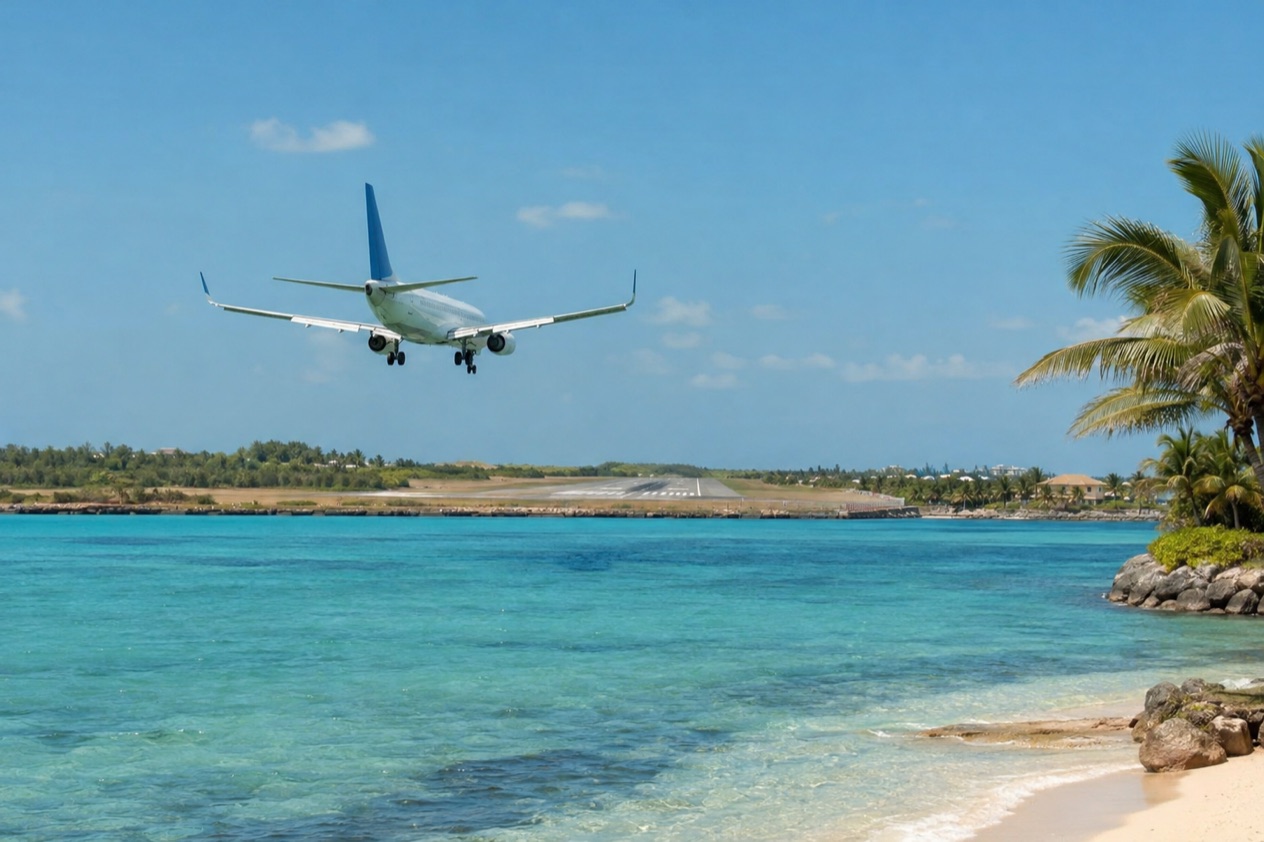
Where is Nassau’s airport?
Nassau’s airport sits at the western end of New Providence, the island on which the city of Nassau stands, about 10 miles west of downtown. Its full name is Lynden Pindling International Airport, after the first prime minister of the Bahamas, and older signs or conversations may still call it Nassau International Airport, its former name.
It is the largest airport in the Bahamas and the largest international gateway into the country. That matters if you are heading elsewhere: many trips to the other islands begin here, and the airport is a hub for local carriers such as Bahamasair, Western Air, Flamingo Air, Southern Air Charter and Pineapple Air. A connection to the islands is often just a change of terminal rather than a change of city.
The terminals
The airport is organized around three buildings: the US Departure terminal, the International terminal and the Domestic terminal. Which one you use depends on where you are flying. Flights to the United States leave from the US terminal, flights to other countries use the International terminal, and hops to other Bahamian islands go from the Domestic terminal.
Taxis wait outside all three, so you are never far from a ride whichever building you land at or leave from. Smoking is allowed only at designated curbside areas outside the Arrivals and Departure terminals, and there are no smoking areas past security.
Airlines and services on site
Air Canada, American Airlines, British Airways and Bahamasair all serve Nassau, and Alaska Airlines has a customer service line for the airport. Inside, you will find ABM machines for banking and currency exchange, a nurse’s station for medical needs, a post office where you can send mail before and after flights, and a Travel & Luggage Centre that offers luggage storage.
The post office is a small pleasure for anyone who still likes to send a postcard from the departure hall. The luggage storage is useful on a long layover or on the last afternoon after hotel checkout.
What happens when you arrive at Nassau airport?
On arrival, your first stop is Bahamas Immigration, then you collect your checked bags, pass through Bahamas Customs and walk out ready for vacation. That is the whole sequence, and it is the same whether you come from a big hub or a small connection.
Immigration, bags and customs
Right after landing you follow the signs to the immigration hall, where officers process arriving passengers. Once you are cleared, you go down to the baggage claim, pick up your suitcases and carry on to Bahamas Customs. The order matters: bags come after immigration, never before.
Beyond customs you reach the arrivals curb. At the arrivals curb, taxi ranks, transfer drivers and car rental desks are ready to help you choose your ride. The warm air outside is the first real taste of the islands, so it helps to have a light layer you can change out of quickly.
Money and water on landing
The legal tender is the Bahamian dollar, which has a one-to-one exchange rate with the US dollar, and US currency is widely accepted in Nassau, as are most major credit cards and traveler’s checks. If you want local cash, the ABM machines in the airport handle banking and currency exchange.
Tap water in Nassau and Paradise Island is safe to drink, and bottled water is also readily available, so you can skip buying a large supply at the terminal. Banks in town keep their own hours, open Monday through Thursday from 9:30am to 3:00pm and Fridays from 9:30am to 4:30pm, which is worth remembering if you land late in the week.
How do you get from the airport to your hotel?
The usual way from the airport to a hotel is a taxi, and taxis are available at any time outside the US, International and Domestic terminals. You can also arrange a transfer, hire a private car or pick up a rental.
Taxis and their fares
Taxis from the airport charge set zone fares, so the price depends on where you are going rather than on a meter. Fares are based on two passengers, and each additional passenger adds US $5.00. Children under three ride free.
| Extra | Charge (US $) |
|---|---|
| Each additional passenger beyond two | 5.00 |
| Each piece of luggage beyond two per person | 2.20 |
| Oversized bags, golf bags and boxes | 3.30 |
If you travel with golf clubs or big boxes, count on the oversized charge. A light traveler with two bags per person pays nothing extra for luggage.
Transfers, private cars and rentals
Airport transfers can be arranged through an extensive list of livery and tour operators, and private or chauffeured car service is available for those who want to travel in more style. These suit travelers who like to have a driver waiting rather than looking for a taxi.
Car rentals at the airport offer a wide selection of vehicles for exploring New Providence. Avis (+1-242-377-7121, [email protected]), Budget (+1-242-377-7405, [email protected]) and Dollar / Thrifty (+1-242-377-0326) can all be reached directly by phone, and Avis and Budget also by email.
What happens when you leave?
When you leave, the process depends on your destination: flights to the United States include U.S. preclearance before boarding, while trips to other countries or other Bahamian islands only require clearing airport security. Arrive earlier for the first case.
Flying to the United States
Nassau has a U.S. Customs and Border Protection preclearance facility, at the airport on Windsor Field Road. Preclearance means CBP officers inspect you here, before boarding, so you complete U.S. customs and immigration in Nassau and bypass CBP and TSA inspections on arrival, going straight to a connecting flight or your destination.
In the US Departure terminal, airport security and US Customs open at 6AM. Passengers on U.S.-bound flights should be at the airport at least 3 hours before their flight. Programs that speed things up include TSA PreCheck, Mobile Passport Control, Global Entry and Automated Passport Control kiosks, and pre-approved Global Entry members can use self-service kiosks to finish U.S. entry processing before departure.
U.S. citizens returning after 48 hours abroad may bring back up to $800 worth of duty-free merchandise, with no more than two liters of alcohol. Carry-on liquids follow the 3-1-1 rule: containers of 3.4 ounces or less, all in one quart-sized clear zip-top bag, one bag per passenger.
Other countries and other islands
| Trip | Arrive at the airport |
|---|---|
| U.S.-bound flights | At least 3 hours before |
| Other international flights | At least 2 hours before |
| Domestic flights within the Bahamas | 2 hours before |
For a non-US destination or another island of the Bahamas, the departure process is as simple as clearing airport security. The airport’s tariffs and fees cover aeronautical charges, with separate documents for domestic travel and for international U.S. travel, and they help the airport maintain its terminals.
Good to know before you go
The U.S. State Department rates the Bahamas Level 2, “Exercise increased caution”, and says most crime occurs in Nassau on New Providence and in Freeport on Grand Bahama.
Money is easy in Nassau, since US dollars are accepted alongside the Bahamian dollar at one-to-one. The Atlantic hurricane season runs from June 1 to November 30, so a trip in those months deserves a flexible mindset about flights.
Sources
- Wikipedia, Lynden Pindling International Airport (https://en.wikipedia.org/wiki/Lynden_Pindling_International_Airport), checked October 10, 2026
- Lynden Pindling International Airport (Nassau), FAQs (https://nassaulpia.com/help/faqs/), checked October 10, 2026
- Lynden Pindling International Airport, Renting a car (https://nassaulpia.com/to-from/renting-a-car/), checked October 10, 2026
- Lynden Pindling International Airport, Transportation options (https://nassaulpia.com/to-from/transportation-options/), checked October 10, 2026
- Lynden Pindling International Airport, Taxis (https://nassaulpia.com/to-from/taxis/), checked October 10, 2026
- Lynden Pindling International Airport, Island tips (https://nassaulpia.com/island-guide/island-tips/), checked October 10, 2026
- Lynden Pindling International Airport, Airport checklist (https://nassaulpia.com/airport-guide/airport-checklist/), checked October 10, 2026
- Lynden Pindling International Airport, Customs and immigration (https://nassaulpia.com/help/customs-immigration/), checked October 10, 2026
- Lynden Pindling International Airport, Services (https://nassaulpia.com/airport-guide/services/), checked October 10, 2026
- Lynden Pindling International Airport, Airport fees and tariffs (https://nassaulpia.com/about-lpia/airport-fees-and-tariffs/), checked October 10, 2026
- Lynden Pindling International Airport, Airlines (https://nassaulpia.com/flights/airlines/), checked October 10, 2026
- U.S. Customs and Border Protection, Preclearance (https://www.cbp.gov/travel/preclearance), checked October 10, 2026
- U.S. Department of State, The Bahamas Travel Advisory, Level 2 (https://travel.state.gov/), checked October 10, 2026
- NOAA National Hurricane Center, Climatology (https://www.nhc.noaa.gov/climo/), checked October 10, 2026
To plan your stay
- Best Time to Visit Nassau: Weather by Month, Hurricane Season, Beaches and Junkanoo
- Things to Do in Nassau: Forts, the Fish Fry, Beaches and Blue Lagoon Island
- Where to Stay in Nassau: Cable Beach, Paradise Island, Downtown and How to Choose
- Know Before You Go to Nassau: Entry Rules, Money, Getting Around and Local Customs