
In March, the last weeks of crawfish season send Grand Bahama kitchens into a final round of lobster salads and stews, and the sea off Lucaya has lost its winter chill without yet turning to bathwater. Mornings start soft over the Atlantic, days stretch a little longer each week, and the island’s wide, low landscape of pine, sand and blue holes is ready to be explored. It is a good month in Freeport and Grand Bahama for anyone who wants beaches, boats and cave country in the same trip.
What is the weather like in Freeport and Grand Bahama in March?
March is mild and bright, with a sea that is comfortable for a dip and days that are noticeably longer than in the winter months.
| Month | Sea at Freeport and Grand Bahama (°F) | Daylight on the 15th (hours and minutes) |
|---|---|---|
| February | 76.7 | 11 h 19 min |
| March | 77.6 | 12 h 03 min |
| April | 78.2 | 12 h 51 min |
The air picture comes from Nassau, where highs average about 81°F in March. On Grand Bahama that kind of warmth means you can sit outside for breakfast and lunch in short sleeves, and the evenings still ask for a thin layer once the sun is down and the breeze picks up off the water.
The day now runs just past twelve hours, so the light is generous both early and late. Early mornings suit a walk on a beach with nobody on it, and the last hours of the afternoon turn the shallows pale green and the pines along the roads gold. Rain, when it comes at this time of year, tends to be a passing interruption rather than a lost day, and the sky usually clears in time for the evening.
The sea is the number to plan around. It has warmed since February, and the surface near Freeport and Lucaya is pleasant for a first swim of the trip, though some people will still want a few minutes to get used to it. Pack for sun first, and for a cool breeze second.
Can you swim in Freeport and Grand Bahama in March?
The sea is warm enough for a proper dip in March, and for many people long enough to stay in, though it is not yet the bathwater of late summer.
Conditions change from day to day and from one stretch of shore to another, so a beach that is quiet one morning can look different the next. Taino Beach sits right at Freeport and Lucaya, in a park the Freeport/Lucaya Council has developed for Bahamians and visitors alike, which makes it a natural place to start.
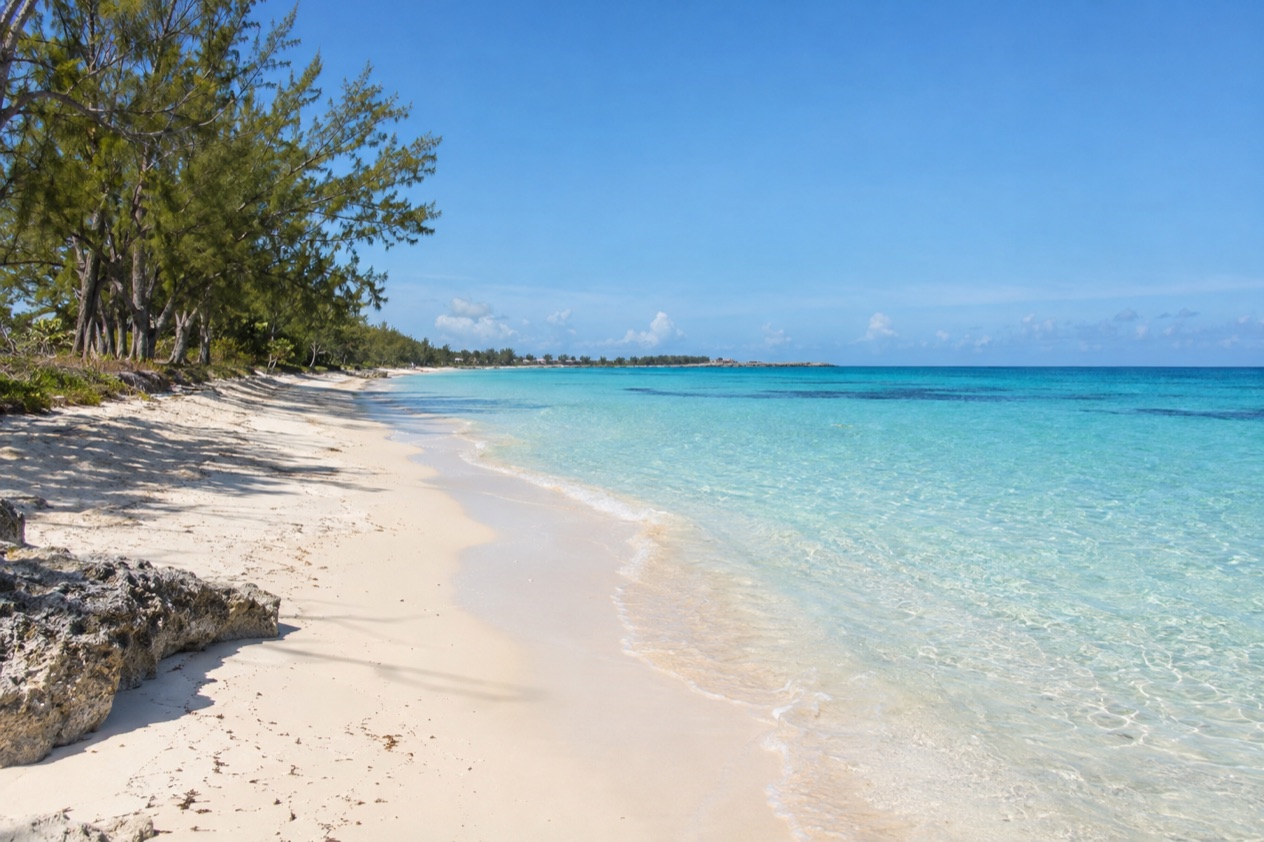
Gold Rock Beach, part of Lucayan National Park and protected by the Bahamas National Trust, has a very different character. At low tide the shoreline spreads for yards out into the sea, which is why it is called the island’s welcome mat.
Snorkelers and divers find the water inviting at this time of year. Divers in Freeport can visit coral heads shaped like a painter’s palette at Picasso’s Gallery, swim among sunken shipwrecks hung with gorgonian sea fans, and share the water with reef sharks. Bring a swimsuit, a mask of your own if you like to snorkel, and a towel for the beach walks, since a sea this mild invites more than one swim a day.
What to do in Freeport and Grand Bahama in March
The great seasonal event of the month is on the plate. Crawfish season in the Bahamas runs from August 1 to March 31, so March is the last chance of the year to order the local spiny lobster at its freshest, and kitchens on Grand Bahama treat it that way. Menus often use the words crawfish and lobster for the same thing, and if a different variety is served it is named.
The classic order is crawfish salad, a mix of onions, sweet peppers, lime juice and diced lobster, served on a bed of greens or on its own, and just as good packed into a sandwich. Order it with a cold drink on a shaded terrace at Port Lucaya, where boats nose up to the docks and the marketplace hums by early afternoon.
The mood in March is easygoing. Beaches are good for long afternoons, craft stalls and bars around the Lucaya waterfront get busier by evening, and the island’s outdoor attractions are comfortable to do in daylight that now lasts into the evening.
Lucayan National Park and Gold Rock Beach
Lucayan National Park lies on Grand Bahama near Freeport and covers only a small area, but it is rich in things to see. It incorporates one of the largest underwater cave systems in the world, and its two inland blue holes are the headline sights. One of them, Ben’s Cave, takes its name from UNEXSO legend Ben Rose. The park was established in March 1982, so the month is also its anniversary.
What you see above ground is a quiet landscape of pine woods, mangroves and limestone, with signs of the caves below. March light is soft and the afternoons are warm without being heavy, which suits a slow wander through the trees. Gold Rock Beach, part of the same park, lies at the end of the visit, and the wide shoreline at low tide is the main picture to take home.
Give this outing a morning or most of a day, and bring water, sun protection and a camera. It suits anyone who likes walking and nature more than a day at a resort pool.
On the water: stingrays and reef dives
In Freeport, Keith Cooper runs a stingray meet-and-greet in which visitors swim with wild stingrays he has befriended over twelve years. It is a gentle, hands-on way to meet marine life, and it fits a March morning when the sea has lost its winter edge. Expect to get wet, so wear a swimsuit.
Divers have more to choose from. Picasso’s Gallery is known for its colorful coral heads, the wrecks around Freeport bloom with sea fans and swarms of fish, and there are dives where reef sharks swim alongside you. March conditions let you plan around the water rather than around the cold, and the outings reward people who like to see something that does not exist on the usual beach day.
Crawfish in its last month
Think of March as the month to order crawfish at least once, in whatever form you like best: cold in a salad, hot in a stew, or tucked into a sandwich after a morning on the sand. It is a local flavor that disappears from menus at the end of the season, and the next chance to taste it fresh comes in August.
Pair it with something light and sharp, such as a citrus drink, and keep the rest of the meal simple. Lunch is a good time for it, because the lime and sweet pepper in the salad suit the warmth of a March afternoon.
A two-day itinerary for Freeport and Grand Bahama in March
Day 1 stays close to Freeport and Lucaya and follows the water. Start early on Taino Beach, when the light is gentle and the sand is quiet, and take a first swim while the air is still cool. Late morning is the time for the stingray meet-and-greet, which suits a day when you want to be in the sea and not just look at it.
Lunch belongs at Port Lucaya, where a crawfish salad or sandwich is the obvious order in this last month of the season. The afternoon can go to the marketplace and the docks, or to a dive for those who want a wreck or a coral head. As the light turns golden, walk the waterfront and stay for dinner outdoors, with a sweater close by for after dark.
If rain turns the day gray, shift to the covered stalls and restaurants of the marketplace and save the beach for the next break in the clouds. Day 2 heads to Lucayan National Park, which is best reached in the morning while the air is cool. Walk the trails through the pines and mangroves, stop at Ben’s Cave and the other blue hole, and think about the cave system running beneath your feet. Gold Rock Beach, about 25 miles from Freeport, comes next, and the low tide shoreline is the thing to see.
Spend the early afternoon on the sand, with a picnic or a late lunch. Return toward Freeport as the light softens and finish with dinner in Lucaya, where crawfish stew gives the trip a fitting last course. On a wet day the park is still worth a visit, but plan a long, slow lunch indoors to wait out the shower.
Is Freeport and Grand Bahama busy in March?
March is a lively month, but it is not uniformly crowded: the busy stretches come with school breaks and, when Easter falls early, Holy Week.
Families on spring break are the group you notice, and the beaches and waterfront bars show it in the afternoons. Outside those weeks the island feels relaxed, with space on the sand, easy conversations at the docks and no sense of a rush on the trails.
Easter moves every year, so it can fall in March or April, and the weeks around it will be livelier than the rest of the month. A trip planned around the holiday weeks should be arranged early as a habit, and a trip planned for the quieter weeks can be settled later.
The experiences that depend on a boat, such as the stingray meet-and-greet or a dive, are the kind of outings to settle in advance when you know your dates. The park and the beaches are open-air places and sit well with a loose plan.
What to pack for Freeport and Grand Bahama in March
Think of warm days, a mild sea and cool evenings, and pack for the beach, the trails and the dinner table.
- Two swimsuits, because the sea is warm enough to bring you back more than once a day.
- A light sweater or wrap for evenings on the waterfront.
- A hat and sunscreen for the long, bright days and the open beaches.
- Sturdy sandals or walking shoes for the trails of Lucayan National Park.
- Your own snorkel mask if you like one that fits, for the reefs and the stingray outing.
Good to know before you go
The U.S. State Department rates the Bahamas Level 2, “Exercise increased caution”, and says most crime occurs in Nassau on New Providence and in Freeport on Grand Bahama.
March is outside the official hurricane season, which runs from June 1 to November 30. For entry, U.S. citizens do not need a Bahamian visa for a visit, but the Bahamas Department of Immigration asks for a passport valid for at least six months, and passport cards are not accepted.
A return or onward ticket is required, and visitors may be asked to show proof of enough funds. A stay can last up to eight months.
Crawfish season closes at the end of this month, so plan the lobster meals first. The Bahamas Health Visa and COVID-19 testing requirement have been eliminated.
Freeport and Grand Bahama in March vs February and April
Going four weeks earlier gives a cooler sea and shorter days, which suits people who mostly want to explore the park, the docks and the restaurants. February still has crawfish on the menu, and the beaches are quieter, but swimming will feel more like a quick dip. March gives you more daylight, and the water is friendlier.
Going four weeks later brings a warmer sea and a longer day, and the sand is more inviting for slow afternoons. The trade-off is that crawfish season is over, so the signature taste of March is gone from the menu, and the pace of the island may shift as the spring weeks end.
Choose March if you want crawfish at the end of its season, a mild sea and the best balance of light and warmth. Choose February if you prefer quiet and cooler walking weather. Choose April if swimming is the main reason for the trip and you are happy to let the lobster go.
Is March a good time to visit Freeport and Grand Bahama?
Yes, March is a very good time, especially for travelers who want beaches, boat outings and cave country without waiting for the water to warm up fully.
It suits divers, snorkelers, walkers and food lovers who like a seasonal dish. It suits families as well, with a sea that is comfortable and plenty to see in a day. It is less ideal for anyone who wants a hot, lazy pool-and-ocean vacation and expects the sea to feel like summer from the first step.
On arrival, put crawfish at the top of the list, then head to the water: a first swim at Taino Beach is a good way to settle in, and Lucayan National Park and Gold Rock Beach make the best full day. Keep a sweater close for the evenings. What stays with you from March here is the last bowl of crawfish salad, the low-tide shoreline at Gold Rock Beach stretching out toward the sea, and a day that still has light in it when dinner is served.
Sources
- Open-Meteo Marine API, average 2015-2024, checked October 10, 2026
- sunrise-sunset.org, sunrise and sunset calculated for the 15th of the month, checked October 10, 2026
- NOAA NCEI, GHCN-Daily station BF000078073 (Nassau Airport), normals 1991-2020 computed from the daily record (https://www.ncei.noaa.gov/access/services/data/v1?dataset=daily-summaries&stations=BF000078073), checked October 10, 2026
- Bahamas Ministry of Tourism, crawfish season (https://www.bahamas.com/blog/its-crawfish-season), checked October 10, 2026
- Bahamas Ministry of Tourism, Investments & Aviation (bahamas.com), Lucayan National Park (https://www.bahamas.com/natural-wonders/lucayan-national-park), checked October 10, 2026
- Wikipedia, Lucayan National Park (https://en.wikipedia.org/wiki/Lucayan_National_Park), checked October 10, 2026
- Bahamas Ministry of Tourism, Investments & Aviation (bahamas.com), Gold Rock Beach (https://www.bahamas.com/natural-wonders/gold-rock-beach), checked October 10, 2026
- Bahamas Ministry of Tourism, Investments & Aviation (bahamas.com), Taino Beach (https://www.bahamas.com/natural-wonders/taino-beach), checked October 10, 2026
- Bahamas Ministry of Tourism, Investments & Aviation (bahamas.com), Bens Cave (https://www.bahamas.com/natural-wonders/bens-cave), checked October 10, 2026
- Bahamas Ministry of Tourism, Investments & Aviation (bahamas.com), Keith Coopers Stingrays Freeport (https://www.bahamas.com/experiences/keith-coopers-stingrays-freeport), checked October 10, 2026
- Bahamas Ministry of Tourism, Investments & Aviation (bahamas.com), Dive Freeport (https://www.bahamas.com/experiences/dive-freeport), checked October 10, 2026
- Wikipedia, Geography of the Bahamas (https://en.wikipedia.org/wiki/Geography_of_the_Bahamas), checked October 10, 2026
- Bahamas Ministry of Tourism, Investments & Aviation (bahamas.com), Island FAQ (https://www.bahamas.com/plan-your-trip/island-faq), checked October 10, 2026
- U.S. Department of State, The Bahamas Travel Information, Safety and security (https://travel.state.gov/), checked October 10, 2026
- Bahamas Department of Immigration, Entry requirements (https://www.immigration.gov.bs/entry-requirements/), checked October 10, 2026
- Bahamas Department of Immigration, Before your arrival (https://www.immigration.gov.bs/entry-requirements/before-your-arrival/), checked October 10, 2026
- U.S. Department of State, The Bahamas Travel Advisory, Level 2 (https://travel.state.gov/), checked October 10, 2026
- NOAA National Hurricane Center, Climatology (https://www.nhc.noaa.gov/climo/), checked October 10, 2026
To plan your stay
- Things to Do in Grand Bahama: Lucayan National Park, Diving, Beaches and Port Lucaya
- Where to Stay in Grand Bahama: Lucaya, Freeport, West End and How to Pick a Hotel
- Freeport and Grand Bahama from Miami: Ferry, Flights, Cruise Ships and a Day in Lucaya
- Know Before You Go to Grand Bahama: Entry, Money, Getting Around and Sun