
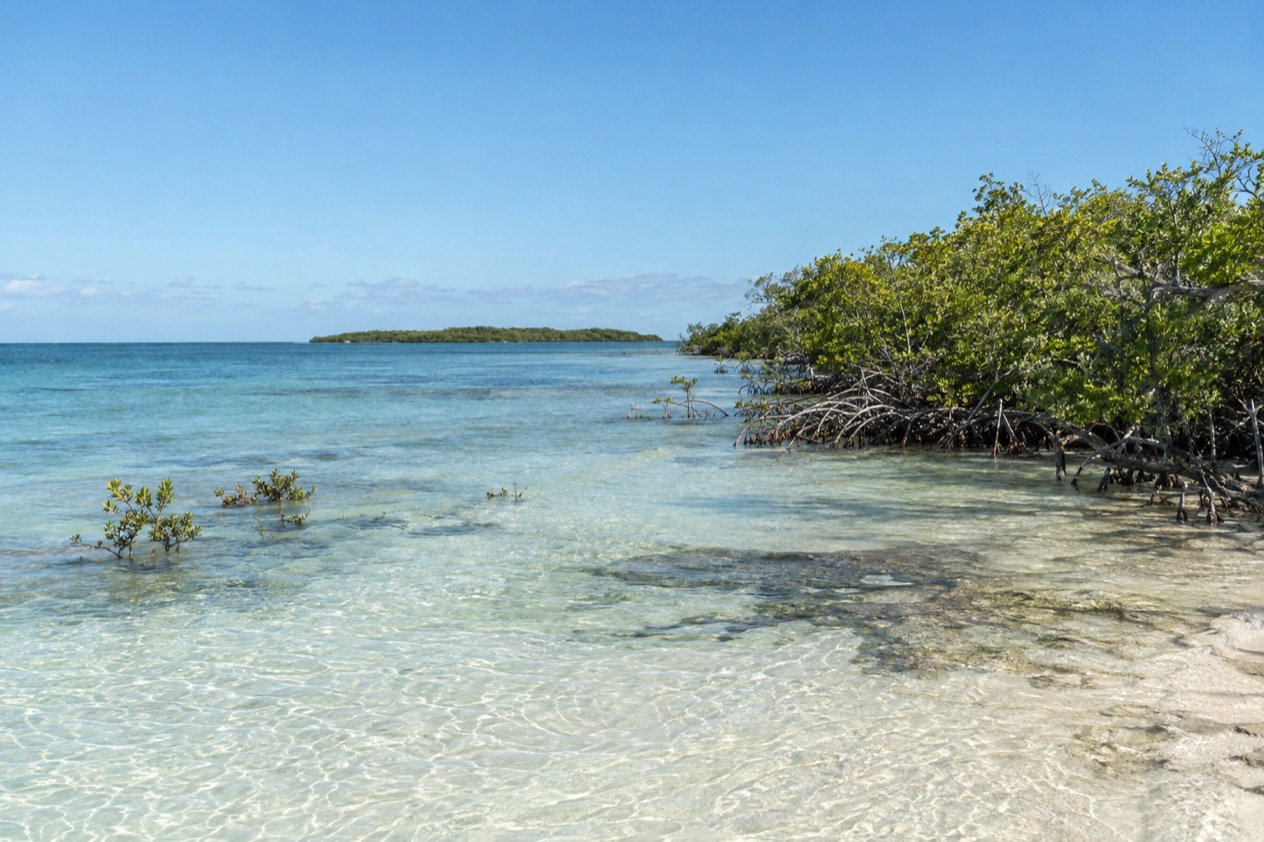
Early on a February morning the mangrove creeks of Andros lie flat and pale under a low, clear light, and somewhere in a settlement a pot of crawfish is already simmering for the day. The island is enormous and green, cut by tidal channels and ringed by a reef, and in this month it feels unhurried. February here is for the water, the blue holes and the table: a sea still warm enough to enjoy, long bright days, and the last weeks of crawfish season.
What is the weather like in Andros in February?
February in Andros is a gentle, bright winter month, with a sea that has cooled a touch since January and days that grow noticeably longer as the weeks pass.
| Month | Sea at Andros (°F) | Daylight on the 15th (hours and minutes) |
|---|---|---|
| January | 78.0 | 10 h 49 min |
| February | 76.8 | 11 h 22 min |
| March | 77.6 | 12 h 03 min |
The daylight is what you notice first. By mid-February the sun is up early enough for a sunrise walk along a creek or a shoreline and still lights the water well into the late afternoon, so a day outdoors has a comfortable length. The light is clean and slanting in the morning and again in the evening, which suits photographs of the flats, the mangroves and the white sand.
For the air, look at Nassau, where February highs average about 80°F and the rain comes on only a few days. That is a picture of a dry, easy winter month in the northern Bahamas. When a shower does pass over Andros, it tends to be a passing cloud rather than a lost day, and the island’s creeks and flats look even greener afterward.
The sea stays in the upper 70s, a shade lower than a month earlier and a shade lower than it will be in March. In practice that means water that feels refreshing on arrival and pleasant once you are moving. Pack light clothes for the day and one extra layer for evenings on a porch or a boat deck, where a breeze off the water can make you glad of a sleeve.
Can you swim in Andros in February?
The sea is warm enough for a good dip and for time in the water with a mask, though it is a little cooler than in the heart of summer, so some people prefer to stay in with a thin layer.
Andros has a long coast, and the character of the water changes from one stretch of shore to another and from one day to the next. On the island side of the barrier reef the water is shallow, only about eight feet at the reef, while the ocean side falls away into very deep water.
Some shores meet open sea and some look onto sheltered flats, so conditions vary with the wind and the tide. Ask where you are staying about the stretch of coast in front of you on that particular day.
Snorkeling and scuba diving are the activities the Andros Barrier Reef is known for, and February’s clear light helps you see down into the water. Bring a mask and snorkel you trust, reef-friendly sunscreen, and a rash guard or thin wetsuit top if you tend to feel cold. Visitors who prefer to stay out of the water will still find plenty to see from a boat or a beach chair.
What to do in Andros in February
February in Andros is not a month of parades or crowded festivals. It is a month of water, wildlife and slow meals, and the island’s size means you can organize a trip around one or two ambitions instead of trying to see everything. Andros is an archipelago of three major islands, North Andros, Mangrove Cay and South Andros, joined by hundreds of small cays, mangrove estuaries and tidal swamps.
The season of the month is crawfish. Spiny lobster season in the Bahamas runs through the end of March, so February menus are full of it.
Many menus use crawfish and lobster as if they mean the same thing, and the dishes locals love most are crawfish salad (onions, sweet peppers, lime juice and diced lobster, frequently offered on greens or packed into a sandwich) and stewed crawfish in a thick brown gravy. Order it wherever you eat, from a settlement kitchen to a lodge dining room.
The Andros Barrier Reef
Along Andros’s east coast lies the third-largest fringing barrier reef on earth, and it stands as the island’s premier underwater attraction. Visitors get to know it by means of scuba diving and snorkeling. The reef descends just around eight feet on the island side, so sunlight can reach the coral there, but on the ocean side it plunges to some 6,000 feet into the Tongue of the Ocean, the dark trench that lends the reef its drama.
February visibility is often good in winter’s clear light, and the cooler water brings a fresh feel to a morning on a boat. The reef suits anyone who likes to look at fish and coral, whether from the surface or a little below it, and the day usually ends with a meal of fresh seafood on shore. Plan this outing for the middle of your stay, so that a windy day can be swapped for another.
Blue Holes National Park and the Guardian Blue Hole
Roughly 40,000 acres of Andros, a terrain of pine, mangrove, creek and those round, startlingly dark pools it is named for, lie within Blue Holes National Park. The blue holes are sinkholes and cave systems that look from above like deep ink wells set in green.
The Guardian Blue Hole is one of the island’s most talked-about, with a maximum explored depth of 436 feet, said to be the second deepest cave in the Bahamas. Its surface pond holds fresh water.
February’s clear light makes the colors stronger, and the mild air makes a walk through the pines and around the pools pleasant. Come for the sight itself, the contrast between the turquoise rim and the black depth, and for the quiet and birdlife of the forest around it. Bring a hat, bug repellent and shoes that can handle damp, rooty ground.
Andros Town, the creeks and the flats
Fresh Creek runs through the middle of the island, and Andros Town, which rests along its banks, makes an easy home base for a day of exploring. The creek is lined with small docks and boats, and the settlements nearby have the unhurried feel of a place where the sea sets the day’s rhythm. In the morning, fishing boats go out and the water is at its quietest.
Beyond the town, the flats and mangrove channels that make up so much of Andros are a world of birds, shallow water and tidal movement. They are best explored by boat with someone who knows the channels, and February’s gentle light and pleasant temperatures suit a few hours on the water. Afternoons are for a long lunch in a settlement, with crawfish salad, conch and a cold drink.
A two-day itinerary for Andros in February
Day 1 begins in Andros Town at sunrise, when the creek is still and the light is soft. Have a slow breakfast, then wander along Fresh Creek to watch the boats and the settlement wake up. By mid-morning, head out toward the barrier reef for a half day of snorkeling or diving, when the light stands highest and the water shows its colors.
Return to shore for a late lunch of crawfish salad or stewed crawfish at a settlement kitchen, the right meal for the season. The afternoon is for a quiet stretch on the sand or a walk along the water, and in the evening the sun drops over the island. Dinner is a simple seafood supper and an early night. If the weather turns, spend the afternoon in town with a long meal and conversation.
Day 2 is for the interior. Start early for Blue Holes National Park and the pines, mangroves and dark pools. The morning is cooler and the light is best for seeing the colors of the water, and the Guardian Blue Hole, with its fresh surface pond, is a good thing to see before the day warms up. Take your time and stay quiet, because birds are often most active at this hour.
Lunch is a casual meal near the park or back in a settlement, ideally with conch salad. In the afternoon, take a boat out onto the flats and mangrove channels, where the late light is gentle and the wading birds are busy. End the day with a last crawfish dinner while the season lasts. On a rainy day, shift the park visit to a dry hour and keep the rest for the dining table.
Is Andros busy in February?
No, Andros is not busy in the way a resort island can be, because the island is so large and so thinly settled that visitors spread out across it.
The settlements are small and strung along the coast, and a day on the reef, in the blue holes or on the flats is more likely to be quiet than crowded. February is a winter month, a time when travelers from the north look for sun and clear water, and Andros offers that without the buzz of the big resort islands.
What this means for you is a feeling of space. Restaurants are small and local, the dining rooms are friendly, and the best meals are often the simplest ones.
It is wise to plan the days that matter most to you, such as a reef outing or a visit to the blue holes, before you arrive, and to leave other days open for the weather and your mood. The island rewards flexibility and slow pace more than tight scheduling.
Holiday weeks tend to be the moments when travelers think hardest about planning, so if your trip falls near one, make your arrangements early. For quieter weeks, a little more room to decide later is natural. Whichever applies, the sensible habit is to fix the stay and the main outings first and leave the meals and walks to the day.
What to pack for Andros in February
Pack for a warm sea, bright sun and a few cooler evenings, with gear for the water and for walking in wet forest.
- A mask and snorkel that fit you well, for time over the barrier reef.
- A rash guard or thin wetsuit top, since the sea is a little cooler than in summer.
- Reef-friendly sunscreen and a wide-brimmed hat, because the sun is strong even on mild days.
- Insect repellent for the pine forest and the mangrove edges.
- Shoes with grip for damp, rooty paths around the blue holes.
- A light layer for evenings on a boat or a porch.
Good to know before you go
The U.S. State Department rates the Bahamas Level 2, “Exercise increased caution”, and says most crime occurs in Nassau on New Providence and in Freeport on Grand Bahama.
February falls outside the official Atlantic hurricane season, which runs from June 1 to November 30, though a rainy spell can still pass through. Arriving in the Bahamas, U.S. citizens need a passport valid for at least six months, and the Bahamas Department of Immigration does not accept passport cards for air arrivals.
U.S. citizens on a visit do not need a Bahamian visa, but every visitor must hold a return or onward ticket and may be asked to show proof of sufficient funds. A stay of up to eight months is allowed, though the officer at the port of entry sets the period written in your passport.
Andros in February vs January and March
If you shift the trip to January, the sea is a touch warmer and the days are shorter, with the light fading sooner for a winter feel. Crawfish season is on, and the island is as quiet as ever. It suits travelers who want the warmest water of the three months and do not mind losing a little evening light.
A trip in March brings longer days and a sea that has begun to warm again, and the island feels like it is leaning toward spring. The crawfish season closes at the end of the month, so early March is the last chance to eat it in season. Choose March if you want more daylight for the boat and the trails and a sea a shade warmer than February’s.
February sits in the middle and keeps a little of both. Stay with February if you want a balance of clear light, a pleasant sea and a full crawfish season, and shift only if the sea temperature or the day length matters most to you. Divers and snorkelers who feel the cold may lean toward January or March, and anyone who loves long evenings may lean toward March.
Is February a good time to visit Andros?
Yes, for travelers who want water, nature and quiet, and who are happy to let a large, thinly settled island set the pace.
February will suit snorkelers, divers, birdwatchers, anglers and anyone who likes forest walks and long seafood lunches. It is less suited to travelers who want nightlife, big events or a resort with a program of activities, because Andros offers none of that. If that sounds like you, choose another island and another month.
On arrival, settle in and decide which single outing matters most, the reef or the blue holes, and plan the rest around it. Then take a slow first evening, with a plate of crawfish salad and a view of the water. Everything else can follow the weather and your appetite. What makes February special in Andros is the combination: a clear-lit reef, black blue-hole pools in green pine forest, crawfish in its last full weeks of the season, and an island so big that you rarely feel anyone else is there.
Sources
- Open-Meteo Marine API, average 2015-2024, checked October 10, 2026
- sunrise-sunset.org, sunrise and sunset calculated for the 15th of the month, checked October 10, 2026
- NOAA NCEI, GHCN-Daily station BF000078073 (Nassau Airport), normals 1991-2020 computed from the daily record (https://www.ncei.noaa.gov/access/services/data/v1?dataset=daily-summaries&stations=BF000078073), checked October 10, 2026
- Bahamas Ministry of Tourism, crawfish season (https://www.bahamas.com/blog/its-crawfish-season), checked October 10, 2026
- Wikipedia, Andros (https://en.wikipedia.org/wiki/Andros,_Bahamas), checked October 10, 2026
- Wikipedia, Fresh Creek (Andros Town) (https://en.wikipedia.org/wiki/Fresh_Creek), checked October 10, 2026
- Bahamas Ministry of Tourism, Investments & Aviation (bahamas.com), travel blog, Andros nature (https://www.bahamas.com/blog/the-wild-side-of-andros), checked October 10, 2026
- Bahamas Ministry of Tourism, Investments & Aviation (bahamas.com), Andros Barrier Reef (https://www.bahamas.com/natural-wonders/andros-barrier-reef), checked October 10, 2026
- Bahamas Ministry of Tourism, Investments & Aviation (bahamas.com), Blue Holes National Park (https://www.bahamas.com/natural-wonders/blue-holes-national-park), checked October 10, 2026
- Bahamas Ministry of Tourism, Investments & Aviation (bahamas.com), Guardian Blue Hole (https://www.bahamas.com/natural-wonders/guardian-blue-hole), checked October 10, 2026
- Bahamas Ministry of Tourism, Investments & Aviation (bahamas.com), Sapphire Blue Hole (https://www.bahamas.com/natural-wonders/sapphire-blue-hole), checked October 10, 2026
- Wikipedia, Geography of the Bahamas (https://en.wikipedia.org/wiki/Geography_of_the_Bahamas), checked October 10, 2026
- Bahamas Ministry of Tourism, Investments & Aviation (bahamas.com), Island FAQ (https://www.bahamas.com/plan-your-trip/island-faq), checked October 10, 2026
- Bahamas Department of Immigration, Entry requirements (https://www.immigration.gov.bs/entry-requirements/), checked October 10, 2026
- Bahamas Department of Immigration, Before your arrival (https://www.immigration.gov.bs/entry-requirements/before-your-arrival/), checked October 10, 2026
- U.S. Department of State, The Bahamas Travel Advisory, Level 2 (https://travel.state.gov/), checked October 10, 2026
- NOAA National Hurricane Center, Climatology (https://www.nhc.noaa.gov/climo/), checked October 10, 2026
To plan your stay
- Things to Do in Andros: Blue Holes, Barrier Reef Diving, Bonefish Flats and Island Food
- Where to Stay in Andros: North Andros, Mangrove Cay, South Andros and How to Choose
- Andros from Nassau: Flights, Mailboats and the Fresh Creek Side of the Island
- Know Before You Go to Andros: Entry Rules, Money, Getting Around and Island Etiquette