
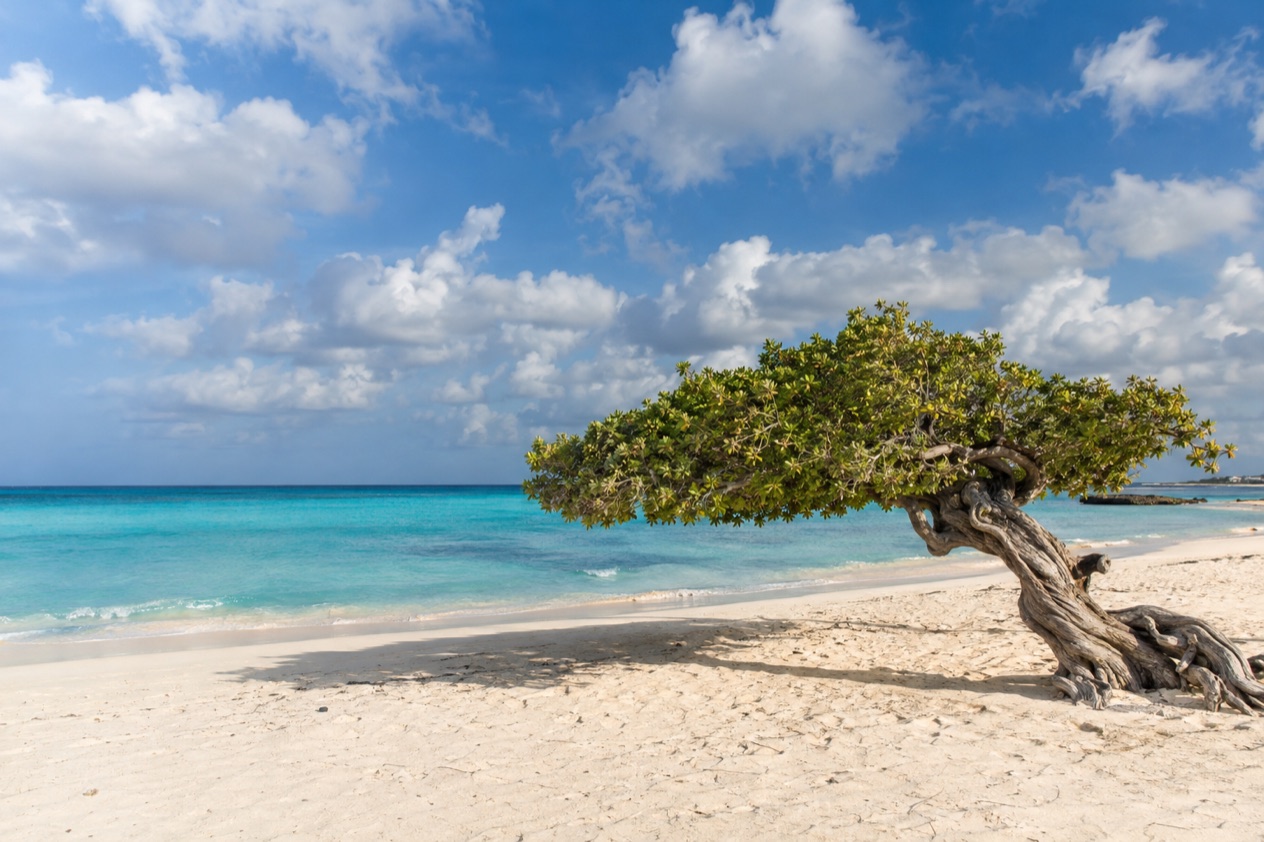
On a late afternoon in Aruba, the fofoti trees on Eagle Beach lean toward the west, bent over by a wind that never seems to take a day off. That breeze, the sunshine and a sea that feels like bathwater are the island’s weather in a few words. Rain is brief and rare for the Caribbean, the heat is constant, and the months differ mostly in how windy and how showery they are.
What is the weather like in Aruba?
Aruba is hot, sunny and dry for a Caribbean island, with a steady easterly breeze and showers that tend to be short. The climate is semiarid, closer to a desert coast than to a rainforest, and the whole year gets only about 18 inches of rain. Cactus, aloe and wind-bent fofoti trees cover the countryside for a reason. Most days start bright and stay that way.
Drier months and wetter months
The spring months, from February to June, are the island at its sunniest, with only a handful of days that bring any rain at all. From October through January the pattern shifts. Showers come more often, a few of them heavy enough to send you under a restaurant awning, and the sky turns gray for an afternoon now and then. Even then, a wet day usually gives way to sun within hours.
Rain days in the table count days with at least a hint of measurable rain, so a month with ten of them is still mostly bright. The wetter stretch lines up with the off-season, when the island is quieter and some restaurants and businesses may close for renovations or vacations.
| Month | Rain (inches) | Rain days |
|---|---|---|
| January | 1.73 | 10.8 |
| February | 0.77 | 4.5 |
| March | 0.39 | 2.0 |
| April | 0.34 | 1.5 |
| May | 0.56 | 1.7 |
| June | 0.69 | 2.8 |
| July | 1.24 | 4.1 |
| August | 0.77 | 3.1 |
| September | 1.69 | 3.3 |
| October | 3.01 | 7.3 |
| November | 3.43 | 9.6 |
| December | 3.15 | 11.0 |
When the showers fall
Rain in Aruba usually arrives in the early morning hours, often while you are still asleep. During the rainy months it can also come in the early or late evening. That leaves the middle of the day free for the beach more often than not, which is one reason the island suits people who plan around the sun.
Sunrise falls between roughly half past six and seven o’clock, and San Nicolas, on the east side, goes by the nickname Sunrise City. If the night brought a shower, an early walk or run after it is often the freshest hour of the day.
Sunshine, daylight and storms
Aruba is known as the Caribbean island with the most sunny days, and the long, bright evenings are part of the pleasure. From June to September the sun sets later and the evening stretches out for a sunset sail or a beachfront dinner. In winter, sunset comes a little earlier, so a stroll on Eagle Beach or Palm Beach just before dusk fits neatly before dinner.
The island sits on the southern fringes of the hurricane belt. Damaging tropical cyclones are rare here, with considerable damage from one passing just to the south happening about once every hundred years. Storm systems passing to the north can still cause some beach erosion and coastal flooding, so a rough stretch of weather in the hurricane season is possible even when the island itself is spared.
How windy is Aruba?
Aruba is windy all year, with the trade wind blowing from the east at a moderate to fresh pace every month. It is the island’s air conditioning, and it explains why the heat feels less heavy than the thermometer suggests. The breeze is also why the trees on Eagle Beach grow sideways.
| Month | Average wind (mph) |
|---|---|
| January | 16 |
| February | 17 |
| March | 18 |
| April | 18 |
| May | 19 |
| June | 20 |
| July | 18 |
| August | 18 |
| September | 15 |
| October | 13 |
| November | 13 |
| December | 15 |
Strongest and gentlest months
The wind builds through spring and peaks around early summer, when the airport readings are at their highest. Those months feel brisk on an open terrace, and napkins and hats tend to wander. October and November bring the lightest breeze of the year, so the air feels stiller and the afternoons a touch stickier, which is when a shower or an overcast morning is most welcome.
Hi-Winds Aruba, the annual kiteboarding and windsurfing competition, is usually held in late June or early July. Even if you never touch a board, the event is a good reason to watch from the shore.
Two coasts, two moods
The wind shapes the island’s geography. The leeward coast, to the west and southwest, is where the resort beaches sit, including Palm Beach and Eagle Beach, and the breeze there feels like a steady push rather than a blast. The windward coast, to the north and east, faces the wind head on. It is rough and wild, with rocky shores and surf that pounds against the limestone.
Along that north coast you come across places such as Bushiribana, where the landscape looks scoured and bare. On the windward side the wind is a feature of the view, so a walk there feels very different from an evening at a beach bar on Palm Beach.
A breeze this constant changes small things, too. Drinks on a terrace are kept cool, the sails of a sunset boat fill easily, and the dry air dries towels quickly. Hair and loose papers are another matter.
How warm is the sea?
The sea around Aruba is warm all year, and it is at its warmest in early autumn. Off Oranjestad the surface reads comfortably above 80 degrees in every month, which means you never need to brace yourself for the first plunge. The coolest water arrives in February and March, and even then it is gentler than most beaches in the United States ever get.
| Month | Sea surface (°F) |
|---|---|
| January | 81.0 |
| February | 80.3 |
| March | 80.2 |
| April | 80.8 |
| May | 82.1 |
| June | 82.6 |
| July | 82.2 |
| August | 83.7 |
| September | 85.3 |
| October | 86.5 |
| November | 85.0 |
| December | 82.4 |
The warmest stretch of the year
From August to November the sea reaches its highest readings, with October at the top. It is the same period when the wind is gentlest and the showers more frequent, so a warm sea and a still afternoon often go together. In practice, the water feels like part of the air, and a dip does little to cool you down.
Winter and spring are slightly cooler, though only by a few degrees. In peak season, from December to April, the sea averages in the high seventies to low eighties, which still feels pleasant against the dry heat on shore.
What the sea is like by coast
The leeward coast, home of Palm Beach and Eagle Beach, is the sheltered side where the resorts face the sunset. The windward coast, to the north and east, is rough, so the sea there is something to look at from the shore rather than a place to linger.
A sunset sail along the west coast is a fun way to be on the water, and the warm temperature adds to the pleasure of staying out until the sky turns orange. Pairing a late-afternoon walk on the sand with a beachfront seafood dinner is an easy way to end the day by the sea.
How hot does Aruba get?
Aruba is hot every day of the year, with afternoons in the upper 80s to low 90s and nights that stay warm. Temperatures stay between 80 and 90 degrees through the year, and the real difference between seasons is slight. What changes more than the heat is the wind and the occasional shower.
| Month | Average high (°F) | Average low (°F) |
|---|---|---|
| January | 86.5 | 76.6 |
| February | 87.1 | 76.6 |
| March | 88.0 | 77.5 |
| April | 89.4 | 78.8 |
| May | 89.6 | 80.1 |
| June | 90.5 | 80.4 |
| July | 90.3 | 80.1 |
| August | 91.8 | 81.0 |
| September | 91.8 | 81.1 |
| October | 90.3 | 80.1 |
| November | 88.7 | 78.8 |
| December | 87.3 | 77.5 |
Cooler months and hotter months
The mid-80s of winter feel the most forgiving, and the evenings are pleasant for dinner outdoors. January and February are also the months of Carnival, when the streets of Oranjestad fill with parades, so the warm air is part of the festival mood. In peak season, the daily average sits at about 81 degrees, which is the figure to keep in mind for the busy winter weeks.
August and September are the hottest months, with afternoons that reach the low 90s and nights that barely cool off. In those weeks the trade wind is what keeps the air bearable, and in autumn, when it eases, the warmth is more noticeable.
Shaping a day around the heat
Mornings are the soft hour. The sun rises around half past six, and active visitors like an early run to catch the light before the heat builds. Midday is for shade, a long lunch or time in the water. The late afternoon, when the light turns golden, is for a walk on the sand.
Because the dry season brings abundant sunshine and very little rain, a day on the beach is a safe bet in winter and spring. In the autumn rainy stretch, plan the outdoor part of the day for later in the morning, when the early showers have usually passed.
Good to know before you go
The U.S. State Department rates Aruba Level 1, ‘Exercise normal precautions,’ and says Aruba is generally a safe destination for travelers, with petty crime the main concern in popular tourist areas.
The official hurricane season runs from June 1 to November 30, covering the hottest and wettest part of the year. As the island lies on the southern fringes of the belt, damaging storms are rare, but the autumn showers and the occasional swell from a distant system are part of the season.
Peak season runs from December to April, and the best weather overall is found from February to August. If you want fewer crowds, September to November, or July and August, are the quieter times.
Sources
- Departamento Meteorologico Aruba, Climate Data (https://www.meteo.aw/climate.php), checked October 9, 2026
- Aruba Tourism Authority, Weather and climate (https://www.aruba.com/us/our-island/island-facts/weather-and-climate), checked October 9, 2026
- Aruba Tourism Authority, Best time to visit (https://www.aruba.com/us/our-island/one-happy-island/when-is-the-best-time-to-visit-aruba), checked October 9, 2026
- Aruba Tourism Authority, Sunset and sunrise (https://www.aruba.com/us/our-island/island-facts/aruba-sunset-and-sunrise-time), checked October 9, 2026
- Meteorological Department Aruba (meteo.aw), Summary Climatological Normals 1991-2020, Queen Beatrix Airport station (http://www.meteo.aw/files/Download/climatnormals19912020.pdf), checked October 9, 2026
- Open-Meteo Marine API, average 2015-2024, checked October 9, 2026
- U.S. Department of State, Aruba Travel Advisory, Level 1, issued August 19, 2026 (https://travel.state.gov/content/tsg_aem/us/en/home/international-travel/travel-advisories/destination.abw.html), checked October 9, 2026
To plan your stay
- Things to Do in Aruba: Beaches, Arikok National Park, Island Tours and Food
- Where to Stay in Aruba: Palm Beach, Eagle Beach, Oranjestad and All-Inclusives
- Aruba Airport (AUA): Arrival, Getting to Your Hotel, U.S. Preclearance and Departure
- Know Before You Go to Aruba: Entry Forms, Money, Water and Local Customs