
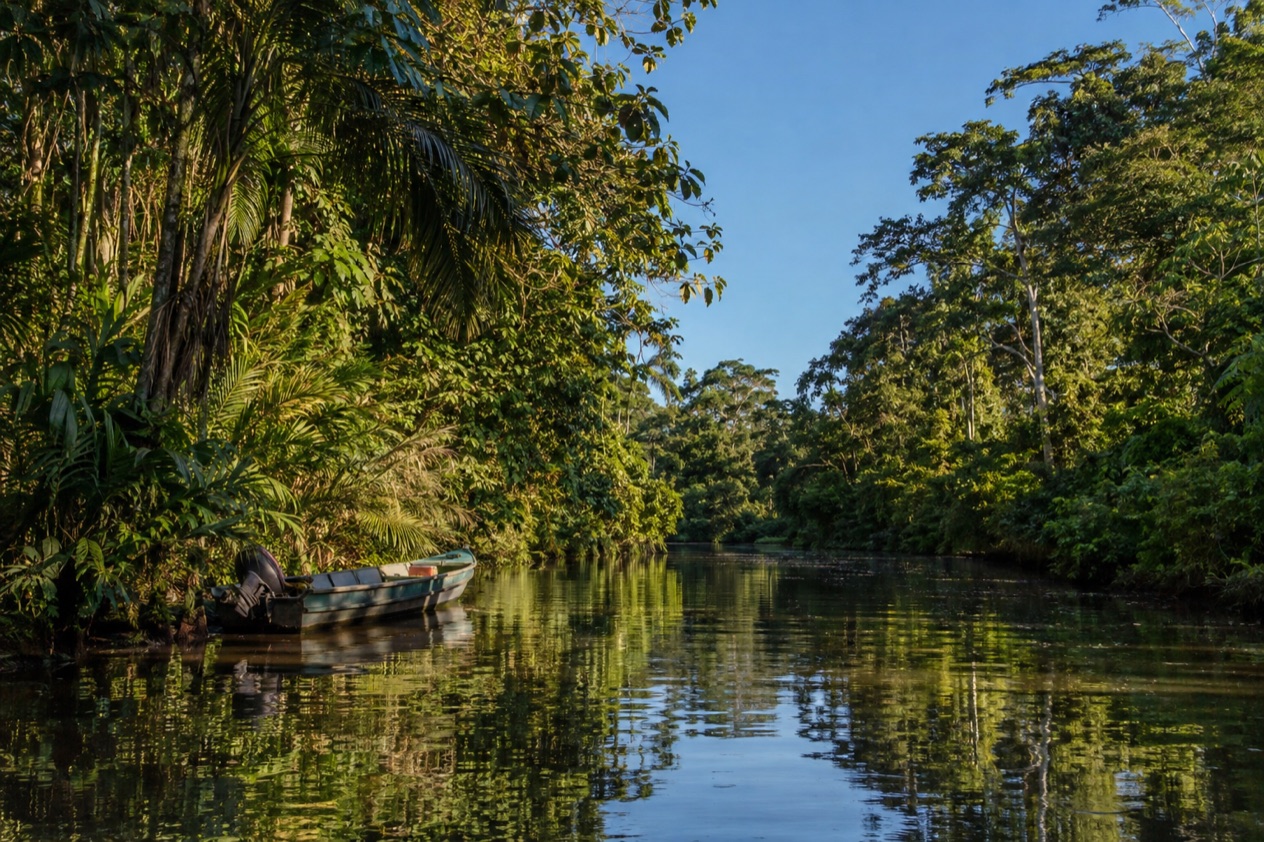
In Tortuguero, the canals take on a tea-like hue and mist sits among the trees before the sun has fully risen. A boat engine cuts to a whisper, a kingfisher drops from a branch, and somewhere in the canopy a troop of howler monkeys starts its low roar.
March here is warm, green and still plenty wet, a month for slow mornings on the water, village walks and evenings with frogs and insects for a soundtrack. It suits travelers who want rainforest wildlife on the Caribbean side of Costa Rica.
What is the weather like in Tortuguero in March?
March in Tortuguero is hot, humid and green, with showers that can arrive at any hour rather than on a fixed afternoon schedule.
| Month | Average high (°F) | Average low (°F) | Rain days | Sea (°F) |
|---|---|---|---|---|
| February | 80.9 | 71.5 | 11.8 | 81.9 |
| March | 81.9 | 72.4 | 11.1 | 83.0 |
| April | 83.3 | 73.9 | 11.6 | 84.4 |
Mornings start soft and sticky, and the early hours on the water are the most comfortable of the day, with a light breeze off the boat and the forest still cool from the night. By midday the heat settles in under the canopy, and it feels heavier than the thermometer suggests because the air is saturated. Evenings stay warm enough for a T-shirt, though a thin layer helps on a moving boat after dark.
The rain here does not follow the Pacific side’s pattern of dry mornings and stormy afternoons. The Caribbean coast catches showers off the sea all year, so a bright sunrise can turn gray by ten and clear again by lunch. Just under four inches of rain falls over the month, spread across many short spells, and a heavy downpour of an hour or two is more likely than a gray week.
Dress for wet and warm: quick-drying fabrics, a real rain jacket or poncho, and shoes that can get soaked. The light is soft and often diffuse, which flatters the greens and makes photographs of birds easier than under harsh sun, though a cloudy canopy can be dim at dawn. Treat any clear sky as a gift, never a promise.
Can you swim in Tortuguero in March?
The sea is warm enough for a long swim in March, but the beach in front of Tortuguero is not a place most visitors should count on for swimming.
The Caribbean here is as warm as bathwater by the numbers, yet the shoreline is a long, open stretch of dark sand with surf that can be heavy and currents that pull. Several U.S. tourists lose their lives to rip currents on this coast every year, a serious hazard, and on most beaches you will find neither lifeguards nor any means of warning that the water is unsafe. With dangerous rip currents and no lifeguard or warning guaranteed, stay out of the sea.
What the beach does well is walking. At low tide the hard sand near the water makes an easy stroll, with driftwood, almond trees and the sound of surf on one side and forest on the other.
For families with small children and nervous swimmers, the lodge pool, when the lodge has one, plus the canals for wildlife, will make them happier. Surfers and snorkelers should look elsewhere on the coast, since the water here is rarely clear and the waves are not set up for either.
What to do in Tortuguero in March
What to do in Tortuguero in March comes down to water, forest and the village, with wildlife as the main attraction. There is no road in, so every outing starts on a boat, and most visitors stay at lodges that organize guided tours of the canals. March is a good month to spend on the water, with rain showers that come and go and plenty of birds active in the early hours.
The one national festival of the month falls far from here. The Dia del Boyero, a parade of painted oxcarts in Escazu near San Jose, is held on the second Sunday of March and honors the oxcart drivers who once carried coffee to the coast. If your trip passes through the capital that weekend, the carts, in their swirling geometric patterns, are worth a detour before the boat ride north.
The turtle nesting that made Tortuguero famous runs on its own calendar, with different species coming ashore in different months. A guide at your lodge can tell you what may be on the beach during your stay, and sightings are a chance, never a promise. Wildlife on the canals, by contrast, is a daily possibility.
The canals by boat
A guided boat ride is the heart of a stay. The narrow channels run between walls of heliconia, palms and fig trees, and the boat drifts slowly so the guide can spot what you would miss.
Caimans lie half-submerged near the banks, herons stand motionless in the shallows, kingfishers flash from branch to branch, and monkeys travel the treetops overhead. A sloth curled in a cecropia is a classic find, and a good guide is the reason you see it.
The best hours are the earliest, when the animals are active and the water is glassy. Early boats in March often meet a damp, cool morning, and wet-weather gear matters more than sunscreen.
Paddling in a kayak or a canoe is quieter than an engine and lets you hear the forest, which suits patient travelers who like a slower pace. Showers can fall on any outing, and in a light rain the birds often keep right on moving.
The village and the beach walk
Between the canal and the sea, Tortuguero village occupies one sandy strip, with a handful of lanes, tiny sodas, souvenir shops, a church and a soccer field where children play in the evening. The compact village is easy to explore on foot, with music from open doors, bicycles, and people chatting on porches. Walking from one end to the other takes you from the canal docks to the open beach.
Food here has a Caribbean accent. Seek out rice and beans simmered in coconut milk, fried plantains, fresh fish, plus rondón, a coconut stew of fish, root vegetables and spices left to cook low and slow. Fresh tropical fruit and cold drinks are the afternoon reward after a humid walk. On the beach itself, keep to the sand and the edge of the water, and do not count on lifeguards.
Rainforest on foot
Forest trails near the village let you see what the boat cannot: the small things. Leaf-cutter ants march in lines, poison dart frogs sit on the leaf litter, and birds call from hidden perches. Rubber boots are the standard footwear, since the paths are muddy in a month with this much rain, and a guide is the best way to find animals that blend into the greens and browns.
A night walk, if your lodge offers one, reveals frogs, insects and sleeping birds that the daytime misses. Humid evenings bring out the chorus, and a flashlight beam picks out eyes along the trail. Wear long sleeves and trousers for the mosquitoes. Check current park entry and reservation requirements directly with SINAC before you go.
A two-day itinerary for Tortuguero in March
Day 1 starts with the boat or small plane that carries you in. Settle into your lodge, have lunch, and take the afternoon for the village on foot, when the heat has softened and the light is gentle.
Walk the lanes to the beach and back, stop at a small soda for rice and beans or a cold fruit drink, and look into the church and the shops. About twelve hours of daylight means the sun sets in the early evening, so plan to be back at the lodge by dusk.
Evening is for the lodge: dinner, a night walk if it is offered, and the sound of frogs. If it rains hard, which is likely at some point in March, stay on the porch with a drink, listen to the downpour on the roof and plan the morning boat.
Day 2 starts early, on the water, when the canals are quiet and the animals are most active. Take the guided boat ride before breakfast, then return to the lodge for a big plate of gallo pinto, the rice-and-bean breakfast of Costa Rica, and a break from the humidity. The middle of the day is slow, and a hammock or a book is the right answer to the heat.
In the afternoon, take a forest walk with a guide, boots on, while the light is still good under the trees. If showers roll in, the lodge, the covered boat and the village sodas are your rain card. Leave for your next stop by boat or plane the following morning, since there is no road out either.
Is Tortuguero busy in March?
Tortuguero is moderately busy in March, with a steady flow of lodge guests rather than the crush of a peak holiday week.
Because everyone arrives by boat or small plane, the village has a natural limit, and lodges fill in waves rather than all at once. Weeks that overlap school breaks and spring holidays in the United States bring more families and tour groups, and rooms in the better-known lodges go first. The quieter weeks leave more room on the boats and more silence on the canals, which helps with wildlife.
As a habit, book early for any holiday week and a bit later for ordinary weeks. The tables in the village sodas rarely need a reservation, but dinner at a lodge is part of the package. Rental cars are of no use here, since the village has no roads in, and your transfer is the thing to arrange.
The Dia del Boyero parade in Escazu can bring traffic around San Jose on that Sunday, so allow for it if you are traveling to or from the capital that weekend. Beyond that, no festival fills the village in March, and the pace stays calm.
What to pack for Tortuguero in March
Pack for heat, humidity and sudden rain, with clothes that dry quickly and gear that protects your camera and phone.
- A light rain jacket or poncho, because showers can start in any hour of the day.
- Quick-drying shirts and trousers, since cotton stays damp for hours in the humid air.
- Closed shoes or rubber boots for muddy forest trails.
- Insect repellent, for the canals and the evening walks.
- Binoculars, to bring distant birds and monkeys close.
- A dry bag or zip-top bags for cameras and phones on the boat.
Good to know before you go
The U.S. State Department rates Costa Rica Level 2, ‘Exercise increased caution,’ due to crime; it says petty crime is common throughout Costa Rica and that violent crime also affects tourists, including armed robbery, homicide and sexual assault.
Tortuguero, a tiny village encircled by rainforest and canals, lies on the northern Caribbean coast and can be reached only by small plane or boat. Plan transport and your lodge first, since they shape the rest of the trip.
Allow for a damp March: some outings may be shortened or shifted by rain, and having a flexible day helps. Even when clouds cover the sky, apply sunscreen, and avoid the water, because rip currents pose a genuine hazard along this coast.
Tortuguero in March vs February and April
Moving the trip four weeks earlier brings a slightly cooler and a touch wetter feel, with a sea that is a shade less warm. February is a good month for the same canal rides and forest walks, and the difference is small enough that most travelers will not notice it on the water. Moving four weeks later brings more heat and a warmer sea, with rain days still frequent, so April feels stickier in the middle of the day.
Crowds follow school calendars more than weather. April can overlap with Easter week, which moves every year and fills lodges and boats, while March has the quieter weeks. The nature seasons here shift on their own schedule, so ask your lodge which animals and turtles may be around for your dates.
Choose March if you want warm, green days with a good chance of wildlife and fewer holiday crowds. Shift earlier if you prefer slightly milder air, and later if you want the warmest sea and do not mind the extra heat. Anyone set on a particular holiday week should book first and let the month follow.
Is March a good time to visit Tortuguero?
For travelers who want rainforest wildlife, quiet canals and warm weather, and who accept that rain comes with the territory, yes, March is a good time to visit Tortuguero.
It will suit birders, photographers, families with children old enough to sit in a boat, and anyone who likes the slow rhythm of a place with no cars. It suits less those who want a beach holiday, since the surf and currents rule out casual swimming, or travelers who need dry, predictable skies. On arrival, settle your boat tours first, then walk the village before dinner to get your bearings.
What makes March special here is the combination: a sea warm as it gets, canals that glow green after a shower, and a village that stays calm between the holiday weeks. A morning on a quiet channel with the mist lifting and a monkey crashing through the leaves is the picture to carry home.
Sources
- Open-Meteo / ECMWF ERA5, normals 1991-2020 computed for the grid cell at 10.543N 83.502W, checked October 8, 2026
- Open-Meteo Marine API, average 2015-2024, checked October 8, 2026
- sunrise-sunset.org, sunrise and sunset calculated for the 15th of the month, checked October 8, 2026
- U.S. Department of State, Costa Rica Travel Information, Safety and security (https://travel.state.gov/content/travel/en/international-travel/International-Travel-Country-Information-Pages/CostaRica.html), checked October 8, 2026
- U.S. Department of State, Costa Rica Travel Advisory, issued April 1, 2026 (https://travel.state.gov/content/travel/en/traveladvisories/traveladvisories/costa-rica-travel-advisory.html), read via the State Department open data API on October 8, 2026
To plan your stay
- Things to Do in Tortuguero: Canal Boats, Turtle Nesting, Rainforest Walks and Caribbean Food
- Where to Stay in Tortuguero: Village, Beachfront and Canal Lodges
- Tortuguero National Park: Turtle Nesting, Canal Boat Tours, Hours and How to Get There
- Best Time to Visit Tortuguero: Turtle Season, Weather by Month and Canal Tours