
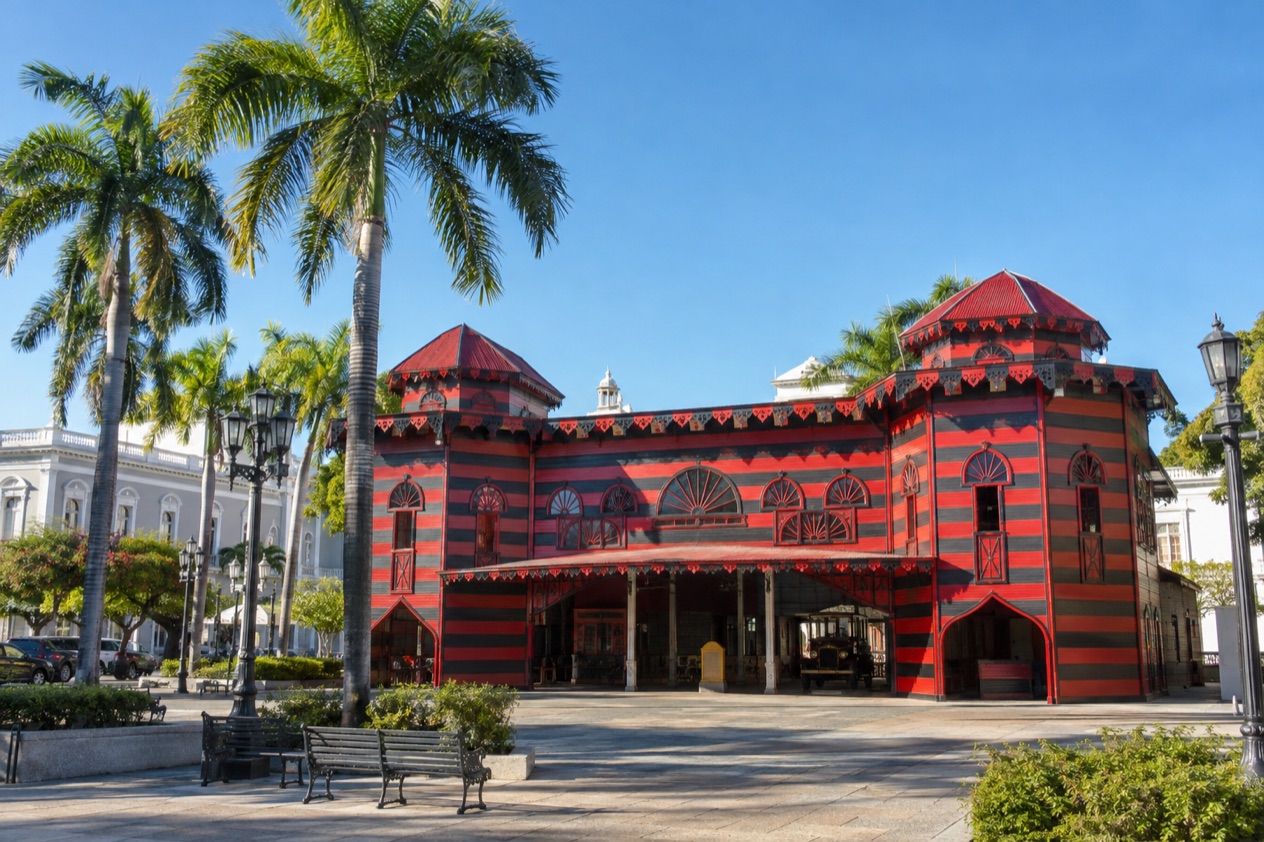
Leaving San Juan at first light, you trade the glass towers and traffic of the capital for cane-green hills, roadside fruit stands and the first cool air of the mountains. Somewhere past the central ridge the clouds thin out and the land turns drier and sunnier, and then the south coast opens up. At the end waits Ponce, the Pearl of the South, with its striped red-and-black firehouse, its grand plaza and a museum that deserves a long visit.
How do you get to Ponce from San Juan?
The easiest way is to drive yourself, crossing the island from the north coast to the south on the tolled autopistas, which makes Ponce a full day out and an easy overnight. It is a trip across the middle of the island, through mountain country, so plan on a long morning at the wheel rather than a quick hop. Every other route to Ponce is a variation on that same crossing.
Two things decide the right option for you. The first is how much freedom you want once you arrive, because Ponce’s sights are spread between the old center, a hill above the city and the waterfront, and a car makes linking them painless. The second is how you feel about mountain roads and the toll system, since the tolls here work electronically and cash is not accepted on most tollways.
The route itself is part of the pleasure. The fast way runs on the autopistas, which carry most of the through traffic. The old way is PR-1, which today is mostly used by people living nearby and as a scenic route between San Juan and Ponce. It winds through small towns and past bakeries and fruit stands, and it suits travelers who would rather see the island than arrive early.
If you land at Luis Muñoz Marín International Airport, Puerto Rico’s main gateway, you can start your drive from that very spot. Ponce also has its own airport, Mercedita, just east of the city center, but the island’s biggest range of connections from the mainland is at San Juan. That is why most visitors begin the trip in the capital.
Ways to get to Ponce from San Juan
By rental car
Driving is the most flexible way to do it, and the one that lets you stop in a mountain town for coffee or a roadside lunch. You pick up the car in or near San Juan, follow the autopista south and cross the island’s central range, and the coast of the Caribbean appears on the far side. Leave early, especially if you want time in the city before the afternoon heat.
The tolls are the one thing to sort out before you go. AutoExpreso is the electronic system on Puerto Rico’s tollways, and since 2012 it has been the exclusive form of payment on most of them, with cash no longer accepted.
Your E-ZPass or SunPass will not work here, so ask the rental company how it handles tolls when you pick up the car. This option suits couples, families and anyone who wants to pair Ponce with a few stops on the way back.
By carro público
Carros públicos are the island’s jitney-style shared taxis, with over 3,000 vehicles covering almost 500 routes for local and islandwide travel. They are an old Puerto Rican institution, and riding one gives you a real feel for how people get around outside the tourist zones. Carros públicos run on set routes, but confirm locally whether a workable connection to Ponce is operating before relying on one.
This is the choice for adventurous travelers with flexible schedules who are happy to take a longer day and ask locals for directions along the way. Bring a little Spanish, since the drivers and fellow passengers are your best guides, and ask at the departure point which route heads for Ponce.
With a private driver or an organized tour
If you arrange a private driver or a guided day trip, you can spend the long drive looking out the window instead of at the signs. This option appeals to travelers who do not want to drive on unfamiliar mountain curves, to groups who would rather share the ride, and to anyone planning a long day that includes a rum-country stop or a coastal lunch.
Tours generally follow a fixed itinerary, so they trade freedom for ease. If you want to linger at the Ponce Museum of Art or see the carnival masks in a workshop, a private driver who waits for you fits better than a set program. Ask what the day includes before you commit, and whether the return to San Juan is timed for you or for the group.
Options compared
| Option | Time each way | Best for | What to know |
|---|---|---|---|
| Rental car | A long morning’s drive | Flexibility, stops along the way, an overnight | Tolls are electronic only, and cash is not accepted on most tollways |
| PR-1 scenic route (by car) | Longer than the autopista, a slow day | Small towns, bakeries, mountain views | Mostly used by locals and as a scenic route between San Juan and Ponce |
| Carro público | Longer than driving, with a transfer or two | Travelers on a flexible schedule who like local color | Shared jitney on set routes, dropping you at a central point |
| Private driver or tour | Similar to driving | No-stress days, groups, first-timers to mountain roads | Less freedom, so confirm the itinerary and the return time |
If the day is the whole point, a rental car or private driver gives you the most hours in Ponce, because nothing depends on a route schedule. If the journey is part of the adventure, a carro público or a slow run along PR-1 puts you among the island’s small towns, though you will want an overnight to enjoy the city afterward. Either way, the sensible plan is to treat the crossing as half the day and Ponce as the other half.
Staying the night changes the whole feel of the trip. You see the plaza in the evening, when families sit on the benches and the lights come on, and you do not spend the afternoon watching the clock. For a single day, pick a few places and enjoy them well rather than racing through the lot.
Making a day of it
Start with Plaza Las Delicias, the heart of the historic center, where the Parque de Bombas firehouse in red and black stripes is the best-known photograph in the city. Around it you find the cathedral, shaded benches, and cafés where you can try a strong coffee and a pastry. The historic district sits inland from the coast, so you can walk much of it on foot, and it is easy to wander streets of pastel facades and wrought-iron balconies.
The Ponce Museum of Art is the cultural anchor of the visit, with a collection that rewards an unhurried hour or two. Check the museum’s current opening status before making it your midday plan. After lunch, head uphill to Castillo Serralles, the mansion from the 1930s that overlooks the city, for the views and a look at how the sugar and rum families lived.
Finish by the sea at La Guancha, one of Ponce’s landmarks, and check what is open before you go. Try local fried snacks such as alcapurrias (fritters of green banana and taro stuffed with meat) and a cold drink. Sunset over the Caribbean is a good reason to stay late, and you can drive back to San Juan afterward or settle into a hotel for the night.
A longer stay, the mountains and the island
With a second day, Ponce opens up. Ponce’s borders extend into the Cordillera Central, and in Barrio Anón the island’s tallest mountain, Cerro de Punta, climbs skyward. The air is cooler up there and the scenery is a world away from the beach, so it suits drivers who like a mountain road and a view.
A ferry route connects Ponce and Caja de Muertos, but confirm current service before planning a beach day around it. Should your visit fall during the weeks ahead of Lent, Carnaval de Ponce takes over the streets with loud parades and vejigantes in horned masks, so reserve your room early and plan to stay.
Start for Ponce from San Juan at dawn, put on shoes made for walking, and bring along water plus a hat and sunscreen, because the south coast brings heat and strong sun. Bring a light layer for cool museum interiors and a little cash for small kiosks, though most restaurants take cards. Allow a full day in the city if you drive back the same evening, and an overnight if you want the plaza at night.
Good to know before you go
Puerto Rico uses the U.S. dollar, and U.S. citizens may visit with no passport or visa required. The Atlantic hurricane season runs from June 1 to November 30, with the peak in September, so on a trip in those months follow the National Hurricane Center and local official alerts before you set out across the mountains.
Sources
- Wikipedia, Ponce (https://en.wikipedia.org/wiki/Ponce,_Puerto_Rico), checked October 8, 2026
- Wikipedia, Mercedita Airport (Ponce) (https://en.wikipedia.org/wiki/Mercedita_Airport), checked October 8, 2026
- Wikipedia, Transportation in Puerto Rico (https://en.wikipedia.org/wiki/Transportation_in_Puerto_Rico), checked October 8, 2026
- Wikipedia, AutoExpreso tolls (https://en.wikipedia.org/wiki/AutoExpreso), checked October 8, 2026
- Wikipedia, Luis Muñoz Marín International Airport (https://en.wikipedia.org/wiki/Luis_Muñoz_Marín_International_Airport), checked October 8, 2026
- NOAA National Hurricane Center, Climatology (https://www.nhc.noaa.gov/climo/), checked October 8, 2026
To plan your stay
- Best Time to Visit Ponce: Weather by Month, Beaches, Carnaval and Hurricane Season
- Things to Do in Ponce: Plaza Las Delicias, Art Museum, Caja de Muertos and Local Food
- Where to Stay in Ponce: Plaza Las Delicias, La Guancha, the Museum District and the Hills
- Know Before You Go to Ponce: Entry, Getting Around, Heat and Local Customs