
LISBON · MARCH · 38.7° N
March gives Lisbon back its walkable hours. The official normal for the month is a high of 65.1°F (18.4°C) and a low of 50.5°F (10.3°C), with 2.63 inches of rain spread over 7.2 days that record at least 1 mm. That is a city you can climb at two in the afternoon without routing yourself through shade, and a sea at 59.4°F that will not let you swim without a wetsuit.
What the month takes away is certainty. Two or three days in an average March deliver 10 mm of rain or more, and Belém Tower reserves the right to close whenever conditions make it unsafe. In exchange you get daylight until quarter to seven, a Jerónimos cloister you can still book, and a city that has not yet moved to its summer setting. The Sintra palaces and the Cascais coast shift far less with the calendar than the water does, and they keep their own guide.
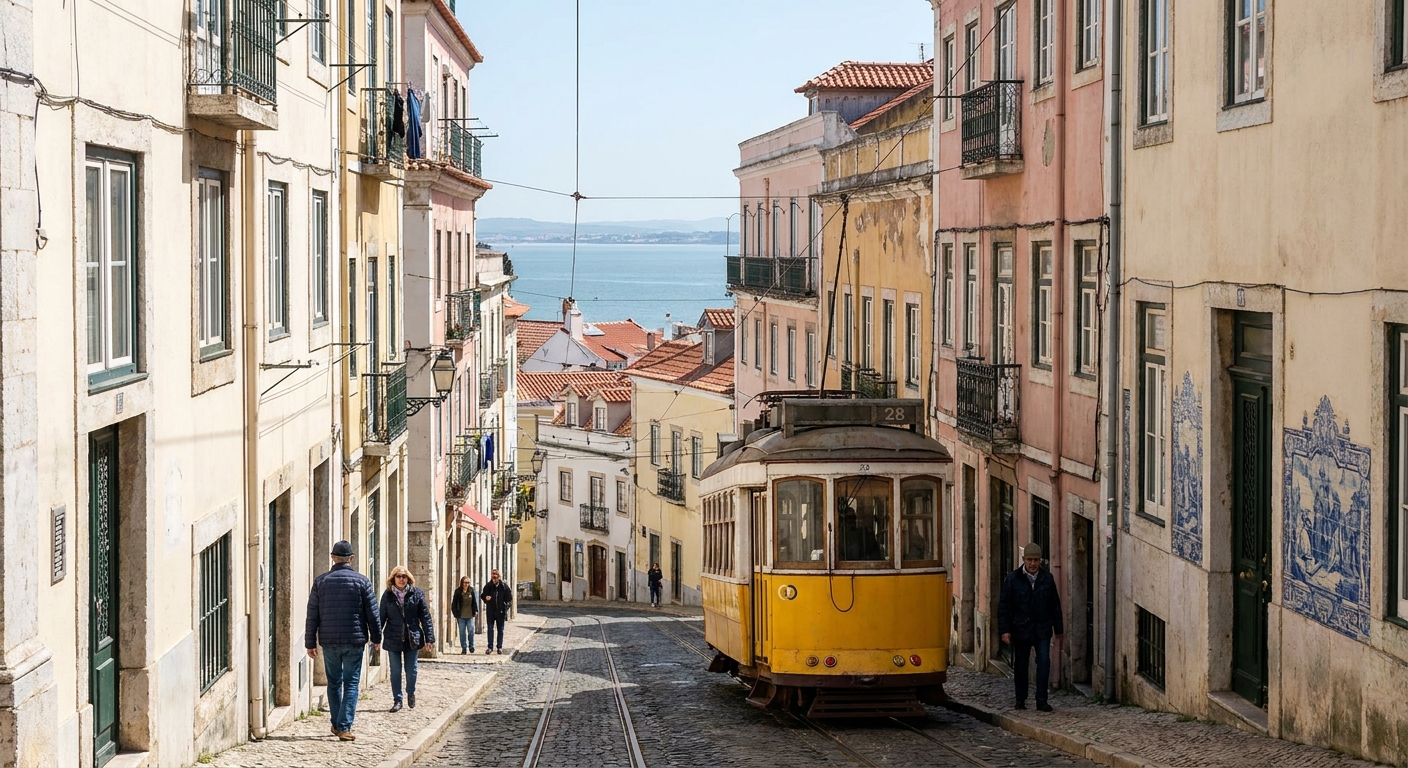
MARCH AT A GLANCE · LISBON
March is Lisbon’s walking month: 65°F afternoons, roughly one wet day in four, and a sea too cold for anything but a wetsuit.
AVG HIGH 65.1°F · 7.2 RAIN DAYS · SEA 59.4°F · IPMA 1991–2020 NORMALS
Go for: hill walking at 65°F, museum afternoons priced from EUR 8, and a sunset from a miradouro at 6:45 p.m. instead of 9 p.m.
Think twice before: planning a beach day. At 59.4°F the water is wetsuit territory, and April adds only 2.8°F.
Normals: IPMA station 579 · Sea: Open-Meteo Marine · Fares: Metropolitano de Lisboa & Carris 2026 · full sources at the end
On this page
- Lisbon weather in MarchHighs of 65.1°F and 7.2 rain days
- Can you swim in Lisbon in March?Sea at 59.4°F, wetsuit water
- Crowds, prices and the tourist taxWhere March sits, and the tax we could not price
- Things to do with fares and opening hoursJerónimos EUR 18, Gulbenkian EUR 18, Oceanário EUR 25–29
- Two-day itinerary in LisbonHour by hour, with a wet-afternoon swap
- March, February or April?April buys 2.7°F, February costs 4.8°F
- Is March a good month for Lisbon?Yes for walkers, no for swimmers
The numbers below all describe March specifically, and the ones that matter most are the ones you cannot pack around: 7.2 wet days and a 59.4°F sea. If your month is still open, the twelve-month verdict for Portugal compares all of them side by side. If the dates are already bought, start with the thermometer.
Lisbon weather in March: average highs, lows and rain days
| Measure | March (1991–2020) | What it does to a day |
|---|---|---|
| Average high | 65.1°F (18.4°C) | Shirt-sleeves in the sun, jacket in the shade |
| Average low | 50.5°F (10.3°C) | Before 9 a.m. and after sunset you want a layer |
| Precipitation | 2.63 in (67 mm) | Spread across the month, not banked in one week |
| Days at 1 mm+ | 7.2 | About 24 days record no measurable rain |
| Days at 10 mm+ | 2.3 | Two or three days worth an indoor plan |
| Sea surface | 59.4°F (15.2°C) | Mean of daily maxima, 2015–2024 |
| Daylight, Mar 15 | About 12 hours | 6:45 a.m. to 6:45 p.m. |
Every figure here comes from a thermometer rather than a model grid cell. IPMA, Portugal’s national weather service, publishes 1991–2020 normals for station 579, Lisboa Gago Coutinho, which stands at 103.9 m above sea level. Its March normal reads 65.1°F by day, 50.5°F at night, 2.63 inches of precipitation. A riverside terrace in Belém or a sun-trap street in Alfama will run a degree or two off that in either direction, because the station sits inland and uphill from both.
Rain arrives in pieces rather than in a season. 7.2 days in an average March record at least 1 mm (0.04 inch), and only 2.3 of them reach 10 mm (0.39 inch) or more. One caution before you set that beside an American table: IPMA counts from 1 mm while US summaries usually start at 0.10 inch, so the two counts are not interchangeable and IPMA’s total looks higher for identical weather. Read it as one afternoon a week that wants a roof, plus two or three days worth rearranging outright.
The gap between the two normals is 14.6°F, and it lands at both ends of the day. At 7 a.m. on a viewpoint you are in the low fifties. By mid-afternoon on a south-facing street you are in the mid-sixties and carrying the jacket you were grateful for at breakfast. Layers plus one genuinely waterproof shell is the answer, since a 10 mm day has no respect for a fashion coat, and Lisbon’s cobbles turn slick when wet. The full list lives in our Portugal packing guide.
March 15 delivers close to 12 hours of usable light: sunrise at 6:45 a.m., sunset at 6:45 p.m. That is the real gain over a winter visit, when a 5:30 sunset forces a choice between the castle and the viewpoint. Schedule the last climb for 6 p.m. and the light is still on the Tagus when you arrive. Dinner in Lisbon starts long after that, so the sunset slot costs you nothing at the table.
Can you swim in Lisbon in March? Sea temperature at 59.4°F
The sea surface off Lisbon averages 59.4°F (15.2°C) in March. That comes from the Open-Meteo Marine dataset, averaged over 2015 to 2024, and it is the mean of daily maxima rather than a 24-hour mean. So it runs a shade warmer than the water you would actually meet at eight in the morning, which is the hour most people plan a swim for.
In practice this is wetsuit water: a fast immersion, a faster exit, a towel that earns its place in the bag. Set the figure against 58.8°F in February and 62.2°F in April and the curve looks almost flat, because four weeks of spring buy under 3°F. If swimming is the point of the trip, March is the wrong month, and a run of sunny afternoons does not change 59.4°F.
On wind and swell we have to be plain: our sources carry no March normals for either at Lisbon, so no figure appears here. The documented consequence is enough to plan around. Belém Tower states that it can close whenever visitor safety is compromised, and the monument stands fully exposed on the riverfront. Keep its EUR 15 ticket for a calm morning and have the indoor alternative already chosen.
How busy is Lisbon in March? Crowds, prices and the tourist tax
March sits in the quieter half of the Lisbon year, ahead of the Easter traffic and well before the summer peak. We are not going to hand you an occupancy percentage: our sources carry no monthly hotel-rate or arrivals series for the city, so there is no figure here we can stand behind. The country-level ladder of what a day costs is priced in our Portugal cost guide instead.
Beds and timed tickets behave differently. Jerónimos Monastery states outright that its tickets frequently sell out and cannot then be bought on the day of the visit, so that is the one purchase to make online before you fly, two or three weeks out (est.) if your dates are fixed. The Gulbenkian and the Oceanário both sell online without the same warning, and the Oceanário takes 5 percent off web tickets.
Lisbon also charges a municipal tourist tax per night on top of the room rate, added at checkout or on arrival. We could not read the current amount on a primary source: the city’s information portal returns a 403 to automated reading and the Diário da República requires JavaScript. So no figure is printed here. Ask the property for the per-night amount when you book, then add it to your own nightly total rather than discovering it at the desk.
The single line where spending more genuinely changes the month is mobility on a wet afternoon. A 24-hour Carris/Metro ticket costs EUR 7.25; the version adding the Cacilhas ferry costs EUR 10.35, and the one adding the CP suburban trains to Sintra and Cascais costs EUR 11.40. Those extra euros buy the right to change your mind at 2 p.m. Paying the driver is the costly habit: EUR 2.30 on a bus and EUR 3.30 on tram 28, against EUR 1.90 for the same ride from a navegante card.
Things to do in Lisbon in March: fares and opening hours
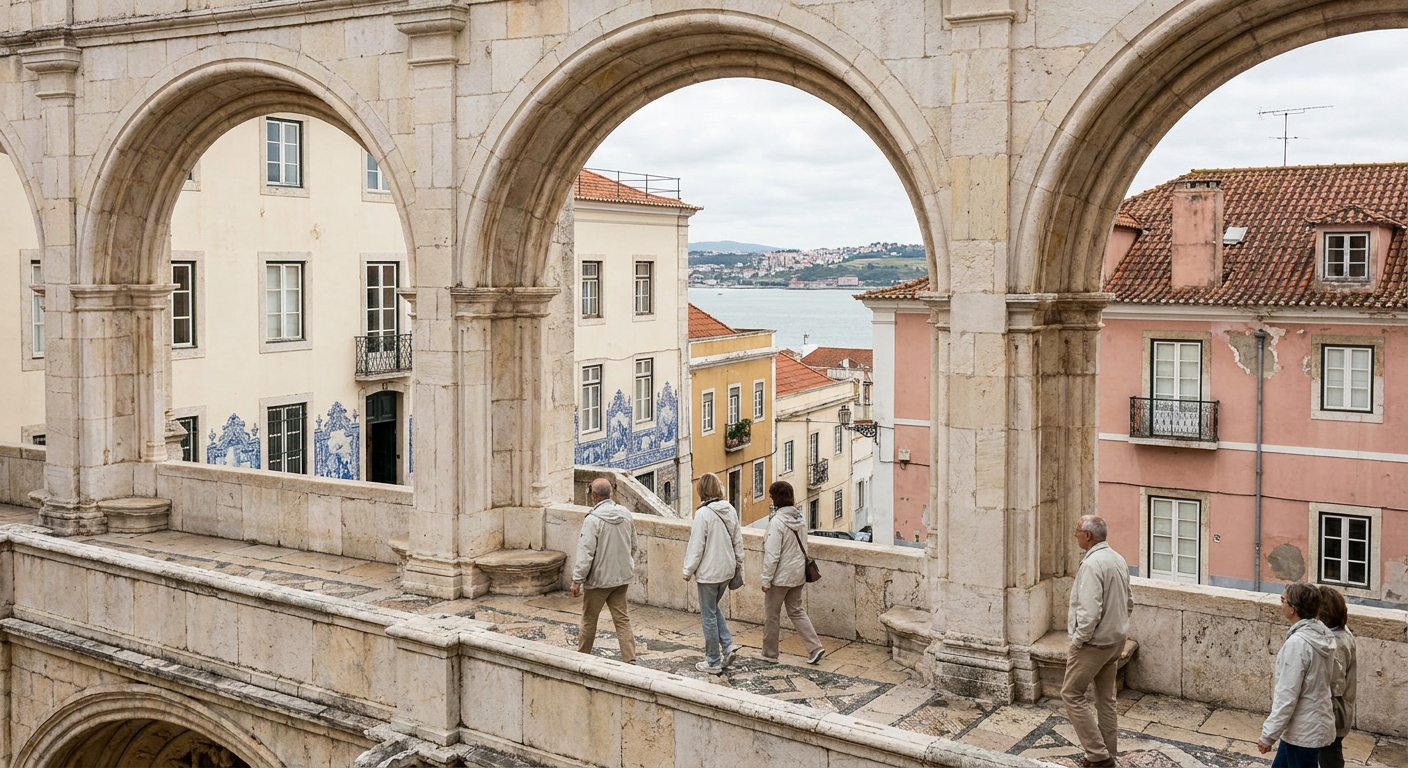
March is the month for the vertical city. Climbing from Baixa to the castle at 65°F is a walk; the same slope at midday in July is a decision. Cool afternoons also turn the big indoor collections into a pleasure rather than a refuge, and a 6:45 p.m. sunset lets a full day of sightseeing still finish on a viewpoint. What the month withholds is the beach afternoon, so the coast stays a walk.
Jerónimos cloister: EUR 18, Tuesday to Sunday 09:30 to 17:30, last entry 17:00, closed Mondays. The church runs its own hours, Tuesday to Saturday 10:30 to 17:00 and Sundays 14:00 to 17:00, and no audio guides are provided. Belém Tower: EUR 15. The Gulbenkian: EUR 18 all inclusive, EUR 16 museum plus CAM, EUR 12 the CAM alone, EUR 8 temporary shows, Wednesday to Monday 10:00 to 18:00, closed Tuesdays. The Oceanário prices by slot: EUR 29 from 10:00, EUR 27 from 12:00, EUR 25 from 16:00, open until 20:00 with last entry 19:00.
Free is narrower than the internet claims. The Acesso 52 exemption at Jerónimos and Belém Tower covers Portuguese nationals and residents in Portugal on any day of the year, and several guides wrongly announce a Sunday-morning freebie for all comers: an American visitor pays the full EUR 18 and EUR 15 whatever the day. The Gulbenkian’s two free windows are gated too, Sunday from 14:00 for under-18s and certain cardholders, Saturday 18:00 to 21:00 for under-30s with the free Cartão Gulbenkian. Reductions travel further: 50 percent for ages 13 to 24 and over-65s at both Belém monuments, under-13s free at Jerónimos.
Lisbon in March: two-day itinerary and daylight hours
Day one runs on the light. Out at 8 a.m. in a layer for a low-fifties start, down to Belém, and at the Jerónimos cloister for the 09:30 opening with the online ticket already on your phone. Belém Tower next if the river is calm, then a long lunch. Cross back into Baixa for the warmest stretch of the afternoon, when 65°F makes the Chiado hills reasonable, and be on a miradouro by 6 p.m. for the 6:45 sunset. Dinner will still be waiting afterward.
Day two opens indoors by design. The Gulbenkian runs 10:00 to 18:00 and shuts on Tuesdays, with its garden as the dry-weather half of the morning. Afternoon: Alfama on foot, or the Cacilhas ferry for the skyline from the water. If the forecast turns, move the whole afternoon to the Oceanário’s EUR 25 slot from 16:00 and allow the hour and a half to two hours it advertises. On a 10 mm day, hold the outdoor monuments for tomorrow rather than spending EUR 15 to stand in the rain.
Lisbon in March vs February and April
| Measure | February | March | April |
|---|---|---|---|
| Average high | 60.3°F | 65.1°F | 67.8°F |
| Average low | 47.1°F | 50.5°F | 53.2°F |
| Precipitation | 2.80 in | 2.63 in | 2.50 in |
| Days at 1 mm+ | 7.8 | 7.2 | 7.7 |
| Sea surface | 58.8°F | 59.4°F | 62.2°F |
Four weeks in either direction move the thermometer far more than the rain gauge. February runs 60.3°F by day and 47.1°F at night, April 67.8°F and 53.2°F. Rainfall barely budges: 2.80 inches, then 2.63, then 2.50, with the count of days at 1 mm or more sitting at 7.8, 7.2 and 7.7. All of those come from the same IPMA station and the same 1991–2020 period as the March normals. Our February and April pages take each month further.
Shifting forward to April buys 2.7°F on the daytime normal, 2.8°F in the water and 0.13 inch less rain, at the price of Easter-week demand on beds and monument slots. Going back to February saves nothing on rain days and costs 4.8°F off the afternoon, with the quietest streets of the year as compensation. For actual swimming, none of the three qualifies: 62.2°F in April is still a wetsuit.
Is March a good time to visit Lisbon?
Yes, if you walk. For a trip built from hills, viewpoints, tiles and long lunches, March is one of the two or three strongest months in the Lisbon calendar, and the 65.1°F afternoon is the whole reason. No, if the water matters, or if you need a guaranteed dry week: 2.3 days at 10 mm or more will find your itinerary at some point.
When the answer is no, the month to prefer is April rather than May, and only if your dates dodge Easter. It adds 2.7°F by day and 2.8°F in the sea for slightly less total rain. Anyone whose holiday is genuinely about swimming should skip spring altogether, and the twelve-month verdict sets out the summer trade honestly.
What no other month combines is a cool climb and a late sunset: 65°F on the steepest streets, with the light still on the river at 6:45 p.m.
The last word
Book the Jerónimos slot, pack the waterproof shell, and let the Atlantic wait for another trip. One small thing to settle before you land: a single Carris/Metro ticket on a navegante card costs EUR 1.90 and stays valid for one hour after the first validation, though it will not let you into the metro twice in a row, and the reusable card itself is EUR 0.50 and reloadable for a year. Across a month with 7.2 wet days, that fifty cents is the best-value purchase in Lisbon. The rest of the country is on the same transport logic.
Sources & data for this guide
- March normals: high 65.1°F, low 50.5°F, 2.63 in, 7.2 days at 1 mm+, 2.3 days at 10 mm+ · IPMA 1991–2020, station 579 Lisboa Gago Coutinho (103.9 m) · checked Sep 10, 2026
- February and April normals, same station and same 1991–2020 period · IPMA · checked Sep 10, 2026
- Sea surface 59.4°F in March (58.8°F Feb, 62.2°F Apr), mean of daily maxima 2015–2024 · Open-Meteo Marine API · checked Sep 10, 2026
- Daylight on March 15, sunrise 06:45 and sunset 18:45 · sunrise-sunset.org · checked Sep 10, 2026
- Fares: EUR 1.90 single, EUR 0.50 navegante card, 24-hour tickets EUR 7.25 / 10.35 / 11.40, zapping metro EUR 1.72 · Metropolitano de Lisboa 2026 tariff (PDF) · checked Sep 10, 2026
- On-board fares EUR 2.30 bus, EUR 3.30 tram · Carris Novo Tarifário 2026 · checked Sep 10, 2026
- Jerónimos: EUR 18, hours, Monday closure, online sellouts, no audio guides, Acesso 52 residents-only free entry · mosteirojeronimos.gov.pt · checked Sep 10, 2026
- Belém Tower: EUR 15 and weather closures · Torre de Belém official site · checked Sep 10, 2026
- Gulbenkian: ticket tiers, hours, two gated free windows · Fundação Calouste Gulbenkian · checked Sep 10, 2026
- Oceanário: slot pricing, 10:00–20:00 hours, 5 percent online discount · Oceanário de Lisboa · checked Sep 10, 2026
- Municipal tourist tax: amount deliberately not served. The city information portal returns a 403 to automated reading and the Diário da República requires JavaScript · verification attempted Sept 8, 2026
- Itineraries and packing advice are editorial. Fares, hours and monument closures change · confirm with each operator when you book.