
CARVOEIRO · FEBRUARY · THE ALGARVE
Average highs in Carvoeiro reach 62.6°F in February and the sea off the cliffs sits at 61.3°F. That pairing makes this a walking month rather than a swimming one: the clifftop path is yours at midday, the low sun does flattering things to the orange rock, and lunch happens without a wait. Nobody is fighting you for a parking space at a viewpoint.
What the date takes away is straightforward. Daylight on February 15 runs 10 hours 53 minutes, the sun is gone by 6:12 p.m., and 5.4 days in an average February bring measurable rain. Some beach restaurants and boat operators run winter hours, and we could not verify which ones in Carvoeiro keep to them, so call before you count on a cave trip.
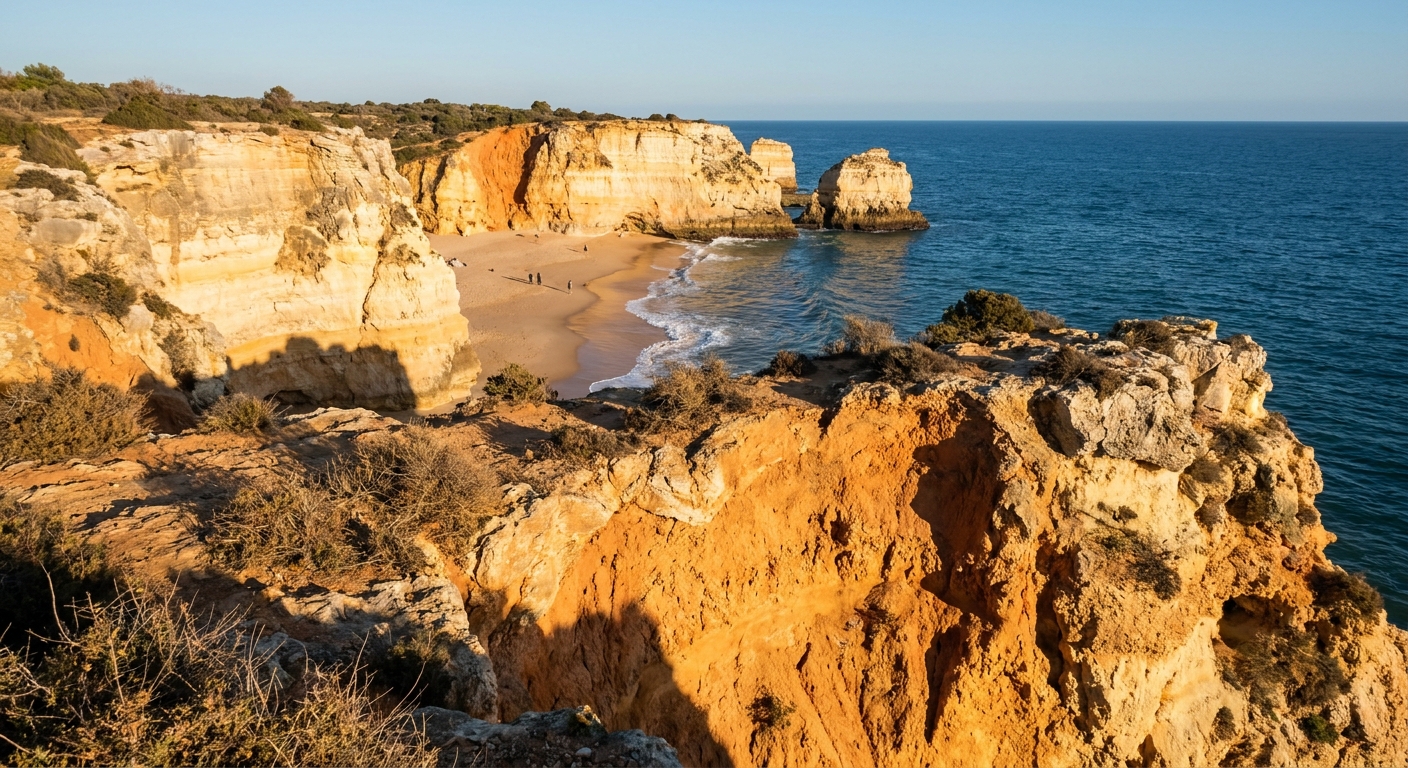
THE MONTH AT A GLANCE · CARVOEIRO · FEBRUARY
February gives Carvoeiro 62.6°F afternoons, the fewest wet days of the three winter months and an empty cliff path, and takes the swimming off the table at a sea of 61.3°F.
AVG HIGH 62.6°F · AVG LOW 47.8°F · 5.4 WET DAYS · SEA 61.3°F
Go for: cliff walking in the 60s, coastal drives with the windows cracked, a cove you can photograph with nobody in it, and a rental car that is worth every cent this month.
Think twice before: booking a beach week. The sea averages 61.3°F, and 1.4 days in an average February record 0.39 inch of rain or more.
Air and rain: IPMA station 554, Faro, 1991-2020 · Sea: Open-Meteo Marine, 2015-2024 · full sources at the end
On this page
- Carvoeiro weather in February62.6°F highs, 1.65 inches, 5.4 wet days
- Sea temperature and swimming61.3°F, and what that feels like
- Crowds, prices and the tourist taxWhat we verified and what we could not
- Things to do in FebruaryCliff paths, boat trips and rain-day drives
- A two-day plan for FebruaryHour by hour on 10h 53m of daylight
- February vs January and MarchHow the three months compare
- Is February a good time to go?Who it suits, who should shift four weeks
Every air and rain figure here comes from IPMA, the Portuguese weather service, and specifically from its 1991-2020 normals at station 554 in Faro: a real thermometer 5.0 m above sea level, east of Carvoeiro, not a model grid cell. That distinction matters west of here, where the coast runs cooler and windier, and it matters inland, where high ground is colder and a good deal wetter. Pack for a hill trail on a Faro reading and you will be underdressed by lunchtime.
Carvoeiro weather in February: average highs, lows and rain days
| Measure | February | Where it comes from |
|---|---|---|
| Average high | 62.6°F | IPMA normals 1991-2020, station 554 Faro |
| Average low | 47.8°F | IPMA normals 1991-2020, station 554 Faro |
| Precipitation | 1.65 in | Monthly total, same normals |
| Days with 0.04 in or more | 5.4 | IPMA 1 mm threshold |
| Days with 0.39 in or more | 1.4 | IPMA 10 mm threshold |
| Sea surface | 61.3°F | Open-Meteo Marine, mean of daily maxima 2015-2024 |
| Daylight, Feb 15 | 10h 53m | Sunrise 7:19 a.m., sunset 6:12 p.m. local |
IPMA’s February normal at Faro is an average high of 62.6°F, an average low of 47.8°F and 1.65 inches of rain across the month. Those are thirty-year averages covering 1991 to 2020, which means they describe the shape of a typical February rather than the fortnight you personally booked. A mild run can hold the upper 60s for days; a cold, wet week is equally within the record.
The rain arrives in a handful of parcels, not as a drizzle spread thin. Of the 5.4 days that record at least 0.04 inch, only 1.4 reach 0.39 inch or more, so a genuine soaking day turns up once or twice in the month and the rest is passing weather you walk through. One caution on the arithmetic: those are IPMA’s own thresholds of 1 mm and 10 mm, not the 0.10-inch cutoff American tables use, so the counts are not interchangeable with a US forecast page.
Day to night, the gap runs 14.8°F. An afternoon on the cliff path in a long-sleeve shirt becomes a dinner walk that wants a real jacket, and stone-floored apartments hold the night temperature longer than you expect. Bring layers you can shed at noon, a light waterproof shell, and shoes with grip: limestone goes slick after rain. Our Portugal packing guide has the full list for a winter coast trip.
On February 15 the sun comes up at 7:19 a.m. and sets at 6:12 p.m., giving 10 hours 53 minutes of daylight. Portugal stays on UTC through the winter, so those are local clock times. In practice the color is off the western cliffs well before seven, which quietly caps the day: a long drive plus a coastal walk plus a sunset viewpoint does not fit unless you start before nine.
Can you swim in Carvoeiro in February? Sea temperature and what it feels like
The sea surface off Carvoeiro averages 61.3°F in February, from the Open-Meteo Marine API across 2015 to 2024. One nuance belongs with that number: it is the mean of daily maxima, the warmest reading of each day, so it sits a shade above what a full 24-hour average would give. Treat 61.3°F as the friendly end of the range, not the middle of it.
Sixty-one degrees is cold-water swimming by any American standard, closer to a Northern California summer than a Florida winter. Wetsuited surfers are comfortable, lap swimmers get ten or fifteen minutes, and everyone else gets in to the knees, shouts, and gets out. Curiously, the water is 13.5°F warmer than the February night air, which is why the coves feel less punishing at four in the afternoon than the thermometer suggests.
On wind and swell we have to stop short. We found no wave-height or wind series for February off this stretch of coast that we would put a number to, so we give none. It matters because the sea caves are reached by boat and the operators cancel on swell, not on rainfall, meaning a bright dry morning can still be a no-go day at the slipway.
How busy is Carvoeiro in February? Crowds, prices and the demand peak
February falls in the Algarve’s winter, after the holiday weeks and before the spring arrivals, and the town reads that way: parking on the clifftop, tables free at dinner, the beach used mostly by walkers. We found no occupancy series and no monthly room-rate curve for Carvoeiro, so we crown no month the cheapest and no month the most expensive. The seasonal picture across the country sits in our best-time-to-visit guide.
Without a rate curve we cannot tell you how many weeks ahead to book, and we would rather say so than invent a number. What we can say about the cost of a February trip: the count of nights moves the total more than anything else, flights from the US run thinner in winter than in July, and a car booked from home beats one grabbed at the airport desk. Our trip-cost breakdown and the flights guide carry that side.
On the tourist tax, we could not verify a municipal rate for Lagoa, the council Carvoeiro sits in, so no percentage appears here. Several Algarve municipalities levy one per person per night and several do not. Ask when you reserve rather than discovering it on the checkout invoice, and if your booking platform shows a line for it, take that as the answer.
There is one place where spending more genuinely changes the month, and it is the rental car. With 5.4 wet days and daylight closing at 6:12 p.m., a car converts a written-off morning into Silves, Faro or Lagos and gets you back for the light. Without one, a rainy day in a small clifftop town is a long day. Bus options and the rest are in getting around Portugal.
Things to do in Carvoeiro in February
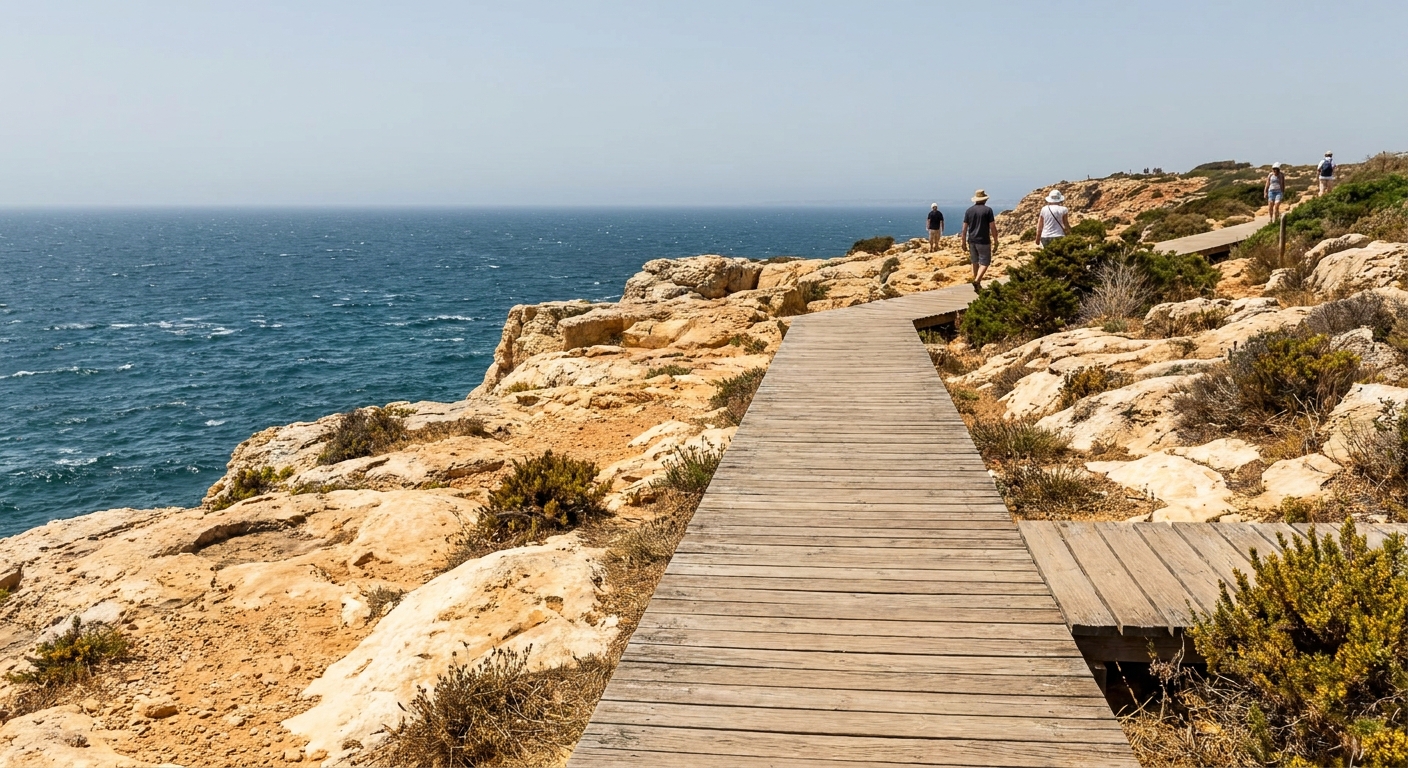
February opens the middle of the day, which July closes. At 62.6°F you can walk the cliff line at noon in a shirt, the hour when a summer visitor is hiding under an umbrella, and you do it without queueing for a viewpoint or circling for a space. Sunrise at 7:19 a.m. also means first light costs you nothing: no alarm at five, no headlamp on the path.
Start with the Algar Seco boardwalk at the end of the clifftop street, then the Percurso dos Sete Vales Suspensos, the coastal trail that links Vale Centeanes toward Praia da Marinha. Boats run west to Benagil and around Ponta da Piedade at Lagos; we could not verify February sailing times or fares for the Carvoeiro operators, so we quote none. For an indoor afternoon, Faro‘s old town is the obvious drive east.
What the date changes at these places is the air, not the water. The sea barely moves all winter, 62.0°F in January, 61.3°F in February, 60.9°F in March, while the daytime air climbs 4.7°F across the same three months. So the cove looks identical in every winter photograph and feels different on your skin: in February the water is within a couple of degrees of the air, and by late March the air has pulled well ahead of a sea that has kept cooling.
The best of the month costs nothing. The clifftop boardwalk, the coastal trail, the beach and every viewpoint between them are public and free, and in February you are not paying for parking patience either. We could not verify any February free-admission day at the museums in Lagoa or Faro, so we name none: check at the desk when you arrive.
Carvoeiro in February: a two-day itinerary
Day one, on the coast. Coffee at 8:30, when the sun has been up an hour and the cliffs are still pink. Walk Algar Seco from 9:00, then drive five minutes to Vale Centeanes and take the Sete Vales trail east until noon. Lunch inland out of the wind. Keep 2:00 to 4:00 p.m. for the beach or a boat, because that stretch holds the day’s warmth, and be at a west-facing viewpoint by 5:45 for a 6:12 sunset.
Day two, a drive with an exit. Head west to Lagos and Ponta da Piedade, or east to Faro, leaving by 9:00 so the return happens in daylight. If the forecast turns, swap the coast for Silves and its castle hill, or run the Faro plan entirely indoors: the odds say you will use this option once, since only 1.4 days in an average February bring 0.39 inch of rain or more. A wet morning almost always clears into a walkable afternoon.
Carvoeiro in February vs January and March
| Measure | January | February | March |
|---|---|---|---|
| Average high | 61.3°F | 62.6°F | 66.0°F |
| Average low | 46.9°F | 47.8°F | 51.4°F |
| Precipitation | 1.94 in | 1.65 in | 1.84 in |
| Days with 0.04 in or more | 6.0 | 5.4 | 5.6 |
| Sea surface | 62.0°F | 61.3°F | 60.9°F |
Across the three winter months, February is the driest at 1.65 inches and has the fewest wet days at 5.4. March is the warmest by a clear margin, 66.0°F by day and 51.4°F at night, and January the coolest at 61.3°F and 46.9°F. The sea runs the other way from the air: 62.0°F in January, 61.3°F in February, 60.9°F in March, so the coldest water of the three arrives in the warmest month.
Shift four weeks later and you buy 3.4°F of daytime warmth and 3.6°F of night warmth, at the price of 0.19 inch more rain and a sea that is 0.4°F cooler still. Shift four weeks earlier, to Carvoeiro in January, and you give up 1.3°F by day and take on 0.29 inch more rain and an extra half-day of it, in exchange for the warmest winter sea of the three. Neither swap turns the Atlantic into swimming water.
Is February a good time to visit Carvoeiro?
Yes, if your trip is built on walking, driving and eating. Cliff trails at 62.6°F with 5.4 wet days in the month, a town that still functions but is not crowded, and viewpoints you have to yourself add up to a genuinely good week. No, if the plan involves a beach lounger and children in the water: 61.3°F is a wetsuit temperature, and the shortest day of your stay ends at 6:12 p.m.
If that second description is yours, move later rather than earlier. March brings 66.0°F afternoons and 51.4°F nights, which changes how a beach day feels even though the water does not cooperate, and the months past it keep that direction. Nothing in the January-to-March window fixes the sea, which stays between 60.9°F and 62.0°F throughout; for warm water you are looking at a different season entirely, which is what our Algarve guide is for.
One thing belongs to February alone among the three: it is the driest month of the winter and the one with the fewest wet days, and it carries that while the daylight has already stretched back to 10 hours 53 minutes.
The last word
Decide the sea question before you book anything else, and the rest of a February trip falls into place: this is a walking and driving month with a coast attached, not a beach month with cool weather. A detail worth carrying with you: the water at 61.3°F and the daytime air at 62.6°F sit within 1.3°F of each other, so the cove never feels shocking, it just feels like February. Reserve the car from home, and keep one afternoon unplanned for the day the light behaves.
Sources & data for this guide
- February air normals (62.6°F high, 47.8°F low, 1.65 in) · IPMA, climatological normals 1991-2020, station 554 Faro, 5.0 m · checked Sep 23, 2026
- Rain-day counts (5.4 days at 1 mm, 1.4 days at 10 mm) · IPMA, same normals · thresholds are metric and differ from the 0.10-inch cutoff used by US tables · checked Sep 23, 2026
- Scope caveat: the Faro thermometer sits east of Carvoeiro; the western Algarve runs cooler and windier, and inland high ground is colder and wetter · IPMA · checked Sep 23, 2026
- Sea surface 61.3°F, mean of daily maxima · Open-Meteo Marine API, 2015-2024 average · checked Sep 23, 2026
- January and March figures used in the comparison · IPMA 1991-2020 for air and rain, Open-Meteo Marine 2015-2024 for sea · checked Sep 23, 2026
- Daylight, sunrise 7:19 a.m. and sunset 6:12 p.m. on February 15 · sunrise-sunset.org, converted to local time · checked Sep 23, 2026
- We could not verify a Lagoa municipal tourist tax rate, February sailing times or fares for the Benagil boat operators, any February free-admission day, or a monthly occupancy or room-rate series for Carvoeiro, so none of those figures appear · check operators and your booking when you reserve.
To plan your stay
- Best Time to Visit Carvoeiro: Sea Temperatures, Rain Days and the Quiet Months
- Carvoeiro in January: Weather, Sea Temperature, Rain Days and Crowds
- Carvoeiro in March: Weather, Sea Temperature and How It Compares With February and April
- Carvoeiro in April: Weather, Sea Temperature, Crowds and How It Compares to March and May