
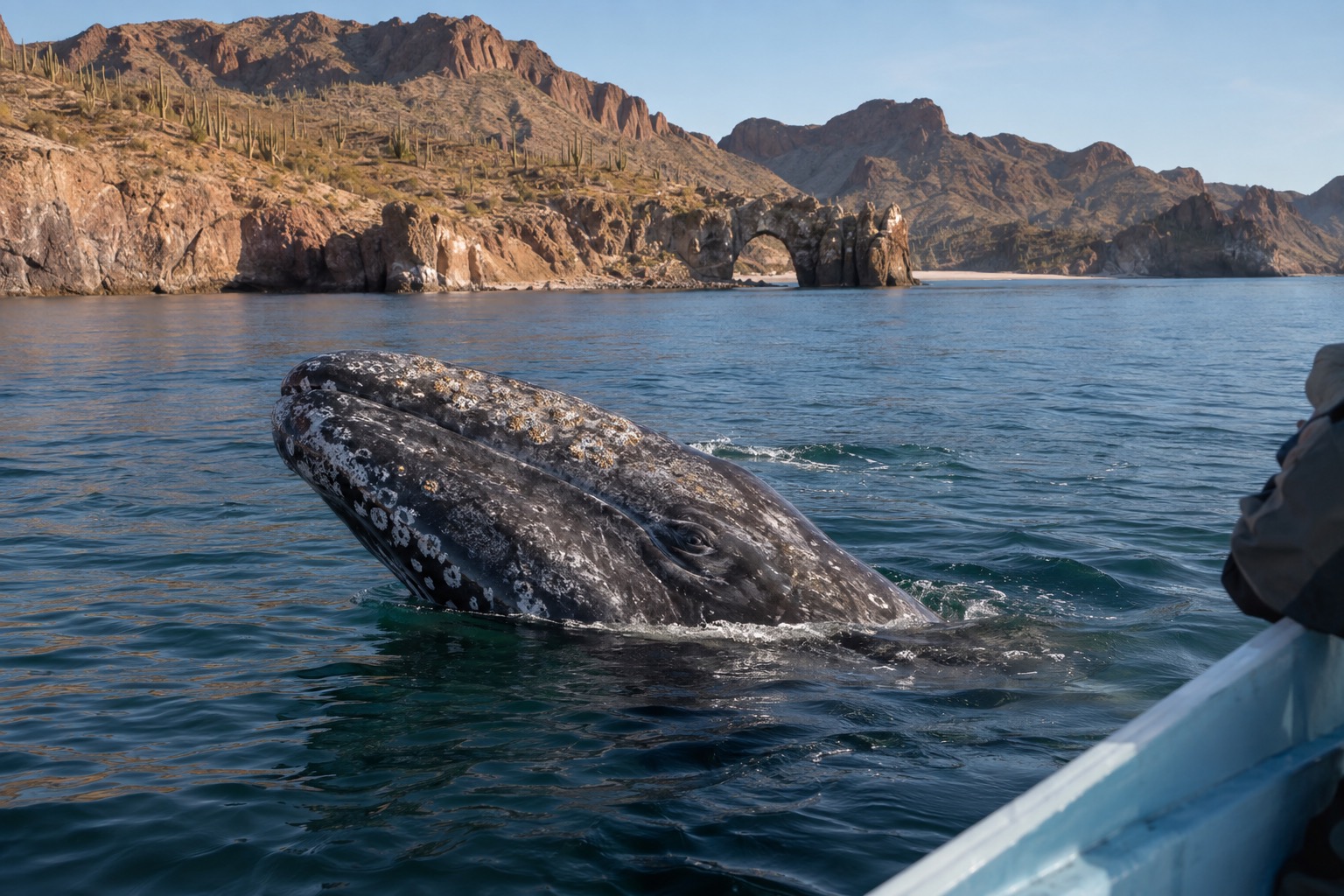
A skiff drifts in a still lagoon, the engine is cut, and a gray whale rises beside the boat close enough that you hear its breath before you see the spout. Some mothers lift their calves toward the passengers, and people reach out a hand. This happens every winter in the lagoons of Baja California Sur, while humpbacks work the open water off Los Cabos and the Bay of Banderas at Puerto Vallarta.
When is whale watching season in Baja?
Gray whales come to the lagoons of the El Vizcaíno reserve to calve in the peak season. That is the stretch the park authority CONANP announces each year for Ojo de Liebre and San Ignacio, the two lagoons where most travelers go.
Early in the season you see courting groups and the first arrivals. By late winter the lagoons hold mothers with newborns, and the calves grow bolder as the weeks pass. Humpbacks off Los Cabos and Puerto Vallarta are also a winter sight, watched from tour boats.
Whale sharks, the other Baja season
If your trip falls outside winter, the Bahía de los Ángeles Biosphere Reserve on the Baja California side of the Sea of Cortez has its own visitor. The whale shark arrives there in June and stays until December, so the calendar hands the baton from sharks to gray whales almost without a gap.
On the Caribbean side, whale shark trips set out from Holbox, Isla Mujeres and Cancún. A guide remains alongside swimmers as they slip into the water near the shark, and they never touch it. It is a different trip from Baja, but it fills the months when the lagoons are empty.
Where to see gray whales in Baja California
At Ojo de Liebre and San Ignacio, two coastal lagoons inside Baja California Sur’s El Vizcaíno Biosphere Reserve, travelers get the chance to see gray whales. These are shallow, sheltered waters on the Pacific side of the peninsula, a world away from the resort coast at the southern tip.
San Ignacio Lagoon
San Ignacio is the lagoon people describe when they talk about whales that come to the boat. Small skiffs carry a handful of passengers at a time, and the so-called friendly whales often surface alongside, rolling slightly so an eye looks up at you. The landscape is bare desert meeting flat silver water, with pelicans and ospreys overhead.
It is remote, and the experience is quiet and unhurried. Many visitors stay in simple camps near the shore, which suits travelers who like open sky and few comforts. Late in the season the calves tend to be the most curious, a good reason to aim for the later weeks if you can.
Ojo de Liebre Lagoon
Ojo de Liebre, also known as Scammon’s Lagoon, sits beside the salt works near Guerrero Negro. The boats are similar, and the whales are just as present, with spouts scattered across a wide, pale lagoon. Many people come here because the town gives easy access to meals and a bed.
Bring layers and a windproof jacket, since the lagoon breeze is cool even on bright days. Sun hats and sunglasses matter as much as warm clothes. The sea is not a swimming place here, and no one expects you to get in the water. The whales come to you, or they do not, and either way the morning is memorable.
Whale watching in Cabo
Humpback whales are watched off Los Cabos in winter from tour boats, which makes Cabo the easiest place to add whales to a beach vacation. Boats head out past the arch at Land’s End into open water, where you scan for blows, tail slaps and the occasional breach.
Winter days here are sunny and dry, with afternoons in the low 80s by late winter and cooler, breezy mornings on the water. Rain is rare in these months. The sea is usually cool compared with summer, so the beach is for walking and sunbathing more than long swims, and a light layer is welcome on the boat.
| Month | Average high (°F) | Average low (°F) | Rain days | Sea surface (°F) |
|---|---|---|---|---|
| January | 79.9 | 55.0 | 0.9 | 73.6 |
| February | 80.8 | 55.2 | 0.6 | 71.1 |
| March | 83.3 | 57.0 | 0.3 | 71.3 |
Humpbacks put on a more athletic show than the gray whales, and a boat trip from Cabo suits families and anyone who wants whales without leaving the resort area. Expect company, since many boats share the same stretch of water, and the sightings depend on the day.
Whale watching in Puerto Vallarta
From Puerto Vallarta, winter humpback watching is available in the Bay of Banderas, with tour boats heading out from the marina and from the beach towns that line the bay. The bay is broad and sheltered, backed by green mountains, which gives the outing a different feel from the desert lagoons of Baja.
Whales often travel in small groups, and a good day brings spouts on the horizon, then a fluke lifted as one dives. The boat is the place for it, with the town and the Sierra Madre foothills as a backdrop. It pairs easily with the rest of a Pacific coast stay, from the Malecón walk to seafood on the beach.
Good to know before you go
The gray whale lagoons lie in Baja California Sur, rated Level 2 by the U.S. State Department, and the advisory notes no specific restrictions for U.S. government employees in that state. Puerto Vallarta, in Jalisco, is also free of restrictions for them, although the rest of the state is rated higher. Bring sun protection and warm layers, and keep some pesos for small purchases in the lagoon towns.
Sources
- CONANP (Comision Nacional de Areas Naturales Protegidas), "Inicia la temporada de avistamiento de ballena gris en la Reserva de la Biosfera El Vizcaino", gob.mx/conanp, checked September 29, 2026 (window confirmed over several seasons, including the 2025-2026 announcement)
- CONANP (Comision Nacional de Areas Naturales Protegidas), "Inicia la temporada de tiburon ballena en la Reserva de la Biosfera Bahia de los Angeles", gob.mx/conanp, checked September 29, 2026
- CONANP (Comision Nacional de Areas Naturales Protegidas), "Inicia la temporada de visitacion a los santuarios de Mariposa Monarca, periodo 2024-2025", gob.mx/conanp, checked September 29, 2026
- U.S. Department of State, Mexico Travel Advisory (main, level banner), travel.state.gov, read live via browser (protected by Cloudflare, direct fetching blocked with 403) on 29 September 2026
- U.S. Department of State, Mexico Travel Advisory, section "Risks in specific areas" / State of Guerrero, travel.state.gov, read live via browser on September 29, 2026
- U.S. Department of State, Mexico Travel Advisory, section "Risks in specific areas" / State of Baja California, travel.state.gov, read live via browser on September 29, 2026
- U.S. Department of State, Mexico Travel Advisory, section "Risks in specific areas" / State of Baja California Sur, travel.state.gov, read live via browser on September 29, 2026
- U.S. Department of State, Mexico Travel Advisory, section "Risks in specific areas" / State of Sonora, travel.state.gov, read live via browser on September 29, 2026
- U.S. Department of State, Mexico Travel Advisory, section "Risks in specific areas" / State of Michoacan, travel.state.gov, read live via browser on September 29, 2026
- U.S. Department of State, Mexico Travel Advisory, section "Risks in specific areas" / State of Quintana Roo, travel.state.gov, read live via browser on September 29, 2026
- U.S. Department of State, Mexico Travel Advisory, section "Risks in specific areas" / State of Mexico (Estado de Mexico), travel.state.gov, read live via browser on September 29, 2026
- U.S. Department of State, Mexico Travel Advisory (reissued May 29, 2026), section « Risks in specific areas », travel.state.gov/en/international-travel/travel-advisories/mexico.html, read via browser (Cloudflare blocks curl) on 29 September 2026
- Servicio Meteorologico Nacional (CONAGUA), normales climatologicas 1991-2020, estacion 03005 (Cabo San Lucas, Los Cabos), checked September 29, 2026
- Open-Meteo Marine API, average 2015-2024, checked September 8, 2026
To plan your stay
- Best Time to Visit Mexico: Weather by Region, Crowds, Hurricane Season and Festivals
- Where to Stay in Mexico: Riviera Maya, Los Cabos, Puerto Vallarta, Mexico City and All-Inclusive Areas
- Getting Around Mexico: Buses, the Tren Maya, Taxis and Driving Your Own Car
- Mexico Travel Tips: Dollars, Tourist Tax, Tipping, Tap Water, Driving and Safety by State