
Standing at a rental counter at the Cancun airport, with the agent sliding a contract across the desk and the humid air pushing in each time the doors open, is where most travelers first wonder what Mexican car insurance actually involves. The short answer is that liability insurance is required by law, and that a rental car makes sense in some parts of the country and very little sense in others.
Is car insurance mandatory in Mexico?
Yes, liability coverage for harm done to others and their belongings is required for any vehicle using a federal highway, road, or bridge. The rule comes from the federal law on roads, bridges and motor carriers, and it makes the owner responsible for buying the policy. No insurer can be imposed on the owner.
The mandatory policy includes minimum coverage limits, which the finance ministry sets and rolls out by model year and invoice value until all vehicles were covered. The premium has to be paid in one payment, not in installments, which is worth remembering when you compare quotes.
| Minimum mandatory coverage | Amount (pesos) |
|---|---|
| Property damage to third parties | 50,000 |
| Bodily injury or death | 100,000 |
What happens without a policy
Driving on a federal road without the insurance is a fine of 20 to 40 days of minimum wage. A fine is not the end of it, as the owner then has a set period to fix the situation.
For someone renting, the practical point is that the rental company is the owner of the car. Look closely at what the contract includes for third-party liability before you sign, since that is the coverage the law is about.
Bringing your own car from the U.S.
If you drive a car with foreign plates past the border free zones, you must get a Temporary Vehicle Import Permit from Banjercito, the army bank. It is available only to foreign tourists arriving with their own vehicle and to Mexican residents living abroad. You can get the permit at a border module or consulate for 51 US dollars plus VAT, or online for 45 US dollars plus VAT.
A refundable deposit comes on top, and it depends on the model year. You get the deposit back as soon as the car’s exit is recorded, as long as that happens before the permit runs out. Baja California, Baja California Sur and the northwestern free zone of Sonora do not require the permit, and the State Department’s advisory calls them hassle-free zones where you can drive throughout the state.
| Vehicle model year | Refundable deposit (USD) |
|---|---|
| 2000 or older | 200 |
| 2001 to 2006 | 300 |
| 2007 or newer | 400 |
Should I rent a car in Mexico?
It depends on the trip: a car is useful on the Yucatan peninsula and for loose, self-paced itineraries, and it is unnecessary for a city stay or a hop between far-apart regions. Since Mexico covers a vast area, getting from one region to the next by car can mean days instead of hours, so the majority of visitors fly among Cancun, Oaxaca, Puerto Vallarta, Los Cabos and Mexico City, usually with a connection in Mexico City.
When a car is not needed
Buses, ADO above all, serve most long routes on the Yucatan peninsula. They are comfortable, they save you the parking hunt, and they let you watch the countryside instead of the road.
The Tren Maya also links Cancun, Merida, Valladolid and Tulum, which suits a trip that hops between towns. In lots of cities, ride-hailing apps operate in many areas, and at major airports you pay for official taxis and shuttles at a booth inside the terminal. Some resort areas do not allow the apps to pick you up at the airport, so in certain spots you should count on using the booth.
When a car earns its keep
A car pays off when you want to stop at a roadside stand for cochinita pibil, reach a cenote before the tour buses, or linger at a small town square without watching a bus schedule. On the peninsula that freedom is the whole appeal, and the roads between the main towns are straightforward. If your plans stay in one resort area or one big city, taxis, apps and buses will cost you less trouble than parking and insurance paperwork.
Tips for driving in Mexico
The best habit is to plan your drives for daylight and to pick the road type before you set out. Cuotas, which are toll highways, tend to be quicker on long drives connecting cities, and when they are available, they make for a less stressful option.
For a direct drive from Cancun to Tulum, take Federal Highway 307, and you will not pay any toll. It passes through a string of towns and resort entrances, so the pace is set by traffic and by the local rhythm rather than by the speed limit.
Topes, towns and night driving
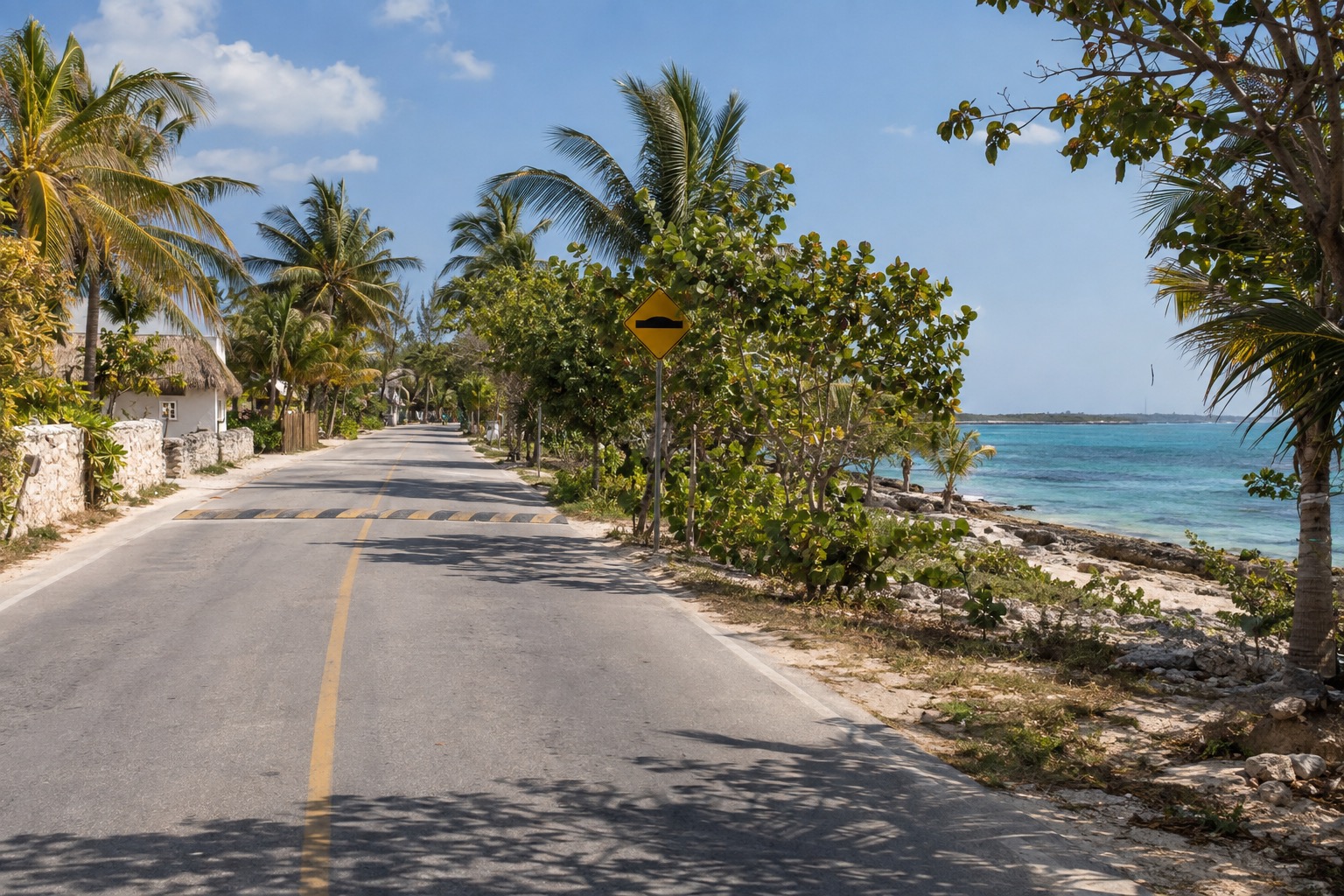
Speed bumps, called topes, are common at the approaches to towns, and they are not always well marked. Watch the cars ahead of you, because a sudden brake light often means a tope. Slowing early saves your suspension and the rental deposit.
When you are away from cities, the smart move is to avoid driving at night unless it is necessary. Roads can be dark, animals and cyclists appear without warning, and a bump you would see by day becomes a surprise. Plan to arrive where you are sleeping before dusk.
Is it safe to drive in the Yucatan?
Largely yes by the State Department’s ratings: Yucatan state is at Level 1, exercise normal precautions, the lowest level, and Campeche shares it. Quintana Roo, home of Cancun, Playa del Carmen and Tulum, is at Level 2, exercise increased caution, due to terrorism and crime.
That makes the peninsula one of the easier places in the country to drive. A trip from Cancun to Valladolid, Merida or the coast stays within states rated Level 1 or 2, and the usual habits apply: daylight driving, toll roads where they exist, and slow approaches to town topes.
Drives elsewhere in the country
The ratings change a lot from state to state, which matters if you picture a long road trip. Colima, Guerrero, Michoacan, Sinaloa, Tamaulipas and Zacatecas are at Level 4, do not travel. Baja California, Chiapas, Chihuahua, Guanajuato, Jalisco, Morelos and Sonora are at Level 3, reconsider travel.
Baja California Sur is at Level 2 and has no specific travel restrictions for U.S. government employees. For the Monarch butterfly sanctuaries, three of the four open ones lie in Michoacan, a Level 4 state, while Piedra Herrada is in the State of Mexico, rated Level 2.
Good to know before you go
Tolls on the cuota highways are paid at booths along the way, so keep small bills and coins in the car. The Yucatan peninsula also falls under the Atlantic hurricane season, which is worth keeping in mind when you plan a road trip near the coast in the later months of the year. Check the rental contract line by line for what the liability cover includes, take photos of the car at pickup, and leave the airport with a full tank and a charged phone.
Sources
- Ley de Caminos, Puentes y Autotransporte Federal, art. 63 Bis (texte en vigueur, Camara de Diputados), diputados.gob.mx, checked September 29, 2026
- Diario Oficial de la Federacion, ACUERDO 07/2014, 27 mars 2014, dof.gob.mx, checked September 29, 2026
- Ley de Caminos, Puentes y Autotransporte Federal, art. 74 Bis, fraccion II, diputados.gob.mx, checked September 29, 2026
- Banjercito, "Importacion Temporal de Vehiculos", gob.mx/banjercito, checked September 29, 2026
- Cross-check: Banjercito / ANAM (perimeter silence for Baja California, Baja California Sur, and the northwest of Sonora); U.S. Department of State, Mexico Travel Advisory, section "Travel and transportation", travel.state.gov, read live via browser on 29 September 2026
- U.S. Department of State, Mexico Travel Advisory (main, level banner), travel.state.gov, read live via browser (protected by Cloudflare, direct fetching blocked with 403) on 29 September 2026
- U.S. Department of State, Mexico Travel Advisory, section "Risks in specific areas" / State of Guerrero, travel.state.gov, read live via browser on September 29, 2026
- U.S. Department of State, Mexico Travel Advisory, section "Risks in specific areas" / State of Baja California, travel.state.gov, read live via browser on September 29, 2026
- U.S. Department of State, Mexico Travel Advisory, section "Risks in specific areas" / State of Baja California Sur, travel.state.gov, read live via browser on September 29, 2026
- U.S. Department of State, Mexico Travel Advisory, section "Risks in specific areas" / State of Sonora, travel.state.gov, read live via browser on September 29, 2026
- U.S. Department of State, Mexico Travel Advisory, section "Risks in specific areas" / State of Michoacan, travel.state.gov, read live via browser on September 29, 2026
- U.S. Department of State, Mexico Travel Advisory, section "Risks in specific areas" / State of Quintana Roo, travel.state.gov, read live via browser on September 29, 2026
- U.S. Department of State, Mexico Travel Advisory, section "Risks in specific areas" / State of Mexico (Estado de Mexico), travel.state.gov, read live via browser on September 29, 2026
- U.S. Department of State, Mexico Travel Advisory (reissued May 29, 2026), section « Risks in specific areas », travel.state.gov/en/international-travel/travel-advisories/mexico.html, read via browser (Cloudflare blocks curl) on 29 September 2026
To plan your stay
- Best Time to Visit Mexico: Weather by Region, Crowds, Hurricane Season and Festivals
- Where to Stay in Mexico: Riviera Maya, Los Cabos, Puerto Vallarta, Mexico City and All-Inclusive Areas
- Getting Around Mexico: Buses, the Tren Maya, Taxis and Driving Your Own Car
- Mexico Travel Tips: Dollars, Tourist Tax, Tipping, Tap Water, Driving and Safety by State