
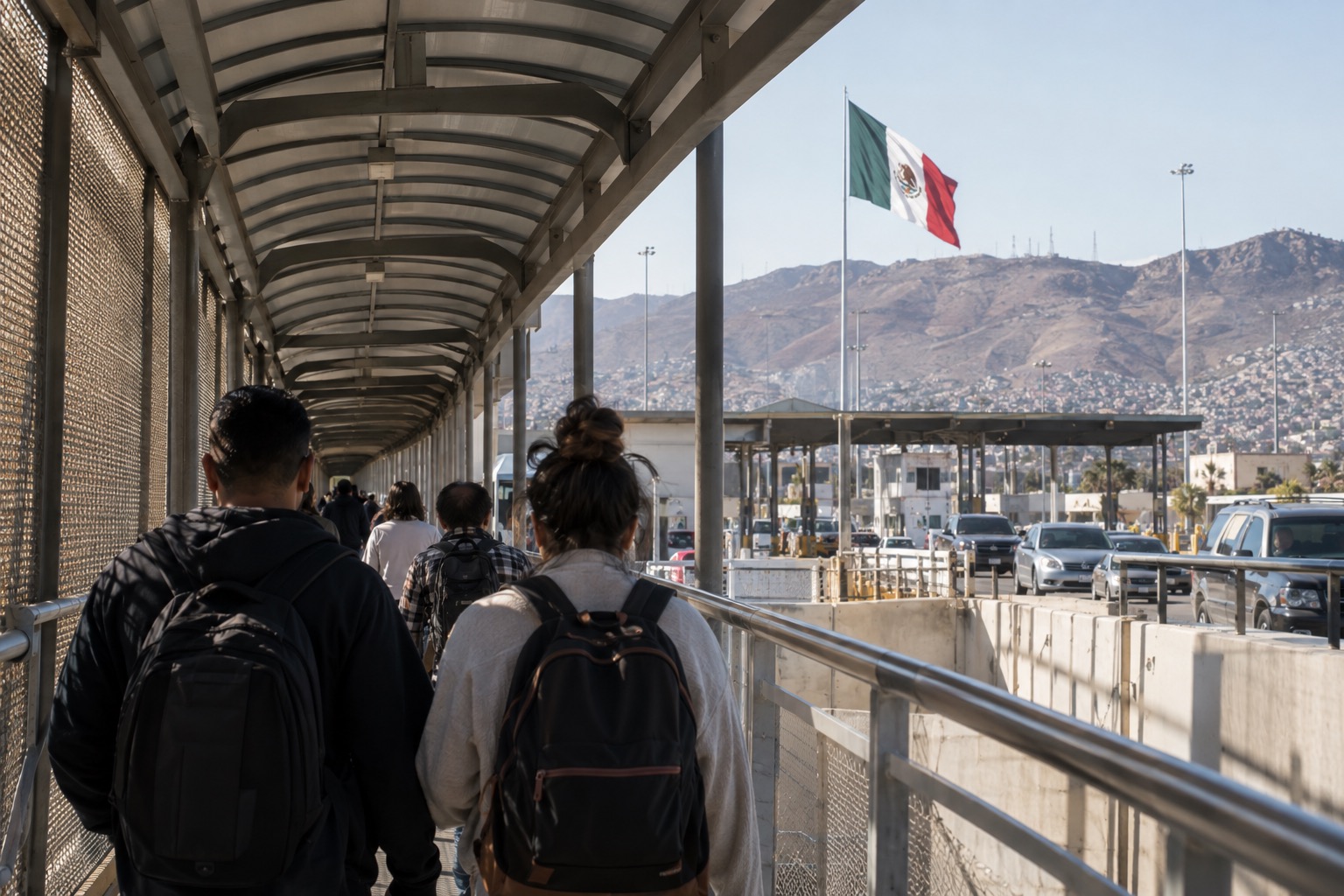
On the pedestrian bridge that leads from the San Ysidro side toward the turnstiles, the smell of grilled street tacos starts to drift in before you even see the first Mexican flag. Whether you walk across for a day or drive down the peninsula, the crossing is simple once you know which papers to carry and which lane suits you. Most trips need a passport or passport card, a tourist form and, for drivers, a few extra decisions.
How to cross into Tijuana from San Diego
You can cross on foot or by car, and walking is the easiest way for most visitors: you reach the border, pass through the turnstiles into Tijuana and come back through the U.S. inspection line later in the day. Many travelers leave the car in a lot on the U.S. side and walk over, which spares them the question of Mexican insurance altogether.
Walking across
On foot, you follow the signs to the pedestrian crossing and walk through into the streets of Tijuana, where taxis, shuttles and the walk toward Avenida Revolución begin. Going into Mexico is usually a quick formality, with little waiting compared to the return.
Coming back is where the time goes. Lines form at the U.S. inspection point, and travelers holding a passport card can use the Ready Lanes, which are meant to move faster. Late afternoon and evenings, when day visitors all head home together, are the slowest stretch, so a mid-afternoon return is a comfortable habit.
By car, you wait in the vehicle lanes into Mexico and again on the way back, and the return line is the long one. Travelers enrolled in SENTRI have dedicated lanes that skip much of that wait, which is the main reason regulars sign up. Drivers also need to think about insurance and permits, both covered further down.
What do I need to cross the border to Mexico and back?
A U.S. citizen needs proof of citizenship to return and a Mexican tourist form to enter, and the right document depends on whether you travel by land or by air. Coming back by land or sea, you may present a U.S. passport, a passport card, an Enhanced Driver’s License or a trusted traveler card such as NEXUS, SENTRI or FAST.
The passport card
The passport card is a wallet-size alternative that works for entering the United States from Mexico by land or sea, and it can be used in the Ready Lanes at the land border. Because it cannot be used for international flights, it is a good match for travelers who make land crossings and never fly to other countries. It can also serve as a REAL ID alternative for domestic flights.
| Passport card | Adult | Child under 16 |
|---|---|---|
| First-time card (USD) | 65 | 50 |
| Renewal (USD) | 30 | Must apply again in person |
| Validity | 10 years | 5 years |
A separate execution fee is paid to the acceptance facility when you apply for a first card.
Children
U.S. citizen children under 16 returning by land or sea need only a birth certificate or other proof of citizenship, and an original, a photocopy or a certified copy all work. The age limit rises to under 19 when they travel with a school, religious or other youth group.
By air, the rule changes: children must present their own passport. Families who cross by land often keep a copy of the birth certificate in the same folder as the adults’ documents so it is at hand in the inspection line.
The Mexican tourist form and its cost
Foreign tourists entering Mexico need a Forma Migratoria Múltiple, known as the FMM, issued by the Instituto Nacional de Migración. The fee for a visitor without permission to carry out paid activities was set at 717 pesos, though that base amount is indexed and republished each year, so the amount charged can differ from it.
By air, the airline collects the fee for you and a digital form arrives as a QR code after your passport is stamped, replacing the paper version. Travelers arriving by land deal with the form at the border instead.
What is SENTRI?
SENTRI is a trusted-traveler program run by U.S. Customs and Border Protection that gives pre-approved, low-risk travelers expedited clearance through dedicated lanes into the United States at southern land border ports. Its full name is Secure Electronic Network for Travelers Rapid Inspection.
Getting in takes some effort. Every applicant goes through a rigorous background check and an in-person interview before enrollment, and the application fee is 120 USD per application. For people who cross often, the dedicated lanes are the payoff, and a SENTRI card is also accepted as a document for returning by land.
Can I drive my car into Tijuana?
Yes, you can drive a U.S.-plated car into Tijuana, and in Baja California you do not need a vehicle permit. The Temporary Vehicle Import Permit is not required to circulate within the Baja California peninsula, which covers Baja California and Baja California Sur. Sonora has a limited free zone in its northwest where cars may drive without a permit, but one is required beyond the checkpoint.
The vehicle permit beyond the free zones
If you drive a foreign-plated car past the border free zones, you need a Temporary Vehicle Import Permit, issued by Banjercito, Mexico’s army bank. It is meant for foreign tourists entering Mexico with a foreign vehicle and for Mexican residents abroad.
| Permit item | Amount (USD) |
|---|---|
| Permit at a border module or consulate (plus VAT) | 51 |
| Permit processed online (plus VAT) | 45 |
| Refundable deposit, model year 2000 or older | 200 |
| Refundable deposit, model year 2001 to 2006 | 300 |
| Refundable deposit, model year 2007 or newer | 400 |
The deposit is refunded once the vehicle’s exit is registered before the permit expires, so drivers who go deep into the mainland make a point of stopping at the exit module on the way out.
Mexican auto insurance
Mexican law requires every vehicle on federal roads, highways and bridges to carry insurance covering damage to third parties’ property and persons. Buying it is the owner’s responsibility, and no insurer can be imposed on you, so drivers compare policies before they leave.
The minimum coverage was set at 50,000 pesos for property damage and 100,000 pesos for bodily injury or death, and the premium must be paid in a single payment. Driving a federal road without a policy brings a fine of 20 to 40 days of minimum wage. The owner then has 45 calendar days to buy the policy, and presenting it to the authority within that window cancels the infraction.
Good to know before you go
Bring some pesos for taxis, tacos and tips, and keep your documents in one easy-to-reach pocket while you wait in line. Most visitors stay in the busy tourist streets and head back well before the late-night crowds, a habit that keeps the day relaxed. Outside the Baja peninsula, the hurricane season on the Pacific coast starts in mid-May, which matters if you continue south by car.
Sources
- U.S. Customs and Border Protection, "SENTRI", cbp.gov, checked September 29, 2026
- U.S. Customs and Border Protection, "Non-Refundable Application Fee", cbp.gov, updated September 9, 2025, checked September 29, 2026
- U.S. Department of State, "Compare a Passport Card and Book", travel.state.gov, updated on 28 September 2026, read live via browser on 29 September 2026
- Ley Federal de Derechos, art. 8-I (current text, APTA CE mirror, update 91), apta.com.mx ; supplemented by Instituto Nacional de Migracion, "Forma Migratoria Multiple Digital (FMMd)", gob.mx/inm, checked September 29, 2026
- U.S. Customs and Border Protection, « Western Hemisphere Travel Initiative », cbp.gov/travel/us-citizens/western-hemisphere-travel-initiative, checked September 29, 2026
- U.S. Department of State, Mexico Travel Advisory (main, level banner), travel.state.gov, read live via browser (protected by Cloudflare, direct fetching blocked with 403) on 29 September 2026
- U.S. Department of State, Mexico Travel Advisory, section "Risks in specific areas" / State of Guerrero, travel.state.gov, read live via browser on September 29, 2026
- U.S. Department of State, Mexico Travel Advisory, section "Risks in specific areas" / State of Baja California, travel.state.gov, read live via browser on September 29, 2026
- U.S. Department of State, Mexico Travel Advisory, section "Risks in specific areas" / State of Baja California Sur, travel.state.gov, read live via browser on September 29, 2026
- U.S. Department of State, Mexico Travel Advisory, section "Risks in specific areas" / State of Sonora, travel.state.gov, read live via browser on September 29, 2026
- U.S. Department of State, Mexico Travel Advisory, section "Risks in specific areas" / State of Michoacan, travel.state.gov, read live via browser on September 29, 2026
- U.S. Department of State, Mexico Travel Advisory, section "Risks in specific areas" / State of Quintana Roo, travel.state.gov, read live via browser on September 29, 2026
- U.S. Department of State, Mexico Travel Advisory, section "Risks in specific areas" / State of Mexico (Estado de Mexico), travel.state.gov, read live via browser on September 29, 2026
- U.S. Department of State, Mexico Travel Advisory (reissued May 29, 2026), section « Risks in specific areas », travel.state.gov/en/international-travel/travel-advisories/mexico.html, read via browser (Cloudflare blocks curl) on 29 September 2026
- Banjercito, "Importacion Temporal de Vehiculos", gob.mx/banjercito, checked September 29, 2026
- Cross-check: Banjercito / ANAM (perimeter silence for Baja California, Baja California Sur, and the northwest of Sonora); U.S. Department of State, Mexico Travel Advisory, section "Travel and transportation", travel.state.gov, read live via browser on 29 September 2026
- Ley de Caminos, Puentes y Autotransporte Federal, art. 63 Bis (texte en vigueur, Camara de Diputados), diputados.gob.mx, checked September 29, 2026
- Diario Oficial de la Federacion, ACUERDO 07/2014, 27 mars 2014, dof.gob.mx, checked September 29, 2026
- Ley de Caminos, Puentes y Autotransporte Federal, art. 74 Bis, fraccion II, diputados.gob.mx, checked September 29, 2026
To plan your stay
- Best Time to Visit Mexico: Weather by Region, Crowds, Hurricane Season and Festivals
- Where to Stay in Mexico: Riviera Maya, Los Cabos, Puerto Vallarta, Mexico City and All-Inclusive Areas
- Getting Around Mexico: Buses, the Tren Maya, Taxis and Driving Your Own Car
- Mexico Travel Tips: Dollars, Tourist Tax, Tipping, Tap Water, Driving and Safety by State