
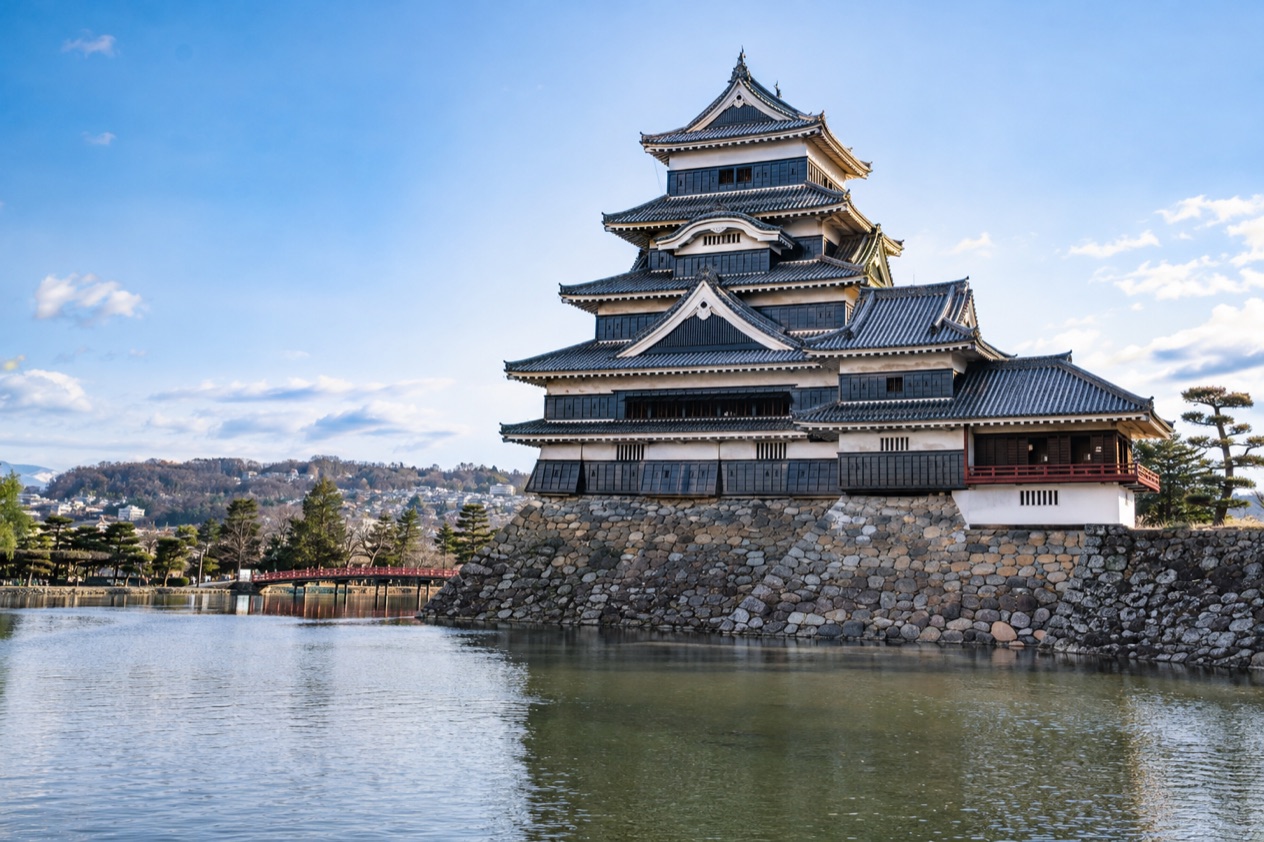
You come around the edge of the moat and the keep rises across the water, its dark walls and layered roofs doubled in the reflection, with the mountains of the Japan Alps standing behind. A red bridge crosses to the castle grounds, and the black timbers look more like a working fortress than a postcard. Matsumoto Castle, in the city of Matsumoto in Nagano Prefecture, is a visit built around a real wooden keep that you can walk inside.
Is visiting Matsumoto Castle worth it?
Yes, especially if you want to stand inside a castle rather than look at a replica, and it suits travelers who like history, architecture and old weapons as much as photographs. The keep is a National Treasure of Japan and one of the twelve surviving tenshu, the main towers of Japanese castles, which is a short list in a country that lost most of its fortresses to war, fire and demolition.
What sets it apart from other castles you may have on a Japan itinerary is that the keep still has its original wooden interiors and external stonework. Here you walk on old timber floors, climb between beams, and look out through the same kinds of openings the defenders used.
It also has an unusual setting for a castle of this rank. It is a flatland castle, built on a plain instead of a hilltop, so the moat and the open ground around it did the work that a steep slope would do elsewhere.
The result is a visit that feels compact in spirit, even if you linger. You circle the water, cross the bridge, go through the keep floor by floor, and come out into a park-like setting with the Alps on the horizon. Castle enthusiasts will find plenty to study, and travelers who only have a passing interest in samurai history still get a striking building and a good walk around it.
It also pairs well with the town around it. Matsumoto sits at the eastern end of the Japan Alps, and the castle gives the city a clear center of gravity. If you are choosing between several castles in Japan, this is the one to pick for authenticity of the structure itself, and for the pleasure of seeing a dark, angular keep standing on level ground with mountains behind it.
What to see at Matsumoto Castle
The main keep and its dark walls
The main keep is the reason to come. Its black exterior and stacked roofs give it a severe, graceful profile, and the nickname Crow Castle comes from that dark plumage. The keep was completed in the late sixteenth century, and it keeps its original wooden interiors and external stonework, which means the walls you see are the ones built for a time when castles were still meant to be fought over.
Inside, look at the thick posts and beams, the narrow windows and the worn floorboards. Details like these tell you more about how a castle worked than any panel could. Notice how the floors step up and how little of the space is decorative. This was a place for soldiers and stores, with only the upper levels given over to the lord’s view of his land.
Teppo Gura, the gun museum on the second floor
On the second floor of the main keep is Teppo Gura, a gun museum with a collection of guns, armor and other weapons. It turns the keep from an empty shell into something with a story, because the matchlock guns and armor on display explain what the building was designed to withstand.
Pay attention to how the castle itself is made for firearms. Openings in the walls were cut for guns rather than for arrows, and the way the floors are arranged makes more sense once you have seen the weapons. It is a good stop for anyone traveling with a history-minded teenager, and for anyone who finds castles more interesting when they are explained by objects.
The moat, the bridge and the grounds
Spend time outside the keep too. The moat is part of the design, and walking its edge gives you the angles that show off the keep with its smaller attached structures. The red bridge over the water is one of the most photographed spots, and the contrast of the red against the black walls is what people remember first.
Look for the moon-viewing turret attached to the keep, a lighter, more open structure than the fortress-like main tower, built for enjoying the view rather than defending against attack. The grounds around the castle make it a place to wander slowly, with the mountains of the Japan Alps in the background in clear weather.
A castle that has weathered earthquakes
Matsumoto Castle has lived through its share of shaking. A magnitude 5.4 earthquake on June 30, 2011 caused around ten cracks in the inner wall of the main tower. It is a reminder that a wooden building of this age is a living structure that needs care, and that its survival is not accidental.
The castle was also selected as one of Japan’s Top 100 Castles on April 6, 2006, a recognition that places it among the country’s best-loved fortresses. Both facts help explain why the keep is looked after so closely and why seeing it intact is worth the trip.
When to visit Matsumoto Castle
Any season suits a castle that is built to be seen against a changing backdrop, and the choice comes down to which version of the setting you want. The keep stays the same, but the moat, the trees around it and the mountains behind shift with the year, so the photographs you take in different months look like different places.
In spring, cherry trees around castle grounds across Japan bring pink against dark walls, and Matsumoto’s black keep is the kind of building that makes the contrast especially strong. Blossom timing changes from one spring to the next, so treat it as a chance rather than a promise. In summer, the greens of the grounds and the sky over the Alps frame the keep, and the water of the moat gives a cooling presence while you walk the perimeter.
Autumn is a gentle fit for a stroll around the moat, with changing leaves along the water and the dark castle standing in the middle of the color. Winter brings the image travelers hope for, a black keep with snow on its roofs, though snowfall comes and goes and is never guaranteed on any given day. The mountains behind are often dusted with white by then, which gives the whole scene a different mood from the warmer months.
Because the keep is a historic wooden building with several floors, think about how you want to spend the visit rather than which day to choose. A clear day lets you enjoy the outside views and the Alps.
A gray or wet day suits the interior, the gun museum and the beams, and the moat still looks atmospheric under cloud. Whatever the weather, give yourself time both inside the keep and out on the grounds, since each part of the visit changes with the light.
Tips for your visit
The keep rewards a slow walk through the floors, and the grounds and moat are worth a loop of their own. Wear shoes that are comfortable on stairs, since you move through the keep on foot from one level to the next and the building is a historic wooden structure rather than a modern museum.
Getting to Matsumoto
Matsumoto can be reached from Tokyo’s Shinjuku Station in 2 hours and 40 minutes by train, which makes the castle a realistic stop on a route through central Japan. From Nagoya Station it takes 2 hours by train, and from Nagano Station it is a ride of 50 minutes.
If you are flying, Matsumoto Airport has commercial flights only from Osaka, Sapporo and Fukuoka, and downtown is about 20 minutes away. Those links make it possible to fold the castle into a trip that begins or ends in one of those cities, without going back through Tokyo.
Paying around town
One detail worth knowing before you arrive concerns local buses. Japanese IC cards do not work on buses in Matsumoto, but contactless payment with major credit cards, except Mastercard, is possible. If you carry a Suica or Pasmo from elsewhere in the country, keep that in mind when you plan your movements around the city.
What to combine it with
Matsumoto is a city at the eastern end of the Japan Alps, so the castle fits naturally into a mountain-region itinerary. It can be a stop between Tokyo and Nagoya, or a day out from Nagano. Pair the castle with a walk through the streets near it, a meal of the regional food of Nagano Prefecture, and some time looking at the mountains on the horizon.
For families and for travelers who like history, the combination of the keep and the Teppo Gura gun museum gives children something to look at, since armor and weapons often hold the attention of younger visitors. Because the keep is a multi-floor wooden building, consider how everyone in your group will manage stairs before you set your plans.
Good to know before you go
Matsumoto is a mid-sized city and its main sights sit close to the castle, so a visit slots easily into a day of general sightseeing. Carry a major credit card with contactless payment for the buses, and remember that a Mastercard will not work there for that purpose.
Treat the usual habits of Japan as your guide, with quiet voices in the keep and care around the old timber, since this is a National Treasure and not a theme park attraction. Pack layers for the mountain air, and keep a bag you can carry up and down the stairs comfortably.
Sources
- Wikipedia, Matsumoto Castle (https://en.wikipedia.org/wiki/Matsumoto_Castle), checked October 11, 2026
- Japan National Tourism Organization, Matsumoto (https://www.japan.travel/en/destinations/hokuriku-shinetsu/nagano/matsumoto-and-around/), checked October 11, 2026
- Wikipedia, Matsumoto, Nagano (https://en.wikipedia.org/wiki/Matsumoto,_Nagano), checked October 11, 2026
- Wikivoyage, Matsumoto (https://en.wikivoyage.org/wiki/Matsumoto), checked October 11, 2026