
The cable car lifts out of the valley, and the first thing that changes is the air, which turns cooler and smells of cedar and incense. Up on the plateau, temple roofs sit among the trees, monks in dark robes cross the street, and a vermilion pagoda stands at the center of the settlement. Koyasan is a working Buddhist community that takes in overnight guests, and a visit here means sleeping in a temple, eating what the monks eat and walking among the graves to Okunoin.
Is visiting Koyasan worth it?
Yes, for travelers who want to spend a night inside a Buddhist temple rather than only photograph one, and for anyone who likes slow walks among old trees, stone markers and quiet courtyards. It suits curious first-timers as much as repeat visitors to Japan who have already seen the big-city temples of Kyoto and Nara.
What sets it apart from other temple towns is that the lodging is the point. Many of the monasteries on the mountain work as guesthouses, with an evening meal, breakfast and an invitation to the morning service. Elsewhere in Japan a shukubo may be the only roof available in a small town. Here the whole settlement was founded in 819 by the monk Kukai, and it remains the world headquarters of the Koyasan Shingon sect, so the temple stay is part of the place’s daily life rather than a side offering.
It is also a different kind of day trip or overnight from Osaka. You leave the city by rail, finish with a cable car, and arrive on a plateau ringed by peaks where the weather is noticeably cooler. If your plans are all neon, department stores and fast connections, Koyasan will feel like a deliberate change of pace. If you want one place on your route where evenings are long and unhurried, this is it.
What to see at Koyasan
Okunoin and the great graveyard
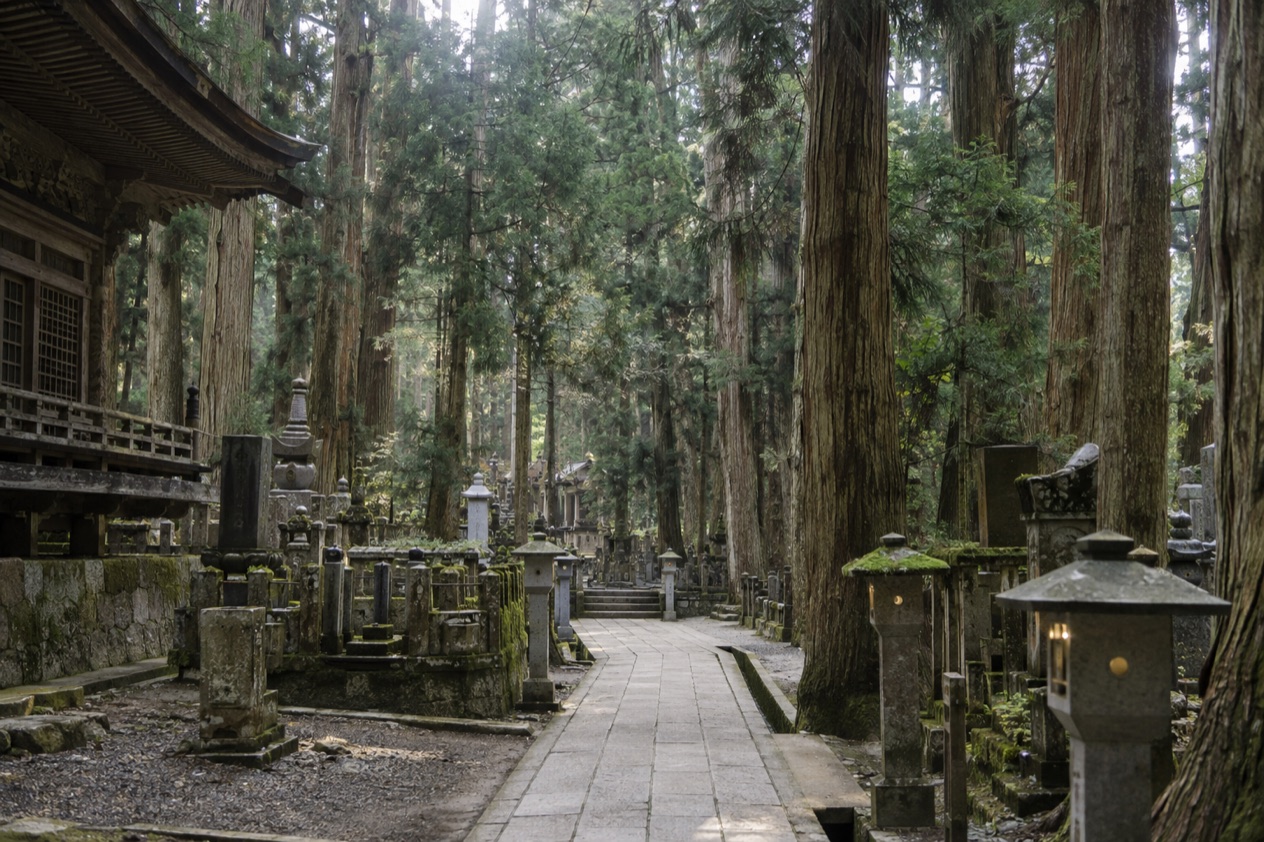
Okunoin is the mausoleum of Kukai, and it is surrounded by an immense graveyard, the largest in Japan. The approach is a path under tall cedars, lined with moss-covered gravestones, memorial towers and small stone figures, some wearing red bibs. Stone lanterns stand beside the path, and the light that filters down through the branches gives the whole walk a hushed, shadowed feel.
The path leads toward the hall where Kukai is believed by followers to rest in eternal meditation, still watching over the faithful. Pilgrims pause, bow and murmur prayers along the way, and the pace of the walk is set by them. Visitors tend to fall into the same rhythm, walking slowly and keeping their voices low. Many travelers say this walk is what they remember most from the mountain.
Konpon Daito, the pagoda at the center
The Konpon Daito stands 48.5 meters tall and is situated right in the middle of Koyasan. Its bright vermilion color stands out against the dark green of the surrounding cedars, which makes it easy to spot as you move between temples. It is a pagoda in the Shingon tradition, and it marks the heart of the monastic settlement that Kukai began.
Look for the way the structure sits within an open precinct of courtyards and halls, with the town’s streets leading in from several sides. It works as a landmark for orientation and as a place to stand for a few minutes and take in the scale of the settlement before heading on to the cemetery or back to your lodging.
A night in a shukubo
A shukubo is a temple lodging that historically hosted traveling monks and worshippers and now welcomes ordinary travelers. Rooms are traditional, with tatami floors and a futon for sleeping. Toilets are generally shared, although some temples offer suites or rooms with a private bathroom. Some temples on Koyasan have open-air baths with onsen water.
Dinner and breakfast are usually part of the room price. The meals are shojin ryori, a Buddhist cuisine without meat, fish, dairy or eggs, much like vegan cooking.
Expect small lacquered trays of seasonal vegetables, tofu, sesame dishes, pickles and rice, served in the quiet of your room or a dining hall. In the morning, guests can take part in the devotional service called gongyo, the form of which depends on the sect of the temple. Some temples also offer meditation training.
Hours, tickets and rules
Koyasan does not run on a single ticket office. Okunoin, the pagoda precinct and the temple lodgings each follow their own routines, and the clearest schedule for a visitor is the one for the trains that carry you up the mountain. The sightseeing train Tenku runs between Hashimoto and Gokurakubashi, and its days change with the season.
| Service | Operates |
|---|---|
| Tenku sightseeing train, Hashimoto to Gokurakubashi (March to November) | Daily except Wednesdays and Thursdays |
| Tenku sightseeing train, Hashimoto to Gokurakubashi (December to February) | Saturdays, Sundays and national holidays |
Some rules sit with the lodgings. Some shukubo accept only cash, so confirm the payment method when you book. Each temple has its own policy on alcohol: some allow it to be ordered as medicinal food or drink, while others prohibit it strictly, so ask before you arrive. All seats on Limited Express trains on the Koya Line are reserved. Shukubo with English online reservations include a listing for Koyasan in Wakayama.
How to get to Koyasan
Koyasan is reached mainly by the Nankai Electric Railway from Namba Station in Osaka. The Koya Line is owned and operated by Nankai, and operationally it starts at Namba together with the Nankai Line, then diverges at Kishinosato-Tamade Station and continues to Gokurakubashi Station at the base of the mountain.
The whole trip from Namba takes about 1.5 hours on an express train, or two hours by non-express. Limited Express trains on the line have reserved seats only. The track is double through the lower section from Shiomibashi to Hashimoto, then single from Hashimoto up to Gokurakubashi, which is where the line starts to climb into the hills.
At Gokurakubashi the railway ends and the Nankai Cable Line takes over. The cable car carries visitors to the top of Mount Koya in five minutes, and it is the last link between the valley and the temple town.
Koyasan lies in Wakayama Prefecture, to the south of Osaka, on a high plain among eight peaks. Osaka is the base given for reaching it, and the rail journey described here is the way in that fits a day out or a night in a temple.
When to visit Koyasan
Any month brings you into a cooler climate than the city below, since the mountain is noticeably cooler than Osaka. That matters for what you pack and for how you plan the day, because walking the grounds, crossing between temples and strolling the cemetery path all happen outdoors, under the trees.
Spring brings cherry blossom, which typically arrives on Mount Koya around mid-April, a few weeks later than in the lowlands. That delay means that if the blossoms in Osaka have finished, the mountain can still offer them. The pagoda and the temple roofs against pale pink branches make a different picture from the green cedar of the rest of the year.
Autumn is the other season that draws people up the mountain. Fall colors around October are a major tourist draw on Mount Koya, when the maples among the dark cedars add reds and golds to the temple grounds. If you want a temple stay in that season, the lodging is part of the experience, so plan around it.
The Tenku sightseeing train changes its days with the seasons, running more often from March to November and only on weekends and national holidays from December to February. That is worth knowing if you want the ride to be part of your trip, since it shapes which days suit you.
Tips for your visit
Because the mountain is noticeably cooler than Osaka, bring a layer, even if you leave the city in light clothes. The walk to Okunoin, the strolls between temples and the open-air baths at some lodgings all take place outside, so you will notice the difference most in the evening and morning.
Plan to stay overnight if you can. The shukubo is the heart of the experience: dinner of shojin ryori, a futon on tatami, the morning gongyo service and, at some temples, meditation training. A day trip from Osaka covers the sights, but it leaves out the part that sets Koyasan apart.
When you book, a few points are worth sorting out. Confirm how you pay, since some temples take only cash. Ask about alcohol if you care about it, since each temple sets its own rules. Think about the bathroom too.
Shared toilets are the general arrangement, but some temples have suites or rooms with a private bath. If you need an English booking, the Koyasan listing in Wakayama is among the shukubo with an English online reservation option.
For a trip that goes beyond Koyasan, the railway itself is part of the outing. Namba is the starting point in Osaka, and the line passes through Hashimoto, where the Tenku sightseeing train begins on its days of operation. Families and travelers who prefer a more relaxed pace can build the whole outing around the temple stay and the walk to Okunoin.
Shukubo began as lodging for monks and pilgrims, and many of today’s operators descend from families who ran them when they were purely religious. Keeping that in mind helps set the tone for your stay: you are a guest in a place that is still part of a living practice.
Good to know before you go
Money matters mostly at the temple. Some shukubo take only cash, so settle the payment method when you reserve. The room price usually covers both dinner and breakfast, which keeps spending on the mountain simple.
A temple stay follows the rhythm of the community, with its meal, its prayers and its quiet, so travelers who treat the lodging as a guest would, and not as a hotel, tend to have the smoothest visit. Alcohol policy differs from one temple to the next, and the details of lodging arrangements can change, so confirm them when you book.
Sources
- Japan National Tourism Organization, temple stays (https://www.japan.travel/en/guide/temple-stays/), checked October 11, 2026
- Wikipedia, Mount Kōya (https://en.wikipedia.org/wiki/Mount_K%C5%8Dya), checked October 11, 2026
- Wikipedia, Nankai Kōya Line (https://en.wikipedia.org/wiki/Nankai_K%C5%8Dya_Line), checked October 11, 2026
- Wikipedia, Shukubo (https://en.wikipedia.org/wiki/Shukubo), checked October 11, 2026
- Wikivoyage, Koyasan (https://en.wikivoyage.org/wiki/Koyasan), checked October 11, 2026