
A bell sounds across a mountain village, cedar trunks stand dark and straight along the lanes, and monks in gray robes cross a courtyard on their way to the morning prayers. Koyasan is a Buddhist temple settlement set on a high plain among eight peaks, and travelers come to sleep inside one of its temples. It suits anyone who wants a night or two of incense, vegetarian meals and forest paths instead of a checklist of sights.
Where is Koyasan and what is it like?
Koyasan, also written Mount Koya or Koya-san, lies in Wakayama Prefecture, to the south of Osaka, on a high plain ringed by eight peaks. It is a working religious center rather than a resort. Temples, schools, shops and monks’ residences share the same few streets, and the whole settlement takes its rhythm from the Buddhist calendar and the daily services.
The monk Kukai first settled the mountain in 819, and it remains the world headquarters of the Koyasan Shingon sect of Japanese Buddhism. That history is felt in small ways. Temple gates open onto gravel courtyards, wooden halls darken with age, and the smell of incense drifts out into the lanes. Visitors who arrive expecting a museum find a place where people still live, study and pray.
The mountain air is noticeably cooler than in Osaka, and you feel it the moment you step off the cable car. Cedar forest closes in around the village and softens the sound of everything, from footsteps on stone to the bell at the hour. Mist often settles among the trunks, and it can turn an ordinary lane into something close to a woodcut.
Koyasan rewards people who like to slow down. It suits travelers curious about Buddhism, lovers of old wooden architecture, photographers who like forest light, and anyone who wants a night away from the neon of the big cities.
It may be less satisfying for those who want nightlife, shopping streets or a long list of attractions to tick off. Evenings here are for tea, a bath and an early night, since the day begins with prayers.
What is there to do in Koyasan?
The big reasons to come are the cemetery forest of Okunoin, the temple precincts at the heart of the village, a night in a temple lodging with a monks’ breakfast, and the seasons on the mountain. Together they make Koyasan different from the city temples of Kyoto or Nara.
There, you visit a temple and leave. Here, you live inside one for a night, among cedars, with the daily routine of the monks going on around you.
Okunoin and the forest of tombs
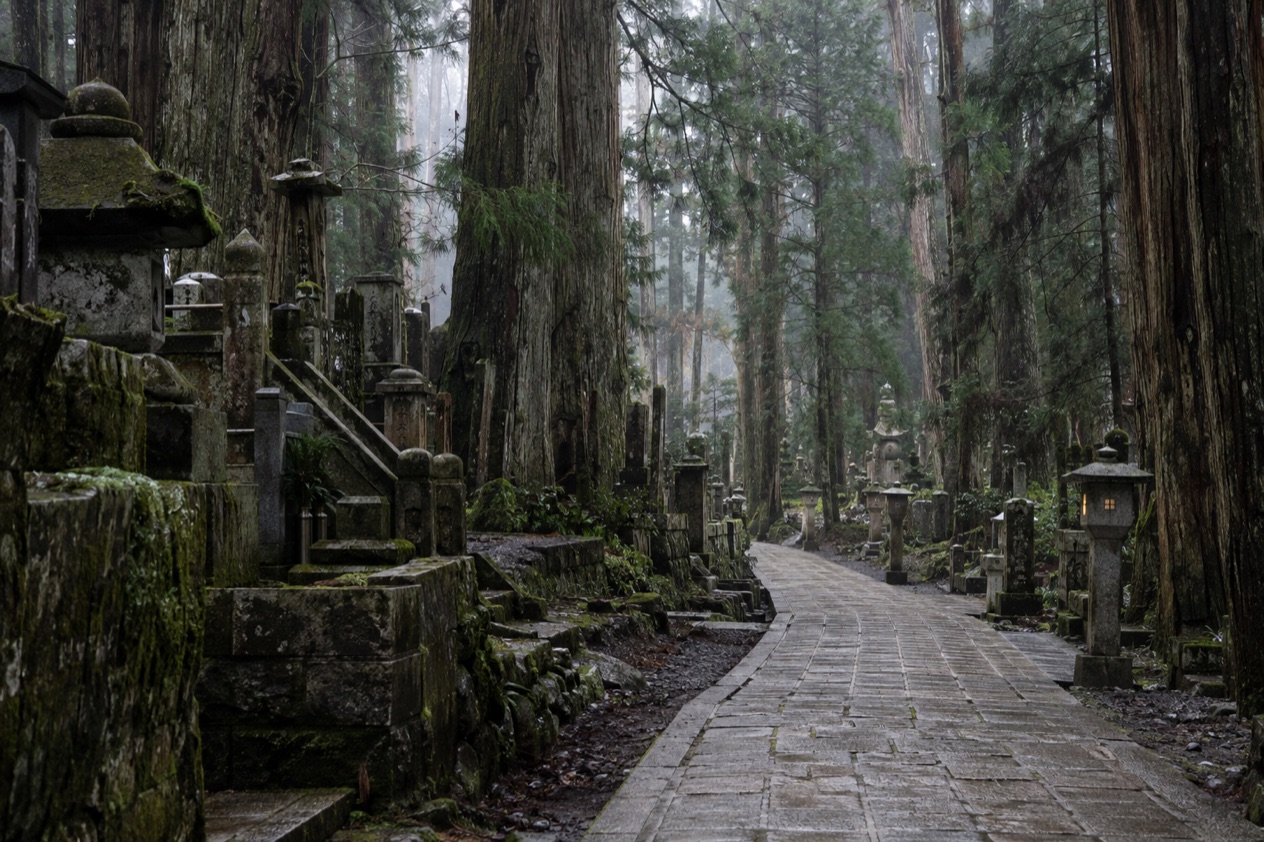
Okunoin is the spiritual core of the mountain, a long approach through towering cedars lined with moss-covered stone lanterns, memorial towers and weathered tombstones. Kukai is believed to rest in eternal meditation at the end of the path, and the atmosphere reflects that belief. People come to bow, to leave offerings and to light incense, and visitors walk among them.
The forest rewards slow walking. Moss softens the edges of the stones, shafts of light fall between the trunks, and stone Jizo figures often wear small red bibs left by families. It is a place for photographs taken with restraint, and for walking at the pace of the people around you. It suits almost any traveler who is curious about how Japan remembers its dead, though it asks for a respectful, unhurried mood.
The temple precincts of the village
At the center of the village stand the large temple compounds, among them Danjo Garan and Kongobu-ji. Garan is a cluster of halls and pagodas whose vermilion paint stands out against the dark cedars. Kongobu-ji is the head temple of the Shingon sect, and its rooms, painted sliding doors and rock garden show the sect’s wealth of craft and tradition.
These precincts are the place to look closely at details: carved eaves, bronze lanterns, gilded statues glimpsed through doorways, the raked gravel of a courtyard. They pair naturally with Okunoin, since one shows the institution and the other the devotion that surrounds it. Wear shoes that slip on and off easily, because many halls ask visitors to remove them at the entrance.
A night in a shukubo
A shukubo is a temple lodging that historically hosted traveling monks and now welcomes ordinary travelers. Staying in one is the experience people come to Koyasan for. You sleep on futons laid over tatami mats in a simple room, share meals in the temple’s style of cooking, and are invited to join the morning prayers, when monks chant before an altar lit by lamps.
The meals are shojin ryori, the vegetarian cuisine of Buddhist temples. Expect small lacquered trays of tofu in several forms, seasonal vegetables, mountain greens, sesame dishes and pickles, all prepared without meat or fish. Koya-dofu, tofu that has been frozen and dried, is a local specialty. The food is plain in appearance and subtle in taste, and it suits curious eaters better than those who want strong flavors.
Cherry blossoms and fall colors
The mountain changes with the seasons, and two moments draw visitors in particular. Cherry blossoms typically arrive around mid-April, a few weeks later than in the lowlands, so the petals can still be falling here when the cities have finished. Fall colors around October are a major draw, and maples glow red and orange against the dark cedar trunks.
Both seasons transform the temple courtyards and the forest path to Okunoin. Even outside these weeks, the mountain has its own character, with green summer shade and bare, misty winter lanes. Koyasan is rarely a place where you need a particular season to make the visit worthwhile, but blossoms and leaves add color to a landscape that is otherwise dark wood, moss and stone.
How many days do you need in Koyasan?
One night is the most rewarding stay, and two nights is a generous one. A single night in a temple lodging lets you see the village, walk through Okunoin and still attend the morning prayers, which is the part visitors remember longest. A day trip from Osaka is possible, but it means you miss the village once the day visitors have gone.
With one night, the shape of the stay writes itself. Arrive, settle into the temple, and walk the precincts of the village. Evening brings dinner at the lodging and an early night. Morning begins with prayers and breakfast, and then the forest path to Okunoin, before heading back down. It is a compact plan, and it works because the village itself is small and everything revolves around the same few lanes.
A second night adds room to breathe. You can return to the temple halls you only glimpsed, sit in a garden, drink tea in a village café, or walk the forest again in different light. Travelers find that the mountain’s mood deepens on the second day, once the rhythm of bells and meals has become familiar. In the fall color weeks, a second night also gives you more time among the maples.
With more time, Koyasan fits into a longer loop through the Kansai region. Osaka is the city the railway runs from, and its food streets and castle make a lively contrast with the mountain. Nara and Kyoto, with their own temples and gardens, round out a wider tour of Buddhist Japan. Treat Koyasan as the calm middle of that trip instead of an extra stop squeezed between cities.
Where to stay in Koyasan
The village is compact, so you do not choose between districts the way you would in a big city. Instead, you choose between temples, each with its own garden, its own style of room and its own way of serving the evening meal.
Staying in a temple suits travelers who want to experience Buddhist life instead of only looking at it. You wake to the sound of a bell, share a vegetarian meal in a tatami room, and may attend prayers before breakfast. It is a good choice for couples, solo travelers and anyone curious about Japanese religion. It is less ideal for those who want a hotel’s privacy and nightlife, since temple routines shape the day.
Habits at a temple lodging follow the logic of the building. Shoes come off at the entrance, rooms are simple, and bedding is laid out on the tatami for the night. Meals arrive on trays at set times, and the pace of the evening is early and gentle. These routines are part of what you came for, and they give the stay a rhythm that a standard hotel cannot reproduce.
The alternative is to base yourself in Osaka and visit the mountain from there, since the railway line to Koyasan starts at Namba Station. That keeps you close to the city’s restaurants and nightlife, but you lose the evening and morning atmosphere that make the mountain special. Travelers who want both can spend a night on the mountain and the rest of the trip in the city.
How do you get to Koyasan and get around?
Koyasan is reached primarily by train from Osaka, on the Nankai Electric Railway from Namba Station to Gokurakubashi Station at the base of the mountain. The Koya Line, which carries you there, runs through Osaka Prefecture and Wakayama Prefecture and is owned and operated by Nankai. Namba is a major station in the center of Osaka, so the journey starts from the city’s busiest district.
At Gokurakubashi, a cable car carries visitors up the mountain in five minutes. The cars climb steeply through forest, and the view of cedar slopes opens out beside the windows. The ride is part of the arrival, a quick change of scene from the lowland train to the high plain where the temples stand.
From the cable car station on Mount Koya, visitors take a bus into the village. The ride takes between 5 and 15 minutes, depending on the destination, because the settlement stretches along a plain with temples at different points. Buses are the way visitors cover the distance between the station and the main areas of the village.
The Koyasan One Day Ticket is a ticket that may be purchased from March 1 to November 30, which means it is available during the autumn colors but not in deep winter. Once you are in the village, you move on foot between the temple lodgings, the precincts and the forest path, and use the bus for longer stretches. Wear comfortable shoes, since stone paths and gravel courtyards are the norm.
When is the best time to visit Koyasan?
April and October are the months with the strongest pull. Cherry blossoms on the mountain typically come around mid-April, a few weeks later than in the lowlands, so travelers who miss the blossoms in Osaka or Kyoto may still find them here. Fall colors around October are a major tourist draw, with maples lighting up the courtyards and the edges of the forest.
The mountain sits higher than the cities, and its air is noticeably cooler than in Osaka. That changes how you plan a visit in any season. A summer stay on the plain can feel pleasantly cool compared with the lowlands, while a visit in colder months asks for warm layers, especially for the early prayers in an unheated hall. Temperatures here are always a step below those of the city you left behind.
The seasons give the mountain different moods. Spring brings blossoms and fresh green, summer brings deep shade under the cedars, autumn brings color, and winter strips the lanes to bare wood and mist. Because Koyasan is built around temples and forest rather than around beaches or outdoor events, its appeal holds through the year. The seasons change the backdrop, not the reason to go.
If you plan to come in blossom or leaf weeks, expect other travelers to have the same idea, and arrange your lodging in good time. Today the Koyasan One Day Ticket can still be purchased until the end of November, so an autumn trip falls within that window. A visit in the shoulder weeks around those seasons trades some color for a calmer pace.
Good to know before you go
Koyasan is a place of worship as well as a destination, and the best habit is to follow the lead of the people around you. Speak softly in the temple grounds and on the forest path, take off your shoes where others do, and ask before photographing monks or ceremonies. Pack layers, because the mountain is cooler than Osaka and the weather in the hills can change, and wear shoes that slip off easily, since temple halls and lodgings are entered without them.
Sources
- Wikipedia, Mount Kōya (https://en.wikipedia.org/wiki/Mount_K%C5%8Dya), checked October 11, 2026
- Wikivoyage, Koyasan (https://en.wikivoyage.org/wiki/Koyasan), checked October 11, 2026
- Japan National Tourism Organization, temple stays (https://www.japan.travel/en/guide/temple-stays/), checked October 11, 2026
- Wikipedia, Nankai Kōya Line (https://en.wikipedia.org/wiki/Nankai_K%C5%8Dya_Line), checked October 11, 2026
- Wikipedia, Shukubo (https://en.wikipedia.org/wiki/Shukubo), checked October 11, 2026