
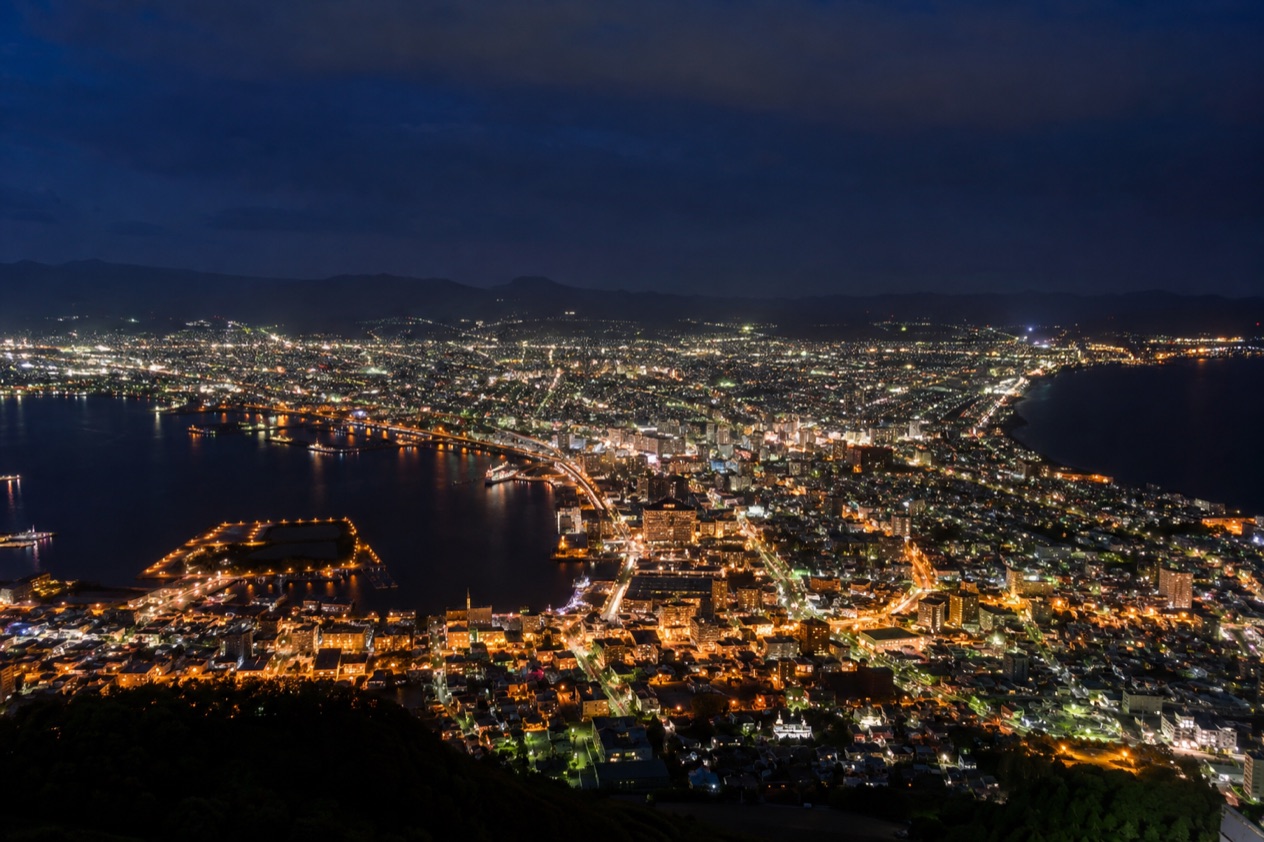
Night comes down over Hakodate and the lights switch on street by street, spreading along the two bays that pinch the city into a narrow neck of land. From the top of Mount Hakodate the whole pattern is laid out below you, dark water on both sides and a glittering band of streets in between. It is a visit built around one view, and it suits anyone spending an evening in this port city at the southern tip of Hokkaido.
Is visiting the Hakodate night view worth it?
Yes, if you like a city you can take in whole, in a single look, and you are happy to spend an evening on that rather than on a long list of sights. Hakodate’s night view from Mount Hakodate is described as one of the world’s must-see night views, and the shape of the town explains why. Water presses in from two sides, so the lights form a curved ribbon instead of a spreading grid.
It also helps to know what the view is not. Goryokaku Tower offers a different outlook, a full view of the star-shaped Goryokaku fort together with the cityscape around it. That is a view of a historic shape set in the town, while Mount Hakodate gives you the harbor town itself, dark and lit, with the sea on either hand. Many visitors see both, since they show Hakodate in two quite different ways.
It suits couples, solo travelers who like a quiet moment above a city, photographers, and families who want one memorable evening in a day otherwise spent at the morning market and the museums. It is less rewarding for anyone who wants activity, since the visit is about looking, lingering and watching the city change as the sky darkens.
What to see at the Hakodate night view
The city between two bays
The first thing you notice is the shape. Hakodate is a port city on the southern tip of Hokkaido, and from above you see how the land narrows, with the harbor on one side and open water on the other. The lights of the streets run along that narrow strip like a curved line drawn in gold, and the dark water on both flanks makes the glow look brighter.
Look for the way the pattern changes as you move along the viewing area. Dense clusters mark the old port district and the neighborhoods near the station, while thinner scatterings of light fade toward the edges of town. The city is separated from Honshu by the Tsugaru Strait, and on a clear evening you may sense that open stretch of dark beyond the lights.
The ropeway ride up
For many people the ropeway is the first part of the show. The Mount Hakodate Ropeway lifts you from the foot of the mountain in a cabin with big windows, and the city opens out beneath you as you rise, first a few streets, then the harbor, then the whole band of the town. One-way and round-trip ropeway tickets are available.
Watching on the way up is part of the pleasure, because the lights look different from the cabin than from the top. Stand near a window and let the view build gradually. If you travel in a group, the cabin becomes a small, shared moment of anticipation before the main view.
The summit viewing area
At the top you step out to the viewing area and the full panorama appears at once. This is where people settle in, lean on the rail, take photos and compare what they see with the postcards they have in mind. The mood tends to be hushed, with conversations dropping low as the sky goes from blue to deep navy and the streetlights sharpen.
Give your eyes a few minutes to adjust. The details come out slowly, the lines of the main avenues, the glow around the port, the small lights of boats on the water. Take time to walk the length of the viewing area rather than standing in one spot, because each end frames the two bays a little differently.
Lights that change with the season
The city below does not look the same all year. Hakodate Illumination runs from December 1 to the end of February, and in those months the winter lighting adds its own sparkle to the town you are looking at. In early August the Hakodate Port Festival, held from August 1st to 5th, fills the streets with activity that adds energy to the evening scene, though what you see from above is the glow rather than the dancing.
In spring the mood is gentler. Cherry blossoms in Hakodate are best seen from late April to mid-May, and an evening on the mountain can be paired with a day among the blossoms in town. Each season gives the same view a different character, so a return visit is not a repeat.
Hours, tickets and rules
Getting up the mountain costs a modest sum in yen, and the ticket you choose depends on whether you want to ride the ropeway both ways or come back down another way. A bus from Hakodate Station is also an option in the warmer months, and the Day Pass is valid on it. The fares are in the table.
| Ticket | Admission |
|---|---|
| Mount Hakodate Ropeway, one-way (adult) | 780 yen |
| Mount Hakodate Ropeway, round trip (adult) | 1280 yen |
| Bus from Hakodate Station to Mount Hakodate, round trip (Day Pass valid) | 400 yen |
The bus runs only in the summer season, from mid-April to mid-November. The bus from Hakodate Station does not operate outside those months.
How to get to the Hakodate night view
From Hakodate Station, the seasonal bus provides direct access to Mount Hakodate. The bus from Hakodate Station to Mount Hakodate operates from mid-April to mid-November, and a round trip costs 400 yen. If you hold the Day Pass, it is valid on that bus. After the season ends, the ropeway is the way up.
Reaching Hakodate itself is straightforward on paper. A flight from Tokyo takes approximately 1 hour and 20 minutes, and Hakodate Airport has direct flights from Sapporo (Okadama with JAL, Shin-Chitose with ANA), Tokyo-Haneda, Nagoya-Centrair, Osaka-Itami and Taipei-Taoyuan. Within Hokkaido, flights also link Hakodate with Chitose, Okadama and Okushiri airports.
By rail, the JR Tohoku/Hokkaido Shinkansen runs from Tokyo to Shin-Hakodate-Hokuto Station in 4 hours. That station is 11 miles north of Hakodate Station and is the northernmost terminal for the bullet train. From Honshu you can also cross by sea, since a ferry from Aomori to Hakodate takes approximately 3 hours and 40 minutes.
When to visit the Hakodate night view
The view is about the dark, so the visit belongs to the evening, once the lights are on across town. The sky shifts from blue to deep navy as the city glows brighter, and Arrive as the sky darkens to watch the city lights come on. Because the city is lit all year, there is no month when the view disappears.
Your choice of month depends on what else you want from the trip. The bus from Hakodate Station runs only from mid-April to mid-November, so those months give you both ways up.
Late April to mid-May brings cherry blossoms to town, which makes a spring evening on the mountain a fitting end to a day of flowers. At Goryokaku Tower, visitors may wait at least 3 hours to go up during cherry blossom season, so plan that stop on its own.
Summer has its own energy, with the Hakodate Port Festival held every year from August 1st to 5th. Winter has the Hakodate Illumination, from December 1 to the end of February, which adds seasonal lights to the town you look down on. Autumn, the season you are in now, sits within the bus season for another few weeks, until mid-November.
Tips for your visit
Plan the mountain as the last stop of a day in Hakodate rather than a stop on its own. In the morning, the Hakodate Morning Market offers fresh fish and shellfish, vegetables and seafood dishes in the early hours, which makes a good start. Then fill the afternoon with a museum or a garden and head up as the light fades.
A few nearby places pair well with the evening. Goryokaku, the star-shaped fort designated as a special historic site, is the other big sight in town. The Seikan Ferry Memorial Museum Mashu-maru, the Hakodate Museum of Northern Peoples and the Tropical Botanical Garden fill a day with different moods, and Yachigashira Hot Springs makes a warming finish after hours on a mountain top. Their hours are in the table.
| Site | Open |
|---|---|
| Hakodate Museum of Northern Peoples | 9:00 to 17:00 (April to October and November to March) |
| Hakodate Tropical Botanical Garden | 9:30 to 18:00 (April to October), 9:30 to 16:30 (November to March) |
| Seikan Ferry Memorial Museum Mashu-maru | 8:30 to 18:00 (April to October), 9:00 to 17:00 (November to March) |
| Yachigashira Hot Springs | 6:00 to 22:00, last entry 21:00, closed the second Tuesday of each month and occasionally the fourth Tuesday |
Bring a layer for the top, since you will spend time standing still, and a camera or phone you are comfortable using in low light. Leave room in the evening to linger rather than rush, because the view rewards patience as the city’s lights settle into their full pattern.
Good to know before you go
Fares on the mountain are quoted in yen, and the same goes for the museums and the hot springs around town. Keep the bus season in mind, since the service from Hakodate Station stops in mid-November.
The city has a calendar of its own, from the Port Festival in early August to the winter illumination, so it is worth knowing which of those you will catch. Outside the bus months, the ropeway is the way to the viewing area, and it is the plan to build your evening around.
Sources
- Hakodate Tourism Association, Hakodate travel guide (https://www.hakodate-kankou.com/en/), checked October 11, 2026
- Wikivoyage, Hakodate (https://en.wikivoyage.org/wiki/Hakodate), checked October 11, 2026
- Japan National Tourism Organization, Hakodate (https://www.japan.travel/en/destinations/hokkaido/hokkaido/hakodate-and-hokkaido-south/), checked October 11, 2026
- Wikipedia, Hakodate (https://en.wikipedia.org/wiki/Hakodate), checked October 11, 2026