
Somewhere over the Pacific, the seatback map zooms in on Tokyo Bay and the cabin starts to stir, with people pulling out train maps and wondering which airport they are about to land at. For travelers leaving Seattle, the question has a clean answer: Delta Air Lines flies nonstop between Seattle/Tacoma and Haneda, the airport of Tokyo city itself. Narita, the other Tokyo airport, and the rest of the Japanese airports are what you think about next.
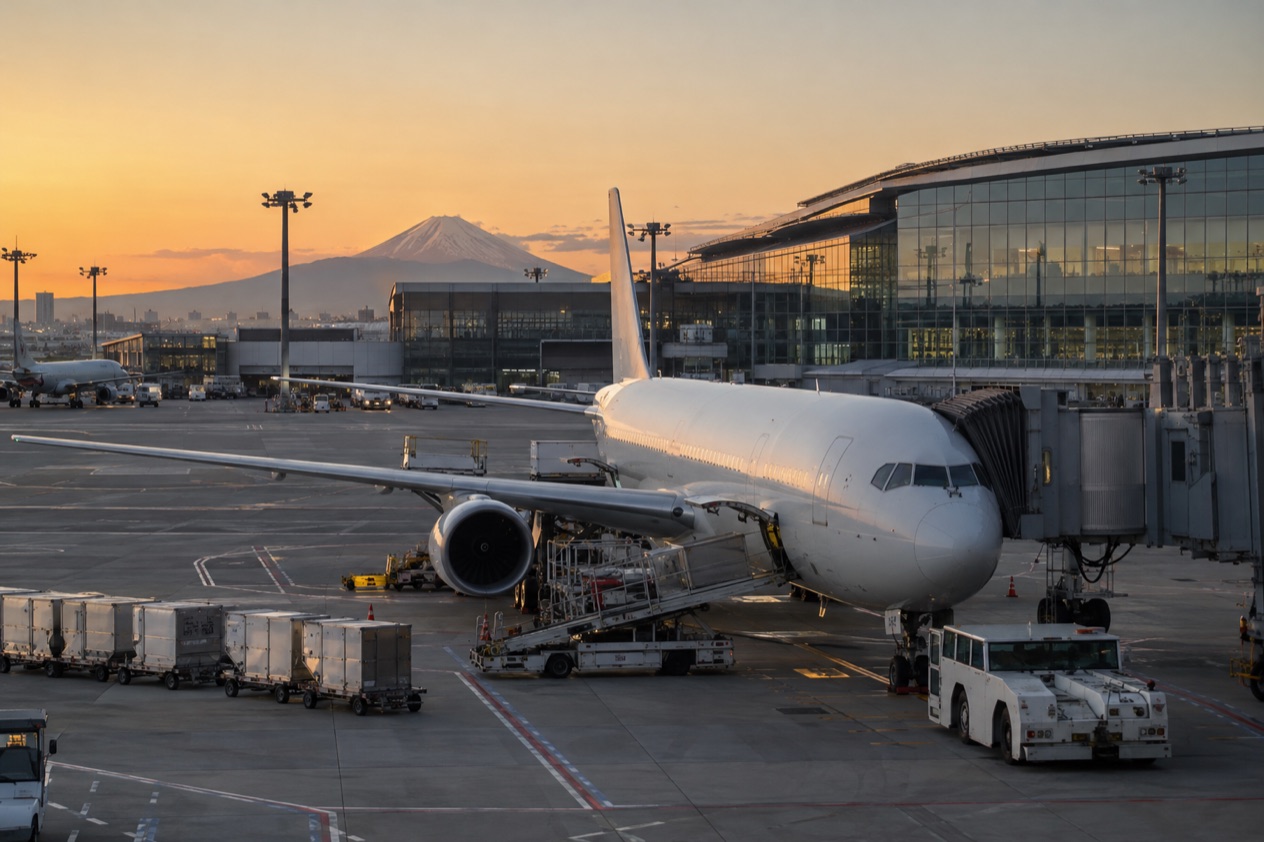
Which airlines fly from Seattle to Tokyo?
Delta Air Lines is the airline that flies nonstop from Seattle/Tacoma to Tokyo, and it lands at Haneda Airport. Delta runs the same airport pairing for several other American cities, so Seattle sits on a list of Delta gateways to Haneda rather than on a route of its own.
Delta from Seattle/Tacoma to Haneda
Delta’s nonstop from Seattle/Tacoma ends at Haneda, which Japan’s national tourism organization describes as the airport of Tokyo city. For a traveler, that means the flight puts you down at an airport that sits within the capital’s own rail and monorail network rather than out in a neighboring prefecture.
Delta’s other nonstops into Haneda start in Atlanta, Detroit, Honolulu, Los Angeles and Minneapolis/St. Paul. If you are comparing fares or flight times for your dates, those cities matter mostly as places where friends or relatives may be starting their own journey to meet you in Tokyo.
Other U.S. airlines serving Tokyo
American Airlines and United Airlines also fly nonstop into Haneda, from other American cities. American serves Haneda from Dallas/Fort Worth, Los Angeles and New York–JFK. United flies there from Chicago–O’Hare, Guam, Los Angeles, Newark, San Francisco and Washington–Dulles. Neither is listed as a Seattle nonstop, so for those two the route to Tokyo would begin with a flight to one of those hubs.
At Narita, All Nippon Airways flies nonstop to Chicago–O’Hare, Honolulu, Los Angeles and San Francisco, with seasonal service to Vancouver. Zipair Tokyo flies nonstop from Narita to Honolulu, Houston–Intercontinental, Los Angeles, San Francisco and San Jose, California, with charter flights to Orlando.
| Airline | Tokyo airport | Nonstop U.S. cities |
|---|---|---|
| Delta Air Lines | Haneda | Atlanta, Detroit, Honolulu, Los Angeles, Minneapolis/St. Paul, Seattle/Tacoma |
| American Airlines | Haneda | Dallas/Fort Worth, Los Angeles, New York–JFK |
| United Airlines | Haneda | Chicago–O’Hare, Guam, Los Angeles, Newark, San Francisco, Washington–Dulles |
| All Nippon Airways | Narita | Chicago–O’Hare, Honolulu, Los Angeles, San Francisco |
| Zipair Tokyo | Narita | Honolulu, Houston–Intercontinental, Los Angeles, San Francisco, San Jose (CA) |
Flying on once you are in Japan
Japanese carriers fan out from both Tokyo airports to the rest of the country. From Haneda, Air Do serves Asahikawa, Hakodate, Kushiro, Memanbetsu, Obihiro and Sapporo–Chitose. Skymark Airlines flies to Fukuoka, Kagoshima, Kobe, Naha, Sapporo–Chitose and Shimojishima, and Solaseed Air serves Kagoshima, Kumamoto, Miyazaki, Nagasaki, Naha and Oita. StarFlyer flies to Fukuoka, Kitakyushu, Osaka–Kansai and Ube.
From Narita, All Nippon Airways flies to Nagoya–Centrair, Osaka–Itami and Sapporo–Chitose, while Japan Airlines flies to Nagoya–Centrair and Osaka–Itami. Low-cost names fill in more of the map: Jetstar Japan, Peach and Spring Japan reach cities from Hokkaido to Okinawa and the southern islands, including Hakodate, Hiroshima, Ishigaki and Amami Oshima.
Where do you land?
If you fly Delta nonstop from Seattle/Tacoma, you land at Haneda, the airport of Tokyo city, which now receives international flights that put you directly in the heart of Tokyo. Narita is the other Tokyo airport, and it is the one you will meet on many other routes.
Haneda, the airport of Tokyo city
Haneda is where Seattle’s nonstop arrives, and from its passenger terminal you can search routes, departure and arrival times and fares for trains, monorails and buses to wherever you are going. That search tool is the practical starting point: type in your hotel’s neighborhood or your next train station and compare the options on screen.
Beyond rail, Haneda has two types of taxi stands, general stands and stands for taxis dispatched through an app or reserved by phone. Passengers who have arranged a taxi that way must use the dedicated stand for reserved taxis. Parking lots P2 through P5 can be reserved in advance, which matters for anyone meeting you by car, with details on each lot’s own reservation page.
Narita, in Chiba Prefecture
Narita International Airport lies in Chiba Prefecture, 1 hour by express train from Tokyo.
Three rail lines serve Narita: the Narita Sky Access line, the Keisei line and the JR line. Each terminal has its own station stop, and the walk from platform to check-in hall differs by terminal.
| Narita terminal | Station | Walk |
|---|---|---|
| Terminal 1 | Narita Airport Station | 5 minutes |
| Terminal 2 | Narita Airport Terminal 2・3 Station | 5 minutes |
| Terminal 3 | Narita Airport Terminal 2・3 Station | 10 minutes |
Kansai and Centrair, the airports beyond Tokyo
Kansai International Airport (KIX) makes it possible to visit Japan without going through Tokyo. It is the gateway to western Japan, serving Kyoto, Osaka, Nara and Wakayama. Both Skymark-adjacent carriers and StarFlyer and Jetstar Japan link Tokyo airports to Osaka–Kansai, so Kansai can also be the second leg of a trip that began in Tokyo.
| From Kansai International Airport | Time |
|---|---|
| Shin-Osaka high-speed train station | About 50 minutes |
| Kyoto Station | 1 hour 15 minutes |
Nagoya’s Central Japan International Airport, known as Centrair, is the airport hub for flights to and from cities in Asia and Japan. Both All Nippon Airways and Japan Airlines fly there from Narita.
What do you need for the trip?
What you need is a clear idea of two things: which Tokyo airport your flight uses, and how you will get from that airport to your first bed. The airline sets the first, and the airport’s own transport options set the second.
If you land at Haneda
Before you fly, decide whether you will take a train, a monorail, a bus or a taxi from the terminal. Haneda’s route search covers trains, monorails and buses, with departure and arrival times and fares for each, and it is built around the destination you enter. A screenshot of the result for your hotel’s neighborhood is a practical thing to carry through arrivals.
If a taxi is the plan, know which stand fits you. Walk-up passengers use the general stands, and anyone who booked by app or phone goes to the dedicated stand. Meeting a driver who parked in advance means the P2 through P5 lots, and the reservation pages of each lot hold the details.
If your route goes through Narita
A different set of choices applies at Narita. Three lines run to the airport, so your first decision is which one gets you closest to your neighborhood, and your second is which terminal you are in. Terminal 1 and Terminal 2 each sit a 5-minute walk from their stations, while Terminal 3 is a 10-minute walk from the Terminal 2・3 station.
Narita’s distance from the city, 1 hour by express train, is something to build into the first day of the trip. It is worth planning a hotel check-in around that ride rather than around the landing time on your ticket.
If you are heading beyond Tokyo
Travelers whose real destination is Kyoto, Osaka or Nara have the option of Kansai International Airport, and the Delta nonstop from Seattle/Tacoma is only to Haneda. Domestic flights from Haneda and Narita reach Osaka–Kansai, Fukuoka, Sapporo–Chitose, Naha and many more, so a flight from Tokyo can carry you to another region the same day.
Pick the airport that matches your first night and your last. Arriving at Haneda and leaving from Kansai, or the reverse, is possible simply because the airports above serve both ends of the country.
Good to know before you go
The U.S. State Department rates Japan Level 1: Exercise Normal Precautions.
Japan is a country where the airport is often the first decision of the trip, so it is worth settling that before the details of your itinerary. Seattle has a nonstop to Haneda, the airport of Tokyo city, while Narita sits in Chiba Prefecture and Kansai opens the western half of the country.
Haneda’s route search for trains, monorails and buses is the tool to open on the plane or before you leave home. If your route has a seasonal element, such as ANA’s service to Vancouver from Narita, it is the airline that sets the schedule.
Sources
- Wikipedia, Haneda Airport, airlines and destinations (https://en.wikipedia.org/wiki/Tokyo_International_Airport#Airlines_and_destinations), checked October 11, 2026
- Wikipedia, Narita International Airport, airlines and destinations (https://en.wikipedia.org/wiki/Narita_International_Airport#Airlines_and_destinations), checked October 11, 2026
- U.S. Department of State, Japan travel advisory (https://travel.state.gov/content/travel/en/traveladvisories/traveladvisories/japan-travel-advisory.html)
- Japan National Tourism Organization, how to reach the city from each international airport (https://www.japan.travel/en/plan/airport-access/), checked October 11, 2026
- Japan National Tourism Organization, how to get to Japan, airports, airlines (https://www.japan.travel/en/plan/getting-to-japan/), checked October 11, 2026
- Narita International Airport, Access by rail (https://www.narita-airport.jp/en/access/train/), checked October 11, 2026
- Haneda Airport Passenger Terminal, Access (https://tokyo-haneda.com/en/access/index.html), checked October 11, 2026
To plan your stay
- Best Time to Visit Japan: Cherry Blossoms, Autumn Colors, Weather and Festivals
- Things to Do in Japan: Kyoto Temples, Onsen, Street Food and Day Trips
- Where to Stay in Japan: Ryokan, Temple Stays, Capsule Hotels and the Best Cities to Base In
- Know Before You Go to Japan: Entry, Money, Etiquette and Getting Around