
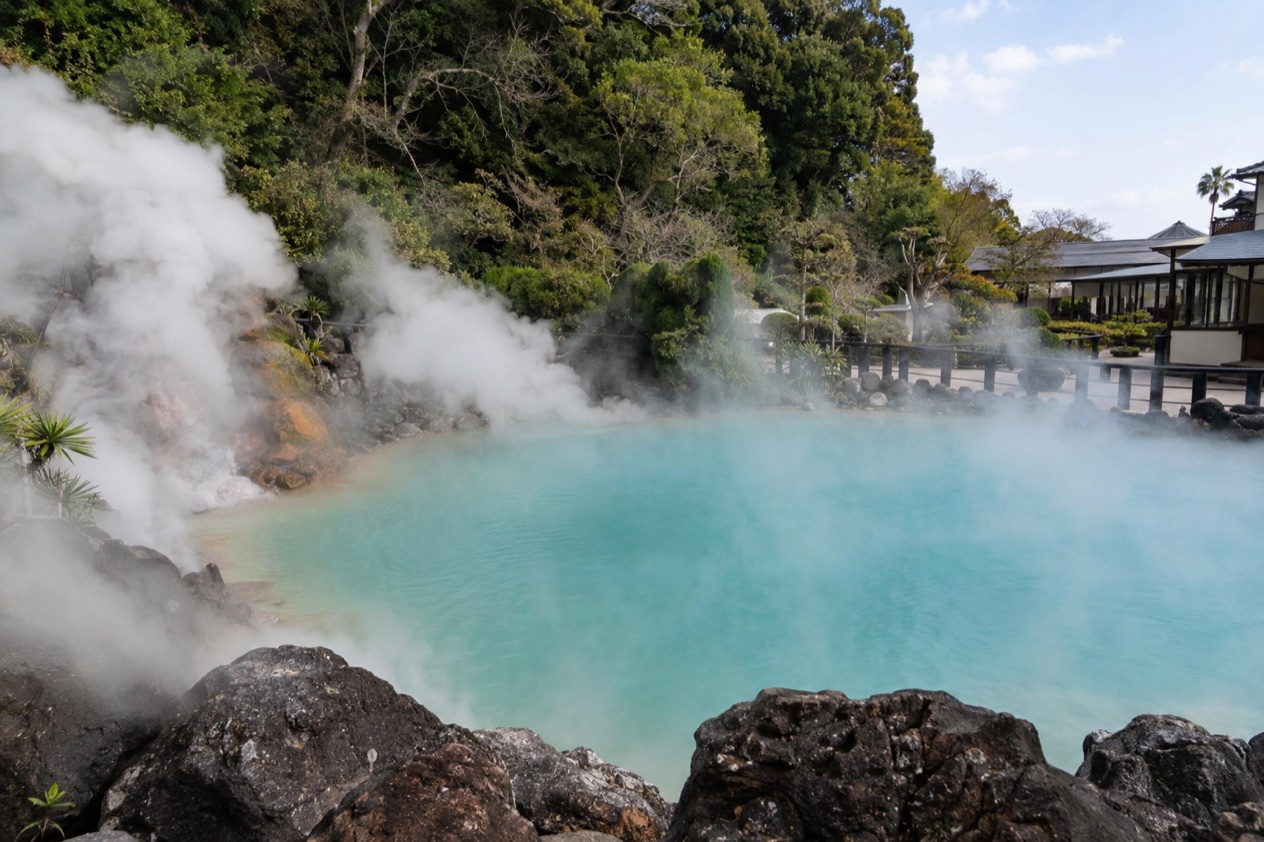
Clouds of white steam drift up between the rooftops of Kannawa, and the air smells faintly of sulfur and boiled eggs. Beside the road, a pond glows an unlikely shade of blue, and a few steps on, another one is the color of red clay. The Beppu Hells are hot springs made for looking at, and a visit means walking from one steaming pool to the next in the middle of an onsen town.
Is visiting the Beppu Hells worth it?
Yes, if you like seeing the earth at work and want something to do in Beppu besides soaking in a bath. The hells suit curious travelers, families, photographers and anyone who has already spent a day in the onsen and wants to see where all that hot water comes from. They are less suited to anyone hoping to bathe, because these are thermal ponds meant for viewing only.
Beppu is the largest hot spring resort in western Japan, with eight major hot spring zones and a great many steam vents. Plenty of places in town let you sink into the water.
The hells are the opposite: you stand at the edge, watch the bubbling and the vapor, and feel the heat on your face. Each pond has its own color, its own personality and its own gimmick, which keeps the tour from feeling repetitive.
The course is called Beppu Jigoku Meguri, and it links seven hells in one loop. There is a geyser that erupts on a regular rhythm, a pond of crocodiles kept warm by the springs, and eggs boiled in volcanic water. It is a visit with a little theater in it, and it works as a counterpart to the quieter pleasures of a ryokan stay or an evening in a public bath.
What to see at the Beppu Hells
Seven hells make up the Beppu Jigoku Meguri course. Most sit close together in Kannawa, and they differ in color, temperature and showmanship. Four stand out for a reader planning the day.
Sea Hell (Umi Jigoku)
Sea Hell is the starting point of the course, and the first one you meet gives you the template for the rest. Its water is a deep cobalt blue, and clouds of steam roll off the surface and across the garden around it. The color comes from minerals dissolved in the spring, and the pond looks cool enough to dive into, which makes the contrast with reality part of the fun.
The water here is 98 degrees Celsius, hot enough to boil onsen tamago, the eggs cooked slowly in spring water until the yolk turns creamy. Look for the baskets of eggs lowered into the steam. Five of the seven hells lie within walking distance of Sea Hell, so this is the natural place to begin on foot.
Oniyama Jigoku (Crocodile Hell)
Oniyama Jigoku is the one everyone remembers, because it is home to about 80 crocodiles. The animals live in pools heated by the same volcanic springs that feed the other hells, so they lounge in warm water while steam curls around them. Some lie motionless with jaws open, others slide along the edges, and children tend to press against the rails.
It is a different mood from the colored ponds. Instead of gazing at water, you watch animals, and the hell turns into a small zoo with a thermal backdrop. It is a good place to slow down and let the group look for as long as it likes.
Chinoike Jigoku (Blood Pond Hell)
Chinoike is the hell with the red water, a thick, rusty pond that sends up steam over its edges. The red comes from iron-rich clay in the spring, and the contrast with the green hillside behind it makes it one of the most photographed ponds of the course. It is about 10 minutes by bus or car from the previous hells, so it sits apart from the group you reach on foot.
The name suggests something grim, but in person the pond is more mesmerizing than frightening. Stand at the rail and watch the surface shift, then look for the red mud that is sometimes collected from the spring.
Tatsumaki Jigoku (Geyser Hell)
Tatsumaki Hell is the only geyser among the Beppu hells, and it stands next to Chinoike. It erupts every 30 to 40 minutes, so a visit is a matter of arriving and waiting for the next show. Without its roof, the jet would reach 30 meters into the air. With the roof in place, the water hits the cover and falls back in a loud, steaming burst.
People gather on benches facing the vent and wait, cameras ready, until the ground starts to hiss. It is an amusing little ritual, and the pause gives you a rest between ponds. Together with Chinoike, this is one of the two hells you reach by car or bus rather than on foot.
Hours, tickets and rules
The hells are separate sites strung along a single course, and each one is its own stop with its own gate. Opening hours and admission amounts are not given for any of them here, so the table keeps to the one thing known about every stop: how you reach it from Sea Hell.
| Site | How to reach from Sea Hell |
|---|---|
| Sea Hell (Umi Jigoku) | Starting point of the course |
| Oniyama Jigoku (Crocodile Hell) | Within walking distance |
| Five hells in the walking group | Within walking distance of Sea Hell |
| Chinoike Jigoku | About 10 minutes by bus or car from the previous hells |
| Tatsumaki Jigoku | Next to Chinoike Jigoku, by car or bus |
The one rule that matters is the simplest. The hells are thermal waters reaching around 98°C, and they cannot be bathed in. They are there to look at, whether the pond is blue, red or a bubbling gray. Bathing in Beppu is for the onsen facilities around town, of which there are over 150.
How to get to the Beppu Hells
The hells are in the Kannawa area of Beppu, almost on the opposite side of the city from the train station. That one fact shapes the whole approach: you arrive in Beppu by rail, then cross town to reach the steam.
For the train, the Sonic limited express runs twice an hour from Fukuoka (Hakata Station) and Kokura, stopping at Beppu before terminating in Oita. Beppu itself is a city in Oita Prefecture on the island of Kyushu. Once you step off the train, Kannawa is across the city, so the hells are a separate outing from the station area rather than a stop beside it.
Within the course, the logic is straightforward. Five of the seven hells are within walking distance of the starting point, Sea Hell, and two of them, Chinoike and Tatsumaki, should be reached by car or bus. Chinoike is about 10 minutes by bus or car from the previous hells, and Tatsumaki is next to it.
When to visit the Beppu Hells
The hells are a sightseeing stop that works in any weather, because the steam is the show and the ponds run all year. Cold days make the vapor thicker and the clouds more dramatic, and the heat of the springs is a welcome thing on a chilly afternoon. In warm weather, you feel the heat from the ponds on top of the heat of the air, which is a reason to pace yourself and take breaks between stops.
A walk through the whole course takes about two to two and a half hours, so it fits comfortably into half a day. Starting earlier leaves room to add a second activity, such as an onsen bath or lunch in town. Since the Tatsumaki geyser erupts every 30 to 40 minutes, you never need to time it exactly: arrive, find a bench and wait for the next burst.
No special festival date is attached to the hells in what is known here, and no particular month is singled out. Choose the season by what else you want from Beppu. The bathing, the steam and the eggs are the same on any trip, and the town’s onsen culture is the larger reason people come.
Tips for your visit
Plan on about two to two and a half hours for the full Beppu Jigoku Meguri. That is enough to see all seven hells without rushing, and it leaves the rest of the day free. Because the course divides into five hells on foot and two by car or bus, it helps to think of it as two parts, with a ride in the middle.
Look for the onsen tamago at Sea Hell, where the 98-degree water boils the eggs. They are the snack of the course and a good reason to arrive hungry. Children usually enjoy Oniyama Jigoku and its crocodiles, and the geyser gives everyone a reason to stand still and wait together.
Pair the hells with a bath. Together they make a day that covers both sides of Beppu: the dramatic, untouchable springs and the gentle ones made for soaking.
Good to know before you go
The hells are for viewing, so keep your hands out of the water and enjoy the steam from the rail. Bring the means to pay at each gate, since every hell is its own stop on the course. Beppu is the largest hot spring resort in western Japan, and the steam you see is part of an everyday landscape, with about 3,000 vents across eight hot spring zones.
Sources
- Wikipedia, Beppu Hells (https://en.wikipedia.org/wiki/Beppu_Hells), checked October 11, 2026
- Japan National Tourism Organization, Beppu (https://www.japan.travel/en/destinations/kyushu/oita/beppu-and-yufuin-around/), checked October 11, 2026
- Wikipedia, Beppu, Ōita (https://en.wikipedia.org/wiki/Beppu,_%C5%8Cita), checked October 11, 2026
- Wikivoyage, Beppu (https://en.wikivoyage.org/wiki/Beppu), checked October 11, 2026