
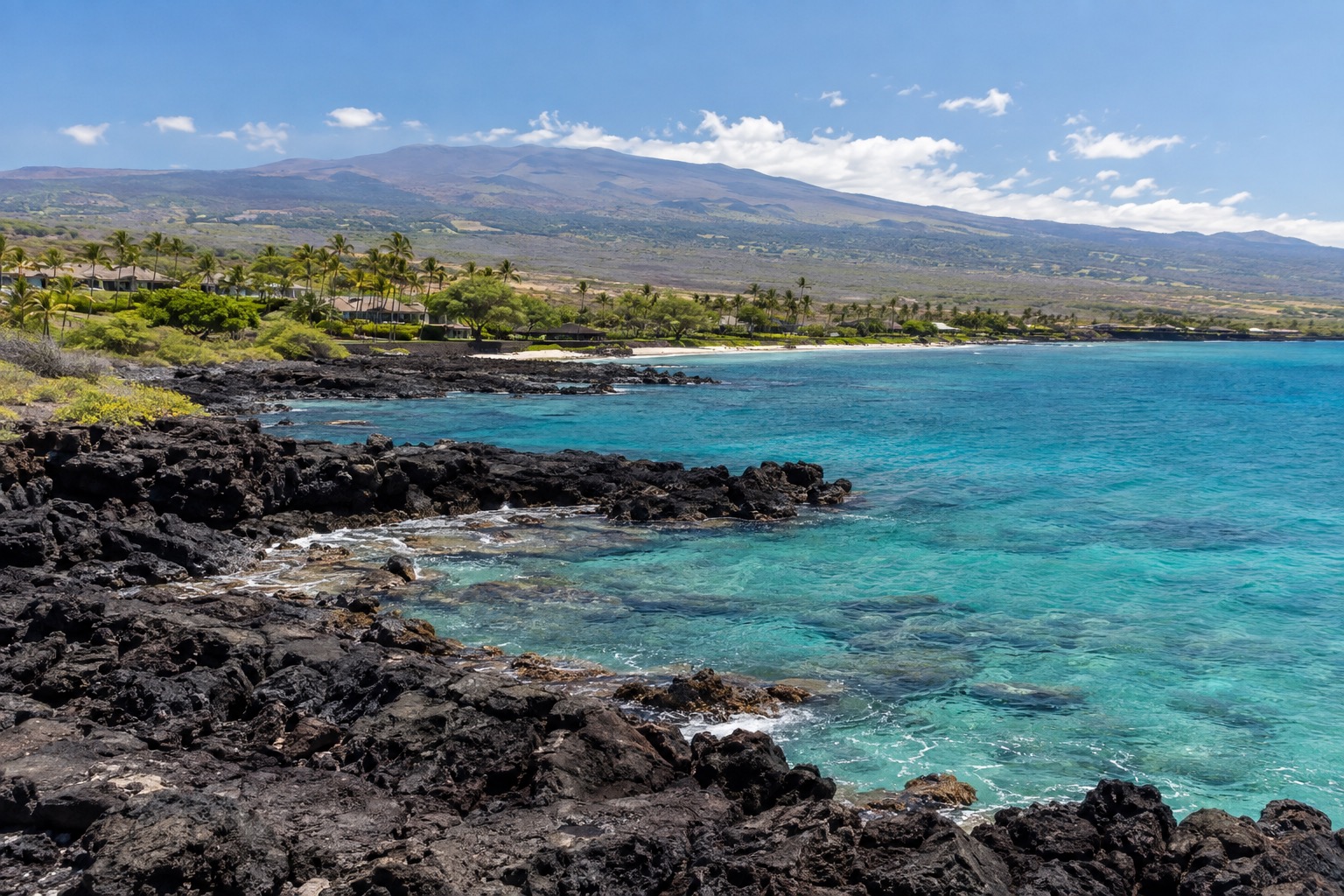
Waikoloa wakes up early, with the lava fields turning gold, the trade winds rustling the palms and the first snorkelers walking down to the water. The dry Kohala coast stays sunny nearly every day of the year, with the hottest stretch from late summer into fall and the busiest weeks around the winter holidays. Here the real question is not whether it will rain but how hot you want it and how many neighbors you want on the beach.
When is the best time to visit Waikoloa?
April, May, early June, September and October are the sweet spots for most travelers, with sunshine almost guaranteed, warm water and crowds that have thinned after spring break and the summer family weeks.
For beach and sea days, May through October brings the warmest water and the gentlest conditions on the west-facing beaches, which is when snorkeling at the bays along the coast feels easiest. Sunny days remain the rule in winter, yet bigger swell may leave certain entry points choppier, so before entering the water on these west-facing beaches, check the posted warnings along with that day’s surf and currents, and only swim near a lifeguard where one is on duty. For sightseeing, the cooler months of December through March are kinder for walking the lava-field trails and the historic sites, and the afternoon heat on exposed ground is far less punishing.
For a quieter, easier trip, the weeks in late April and May, and again in September and October, are the calm ones. Rooms are easier to find and the sand has room to spread out a towel.
Families should know that March brings spring break, with pools and beaches louder and busier, while the summer weeks are warm and full of school-age kids. If your children are happiest with space and calm, aim for just after school starts in the fall.
Waikoloa weather by month
Waikoloa sits on the dry leeward side of the Big Island, so every month is mostly sun and the differences are about heat and a few rainy days.
| Month | Average high (°F) | Average low (°F) | Rain (in) | Rain days | Sea (°F) |
|---|---|---|---|---|---|
| January | 82.2 | 68.3 | 1.52 | 2.2 | 78.1 |
| February | 82.5 | 68.1 | 0.71 | 1.5 | 77.7 |
| March | 83.5 | 69.7 | 0.92 | 1.8 | 77.6 |
| April | 85.0 | 70.8 | 0.36 | 0.8 | 78.0 |
| May | 85.5 | 72.2 | 0.54 | 1.4 | 79.7 |
| June | 87.0 | 73.6 | 0.63 | 1.3 | 80.5 |
| July | 87.9 | 74.9 | 0.21 | 0.6 | 80.6 |
| August | 88.5 | 75.4 | 0.80 | 1.0 | 81.5 |
| September | 87.8 | 74.9 | 0.64 | 1.2 | 81.5 |
| October | 87.2 | 74.0 | 0.75 | 1.0 | 81.3 |
| November | 85.8 | 72.8 | 0.68 | 1.1 | 80.5 |
| December | 83.9 | 70.2 | 1.21 | 1.7 | 79.1 |
The year is a gentle slope. Winter is the mild stretch, with a few more showers that arrive as brief passing clouds, sometimes tied to a cold front or a Kona wind shift, and evenings that call for a light layer.
Summer and early fall are hotter and nearly rain-free, with warm nights and the sea at its warmest. Even the wettest month here sees only a couple of showery days, which is a world away from the soaked windward side around Hilo.
When is Waikoloa cheapest and least crowded?
The quietest stretches are late April through May, and September through mid-November, when the school calendar leaves resorts and beaches noticeably calmer.
The busiest weeks are the ones everyone on the mainland shares: spring break in March, the summer vacation weeks from June into August, Easter week, Thanksgiving, and above all Christmas and New Year, when rooms fill early and peak-season rates apply. Mid-winter brings visitors escaping the cold, so January and February stay lively too.
In the shoulder weeks, resort pools have empty lounge chairs, restaurants take walk-ins more easily and the beaches along the coast feel spacious. Rooms are easier to find, and you can often pick your dates without planning a year ahead.
Which months should you avoid in Waikoloa?
No month is a bad one here, but a few come with trade-offs: the hottest weeks of late summer, the peak holiday weeks, and the official hurricane season.
The Central Pacific hurricane season runs from June 1 to November 30. Hawaii is rarely hit, but that stretch is when a distant system can send swell or change plans, so it is worth watching forecasts if you travel then. December through March is outside the official hurricane season, though winter brings its own surf on north and west shores and the occasional Kona storm.
August and September are the hottest, with afternoons that make the black lava and open sand feel like an oven, so beach time shifts to morning and late day. The rain, by contrast, is no reason to avoid any month on this coast, because it falls so lightly compared with Hilo, where the year adds up to many times more.
When can you swim in Waikoloa?
You can get in the water all year, since the sea stays warm enough for a comfortable dip even in the coolest months.
From late spring through fall the water is at its warmest, which suits long snorkel sessions and relaxed swims at the sheltered beaches. Winter water is a touch cooler, though still pleasant, and that is when swell from northern storms can make some shores rough, especially in the afternoon. Summer tends to be gentler on west-facing beaches, though conditions change by day.
At any season, check the posted signs and the day’s surf before you swim. When you see a green sea turtle either resting on the sand or swimming past, stay at least 10 feet away, whether on land or in the water.
Festivals and events in Waikoloa through the year
Winter: whales, holidays and big surf
Winter is humpback whale season, and from the shoreline and on boat trips out of the Kohala coast you can often see spouts and breaches offshore. Resorts decorate for Christmas with palm-tree lights, and holiday luaus and Hawaiian music fill the evenings.
New Year’s Eve brings fireworks over the bays, and the coast is lively but sunny. The best moments for whale watching are usually calm mornings. Bring a light layer for the breeze on the water, and expect resorts to be full around the holidays.
Spring and summer: Lei Day and Kamehameha Day
Lei Day on May 1 is celebrated across the islands with flower garlands, hula and music, and resorts often hold their own small gatherings. In April, the week after Easter brings the Merrie Monarch hula festival in Hilo, and many visitors make the drive across the island for it.
Kamehameha Day on June 11 honors the king who united the islands, and Puukohola Heiau, which he built around 1790, sits right on this coast. The site is free to enter and a quiet place to learn about that history. Go in the cooler morning hours and treat the stones with respect.
Fall: Ironman and the quiet season
In October the Ironman World Championship takes over Kona, and athletes train along the Queen Kaahumanu Highway and the coast. Spectators fill the area, so the energy is high, though Waikoloa itself stays calmer than town.
Once the race is over, November settles into a gentle pace with warm water, clear skies and thinner crowds until the holidays. It is a good time for slow beach days, sunset dinners and stargazing, with Maunakea’s visitor station offering a cool evening outing above the clouds.
Sources
- NOAA NCEI, monthly normals 1991-2020, station USC00518422, checked September 8, 2026
- Open-Meteo Marine API, average 2015-2024, checked September 8, 2026
- sunrise-sunset.org, sunrise and sunset calculated for the 15th of the month, checked September 8, 2026
- Hawaii Department of Taxation, Tax Announcement No. 2025-03 (Transient Accommodations Tax Law Changes from 2025 Legislative Session), files.hawaii.gov/tax/news/announce/ann25-03.pdf, checked September 24, 2026
- County of Hawaii, Department of Finance, Transient Accommodations Tax (TAT) page, hawaiicounty.gov/departments/finance/transient-accommodations-tax-tat (live returned HTTP 403 on request, read via Internet Archive Wayback Machine snapshot dated August 14, 2026, same official content), checked September 25, 2026
- Hawaii Department of Taxation, County Surcharge on General Excise and Use Tax page, tax.hawaii.gov/geninfo/countysurcharge/, checked September 25, 2026
- Federal Aviation Administration, CY2024 Commercial Service Enplanements (xlsx), faa.gov/airports/planning_capacity/passenger_allcargo_stats/passenger/arp-cy2024-commercial-service-enplanements.xlsx, checked September 24, 2026
- National Park Service, "Fees & Passes", nps.gov/puhe/planyourvisit/fees.htm, read September 25, 2026
- National Park Service, "History & Culture", nps.gov/puhe/learn/historyculture/index.htm, read September 25, 2026
- Hawaiʻi Department of Land and Natural Resources, Division of State Parks, "Hāpuna Beach State Recreation Area", dlnr.hawaii.gov/dsp/parks/hawaii/hapuna-beach-state-recreation-area/, read September 25, 2026
- National Park Service, "Fees & Passes", nps.gov/kaho/planyourvisit/fees.htm, read September 25, 2026
- NOAA Fisheries, "Viewing Marine Wildlife in Hawaiʻi", fisheries.noaa.gov/pacific-islands/marine-life-viewing-guidelines/viewing-marine-wildlife-hawaii, read September 25, 2026
- University of Hawaiʻi at Hilo, Center for Maunakea Stewardship, "Important Things to Know", hilo.hawaii.edu/maunakea/visitor-information/important-things-to-know, read September 25, 2026
- University of Hawaiʻi at Hilo, Center for Maunakea Stewardship, "Maunakea Visitor Information Station", hilo.hawaii.edu/maunakea/visitor-information/station, read September 25, 2026
- NPS, Directions, https://www.nps.gov/havo/planyourvisit/directions.htm, checked September 25, 2026
- NOAA NCEI, monthly normals 1991-2020, station USW00021510
- NOAA NCEI, monthly normals 1991-2020, station USW00021504
- NWS Honolulu / Central Pacific Hurricane Center, « 2026 Central Pacific Hurricane Season Outlook », weather.gov/hfo/hurricaneOutlook2026, checked September 24, 2026